The Insurance Industry Has an AI Problem. The Good Kind.
The numbers do not lie.
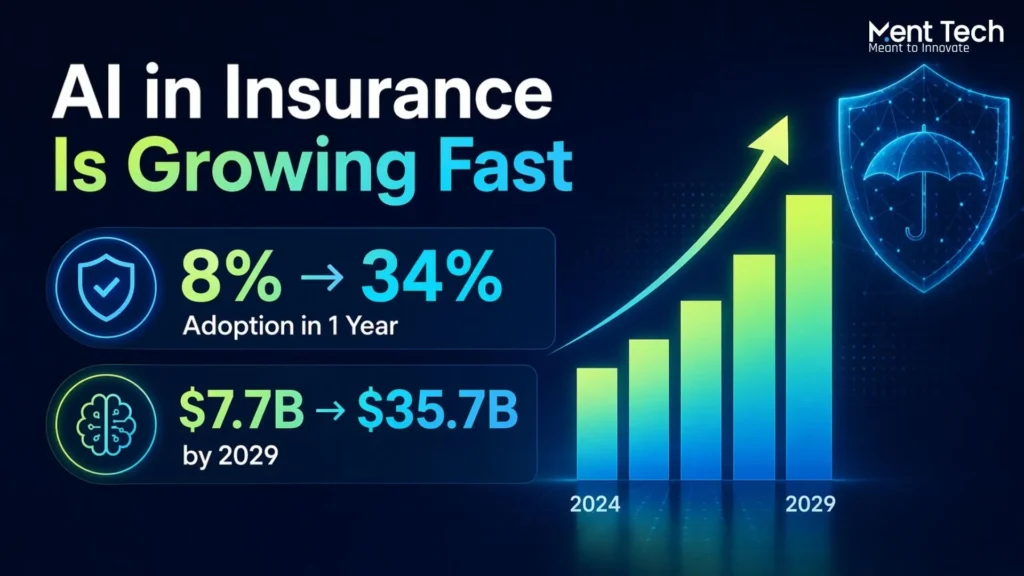
Full AI adoption in insurance jumped from 8% to 34% in just one year, from 2024 to 2025. That is not slow change. That is a full sprint.
The AI for insurance market is projected to grow from $7.71 billion in 2024 to $35.76 billion by 2029. And the market surpassed $10 billion in 2025 alone, recording a 32.8% annual growth rate.
Yet here is the hard truth. Fewer than half of insurance businesses have deployed AI in even a single function. End-to-end workflow automation in underwriting or claims is the least common deployment type. Most carriers have pilots. Few have results.
That gap is exactly where AI agents for insurance come in, purpose-built systems that read, decide, and act across your entire workflow.
An AI agent is not a chatbot. It does not just answer questions. It reads documents, makes decisions, routes tasks, flags fraud, and triggers payments. It acts.
The companies that move now will win. The ones that wait will spend 2027 catching up.
For a deeper look at how this plays out across enterprise functions, this is the Best Read → AI Agent Development for Enterprise Workflows: Costs, Risks, and Use Cases

What Makes AI Agents Different From Basic Automation?
Old automation follows rules. AI agents follow goals.
A rule-based system says: “If claim value is under $500, approve it.” An AI agent says: “Read this claim, check the policy, verify the photo, cross-reference fraud patterns, and then decide.” It does all of that on its own, in minutes.
AI agents use large language models (LLMs) combined with tools like document readers, databases, and APIs. They plan. They reason. They retry when something fails. This is why they work for insurance, a field full of messy documents, complex decisions, and strict regulations.
10 Real Use Cases for AI Agents for Insurance in 2026
1. Claims Processing Automation
This is the biggest win in the industry right now.
Claims processing time has been reduced by 55 to 75% through AI automation. Routine claims now take 24 to 48 hours instead of 7 to 10 days. The agent reads the claim form, checks the policy, pulls photos, and routes the file. Simple claims get paid without a human touching them.
2. Fraud Detection
Insurance fraud costs the U.S. industry over $308 billion annually. AI has reduced fraudulent claim incidents by 22%, and AI anomaly detection models outperform legacy systems by 40 to 60%.
AI agents scan claims in real time. They look for patterns no human would catch. A claimant who filed three water damage claims in two years. A repair shop tied to seven fraud cases. The agent flags it. The adjuster investigates.
3. Underwriting Assistance
The implementation of AI-powered underwriting tools has decreased processing times from weeks to hours, with some insurers reporting up to 90% faster underwriting decisions.
The agent reads applications, pulls credit data, checks third-party risk signals, and produces a risk score. Underwriters spend their time on edge cases, not data entry.
4. Policy Coverage Verification
Policy coverage verification has seen a near 99% time reduction, dropping from 15 to 20 minutes to mere seconds.
A broker asks: “Does this policy cover flood damage in a basement?” The agent reads the policy document, checks the endorsements, and answers in seconds. No hold music. No callback.
5. Customer Service and First Notice of Loss (FNOL)
Travelers has launched an AI Claim Assistant, a fully agentic intelligent voice service that now handles inbound calls from personal auto policyholders filing damage claims.
This is real. An AI agent picks up the phone, collects the claim details, confirms the policy, assigns a claim number, and schedules an adjuster. All before a human is involved.
6. Document Extraction and Intake
Natural language processing in insurance has advanced to the point where it can handle 90% of routine policy inquiries, helping to reduce agent workload significantly.
Insurance runs on paper. Loss runs, medical records, inspection reports. AI agents read them, extract the key data, and push it into the right system. No re-keying. No errors.
7. Risk Assessment and Pricing
Financial impact predictions by generative AI are now 84% accurate, improving readiness and optimizing policy structures. Underwriting errors in cyber policies dropped by 34% in 2025 thanks to AI-generated predictive risk scenarios.
The agent pulls telematics data, weather history, satellite imagery, and credit signals. It builds a risk profile and suggests a price. The underwriter reviews and approves.
8. Regulatory Compliance Monitoring
Insurance is one of the most regulated industries on earth. State rules change. New mandates arrive. AI agents monitor regulatory feeds, flag changes that affect your policies, and alert the compliance team before a deadline passes.
9. Renewal Retention and Churn Prevention
AI-generated risk profiles are helping insurers provide more customized policies, leading to a 15 to 20% increase in customer retention rates.
An agent scans renewal data 90 days out. A customer who filed no claims, never called support, and just got a 12% rate increase? That is a flight risk. The agent flags them. A retention specialist reaches out with an offer before the customer shops around.
10. Agent and Broker Support Tools
Leading firms that equip service and operations employees with AI-powered knowledge assistants are already boosting productivity by over 30% across operations teams.
A broker on a call asks: “What is the difference between occurrence and claims-made coverage?” The AI agent pulls the answer from the policy library in three seconds. The broker stays in the conversation. The customer feels heard.
Take a Read here→ How Enterprise AI Assistants Are Driving 40% Faster Operations
How to Build AI Agents for Insurance: The Technical Stack
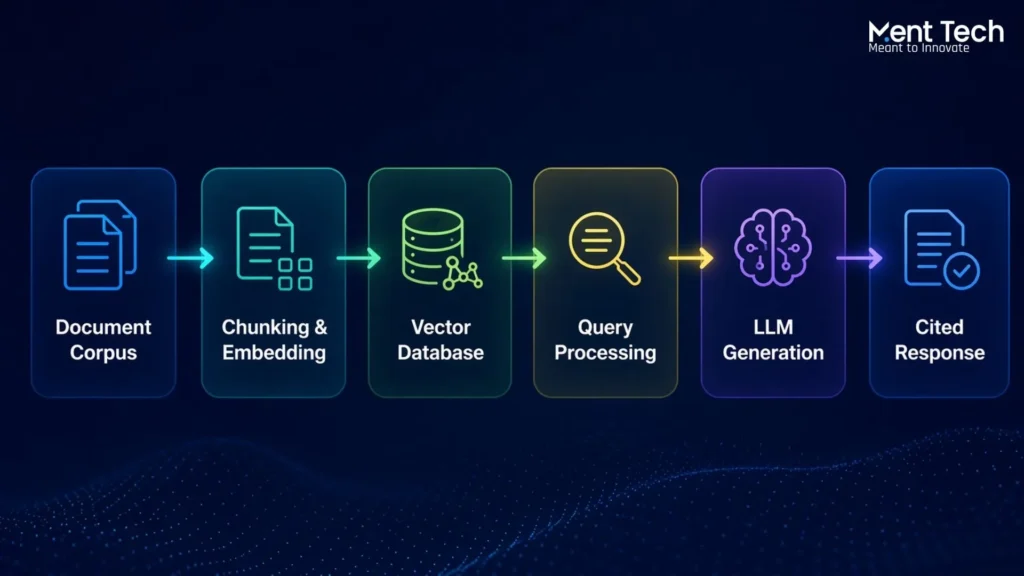
Building AI agents for insurance requires 5 core components. Each one matters.
1. The LLM Layer
This is the brain. GPT-4, Claude, or Gemini. It reads documents, reasons through problems, and generates responses. For insurance, you need a model that handles long documents, legal language, and structured data.
2. RAG Pipeline (Retrieval-Augmented Generation)
The agent needs to know your policies, your guidelines, and your forms. RAG connects the LLM to your document library, if you want to go deeper on how this works, explore RAG development services.
3. Tool Use and API Integrations
The agent must connect to your systems. Guidewire, Duck Creek, Salesforce, core admin platforms. It needs to read claims, write notes, trigger payments, and pull policy data. Without integrations, the agent is just a smart chatbot.
4. Human-in-the-Loop (HITL) Controls
Not every decision should be fully automated. Complex claims, large payouts, and disputed coverage need a human review step. HITL is not a weakness. It is a compliance requirement and a trust builder.
5. Governance and Compliance Layer
High-risk AI system rules under the EU AI Act kick in August 2026. If your AI agent makes decisions that affect people, including insurance underwriting, you are potentially dealing with high-risk classification.
Build audit trails from day one, AI Governance & Compliance practice helps insurance teams structure this from the ground up
AI Agent Development Cost Breakdown for Insurance 2026
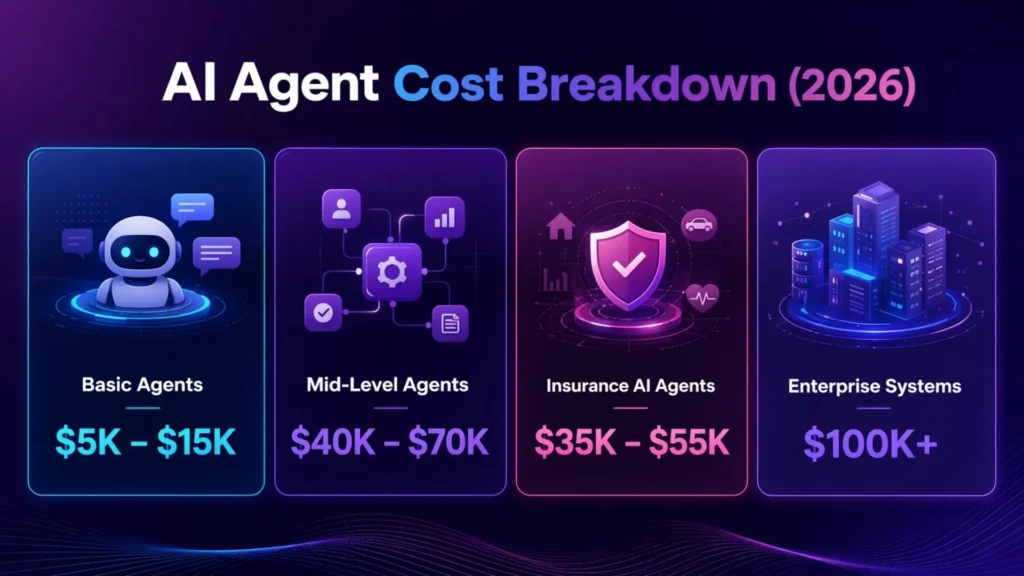
Here is what it actually costs.
The development cost of AI agent solutions in 2026 typically ranges from $25,000 for structured MVP deployments to $300,000 or more for enterprise-grade agentic systems.
| Agent Type | What It Does | Estimated Cost |
| Simple chatbot / FAQ agent | Answers policy questions | $5,000 - $15,000 |
| Mid-level claims triage agent | Routes and categorizes claims | $40,000 - $70,000 |
| Insurance-specific AI agent | Multi-step claims, underwriting, fraud | $35,000 - $55,000 |
| Enterprise multi-agent system | Full workflow automation, compliance | $100,000 - $300,000+ |
For AI agents built specifically for insurance, the development cost ranges from $35,000 to $55,000, reflecting the complexity of multi-channel communication and deep analytics integration
Hidden costs to plan for:
Most enterprise budgets underestimate the true total cost of ownership by 40 to 60%. That gap is where projects die.
Key cost areas to budget beyond the build:
Insurance-specific compliance, including HIPAA, GDPR, encrypted storage, and audit trails, typically increases costs by 25 to 40%.
Also budget for: LLM API usage costs (growing monthly with usage), integration engineering (often 40 to 60% of total build cost), ongoing monitoring and model maintenance, and staff training.
Timeline: Simple agents take 4 to 8 weeks. Mid-complexity LLM and RAG agents take 3 to 5 months. Full multi-agent systems take 6 to 12 months.
ROI: Customer service agents handling tier-one support inquiries typically pay for themselves within 3 to 6 months. Operations automation agents that process documents and route workflows typically break even within 4 to 8 months.

The Barriers Are Real. So Are the Solutions.
52% of insurers face skills and resource constraints as the primary barrier, followed by 40% citing data challenges and 36% facing regulatory hurdles. These are not reasons to wait. They are reasons to plan carefully.
Start with one high-impact use case, AI Agent Workflow Automation service is built exactly for this: one workflow, proven ROI, then scale.
Insurance companies deploying agentic AI into workflows reported between 30% and 40% productivity gains in claims and underwriting operations.
In 2026, agentic AI in insurance usage among businesses rose to 48%. Reported benefits include greater staff efficiency (61%), cost reductions (56%), and enhanced customer service (48%).
The data is not ambiguous. AI agents for insurance work when deployed with a real strategy and proper governance.
If you’re unsure how to move from pilot to production, this is a bonus read → How to Implement Agentic AI in Your Business
The Window Is Open. Not Forever.
Insurance AI spend is expected to grow by more than 25% in 2026. The insurers that combine new agent technology with governance, data, and operational discipline will unlock true enterprise-scale performance.
The companies winning right now are not the biggest ones. They are the fastest ones. Mid-size and regional carriers are deploying AI agents in single workflows, proving ROI in months, and scaling from there.
More than 90% of carriers tested AI in 2025. Only 22% reached full production.
That 22% is where the competitive edge lives.
AI agents for insurance are not a technology experiment anymore. They are an operational strategy. And in 2026, that strategy is the difference between growing and falling behind.