Most startups waste money. They build too much, too fast. They do not know if anyone wants it yet. The development of MVP fixes this problem. It is the fastest and cheapest way to test your AI idea in the real world.
This guide shows you how to develop an MVP with AI features in 2026. It tells you what it costs. It also shows you how to avoid big mistakes.
What Is an MVP App?
Well, MVP means Minimum Viable Product. It is the simplest working version of your product. It has only the features that solve the main problem. Nothing extra. Nothing fancy.
An AI MVP is the same idea. But it has one key AI feature at its centre. The goal is not to build a perfect product. The goal is to learn fast and spend less.
Bonus Read: Already thinking about a chatbot as your core AI feature? Here’s a deep dive on How to Build an AI Chatbot with RAG Integration for Enterprise Applications, it covers everything from architecture to deployment.
Do you even know
According to CB Insights, 90% of startups fail because they did not test their idea with real users first. An MVP reduces this risk. It tests real demand before you spend big.
Why Build an AI MVP in 2026?
AI tools are cheaper and more powerful than ever. But that does not mean you should build everything at once. The smartest teams still start small.
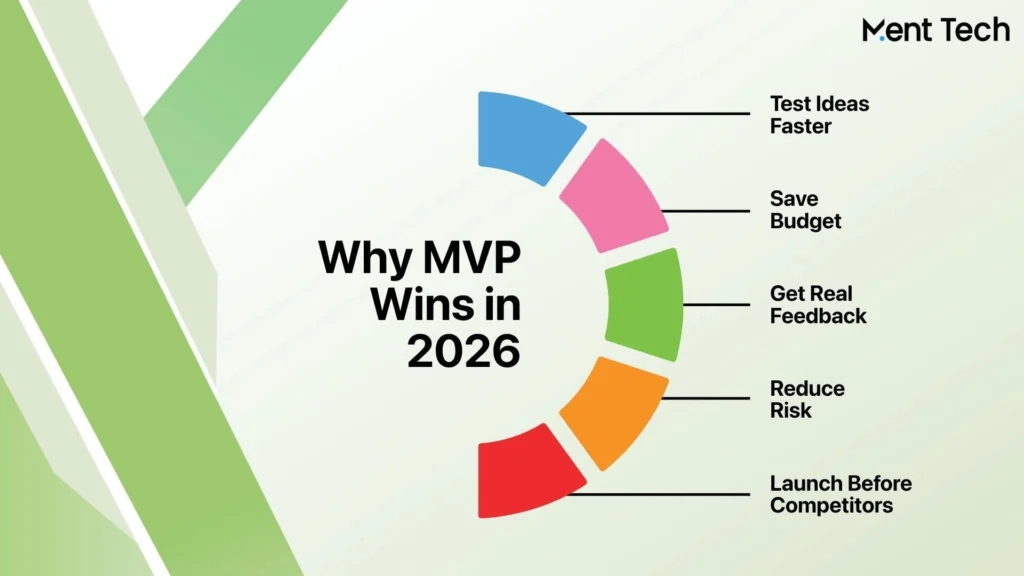
Here is why launching an MVP makes sense in 2026:
Test Your Idea First
You can show your AI to real users before spending big money. You find out fast if people actually want it.
Attract Investors
A working product is more powerful than a pitch deck. Investors want to see something real.
Collect Real Data
Real users give you real data. This data makes your AI model better over time.
Move Faster
Many teams are still stuck in planning. Launching an MVP lets you move while others are still talking.
Lower Your Risk
You avoid building something nobody needs. This saves time and money.
How Much Does the Development of MVP Cost in 2026?
Cost depends on three things. What you are building. Where your team is. How much custom AI work is needed.
Cost Table
| MVP Type | Cost (USD) | Time |
| Basic API MVP | $15,0000 - $30,000 | 3 to 6 weeks |
| Standard SaaS MVP | $55,000 - $140,000 | 8 to 14 weeks |
| AI-Powered MVP | $140,000 - $300,000+ | 3 to 6 months |
| Enterprise MVP | $200,000 - $500,000+ | 6 to 12 months |
The biggest cost is often not the code. It is the data. Getting clean and usable data for your AI can take 20 to 30% of your total budget. Many teams forget this. Do not make that mistake.
Need help planning your build? The right Custom AI Development team helps you scope the right product before writing a single line of code.
8 Steps to Build an MVP
Let’s go through this!
Step 1: Define the Core Problem
How to build an MVP starts here. Write down the one problem your AI will solve. Not ten problems. Just one. If you cannot explain it in two sentences, it is too complex for an MVP. Keep it simple and clear.
If you are unsure how to define the right problem, expert AI Consulting & Strategy can help you validate your idea before development.
Step 2: Know Your Target Users
Who has this problem every day? Find those people. Talk to at least 10 to 15 real people before you build anything. Their feedback will shape every decision you make. Do not skip this step.
Step 3: Choose the Smallest Feature Set
Write a list of every feature you want. Now cut 80% of them. Your MVP only needs the features that prove your core AI idea works. Everything else can come later. Less is more at this stage.
Step 4: Pick Your AI Approach
Do not build a custom AI model from scratch. There is almost never a good reason to do this at the MVP stage. Start with pre-built APIs instead. Tools like OpenAI, Google Cloud AI, and AWS Bedrock are powerful and affordable.
Worth a Read: If you are exploring something more autonomous than a basic API, see how teams are approaching AI Agent Development for Enterprise Workflows in 2026, costs, risks, and real use cases included.
Step 5: How to Design MVP
How to design MVP is simpler than most people think. Keep it clean. Focus on the one user journey that tests your AI feature. Use wireframes first. Do not spend money on beautiful visuals before you know the core idea works.
Every screen should have a purpose. If a screen does not help users try the AI feature, remove it. Simple design saves time and money.
Step 6: Build It Fast
Use a small and focused team. Most successful MVP projects in 2026 were built by teams of just 3 to 5 people. You need a project manager, one or two developers, a designer, and a QA specialist.
Use modern tools. React and Node.js are fast and reliable choices. Host on AWS, GCP, or Azure. These cloud platforms are flexible and cost-effective.
Here’s one FACT
Startups using AI development tools are launching MVPs in 2 to 6 weeks. That is 10 times faster than the old six-month timeline.
Step 7: Test With Real Users
Do not launch to everyone at once. Start with a small group of real users. Watch how they use the AI feature. Where do they trust it? Where do they ignore it or override it? This real-world data is more valuable than any survey or focus group.
Step 8: Improve Based on Feedback
Fix what is broken. Remove what nobody uses. Add new features only when users clearly ask for them. Most successful startups spend about 50% of their first-year budget on improvements after launch. Plan for this.
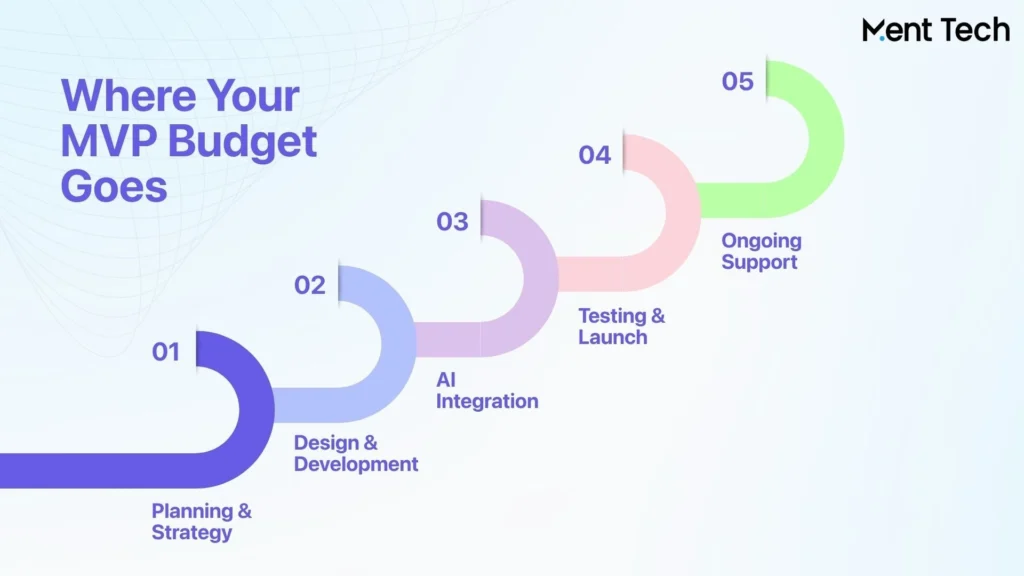
Cost Breakdown by Stage
| Stage | Cost (USD) |
| Strategy & Planning | $1,000 - $3,000 |
| UI/UX Design | $1,500 - $5,000 |
| Backend & API Development | $3,000 - $10,000 |
| AI Integration | $1,000 - $4,000 |
| Frontend Development | $2,000 - $7,000 |
| Testing & QA | $1,000 - $2,000 |
| Cloud Infrastructure | $500 - $2,000 |
| Monthly Support (Post-Launch) | $1,500 - $4,000 |
5 Common Mistakes That Waste Budget
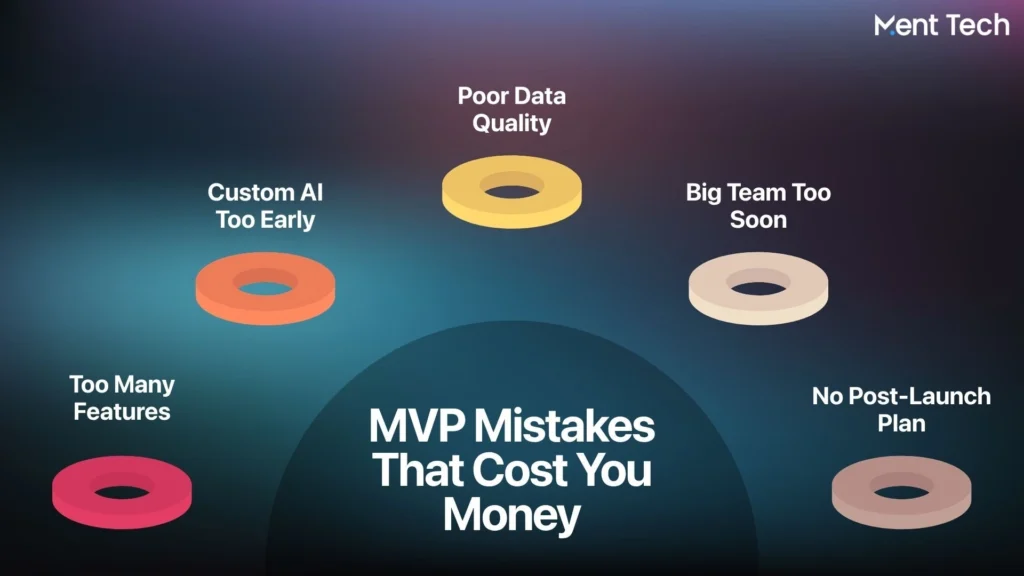
Many teams make the same mistakes. Here are the ones to avoid.
Building a custom AI too early: Do not build a custom model before you have proven that users want the product. Use pre-built APIs first.
Adding so many features at one time: More features mean more cost and obviously, more risk. So, here’s a tip - better keep it small until you have proof it works.
Skipping data preparation: A good AI model requires clean data. And if you skip this thing, the model is not going to work well. Hence, ensure budget time and money for data work.
Hiring a big team too soon: A large team before you know your direction wastes money fast. Start small and grow when you have clarity.
Not planning for post-launch cost: Your AI model will need updates. Real-world data changes over time. Models degrade if you do not maintain them.
Low-Code and No-Code Options in 2026
When You Don’t Need Custom Code
Not every MVP needs a developer. Low-code and no-code tools have matured fast, and the numbers back it up.
By end of 2026, Gartner projects 230 million people will use no-code AI platforms. For context, there are only 28 million software developers worldwide. Businesses using these tools build MVPs 50-70% faster and at 50-65% lower cost.
When to Use Each Approach
Use low-code or no-code when your MVP is straightforward and speed matters most. Move to custom development when you need specialised AI logic, deep system integrations, or have regulatory requirements to meet.
AI MVPs for Specific Industries
Finance
An MVP in finance is a lean product that handles compliance from day one, not as an afterthought. Regulatory checks need to be built in early, especially if your MVP involves digital or tokenized assets. Those compliance layers aren’t optional.
Teams building in this space can also explore our RWA Tokenization Platform as a foundation for an AI-driven financial MVP, covering everything from real estate tokenisation to digital asset infrastructure.
Related Read: Before you build, it helps to know what is already out there. Check out the Top 10 Real World Asset Tokenization Platforms in 2026 to understand the competitive landscape.
Healthcare
Clinical workflow automation is one of the fastest growing MVP categories. AI tools for medical documentation alone can save up to 70% of a clinician’s time. But healthcare MVPs must meet HIPAA rules from the start. Compliance cannot be an afterthought.
Enterprise SaaS
Standard SaaS MVPs cost between $55,000 and $140,000. Common features include multi-tenant architecture, dashboards, and role-based access. Most new SaaS MVP projects now include an AI layer. This could be predictive recommendations or automated reporting. AI is no longer optional in new SaaS products.
Most modern SaaS MVPs now rely on Generative AI Development to power automation, recommendations, and smarter user experiences.
Going Deeper? If you are planning to add AI to your SaaS MVP but are not sure where to start, this guide on How to Implement Agentic AI in Your Business breaks it down step by step.
How to Build an MVP Without a Technical Co-founder
You do not need to be a developer to develop an MVP. But you do need the right partners.
Work with a development company that has built AI MVPs before. Ask to see case studies. Talk to their past clients. Ask for a clear scope document before any money changes hands.
A well-scoped project reduces the risk of cost overruns by 40 to 60%. Most budget problems start before the build begins. They come from unclear assumptions, not from the coding itself.
Should You Build an MVP or a Full Product?
Skip the MVP if:
Your AI use case is already well proven. For example, a basic internal chatbot for a company with clean data and clear workflows may not need MVP validation.
Choose MVP projects when:
- You are entering a new market with no proof of demand
- Your AI idea has not been tested with real users
- Your first-release budget is under $150,000
- You need a working demo to raise funding
- You are building in a regulated industry with uncertainty

Your Idea Is Ready. Now What?
Every great AI product started as a small MVP. The question is not whether you can build it. The question is whether you can build the right thing, fast enough, without burning all your money.
In 2026, the winners are founders who test before they scale. Launching an MVP is how you do that. Start with the smallest version of your biggest idea. Test it. Learn from it. Then build the rest.
Ment Tech Labs helps startups and enterprises go from idea to deployed AI MVP. We offer Custom AI Development, AI Consulting & Strategy, and AI Agent Development built for speed and budget discipline.