Many businesses are already trying AI in one way or another. Some businesses test chatbots, while others use automation tools, and some companies investigate generative AI to support their operations, create content, generate reports, and perform internal functions. The two activities of using AI tools and making AI work for daily business functions represent completely different tasks.
AI systems deliver their true value when they establish connections with the existing systems that your teams use for their work, including CRMs and ERPs, internal dashboards, customer support tools, analytics platforms, data sources, and business workflows. Business operations advance from basic testing stages to operational efficiency through AI integration services, which deliver faster processing times, reduced need for manual work, improved precision, decreased expenses, and enhanced decision-making capabilities.
At Ment Tech, we help businesses bring AI into the places where work actually happens. Our team builds scalable, secure, and custom AI integrations that fit your operations instead of forcing your teams to change the way they work.
Explore how Ment Tech Labs can help you integrate AI into the workflows that actually run your business.
What Are AI Integration Services?
AI integration services are all about making AI work with the systems your business already relies on. Instead of using AI as a separate tool, it becomes part of your everyday operations. It connects with your data, software, and workflows, so it can support how work actually gets done across teams. That is where artificial intelligence integration services start to feel less like an experiment and more like a real business capability.
A complete AI integration setup can include:
- AI model integration: Connecting trained models directly with business systems so they can work on real, live data.
- LLM and generative AI integration: The process implements language models into the workflow system, which supports writing tasks, summarization activities, answer generation, and internal team assistance.
- CRM and ERP integration: The system uses AI to analyze customer data together with sales data and operational data, which helps organizations make better decisions and respond more quickly.
- AI chatbot and Copilot integration: Creating assistants that can do more than answer questions. They can help complete tasks and guide teams.
- AI workflow automation: Reducing repetitive work by letting AI handle routine steps across different processes.
- Data pipeline integration: Ensuring AI has access to clean, up-to-date data across the business.
- MCP server integration services: You create secure and scalable connections that enable AI systems to access different tools, APIs, and databases.
- Custom AI dashboards and analytics: You convert raw data into clear insights that teams can use for their work without needing specialized technical training.
Why Businesses Struggle to Make AI Work in Real Operations
Most AI projects do not fail because the technology is not good enough. They fail because AI is added on top of the business instead of being connected to how people already work. That is where AI integration services matter, because AI only becomes useful when it fits into real systems, real data, and real workflows.
1. Disconnected Tools
In many companies, every team has its own tools. Sales uses a CRM, support uses a ticketing platform, finance works from an ERP, and managers check reports from dashboards or spreadsheets. When these tools do not connect well, AI only gets part of the story.
2. Poor Data Quality
The AI system processes only the information that it receives from external sources. The system produces results that appear refined yet remain incorrect due to the presence of outdated data, duplicated data, incomplete data, and excessively distributed data.
3. Manual Workflows
A lot of work still happens manually. Teams copy data, send follow-ups, check approvals, update reports, and move information between tools. If AI is not built into these steps properly, it becomes another tool people have to manage.
4. No Clear AI Strategy
Companies select their operational tools before they identify their fundamental business problems. Businesses test AI technology because all other companies do it, yet they fail to establish criteria that determine successful outcomes. AI systems remain restricted to research activities because they lack a specific target to achieve.
5. Security and Compliance Concerns
AI systems require access to customer data, financial records, contracts, and internal corporate documents. Teams need to trust that permissions, privacy, and compliance are handled properly before they use AI in daily operations.
6. Lack of Internal AI Expertise
Your team may understand the business well, but building AI into real operations takes experience with models, data, integrations, security, and deployment. The right AI development services partner helps close that gap and turn an idea into something that actually works.
7. Difficulty Moving From Pilot to Production
A small AI demo can look great when everything is controlled. Real business operations are messier. There are live users, changing data, exceptions, approvals, system errors, and performance issues to handle.
8. Legacy System Limitations
Older systems can make AI integration harder. Some have limited APIs, strict data structures, or slow update cycles, which makes it difficult for AI to connect and work smoothly without the right plan.
How AI Integration Services Solve Real Business Problems
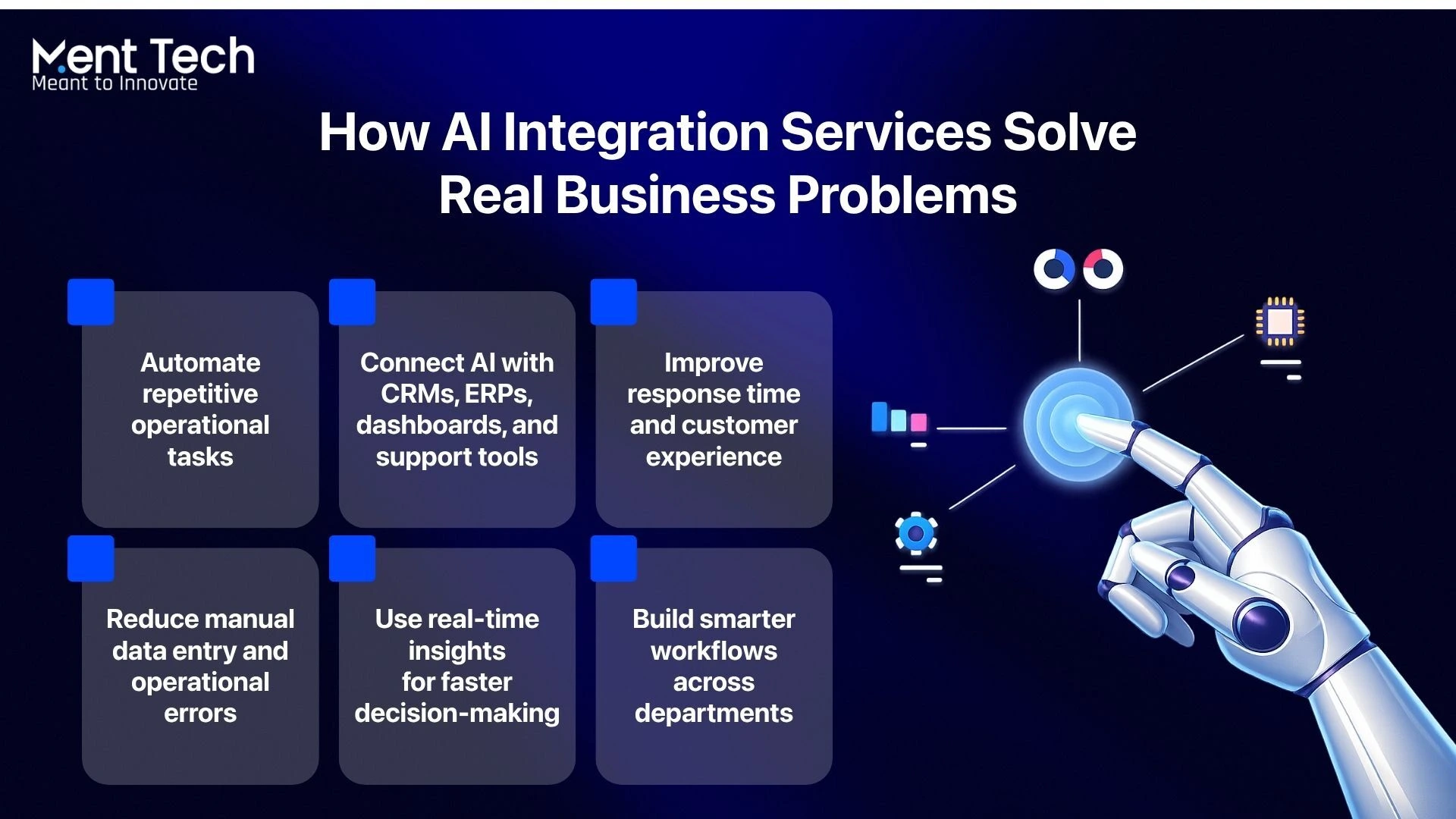
When AI is connected properly, the value is easy to see in everyday work. Teams spend less time on repetitive tasks, decisions happen faster, and fewer things depend on manual effort. This is where AI integration services can turn AI from a nice experiment into something that actually improves ROI.
- Automating repetitive operational tasks
AI can manage repetitive tasks, which include ticket sorting, report creation, follow-up work, document verification, and minor data changes, resulting in multiple hours of weekly time savings for teams. - Connecting AI with existing business software
AI operates through CRMs, ERPs, support tools, dashboards, and internal platforms, which allow teams to finish their work without system interruptions. - Improving customer support response time
AI technology processes customer queries to determine appropriate responses while fetching account details and speeding up ticket assignment, which helps support teams to provide faster assistance. - Reducing manual data entry
AI technology enables organizations to extract and validate information through system updates across multiple databases, which results in reduced errors and allows teams to focus on their most important work. - Improving decision-making with real-time insights
Connected AI systems utilize real-time business data to determine essential elements, which enable teams to make immediate decisions without waiting for operational reports. - Enabling AI copilots for teams
The Generative AI Development Services enable businesses to create copilots that assist employees by searching knowledge, summarizing information, recommending subsequent actions, and completing tasks more efficiently. - Improving forecasting, reporting, and compliance workflows
The AI system enables demand forecasting because it can generate automated reports while performing risk assessments, compliance tracking, and developing effective planning methods that need little human input.
Key Areas Where AI Can Be Integrated Into Business Operations
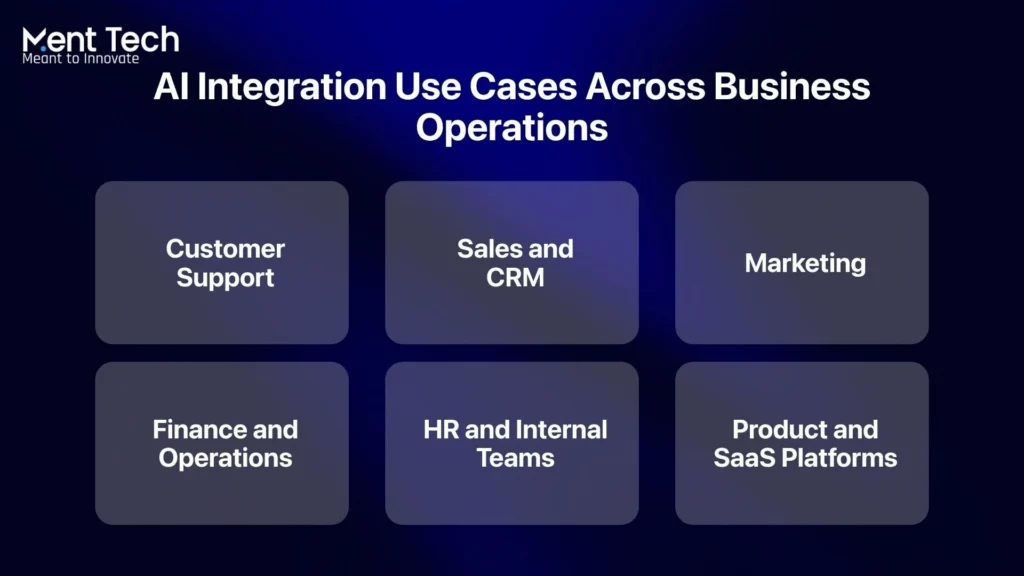
AI becomes useful when it helps teams do their regular work faster and with fewer gaps. With artificial intelligence integration services, businesses can bring AI into the places where people already manage customers, data, reports, decisions, and daily tasks.
1. Customer Support
The AI Customer Support Platform enables support teams to deliver quicker responses because it manages frequently asked questions while directing customer inquiries, analyzing client feedback, recommending appropriate responses, and retrieving specific information from company knowledge databases.
2. Sales and CRM
Sales teams use AI to reduce their lead assessment time because AI helps them create personalized sales emails, precise sales forecasts, business proposals, and customer relationship management work.
3. Marketing
AI technology enables marketing teams to improve their campaigns because it delivers support for all essential marketing functions, including content management, campaign performance assessment, customer behavior analysis, and result measurement.
4. Finance and Operations
AI technology enables organizations to process invoices and monitor expenses while it detects suspicious activities and controls risks and creates operational reports, which enable teams to execute their work with greater precision and better operational insights.
5. HR and Internal Teams
AI can help employees find answers, complete onboarding steps, search policies, screen resumes, and get internal support without waiting on multiple people or long email threads.
6. Product and SaaS Platforms
AI can make digital products smarter with copilots, recommendations, smart search, behavior insights, and generative features. With MCP server integration services, these features can connect more smoothly with backend systems, APIs, and business data.
Role of Generative AI in Modern AI Integration
Generative AI becomes more useful when it is connected to real business data, permissions, user roles, and workflows. This is where generative AI development services help businesses create intelligent features that support daily work, not just one-time experiments.
1. AI Copilots
AI copilots can help teams search for information, summarize data, draft responses, prepare reports, and complete routine tasks faster inside their existing workflow.
2. Knowledge Assistants
Knowledge assistants can search company documents, policies, manuals, FAQs, and internal resources, helping employees find reliable answers without wasting time.
3. Automated Reports
Generative AI can turn business data, meeting notes, support tickets, or financial updates into clear summaries and reports for faster decision-making.
4. Customer Service Agents
AI service agents can understand customer questions, suggest replies, summarize past conversations, and help support teams resolve issues with less delay.
5. Content and Document Workflows
With AI Agent Development, businesses can support contract review, document summarization, marketing content, and AI workflow automation across teams.
AI Workflow Automation: Making AI Part of Daily Operations
The process of AI workflow automation enables organizations to utilize artificial intelligence for performing repetitive tasks that require extended time but do not need human workers to complete them. The system automates request processing and information verification, which enables teams to achieve higher productivity while their staff works on record maintenance and system data extraction.
- The AI system analyzes support tickets that customers submit to identify their content and direct them to the appropriate support department.
- The AI system analyzes lead information when a new sales lead enters the CRM system to evaluate the lead quality and identify which sales representatives should contact the lead first.
- The AI system processes incoming invoices by reading their content to extract essential information, which it then verifies before executing system updates.
- The AI system enables managers to obtain their required reports by gathering data from multiple platforms and presenting it as an understandable summary.
- When an employee has a policy question, AI can search internal documents and give a quick, relevant answer.
How MCP Server Integration Services Improve AI Connectivity
MCP gives AI a more reliable way to connect with the tools, data, and applications a business already uses. MCP server integration services help AI agents work with databases, APIs, CRMs, ERPs, and enterprise systems in a secure and consistent way.
1. Connecting AI Agents With Business Tools
AI agents become more useful when they can work with real business tools. MCP helps them connect with CRMs, support platforms, dashboards, databases, and internal applications.
2. Standardizing AI Access to External Systems
The lack of a standard setup creates challenges for controlling AI connections between different computer systems. MCP provides a better approach for AI systems to connect with tools, data sources, and APIs.
3. Improving Workflow Automation
The right system connections enable AI to handle daily work tasks, which include ticket routing, data lookup, report creation, approvals, and task updates.
4. Reducing Custom Integration Complexity
Businesses do not need to build every connection from scratch. MCP reduces repeated integration work and makes AI connectivity easier to maintain as systems grow.
5. Supporting Scalable AI Agent Ecosystems
MCP maintains system security while enabling business expansion through its ability to connect multiple AI agents and workflow systems. The AI Investment Advisor Platform needs a reliable connection to data, analytics, and business logic because this connection enables its AI functionality to work properly.
How AI Integration Moves From Idea to Implementation
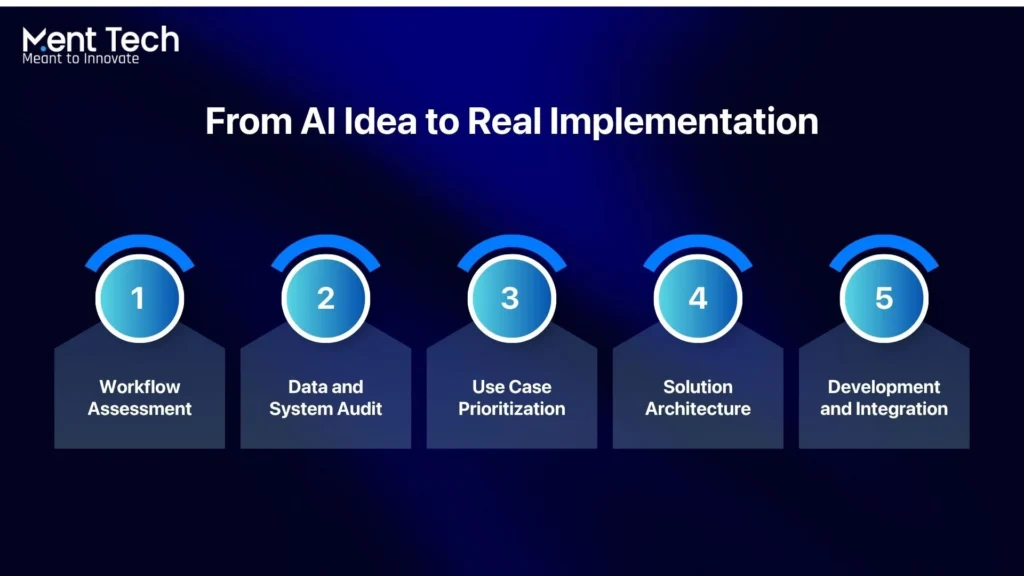
A successful AI project starts by understanding the workflow first. The goal is not to add AI everywhere, but to find where it can save time, reduce manual effort, improve accuracy, and create real business value.
1. Business Workflow Assessment
The team reviews how work happens across departments, where delays happen, and which tasks take too much manual effort.
2. Data and System Audit
Existing tools, data sources, APIs, dashboards, security rules, and integration limits are checked before planning the solution.
3. AI Use Case Prioritization
The best use cases are selected based on ROI, feasibility, and operational value. This may include reporting automation, support workflows, document review, or AI content generation services.
4. Solution Architecture
The architecture defines how AI will connect with systems, databases, workflows, users, and permissions securely and reliably.
5. AI Development and Integration
AI models, APIs, automation logic, agents, copilots, or dashboards are built and connected into the workflow through artificial intelligence integration services.
Benefits of AI Integration Services for Businesses
AI starts creating real business value when it is connected to the systems, workflows, and data your teams use every day. Instead of staying as a separate experiment, AI integration services help turn AI into a practical part of daily operations.
1. Better Operational Efficiency
AI helps teams get routine work done faster. It can reduce delays, handle repeated steps, and keep processes moving without constant manual follow-up.
2. Faster Decision-Making
The connection between AI and ongoing business operations enables teams to detect current events at an earlier time. The leaders have the ability to identify trends, risks, and opportunities through their ability to see data before the development of automated reporting.
3. Reduced Manual Work
AI handles multiple processes through its ability to perform data entry, ticket sorting, and invoice verification, report generation, and document assessment, which allows teams to concentrate on tasks that require human expertise.
4. Improved Customer Experience
AI solutions assist companies in establishing rapid business operations by improving their request handling process and creating customized customer experiences while delivering precise information to customers, which reduces the workload on their support staff.
5. Lower Operating Costs
The implementation of artificial intelligence integration services enables organizations to increase their productivity through reduced duplicate tasks, diminished operational errors and shorter work interruptions while maintaining budgetary requirements.
6. Better Use of Existing Data
Most businesses already have valuable data across CRMs, ERPs, dashboards, support tools, and databases. AI helps teams turn that data into useful insights and actions.
7. Higher ROI From AI Investments
When AI becomes part of real operations, its impact is easier to measure through saved time, faster processes, better accuracy, stronger productivity, and improved business outcomes.
Conclusion
AI creates real value when it is connected to the way a business actually works. It needs to fit into daily workflows, software systems, data pipelines, dashboards, customer processes, and decision-making points. Once that happens, AI stops feeling like a separate experiment and becomes part of everyday operations.
Ment Tech Labs helps businesses build AI solutions that are practical, secure, and ready for real use. From custom AI development and enterprise-grade architecture to AI workflow automation, generative AI development services, and MCP server integration services, our team focuses on building systems that connect smoothly with your existing tools and scale with your business.
If your goal is to move beyond AI demos and isolated tools, the right integration approach matters. Contact Ment Tech to discuss your project and build AI integrations that improve real operations, automate workflows, and create measurable business impact.