DeFi yield farming is not slowing down. Across Web3, platforms are using yield farming to pull in liquidity, keep users engaged, and build token ecosystems that actually have activity behind them. For blockchain businesses, it remains one of the most effective ways to grow a protocol fast.
But building a yield farming platform is not like launching a standard web app. You are dealing with smart contracts that handle real funds, liquidity pools with complex reward logic, wallet integrations, and security layers that need to hold up under pressure. One mistake in the contract logic and the damage can be irreversible. That is why picking the right DeFi yield farming development company matters far more than most founders expect.
The company you choose will shape how your platform handles rewards, how it scales, and whether it survives a security test. Not every blockchain development shop has the DeFi depth to get this right.
Ment Tech Labs helps Web3 businesses build secure DeFi platforms, staking systems, referral reward engines, and yield farming solutions designed for scalable blockchain ecosystems.
What Is a DeFi Yield Farming Development Company?
A DeFi yield farming development company builds platforms where users put their crypto to work. They stake tokens, add liquidity, and earn rewards automatically through smart contracts, no middlemen, no manual processing. But what goes into building one of these platforms is a lot more involved than it looks from the outside. Liquidity pools, staking systems, reward distribution, wallet integration, admin dashboards, tokenomics logic, multi-chain deployment, security testing. Every piece has to be planned, built, and tested properly before anything goes near a live network.
Here is where most founders get surprised. The technical build is only half the challenge. The harder part is getting the DeFi logic right, how rewards get calculated. How the pool behaves when liquidity spikes or drops. How do the tokenomics hold up six months after launch when early users start exiting? A team that has actually built DeFi yield-farming development platforms before has seen these problems play out. They know what breaks, what needs redundancy, and what looks fine in a demo but falls apart in production.
How We Selected the Best DeFi Yield Farming Development Companies
Picking companies for this list was not as simple as googling “top DeFi developers” and pulling the first ten results. There is a lot of noise in this space. Agencies that list every Web3 service imaginable but have never actually shipped a yield-farming platform. To cut through that, we used a set of criteria that focused on real delivery capability. Here is what actually made the cut:
- DeFi Development Experience: Have they built yield farming platforms before, or are they figuring it out on your budget? Real defi yield farming development experience shows up in how a team handles reward logic, pool mechanics, and edge cases, not in their service page copy.
- Smart Contract Expertise: Smart contracts run everything on a yield farming platform. We looked at whether companies write secure, well-tested contracts or just ship code and hope for the best.
- Security and Audit Practices: DeFi platforms handle real money. Any company that treats audits as optional or an afterthought did not make this list. Security has to be part of the build process, not a checkbox at the end.
- Multi-Chain Capability: A strong defi yield farming development services company should be comfortable deploying across Ethereum, BNB Chain, Polygon, and other networks without treating each one like a brand new project.
- Staking and Reward Logic: Generic staking modules are easy to find. What is harder to find is a team that can actually customize APY structures, referral reward engines, and liquidity pool mechanics to match a specific business model.
- Post-Launch Support: A lot of agencies disappear after deployment. DeFi platforms need ongoing attention. Monitoring, upgrades, and fast response when something goes wrong in the chain. We weighted post-launch support heavily.
- USA Market Relevance: This list is built for founders and businesses operating in the US market. Communication standards, timezone availability, and experience working with compliance-aware projects all factored into our evaluation.
10 Best DeFi Yield Farming Development Companies in 2026
There is no shortage of blockchain agencies claiming DeFi expertise. What actually separates a capable partner from a generic one is whether they have shipped real yield farming platforms, how they handle smart contract security, and whether they are still around six months after deployment. Here is our shortlist for 2026.
1. Ment Tech
Ment Tech builds DeFi platforms, staking systems, referral reward engines, and Web3 products for startups and enterprises across the USA and globally. As a defi yield farming development company, what makes them different is not just the tech stack. It is the way they approach the build. Every platform goes through security-first architecture, audit-ready smart contracts, and a delivery process that accounts for what happens after launch, not just before it.
Their defi yield farming development services span liquidity pool design, staking modules, reward distribution logic, wallet integration, admin dashboards, and multi-chain deployment. They also handle smart contract development services, RWA tokenization platforms, development, and broader Web3 product development. For founders who want one partner across multiple blockchain verticals without juggling three different agencies, Ment Tech Labs is worth a conversation.
Core DeFi Services: DeFi yield farming platform development, staking and referral platform development, smart contract development, RWA tokenization, liquidity pool development, wallet integration.
Best Suited For: Web3 startups, DeFi founders, token project owners, RWA platform builders, crypto businesses in the USA and globally.
Security Focus: Audit-ready smart contracts, secure architecture, pre-mainnet testing, post-launch monitoring.
2. ConsenSys
ConsenSys has been part of the Ethereum ecosystem long enough to have built some of its foundational infrastructure. Their work lives primarily at the infrastructure layer. Institutional staking, smart account systems, node infrastructure. If you are an enterprise team building on Ethereum at scale, it is a serious option. If you are an early-stage founder looking for a hands-on yield farming build, they are probably not the right fit.
Core DeFi Services: Blockchain infrastructure, institutional staking, smart account infrastructure, node infrastructure.
Best Suited For: Enterprise teams needing Ethereum-native infrastructure at scale.
Security Focus: Institutional-grade security standards built on years of Ethereum ecosystem experience.
3. Unicsoft
Unicsoft is the kind of shop that sweats the engineering details. Their staking platforms are built around solid tokenomics, clean smart contract architecture, and code that is ready for an audit before one is ever requested. If speed is your priority, they may not be your first call. If getting it right is the priority, they are worth looking at seriously.
Core DeFi Services: DeFi development, DeFi wallet development, DeFi exchange development, DeFi staking development, DeFi smart contract development.
Best Suited For: Founders who need dependable staking infrastructure with strong reward logic and a team that is transparent about how they build.
Security Focus: Smart contract audits, architecture reviews, structured security throughout the entire build.
4. SoluLab
SoluLab takes a modular approach to DeFi development. Their white-label frameworks give projects a solid starting point without having to rebuild common infrastructure from scratch every time. Multi-chain support and real-time analytics dashboards are part of what they deliver, which is useful for teams that want visibility into platform performance from day one.
Core DeFi Services: Blockchain development, Ethereum development, DApp development, DAO development, enterprise blockchain development.
Best Suited For: Projects that need to move fast without sacrificing quality or multi-chain flexibility.
Security Focus: Modular smart contract design with security built into the white-label framework from the ground up.
5. 4IRE Systems
4IRE Systems comes from a fintech background, which shows in how they build DeFi products. The backend is solid, and the frontend actually looks like something users want to interact with. That combination is harder to find than it should be in the DeFi space, and it makes them a strong option for teams targeting both everyday users and institutional participants.
Core DeFi Services: DeFi development, smart contracts, cryptocurrency development, blockchain development, UI/UX design.
Best Suited For: Teams that need a high-performance DeFi platform with strong user experience and serious technical depth behind it.
Security Focus: Automated reward logic, smart vesting rules, structured security layered across the full stack.
6. Antier Solutions
Antier Solutions focuses almost exclusively on DeFi product development. Yield farming, staking, lending, and exchange platforms. They have shipped enough of these to understand where things go wrong, which is exactly the kind of experience that matters when you are building something that handles real liquidity and user funds.
Core DeFi Services: DeFi lending and borrowing, DeFi staking platform development, DeFi yield farming development, DeFi exchange development.
Best Suited For: DeFi founders who need a team that has actually built yield farming and staking platforms before, not one that is learning on the job.
Security Focus: Smart contract reliability and reward distribution accuracy built into the platform from the start.
7. LeewayHertz
LeewayHertz is a full-service technology company that has been around long enough to have worked with both scrappy startups and large enterprise clients. Their DeFi practice covers the full stack from smart contracts and dApps to wallets, tokens, and lending platforms. A reliable option if you want a partner with range.
Core DeFi Services: DeFi dApp development, smart contracts, DeFi wallet development, lending platform development, token development, exchange development.
Best Suited For: Startups and enterprises that need a full-service DeFi partner with a broad and proven delivery history.
Security Focus: Smart contract security woven into the development cycle with structured testing before anything goes live.
8. Debut Infotech
Debut Infotech builds DeFi platforms that actually feel good to use. Clean interfaces, solid code, and a product-first mindset that comes through in the final build. If you have ever used a DeFi platform that felt clunky and confusing, you already know why this matters. Debut Infotech is a good call for founders who want the platform to work well on both ends.
Core DeFi Services: DeFi development, DeFi consulting, token development, exchange development, lending and borrowing platform development.
Best Suited For: Founders who want a DeFi platform that users actually enjoy interacting with, backed by reliable mechanics under the hood.
Security Focus: Code quality standards and smart contract reliability with a structured review process throughout the build.
9. Innowise Group
Innowise Group is built for scale. Large teams, complex multi-layer DeFi ecosystems, and sustained development resources across smart contracts, tokens, and banking-grade applications. If your project has grown beyond what a smaller agency can handle, Innowise is the kind of partner that can absorb the scope without losing structure.
Core DeFi Services: DeFi development, smart contract development, DeFi platform creation, token development, DeFi banking development, exchange development.
Best Suited For: Large-scale DeFi projects and enterprises that need serious delivery capacity with structured multi-chain execution.
Security Focus: Multi-layer security validation across smart contracts and platform infrastructure at every stage of delivery.
10. ScienceSoft
ScienceSoft has been in software engineering long enough that being methodical is just how they work. Their DeFi practice is built for institutions and large platforms where a production incident is not just a bad day; it is a reputational and financial problem. If you need a partner that treats process as seriously as code, ScienceSoft fits that bill.
Core DeFi Services: DeFi consulting, DeFi software development, smart contract development, exchange development, coin development, wallet development.
Best Suited For: Enterprise clients and institutions that need strict security, structured delivery, and a team that does not cut corners.
Security Focus: Mature engineering methodology with enterprise-grade smart contract standards and thorough security reviews at every stage.
Important Features of a DeFi Yield Farming Platform
Most DeFi platforms that fail do not fail because of bad marketing. They fail because the product was not built well enough to hold user attention. Here is what needs to work in any serious defi yield farming platform development project:
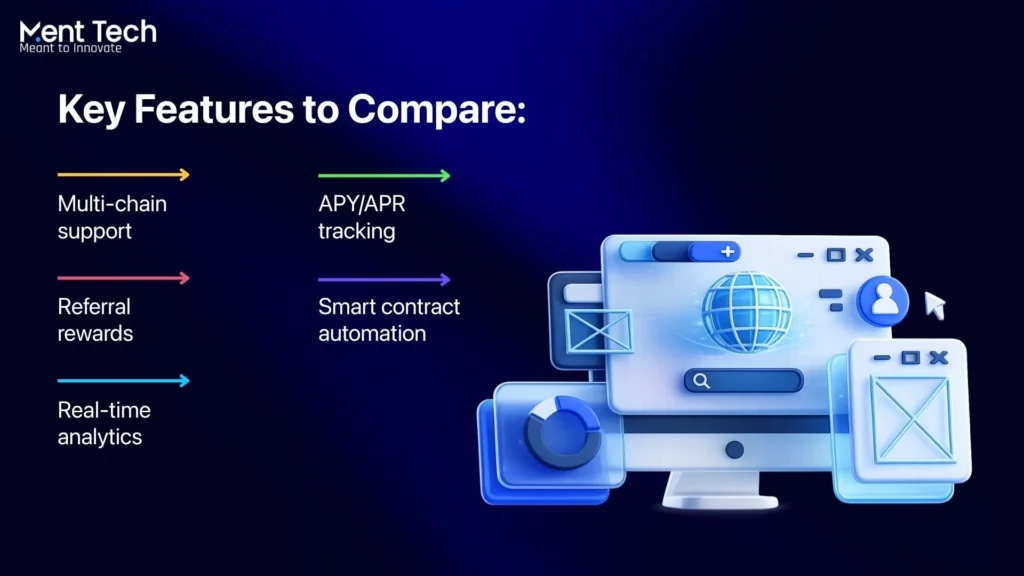
1. Liquidity Pool Management and Staking Modules
Users are putting real money in. They need to see where it is, what it is doing, and what they are earning without second-guessing anything. Unpredictable pool mechanics or shaky staking flows will kill trust faster than almost anything else.
2. APY/APR Display and Token Reward Calculator
This is the first thing users look at and the main reason they stay or leave. Returns need to be visible, accurate, and live. If someone has to hunt around the interface to find out what they are earning, they will not stick around long enough to find out.
3. Wallet Connectivity and Transaction History
Wallet connection should take seconds. MetaMask, WalletConnect, and other major options need to work without drama every time. Once users are in, they want a clean record of every transaction without being sent to a block explorer to figure it out themselves.
4. Referral Rewards and Admin Control Panel
A properly built referral system grows liquidity without a big marketing budget. On the operations side, the team needs real control over reward rates, pool settings, and user management without raising a dev ticket every time a setting needs to change.
5. Smart Contract Automation and Security Alerts
Rewards, stakes, and pool management. All of it runs through smart contracts, and all of it needs to work automatically without anyone manually triggering it. When something looks off, the team needs to know immediately, not after the damage is done.
DeFi Yield Farming Development Company vs General Blockchain Development Company
Hiring a general blockchain development company for a yield farming build is one of the more common mistakes DeFi founders make. It rarely shows up as a problem on day one. It shows up three months after launch when reward logic breaks or a liquidity edge case nobody planned for hits the platform. Here is where the gap actually sits:
| Category | General Blockchain Company | DeFi Yield Farming Development Company |
| Focus | Builds across multiple blockchain verticals | Specializes in liquidity, staking, and reward systems |
| DeFi Knowledge | Knows enough to sound credible in a sales call | Has actually shipped yield-farming platforms in production |
| Smart Contract Depth | Writes contracts that work for general use cases | Builds reward logic and pool mechanics that hold up under real usage |
| Wallet Integration | Standard connectivity for most dApps | DeFi-specific workflows built around liquidity and staking interactions |
| Security and Audits | General security practices | Audit-ready code with DeFi-specific vulnerability testing built in |
| Post-Launch Support | Delivers the build and moves on | Monitors platform behavior and responds when something looks off |
How RWA Tokenization and DeFi Yield Farming Can Work Together
Yield farming has mostly lived in the world of native crypto assets. But that is starting to change. Some Web3 platforms are now experimenting with bringing real-world assets into DeFi reward models, and the results are worth paying attention to.
The starting point is the RWA tokenization platform development. When a real-world asset like real estate, private credit, or a commodity gets tokenized on a blockchain, it stops being locked inside traditional finance infrastructure. It becomes something that can move, participate, and generate yield in ways that were not possible before. Here is where it gets interesting for DeFi builders:
- Tokenized Asset Liquidity: A tokenized real-world asset sitting in a liquidity pool can earn yield for its holder without them having to sell it or move it through a traditional financial intermediary. That is a genuinely new kind of flexibility that did not exist five years ago.
- RWA-Backed Yield Models: Pure token incentives burn out. Yield models backed by real asset performance tend to attract investors who want something more defensible than protocol emissions. It is a harder thing to build, but a much more sustainable foundation for a long-term platform.
- Compliance-Aware Reward Structures: This is where most teams underestimate the complexity. The moment real-world assets enter the picture, KYC, investor eligibility, and jurisdiction-specific rules all become part of the reward structure conversation. Getting this wrong is not just a technical problem; it is a legal one.
- Asset-Backed Token Ecosystems: Platforms backed by real assets attract a different crowd. Institutional participants and compliance-focused founders who would never touch a speculative farming platform will engage seriously when there is a real asset underpinning the model.
How to Choose the Right DeFi Yield Farming Development Company
Picking the wrong development partner for a yield farming platform is an expensive mistake to recover from. The smart contracts are live, the liquidity is in, and unwinding a poorly built system is painful in every direction. Here is what to actually look at before you sign anything with a DeFi yield farming development services company:
1. Check Their Portfolio
Any agency can list yield farming on a service page. What you want to see is the platforms they have actually shipped. Ask for live examples and ask what they built specifically. Real DeFi yield farming development experience shows up in what they have delivered, not in how polished their case studies look.
2. Test Smart Contract Depth
Smart contracts are where yield farming platforms win or lose. Ask how they handle reward calculation logic, what their testing process looks like, and how they approach upgradability. A team that cannot talk fluently about contract architecture is a team that will struggle when things get complicated on a live network.
3. Ask About Audits
Do not assume audits are part of the process. Ask explicitly. Who do they recommend for third-party audits? Do they build with audit readiness in mind from the start? A DeFi yield farming development company that is serious about security will have a clear answer without hesitation.
3. Confirm Blockchain Support
Multi-chain support sounds good in a pitch. What matters is whether they have actually deployed on the chains relevant to your platform. Ask for specifics. A team that has only built on one chain and claims multi-chain capability is a risk you do not need.
4. Check Tokenomics Understanding
A development team that only thinks about the technical build without considering how the reward model holds up at scale is leaving a gap that will eventually hurt the platform. The right partner thinks about the economics alongside the engineering, not after it.
5. Clarify Delivery and Support, Model
Timezone gaps, unclear ownership, and vague timelines create friction that compounds over a long project. Get clarity on who you will actually be talking to, how decisions get made, what post-launch support looks like, and how fast they respond when something goes wrong.
Final Thoughts
Building a yield farming platform is not a decision to rush or cut corners on. The right DeFi yield farming development company shapes everything that comes after. How secure is the platform? How well it handles liquidity under real conditions. Whether it scales when the user base grows or starts showing cracks under pressure. These are not problems you want to discover after launch.
Price is usually the first thing founders compare. It should be the last. What actually matters is smart contract quality, genuine DeFi experience, audit readiness, platform architecture, and whether the team is still engaged six months after deployment. A cheaper build that fails in production is not a bargain. A well-built platform backed by strong defi yield farming development services is an asset that compounds over time.
If you are serious about building a yield farming platform that holds up, Partner with Ment Tech to build a secure DeFi yield farming platform development solution designed for real users, scalable rewards, and long-term Web3 growth.