Real-world asset tokenization is no longer an experiment. Businesses across real estate, private equity, commodities, and fund management are actively exploring how to bring their assets onto blockchain infrastructure. Tokenization opens the door to fractional ownership, wider investor access, faster settlements, and digital asset records that actually make sense in today’s market.
But launching an RWA tokenization platform involves a lot more than picking a blockchain and writing smart contracts. There is compliance, asset structure, investor onboarding, custody, liquidity planning, and security that all need to be sorted before a single token is issued.
This blog walks through the key questions every business should ask before building and launching an RWA tokenization platform.
Ment Tech Labs helps businesses design and develop secure RWA tokenization platforms with blockchain architecture, smart contracts, investor workflows, and scalable Web3 infrastructure.
What Is an RWA Tokenization Platform?
An RWA tokenization platform is a digital system that converts ownership or economic rights in real-world assets into blockchain-based tokens. Think real estate, private equity, commodities, or funds; any asset that holds value can be represented on-chain, broken into fractions, and made accessible to a broader investor base without the friction of traditional investment structures.
What makes it more than just tokenization is everything built around it. Smart contracts handle ownership logic and transfers automatically. Investor dashboards give visibility into holdings and returns. KYC/AML and compliance workflows keep the platform legally sound. Asset documentation is stored and verified on-chain, creating a transparent, tamper-resistant ownership record that all parties can trust.
Read more - Learn How to Tokenize a Real-World Asset (RWA) in 2026
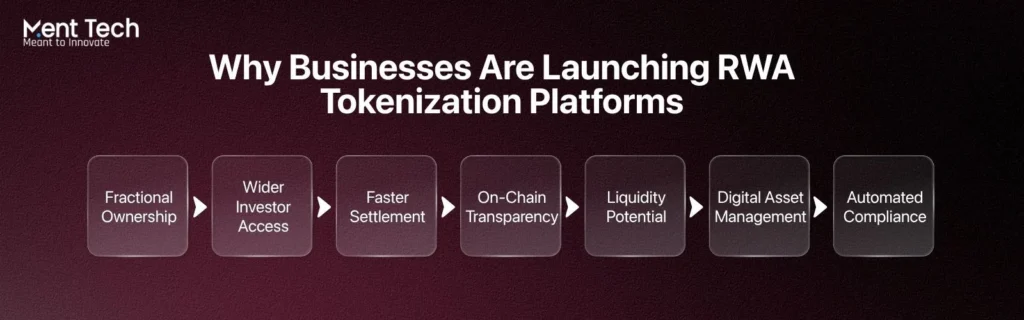
Why Are Businesses Launching RWA Tokenization Platforms?
There are real business reasons behind the shift toward tokenization. Here is what is actually driving companies to build these platforms.
- Fractional ownership
Not every investor can write a million-dollar check. Tokenization splits high-value assets into smaller units so more people can participate without needing to buy in at full value.
- Wider investor access
Digital ownership removes geography from the equation. Businesses can reach accredited investors and institutions across markets without the legal overhead that traditional distribution demands.
- Faster settlement
Asset transfers that used to take days now settle in minutes. Smart contracts execute ownership changes automatically, so deals move faster without manual back and forth.
- Improved transparency
Every transaction is recorded on-chain and visible to anyone who needs to see it. There is no chasing down reports or waiting on third parties to confirm what happened.
- Better liquidity potential
Illiquid assets like real estate and private credit finally have an exit path. An asset tokenization platform with secondary trading support gives investors options they never had before.
- Digital asset management
Everything sits in one place. Ownership records, investor activity, token distribution, no spreadsheets, no manual reconciliation, just real-time visibility into how assets are performing.
- Automated compliance workflows
KYC, AML, transfer restrictions, and reporting: a well-built RWA tokenization platform handles all of this automatically, so your team is not manually policing every transaction.
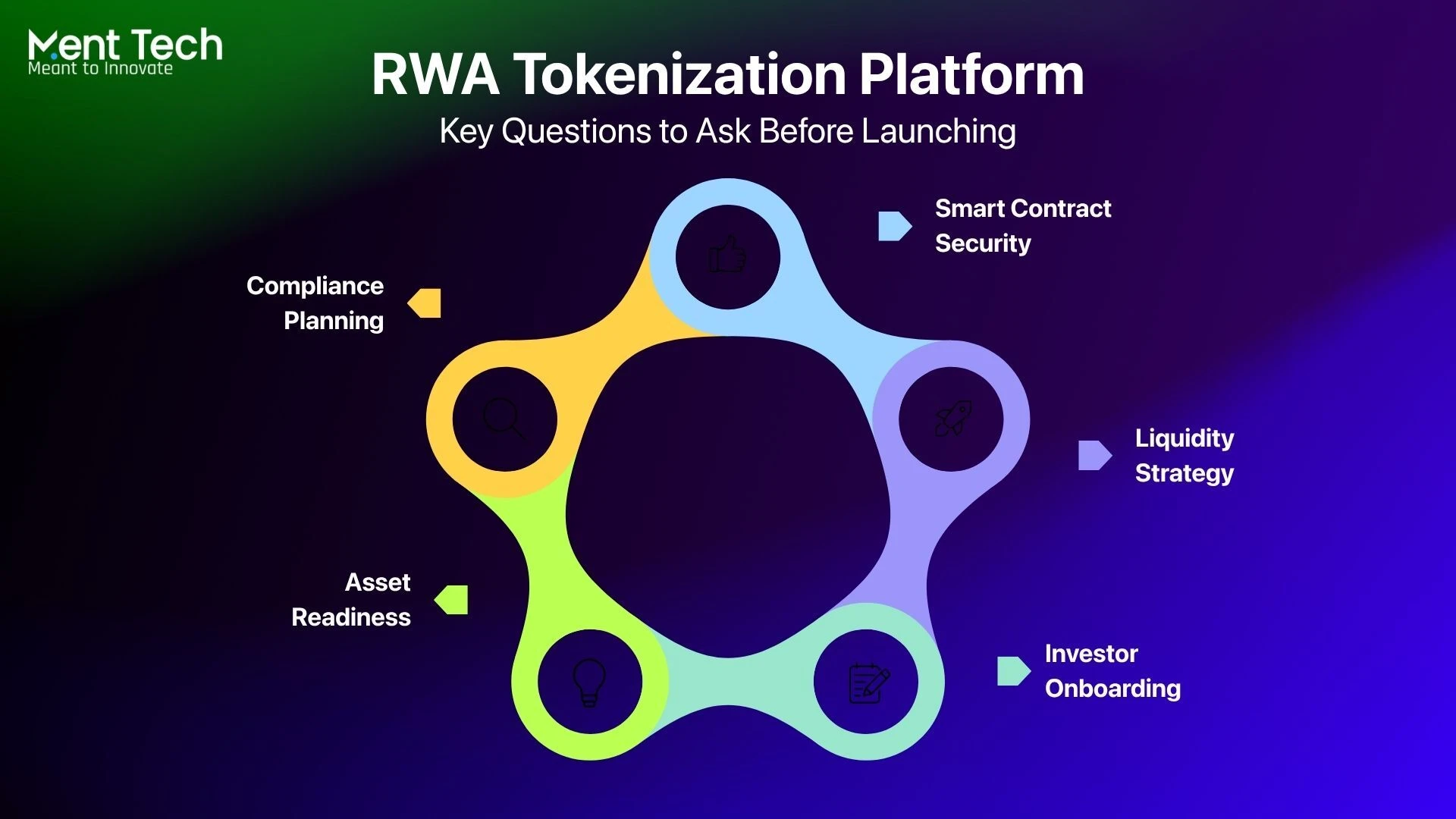
Key Questions Businesses Should Ask Before Launching an RWA Tokenization Platform
Most businesses jump straight into the technology and figure out the rest as they go. That approach works fine for some products. For an RWA tokenization platform, it tends to create expensive problems. Here are the questions worth getting clear on before anything gets built.
1. What Type of Asset Are You Tokenizing?
This sounds basic, but it changes everything downstream. Real estate behaves differently from private equity. Commodities have different documentation requirements than funds or invoices. Bonds, revenue rights, and luxury assets each carry their own legal and operational considerations. The asset you are tokenizing determines your legal structure, your token design, and what your platform actually needs to do day to day.
2. Is the Asset Legally Eligible for Tokenization?
Ownership needs to be clean. Documentation needs to hold up under scrutiny. And someone who knows securities law needs to weigh in on whether your token is going to be treated as a security. In the US, that conversation usually involves SEC frameworks like Reg D or Reg A+. Businesses that skip this step early almost always end up having it later under much less comfortable circumstances.
3. Who Will Use the Platform?
A retail investor and an institutional fund manager have completely different expectations when they log into a platform. Retail users want clarity and simplicity. Institutions want data, documentation, and reporting they can actually use. Asset owners, brokers, fund managers, and admin teams all need their own access levels and workflows. If you build for one group without thinking about the others, you will be redesigning sooner than you planned.
4. What Compliance Workflows Are Required?
KYC, AML, investor verification, accredited investor checks, securities compliance, reporting, and audit trails are not features you add later. They are part of the foundation. A platform that handles compliance well from day one is a platform investors and regulators can trust. One that patches it in after launch is a liability waiting to happen.
5. What Features Should the Platform Include?
A proper asset tokenization platform needs an investor dashboard, asset listing pages, a token purchase flow, a KYC/AML module, wallet integration, admin controls, document management, smart contracts, transaction history, and reporting tools. These are not nice-to-haves. Each one serves a real purpose, and gaps in any of them will surface quickly once real users are on the platform.
6. Which Blockchain Network Should You Use?
Ethereum has the trust and the track record, but costs can climb at scale. Polygon and BNB Chain offer lower fees and solid ecosystem support for most tokenization use cases. Avalanche is worth considering for high-throughput requirements. Private or enterprise chains make sense when you need tighter control over who participates. The honest answer is that there is no single right choice. It depends on your asset class, your investor base, and where you want the platform to go long-term.
7. How Will Smart Contracts Manage Ownership and Transfers?
Smart contracts are doing a lot of the actual work here. Token issuance, ownership records, transfer rules, yield or dividend logic, and investor restrictions. All of it runs through the contract layer. Poorly written contracts are not just a technical problem. They create genuine legal and financial exposure. This part of the build deserves real expertise and proper auditing before anything goes live.
8. How Will Liquidity Be Managed?
This is a question investors will ask before they commit capital, and you need a real answer ready. Tokenization makes liquidity possible, but it does not make it automatic. Whether you are building an internal marketplace, integrating with an exchange, exploring liquidity pools, or setting compliance-based trading limits, having a clear liquidity strategy from the start is part of building a platform people actually want to invest through.
9. How Will Investor Data and Asset Records Stay Secure?
People are trusting your platform with their money and their personal information. That means encryption, role-based access controls, secure wallet flows, detailed audit logs, and data privacy practices that hold up under regulatory review. A serious security incident on an investment platform does not just cost money. It costs the trust you spent months building, and that is much harder to get back.
10. Which Development Partner Can Build the Platform Correctly?
Choosing the right team is honestly one of the most important decisions in this whole process. A good real-world asset tokenization platform development company is not just technically capable. They understand compliance requirements, investor workflows, smart contract security, and what it takes to build something that functions in a real regulatory environment. The difference between a partner who gets this and one who does not usually becomes very clear about three months into the build.
Important Features of an RWA Tokenization Platform
A platform is only as good as what it can actually do. These are the features that matter most when you are building something investors and asset owners will actually use day to day.
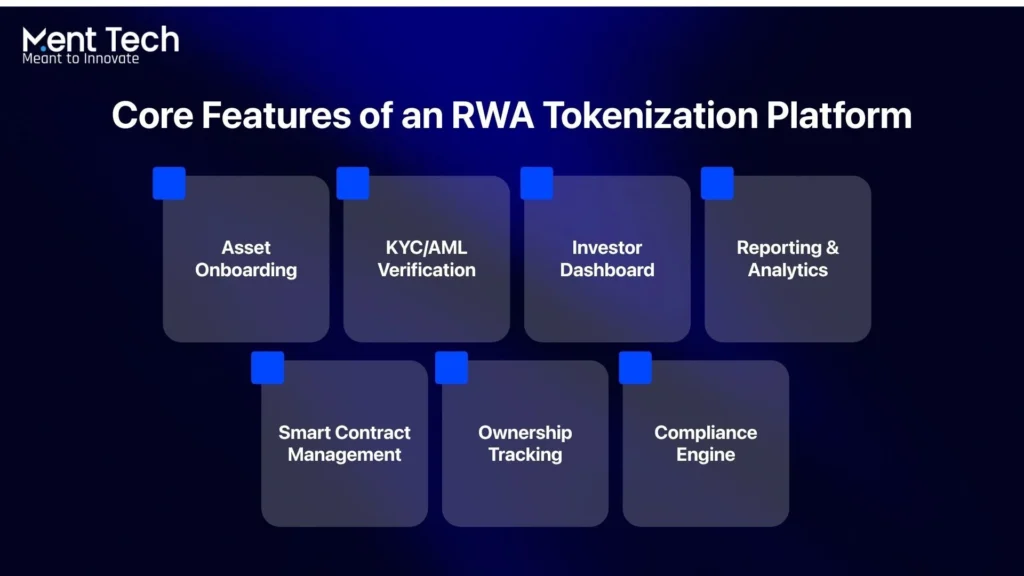
1. Asset onboarding
Before a single token is created, the asset behind it needs to be properly documented, verified, and structured on the platform. Legal records, ownership proof, and valuation data, investors will look at all of this before they commit capital. If it looks incomplete or rushed, they will notice.
2. Investor onboarding and KYC/AML
Bringing investors onto a tokenized assets platform is not just a sign-up flow. It involves identity verification, accredited investor checks, AML screening, and document collection. Get this right, and the rest of the investor experience feels smooth. Get it wrong, and you have a compliance problem before anyone has even made a purchase.
3. Smart contract management
Smart contracts do the heavy lifting. They issue tokens, record ownership, handle transfers, distribute yield, and enforce investor restrictions without anyone having to manually intervene. The catch is that they need to be written well and audited properly because once they are deployed, fixing mistakes is not straightforward.
4. Ownership dashboard
Investors want to log in and immediately see what they own, what it is worth, and what has changed. A clear and honest ownership dashboard builds the kind of confidence that keeps investors engaged and reduces the support load on your team significantly.
5. Compliance engine
Transfer rules, jurisdiction restrictions, eligibility checks, and reporting requirements should all run automatically in the background of a proper asset tokenization platform. Your team should not be manually reviewing every transaction to make sure it meets the rules. The platform should handle that.
6. Reporting and analytics
Asset owners need performance visibility. Investors need transaction records they can actually use come tax time. Regulators need clean audit trails. A solid reporting layer means everyone gets what they need without someone on your team spending half their week pulling data together.
RWA Tokenization Platform Development Process
Building an RWA tokenization platform is not just a development project. It is legal groundwork, technical architecture, compliance workflows, and investor experience all coming together. Here is what a proper RWA tokenization platform development process looks like.
- Discovery and asset assessment
This is where you get clarity on what you are tokenizing, who you are building for, and what the platform actually needs to do. The hard questions are a lot cheaper to answer here than halfway through the build.
- Legal and compliance planning
Securities classification, jurisdiction rules, investor eligibility, and ownership structures all need to be confirmed before the technical work begins. Trying to retrofit legal requirements onto a finished platform is painful and expensive.
- Platform architecture and token model design
Blockchain selection, token structure, ownership model, and transfer logic. these decisions shape everything built afterward. They deserve real thought and not just a quick call between meetings.
- Smart contract development
Smart contracts handle token issuance, ownership records, transfer rules, and yield distribution automatically. This phase needs experienced developers who understand both the technical and legal sides of what they are writing, followed by a proper audit before anything goes near production.
- UI/UX design and investor workflows
A technically solid platform that is confusing to use will not hold investors for long. This phase is about making complex workflows feel simple for everyone, from a first-time retail investor to an institutional fund manager.
- KYC/AML integration and testing
Compliance workflows get built in and tested against real scenarios. Security reviews and smart contract audits happen here, too. This is what separates a platform that is genuinely ready from one that just looks ready.
- Deployment and post-launch support
Going live is the beginning, not the end. Real usage always surfaces things testing never catches. Active monitoring, security checks, and reliable post-launch support are what keep an asset tokenization platform development project successful long after launch day.
Real Estate Tokenization Platform: A Common RWA Use Case
Real estate is one of the strongest RWA tokenization categories because property is valuable, widely understood, and historically difficult to access without serious capital. A real estate tokenization platform changes that by turning property ownership into something that can be divided, distributed, and managed digitally without the usual friction.
1. Fractional property ownership
Tokenization splits property into smaller digital units so more investors can participate at a price point that works for them. The asset stays whole while ownership gets distributed across multiple token holders.
2. Rental income distribution
Smart contracts handle income distribution automatically and proportionally based on token holdings. No manual calculations, no delays, no back and forth between parties.
3. Property documentation and digital ownership records
Title deeds, valuation reports, and ownership history all live on the platform and update in real time. Every ownership change is recorded on-chain, removing the ambiguity that comes with traditional property transactions.
4. Real estate investor dashboards
Investors see exactly what they own, what income has been distributed, and how the property is performing, all in one place. That kind of visibility builds trust and keeps investors engaged without flooding your support team.
5. Secondary liquidity potential
Real estate has always been hard to exit quickly. A real estate tokenization platform with secondary trading support gives investors a real path out without forcing a full property sale, making the asset class more attractive to a wider range of investors.
RWA Tokenization Platform vs Traditional Asset Investment Platform
If you are weighing whether an asset tokenization platform is the right move, this comparison makes the difference pretty clear.
| Traditional Asset Platform | RWA Tokenization Platform |
| Manual ownership records | Blockchain-based ownership records |
| Higher entry barriers | Fractional ownership access |
| Slow transfer process | Faster digital settlement |
| Limited transparency | On-chain transaction visibility |
| Manual reporting | Automated reporting and audit trails |
The gap between the two is not just technical. It is the difference between a system built for a slower, more closed market and one built for how investment actually needs to work today.
Also read - Top 10 Real-World Asset Tokenization Platforms in 2026
Final Thoughts
Launching an RWA tokenization platform is not something you figure out as you go. The businesses that do this well put in the groundwork early, with legal clarity, asset readiness, compliance planning, and investor workflows before anything gets built. The ones that skip that part tend to pay for it later when it is a lot harder to fix.
Technology alone does not make a tokenization platform trustworthy. Smart contract security, proper compliance architecture, and an investor experience that actually holds up under real usage are what turn a promising idea into something people are willing to put money into.
If you are ready to build something that lasts, the team behind it matters just as much as the platform itself. Partner with Ment Tech Labs to build an RWA tokenization platform designed for secure asset management, investor trust, and long-term digital ownership.