AI agents are moving beyond helping people compare products or find deals. They can now take action, follow spending rules, and complete payments on a user’s behalf. That is where agentic payments come in.
For businesses, this can make payment flows faster and more automated. It also raises new questions around agent payment authorization, identity, spending controls, and AI payment security.
In this blog, we cover how agentic payments work, how they differ from commerce, which protocols are shaping the space, and what businesses need to get right before allowing AI agents to make payments.
What Are Agentic Payments, and Why Are They Emerging Now?
Agentic payments are transactions that AI agents can initiate or complete on behalf of a user or business within predefined rules. Instead of simply suggesting what to buy or when to pay, AI payment agents can take the next step and execute the transaction.
They are emerging now because AI agents are becoming more capable, payment systems are becoming more programmable, and businesses want less manual work in areas such as purchasing, billing, and treasury. This is also pushing agentic commerce toward more autonomous transactions.
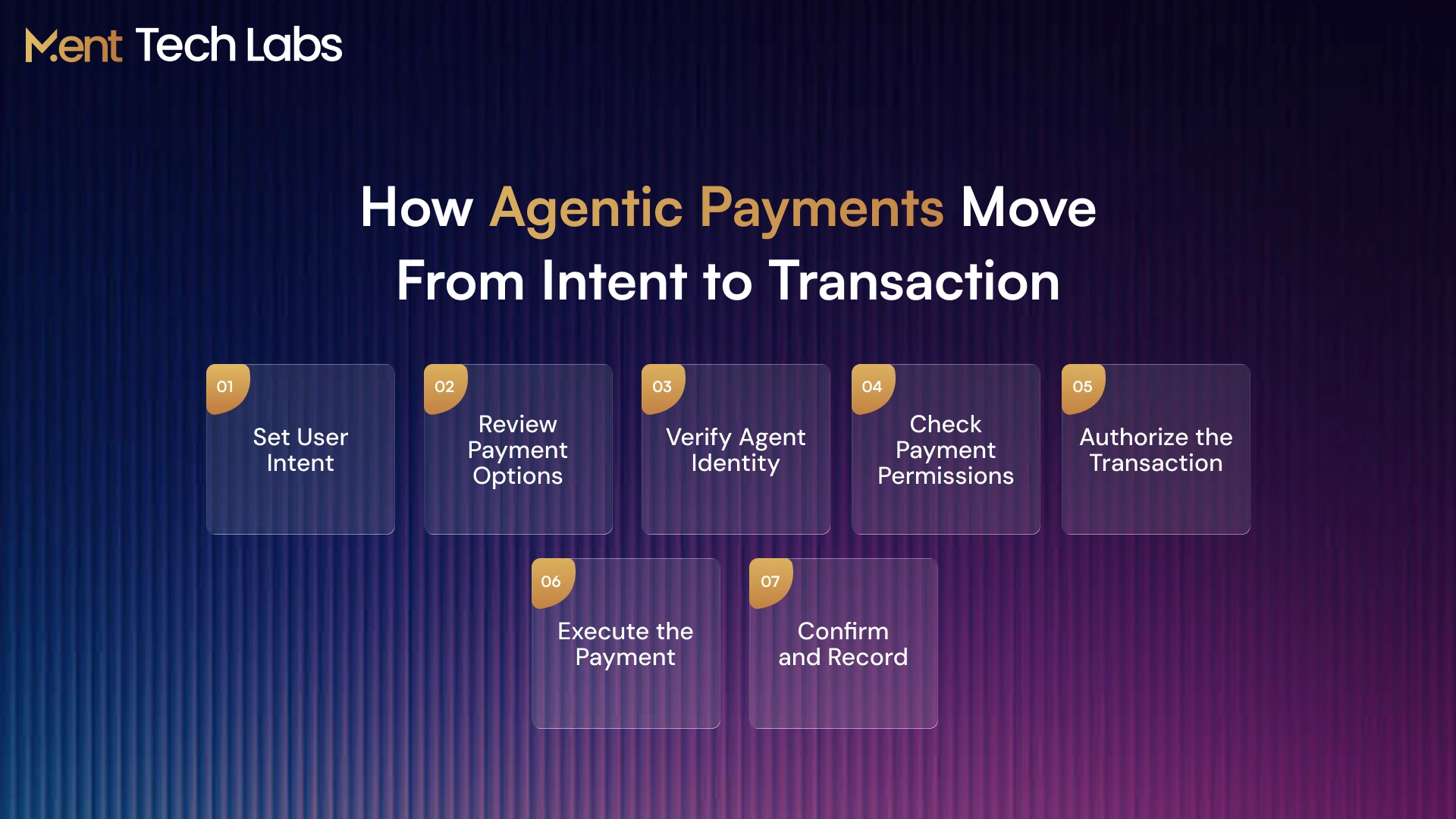
How Agentic Payments Work From Intent to Transaction
Agentic payments typically follow a clear sequence, with identity, permissions, and payment rules governing each step.
1. Define User Intent
The user or business gives the AI agent a clear goal, such as paying an invoice, booking a service, or buying within a fixed budget.
2. Evaluate Payment Options
The agent compares available choices, checks price, timing, and conditions, then decides whether the transaction matches the original request.
3. Verify Agent Permissions
Before money moves, agent payment authorization checks what the agent can do and agent payment authorization checks spending limits, approved merchants, currencies, and human approval rules.
4. Complete the Payment
Once approved, AI payment agents can complete the transaction through cards, bank rails, digital wallets, or stablecoins. Businesses can also work with an AI agent development company to define payment logic and agent permissions.
5. Confirm the Transaction
After payment, the system checks the result, saves the transaction, and looks for anything. This helps make automatic payments simpler to review and match up.
Agentic Payments vs. Agentic Commerce: What’s the Difference?
Agentic commerce covers the full experience of an AI agent finding, comparing, selecting, and purchasing a product or service. Agentic payments focus specifically on how the agent is authorized to move money and complete that transaction securely.
| Area | Agentic Payments | Agentic Commerce |
| Main focus | Secure payment authorization and execution. | The complete AI-led buying journey. |
| Agent role | Initiates or completes an approved payment. | Searches, compares, decides, and purchases. |
| Typical flow | Permission → authorization → payment → confirmation. | Discovery → evaluation → selection → checkout → payment. |
| Key controls | Identity, spending limits, tokenized credentials, and fraud checks. | Product data, pricing, availability, checkout, payment, and fulfillment. |
| Business example | An agent pays an approved supplier invoice within a set limit. | An agent finds a supplier, compares offers, places the order, and completes payment. |
| Core requirement | Trusted payment rails and clear agent permissions. | Agent-ready commerce systems that support discovery through checkout. |
How Do AI Agents Get Authorized to Make Payments?
AI agents should not be able to spend freely. Before they make a payment, the system needs to know who the agent is acting for, what it is allowed to do, and when a human should still be involved. That is where payment agent identity and delegated payment controls matter.
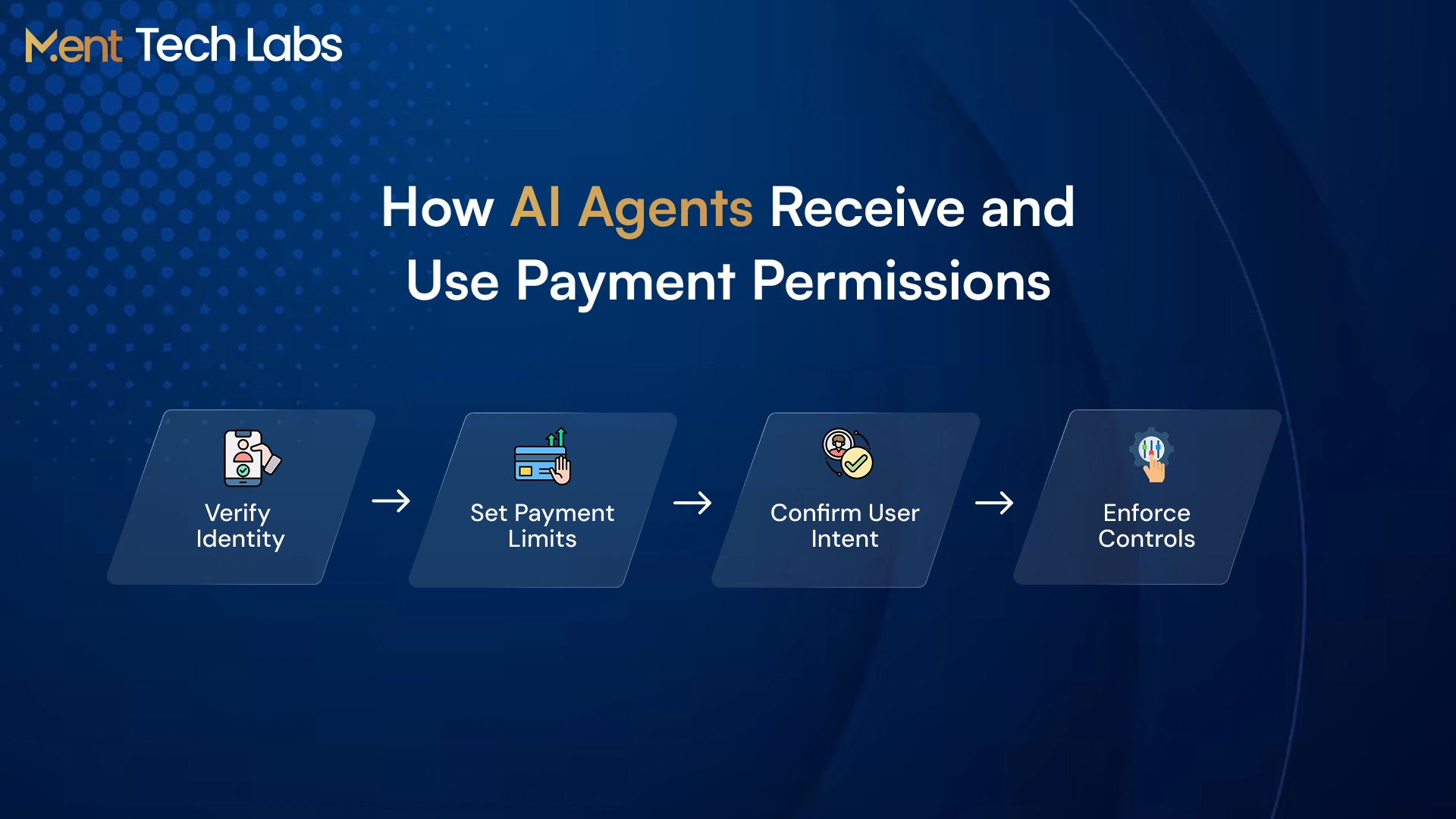
1. Verify Identity
The system first checks who the agent belongs to and whether it is genuinely acting for an approved user or business. This makes the transaction easier to trust and trace.
2. Set Payment Limits
The agent is given clear boundaries, such as how much it can spend, which merchants it can use, and how often it can make payments. These limits help keep the agent focused on the task it was actually given.
3. Confirm User Intent
Before the payment goes through, the system checks whether the transaction still matches the user’s original request. If the amount, merchant, or purchase looks unusual, the payment can be paused for approval.
4. Enforce Controls
Once the checks are passed, the agent can complete the payment. Businesses can also use AI security and red teaming services to test these payment flows for weak permissions, prompt manipulation, and other security gaps before going live.
How Agentic Payment Security Helps Prevent Fraud
With AI-powered payments, security is not just about protecting a card or account. The system also has to check who the agent is, what the user allowed it to do, and whether the payment still makes sense.
Verify Agent Identity: The system first checks that the agent is trusted and is genuinely acting for the right user or business. This helps stop unknown or impersonated agents from making payments.
Check User Intent: The payment is compared with the original request. If the amount, merchant, or purchase changes in a way the user did not approve, the transaction can be stopped or sent for review.
Monitor Agent Activity: AI payment security can flag behavior that looks unusual, such as a sudden high-value purchase, repeated payments, or activity with a new merchant.
Keep Payments Controlled: Spending limits, merchant rules, approval thresholds, and secure payment credentials help keep autonomous payments within clear boundaries.
What Are Emerging Protocols Shaping Agentic Payments?
Several new protocols are being built to support agentic payments, but they do not all solve the same problem. Some focus on permission, some on checkout, and others on settlement.
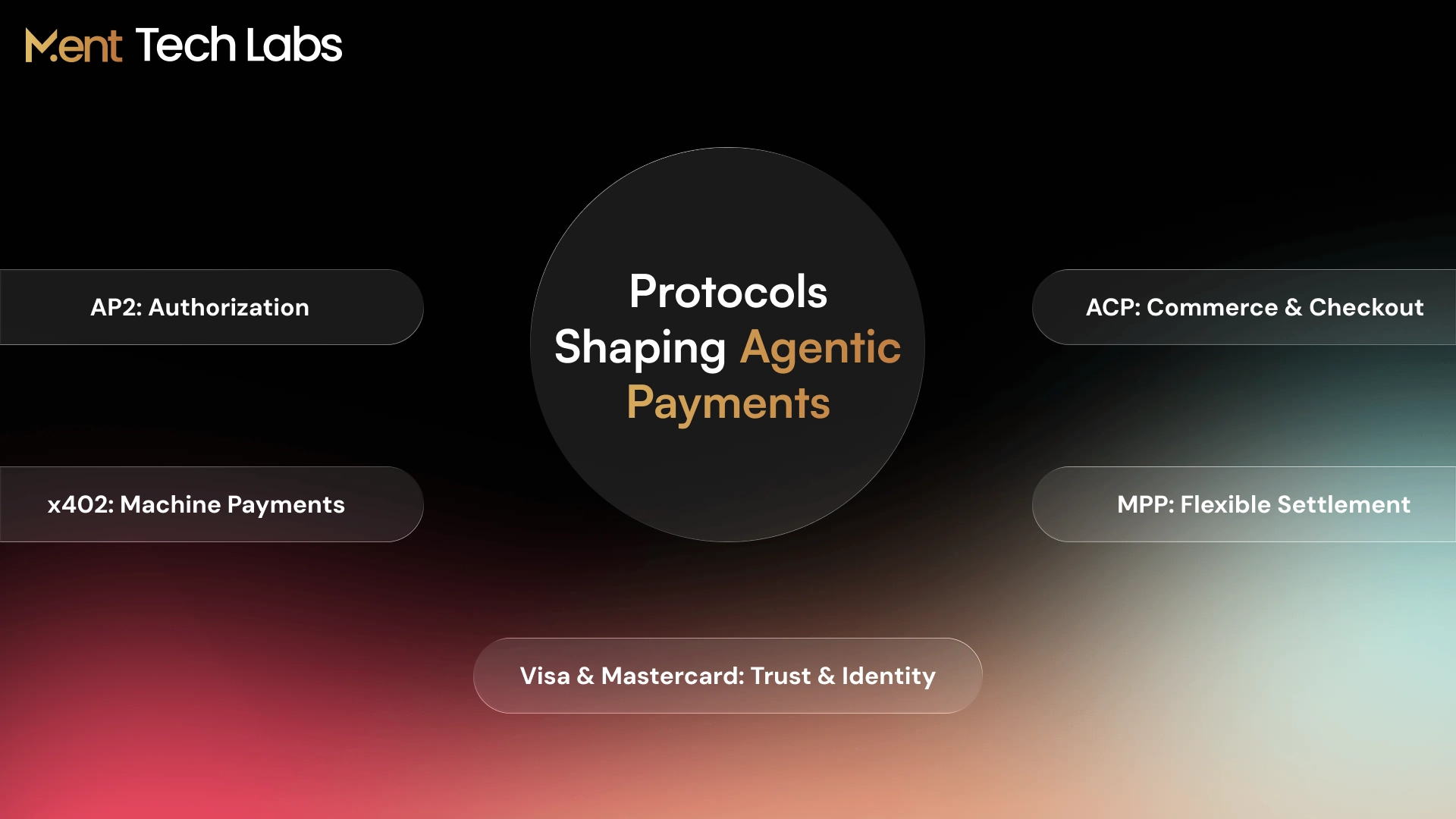
AP2: Authorization
Helps prove what the user allowed the agent to do. It can capture intent, spending limits, and transaction conditions before the payment happens.
ACP: Commerce and Checkout
Helps AI payment agents interact with merchants during the buying process, including product selection, checkout, and payment handoff.
X402: Machine-to-Machine Payments
Designed for software paying software. It is useful for API access, digital services, data, and other transactions where a traditional checkout page is not practical.
MPP: Flexible Settlement
Supports machine payments across different payment rails, making it useful for repeated or smaller transactions between agents and services.
Visa and Mastercard: Trust and Identity
Their frameworks focus on agent identity, tokenized credentials, and proof of user intent so merchants can better understand who the agent represents.
How They Work Together
A single agentic commerce transaction may use more than one protocol:
User intent → AP2 authorization → ACP checkout → x402 or MPP settlement → network identity and verification
Businesses using programmable payment rails can also connect these flows with stablecoin payment platform development for stablecoin-based settlement.
How Can Merchants Prepare for Agentic Payments?
Merchants do not need to rebuild their payment stack from scratch for agentic payments. The bigger priority is making sure AI agents can understand the offer, prove who they are, and complete a transaction without bypassing existing controls.
1. Structure Product Data
Product details, pricing, availability, shipping, and return policies should be easy for an agent to read. The cleaner the data, the easier it is for AI payment agents to evaluate an offer correctly.
2. Support Agent Checkout
The checkout flow should let an approved agent complete a purchase without creating unnecessary friction. At the same time, the merchant should still control taxes, discounts, fulfillment, refunds, and accepted payment methods.
3. Verify Agent Identity
Merchants need to know whether an agent is legitimate and who it represents. Clear identity checks make it easier to trust the transaction and block unknown or suspicious automated activity.
4. Set Clear Payment Rules
Agents should only be able to act within defined limits. That can include spending caps, approved payment methods, transaction rules, or extra approval for higher-value purchases.
5. Keep Fraud Checks Active
Agent-led payments still need fraud and risk screening. Unusual amounts, repeated attempts, or behavior that does not match the user’s normal activity should be reviewed before the payment goes through.
6. Connect Existing Systems
Payments, checkout, orders, and finance systems should all share the same transaction data. Businesses can also use AI agents for banking to connect agent-led payment flows with existing banking and financial operations.
Where Can Businesses Use Agentic Payments?
Agentic payments make the most sense in workflows where the rules are already clear, the payment is repetitive, and a person does not need to review every single step.
1. B2B Procurement
An agent can compare approved suppliers, check prices, follow purchasing rules, and place an order within a set budget. For routine buying, this can remove a lot of back-and-forth between procurement and finance teams.
2. Supplier Payments
Agents can review invoices, match them with purchase orders, check due dates, and release payments that meet the company’s rules. Anything unusual can still be sent to a person for review instead of slowing down the whole process.
3. Business Travel
A travel agent can search flights and hotels, stay within company policy, and complete the booking without asking the employee to manage every step. If the cost goes over budget, the agent can pause and request approval.
4. Subscription Management
Agents can keep an eye on renewals, price changes, and software usage. They can renew tools that are still needed, flag subscriptions that are not being used, or ask for approval before making a larger change.
5. Machine-to-Machine Payments
In agentic commerce, software agents can pay for APIs, data, compute, or other digital services as they need them. These AI-powered payments can happen automatically without a traditional checkout page or manual payment step.
Conclusion
Agentic payments are changing how businesses think about automation. Instead of just helping with a payment, AI agents can now act within set rules and complete approved transactions on their own.
That makes things faster, but it also raises the bar for identity, authorization, security, and payment controls. Businesses that get these basics right will be in a much better position as agentic commerce becomes more common.
Ment Tech Labs helps businesses turn these ideas into working payment systems that fit real workflows. If you’re planning an agentic payment or AI-led commerce project, contact Ment Tech Labs to discuss your project.