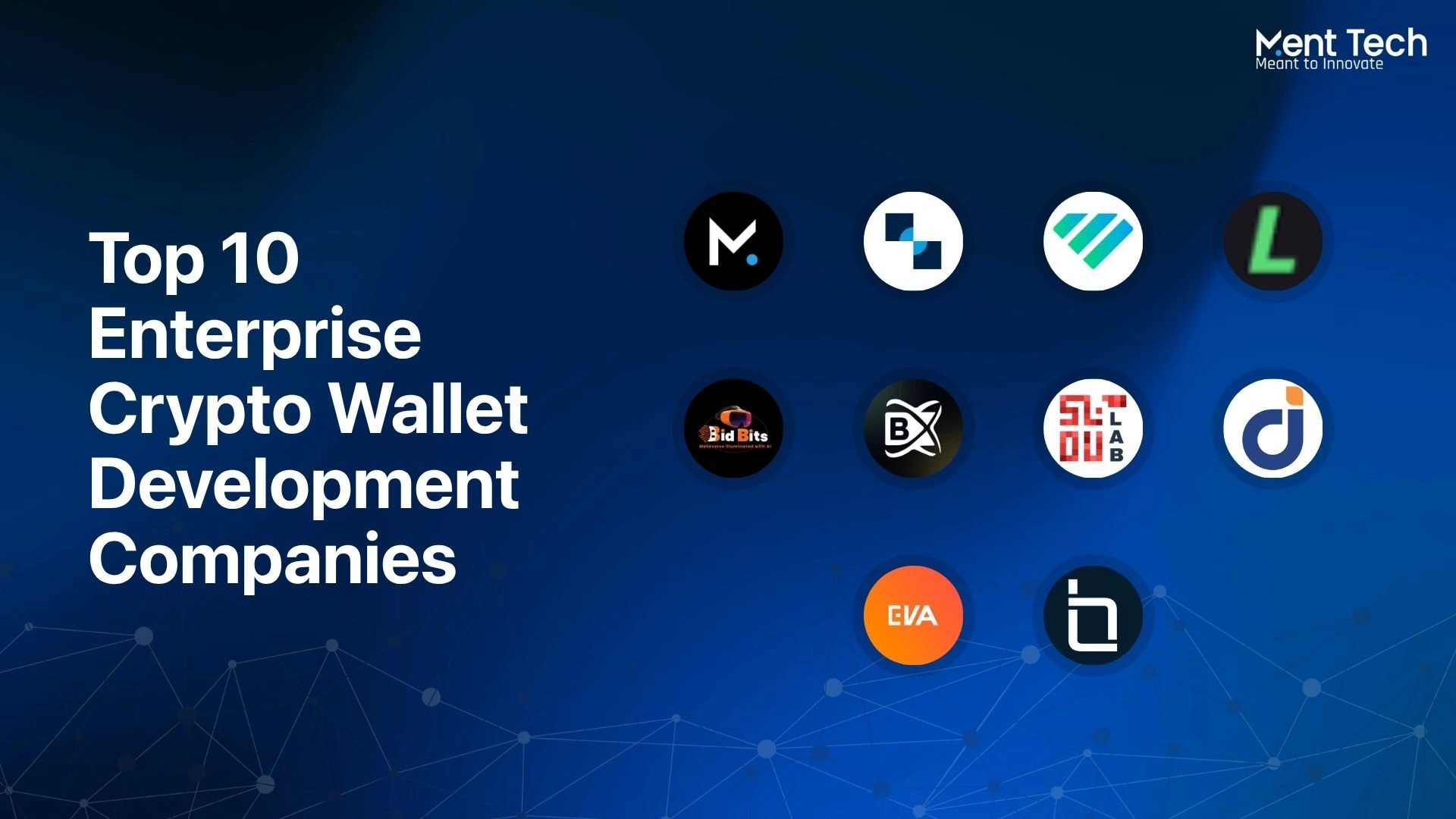
Digital assets aren’t a side bet anymore. Institutions hold crypto on their books, banks pilot tokenized deposits, and stablecoins move billions daily. That growth needs real infrastructure, which is where a cryptocurrency wallet development company comes in. Wallets used to just store coins. Now they run custody, treasury ops, and tokenized assets for businesses that can’t afford security slip-ups.
That’s why enterprises are turning to specialized partners instead of building in-house. A generic wallet can’t handle institutional custody or regional compliance. Businesses need cryptocurrency wallet development solutions that cover encryption, key management, and stablecoin support and are flexible enough for DeFi and Web3.
This guide covers the companies actually building enterprise-grade wallets today, the ones doing stablecoin wallet development and smart wallet development for real businesses, not just retail apps. Whether you’re launching custody, scaling an exchange, or exploring tokenization, this comparison helps you find the right cryptocurrency wallet development company.
What Is a Cryptocurrency Wallet Development Company?
A cryptocurrency wallet development company is basically the team that builds the tech letting you store, send, and manage digital assets without losing sleep over it. Easier said than done, though. Wallet architecture is private keys, signing logic, and encryption all working together behind the scenes, and how well those pieces fit together decides if a wallet is actually secure or just looks the part. Cryptocurrency wallet development covers custodial wallets, where someone else holds the keys for you, and non-custodial wallets, where you hold your own keys and, let’s be real, your own risk too.
Enterprise wallets take this up a notch. They need to scale and talk to multiple blockchains at once, not just sit on one chain. When a business is moving stablecoins or tokenized assets around, digital asset security has to hold up against audits and actual transaction volume, not just a demo. That’s a whole different game than a consumer app holding someone’s weekend crypto buys.
Why Enterprises Need Professional Wallet Development
Building a wallet in-house sounds doable until you actually sit down and map out everything an enterprise really needs. Here’s what professional wallet development actually brings to the table:
- Digital asset custody: Secure, audit-ready storage for crypto and tokenized assets, with proper backup and recovery so a lost device or a departed employee never turns into a lost fortune.
- Institutional security: Bank-level protection built around encryption, MPC or multi-signature setups, and access controls tight enough to survive real audits, not just look good in a pitch deck.
- Stablecoin payments: Rails for moving USDC, USDT, and other stablecoins across borders that settle in minutes, while old-school banking still makes you wait days for the same transfer.
- Web3 integration: Wallets built to talk to DeFi protocols, dApps, and multiple blockchains without extra middleware, so the business isn’t stuck bolted to a single closed ecosystem.
- Regulatory compliance: KYC, AML, and reporting baked in from the start, so when regulators come asking, the answers are already there instead of being pieced together in a panic.
Also Read: White-Label Crypto Payments Infrastructure for Banks and EMIs
How We Selected the Top Enterprise Crypto Wallet Development Companies
Picking companies for a list like this shouldn’t just come down to who has the flashiest website. We looked at real signals that actually matter when a business is choosing a cryptocurrency wallet development company to build long-term infrastructure with:
- Technical expertise
Hands-on experience with wallet architecture, encryption, and the engineering depth needed to build something that doesn’t fall apart under real usage.
- Blockchain ecosystem support
How many networks can a company actually work across, since enterprises rarely stick to just one chain anymore?
- Wallet security
Track record with MPC, multi-signature setups, and audits, because security is the one area where shortcuts show up fast.
- Smart contract and Web3 capabilities
Ability to build smart wallet development features and connect wallets to DeFi protocols and dApps, not just basic send and receive functions.
- Enterprise experience
Proof of delivering for real businesses at scale, not just retail apps with a few thousand downloads.
- Compliance readiness
Understanding of KYC, AML, and regional regulations, so wallets are built to survive scrutiny, not just demos.
- Global delivery and client portfolio
Companies with a track record across regions and industries, backed by projects and clients that can actually be verified.
Ment Tech
Ment Tech is a cryptocurrency wallet development company that pairs blockchain engineering with AI to build wallets suited for real enterprise workloads, not just basic crypto storage.
- Specializes in smart wallet development, multi-chain wallets, and stablecoin wallet integrations built for enterprise-grade security.
- Serves fintech, real estate, healthcare, and Web3 businesses with tailored compliance and workflow needs.
- Combines blockchain development with AI to power smarter features like fraud detection and transaction monitoring.
Antier
Antier has built a solid name in blockchain consulting, and cryptocurrency wallet development is one piece of a much broader crypto services offering that spans exchanges, DeFi, and enterprise blockchain projects.
- Builds custodial and non-custodial wallets along with DeFi wallet integrations for businesses handling different risk and control needs.
- Works closely with crypto exchanges and DeFi platforms as core clients, giving it real exposure to high-transaction-volume environments.
- Brings deep blockchain development company experience alongside its wallet builds, useful for businesses wanting strategy plus execution in one place.
Blockchain App Factory
Blockchain App Factory has built a name around white-label crypto products, giving businesses a faster route to launching wallets and exchanges without starting from scratch.
- Offers white label wallets and exchange-linked wallet solutions built for quick deployment.
- Works largely with startups and crypto exchanges looking to launch fast.
- Brings strong exchange development experience alongside its wallet development company services.
Limeup
Limeup is a European software house that brings fintech development experience into its blockchain and wallet projects, with a clear focus on regulatory awareness.
- Builds custom cryptocurrency wallet development solutions with close attention to EU compliance requirements.
- Works primarily with European fintech and banking clients navigating strict regulatory environments.
- Combines fintech software expertise with blockchain integration for businesses needing both.
BidBits
BidBits has carved out a niche as a cryptocurrency wallet development company that builds wallets plugging directly into trading and exchange systems, making it a solid fit for businesses running both together under one roof.
- Builds wallet apps with tight smart wallet development integration for trading and exchange platforms.
- Works mainly with crypto exchanges and trading platforms that need wallets synced with live trading activity.
- Combines cryptocurrency wallet development with exchange and trading bot experience for businesses wanting one vendor for the whole stack.
BlockchainX
BlockchainX has leaned heavily into the DeFi side of crypto, building wallets that are meant to work with decentralized protocols from day one, not bolted on as an afterthought.
- Builds smart wallet development solutions with direct connectivity to DeFi protocols.
- Works mainly with DeFi platforms and Web3 startups that need wallets deeply integrated with their ecosystem.
- Brings smart contract audit experience alongside its cryptocurrency wallet development work, useful for businesses wanting security baked in early.
SoluLab
SoluLab operates out of the US and brings a broader software development background into its blockchain and wallet projects, so businesses get more than just a standalone wallet build.
- Offers cryptocurrency wallet development as part of larger blockchain and AI development projects.
- Works with enterprises across fintech and healthcare needing wallets tied into bigger software systems.
- Combines broader software engineering capability with blockchain development company expertise for more complex builds.
Debut Infotech
Debut Infotech runs delivery teams across North America and India, and its wallet work usually comes packaged alongside exchange platform builds rather than as a standalone product.
- Builds custom cryptocurrency wallet development solutions designed to work alongside exchange platforms.
- Works with fintech businesses and crypto startups launching combined wallet and exchange products.
- Brings blockchain development company consulting experience into projects needing both strategy and execution.
EvaCodes
EvaCodes is based in Ukraine and takes a leaner approach to crypto projects, focused on straightforward wallet builds without a lot of extra bundled services.
- Offers custom cryptocurrency wallet development solutions built for smaller, focused projects.
- Works mainly with startups and small to mid-size crypto projects needing a no-frills wallet build.
- Brings a lean blockchain development company approach for businesses that want a wallet without a big enterprise overhead.
Also Read: Top Agentic AI Crypto Wallet Development Companies
Cryptocurrency Wallet Types for Different User Needs
Picking a wallet type isn’t really a one-size-fits-all decision, and most businesses end up using a mix depending on what they’re actually trying to solve.
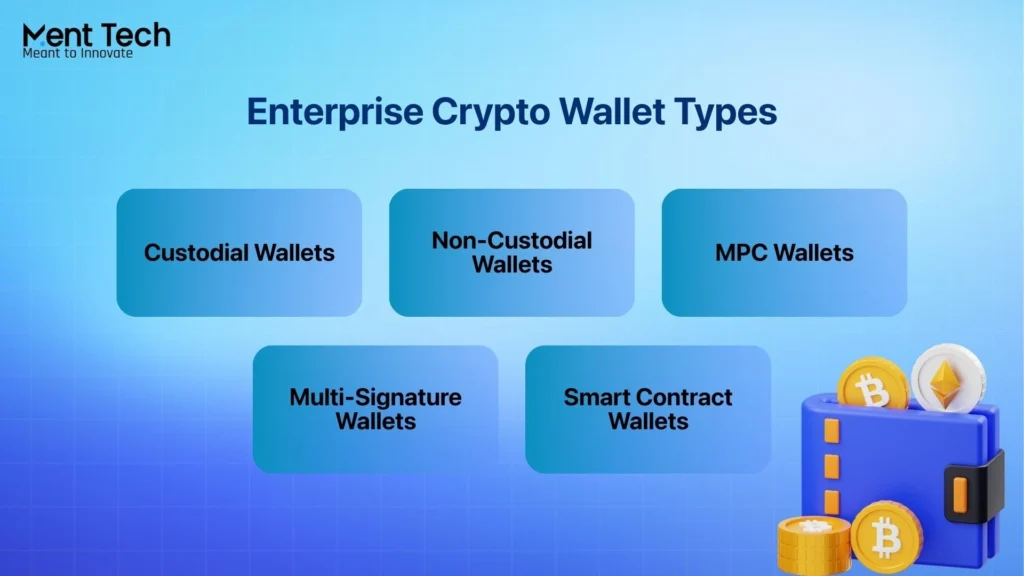
- Custodial Wallets - A third party holds the private keys on the business’s behalf, which makes onboarding a lot easier but also means trusting someone else with control over the assets.
- Non-Custodial Wallets - The business or user holds their own keys directly, which gives full control but also full responsibility the moment a key gets lost or leaked.
- MPC Wallets - Splits key control across multiple parties using multi-party computation, so no single person or device can quietly move funds on their own.
- Multi-Signature Wallets - Need approval from more than one authorized signer before a transaction goes through, which works well for teams that don’t want one person holding all the power.
- Smart Contract Wallets - Built through smart wallet development, these run on programmable logic that can enforce spending limits, automate approvals, or add recovery options without leaning on a single private key.
Essential Security Features for Enterprise Crypto Wallets
Security isn’t a checkbox exercise for enterprise wallets, since one weak link can mean losing funds that don’t come back. Here’s what actually matters:
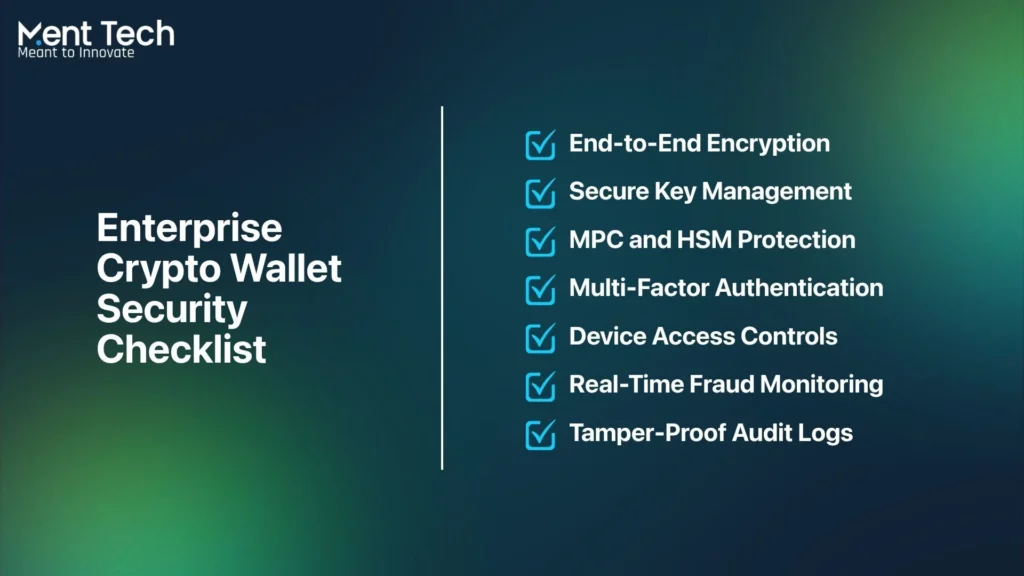
Encryption: Data and private keys need to stay encrypted both at rest and in transit, so even if something gets intercepted, it’s useless without the right keys.
Secure key management: How keys are generated, stored, and rotated matters more than most people realize, and sloppy key management is behind a lot of the big hacks we hear about.
MPC and hardware security modules: Splitting key control through MPC or storing keys in dedicated hardware modules keeps sensitive operations away from any single point of failure.
MFA and biometrics: Passwords alone don’t cut it anymore, so layering in multi-factor authentication and biometric checks adds friction exactly where attackers need it most.
Device management: Enterprises need visibility into which devices can access wallets, with the ability to revoke access instantly when someone leaves or a device goes missing.
Fraud monitoring: Real-time detection for unusual transaction patterns helps catch problems before funds actually leave, not after.
Audit logs: A clear, tamper-proof record of every action taken in the wallet, which matters just as much for compliance as it does for catching internal issues.
Final Thoughts
Choosing the right cryptocurrency wallet development company isn’t something to rush. It comes down to checking technical expertise, blockchain support, and whether the security architecture actually holds up under pressure, not just a good sales pitch.
Compliance readiness matters just as much. A partner with real regulatory understanding and genuine enterprise delivery experience saves a lot of painful rework later, especially once stablecoin wallet development or multi-chain expansion enters the picture.
Wallets aren’t a one-time build, though. Their infrastructure that needs to grow with the business, so picking a blockchain development company or Web3 development company built for long-term growth pays off far more than a quick launch ever will. Let’s Discuss Your Project with Ment Tech Labs!