The office staff faces difficulties with their appointment scheduling system because patients begin contacting them to schedule additional appointments, to cancel their current appointments, to change their scheduled times, to verify available appointment slots, and to finish their follow-up work. The front desk teams face challenges because their workload increases into two problems, which create long waiting times and result in missed incoming calls, and force staff to handle physical updates and create extra errors during the scheduling process.
The current healthcare industry has adopted artificial intelligence systems because these systems provide important advantages to their users. The combination of chatbots and AI voice agents, SMS assistants, and patient portals can handle standard scheduling procedures, which frees up staff resources for essential human interactions.
The transition has already started to show itself. A 2026 healthcare chatbots market report valued the global market at USD 0.7 billion in 2026 and projected it to reach USD 1.99 billion by 2030. The healthcare field needs to implement AI technology responsibly. You can use this comparison to identify the top AI chatbot platforms that support automatic responses to user inquiries.
If you want to build something custom around your actual workflows, Ment Tech Labs can help you design and launch a secure, scalable healthcare AI platform.
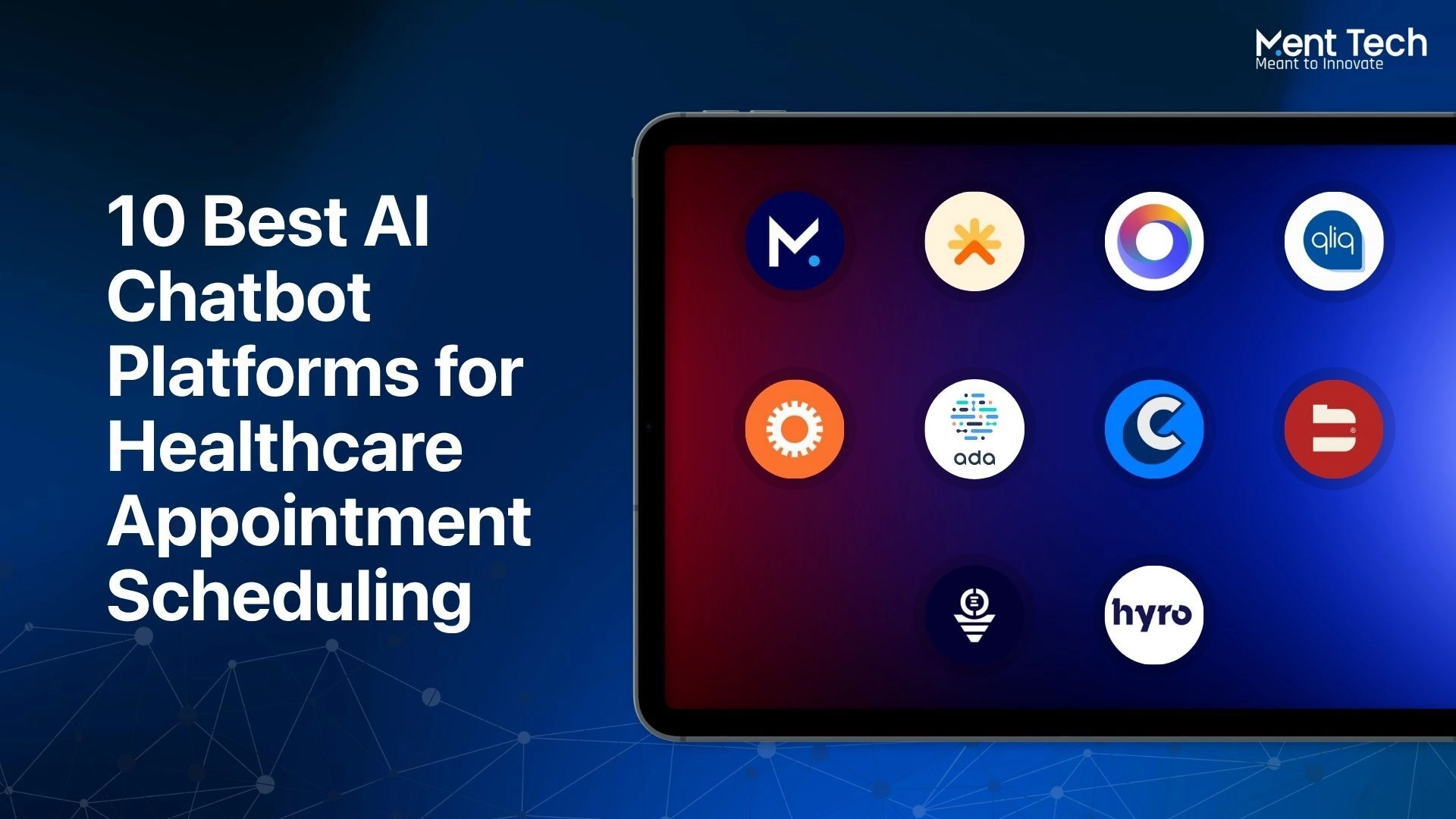
10 Best AI Chatbot Platforms for Automating Appointment Scheduling
There is no shortage of AI scheduling tools in the market right now. The real question is which ones actually fit how healthcare organizations operate. Here are the platforms worth considering, depending on what your organization actually needs.
1. Ment Tech
Most healthcare organizations have scheduling workflows that no generic chatbot can handle properly. Multiple departments, specific EHR systems, unique intake processes, and patient communication needs that an off-the-shelf tool just was not built for. As a healthcare AI platform development company and AI chatbot development company, Ment Tech Labs builds everything around how your organization actually works, not the other way around.
- Best for: Hospitals, healthtech startups, telehealth platforms, and mental health platforms that need something built specifically for them.
- Key strengths: HIPAA and GDPR conscious architecture, multilingual support, RAG integration, and Generative AI integration services.
- Scheduling capabilities: Appointment chatbots, AI voice assistants, reminder automation, patient intake, and EHR and EMR integration.
- Why it stands out: Nothing comes as a fixed template. Everything is designed around how your organization actually runs and what your patients actually need.
- Things to consider: A better fit for teams ready to build something custom rather than deploy something off the shelf.
2. Bland AI
Phone calls are still how a large chunk of healthcare scheduling happens, and Bland AI is built specifically for that. Their voice AI handles inbound and outbound appointment calls, manages rescheduling, sends reminders, and supports patient intake without putting everything on a human receptionist. For healthcare teams dealing with high call volumes and too many no-shows, it is a focused solution that does one thing and does it well.
- Best for: Healthcare teams drowning in appointment calls who want to automate the volume without sacrificing the patient experience.
- Key strengths: Voice AI that actually sounds natural, call handling at scale, and healthcare call center automation that reduces the pressure on reception staff.
- Scheduling capabilities: Appointment booking, rescheduling, outbound reminders, and patient intake support over the phone.
- Why it stands out: It is laser-focused on the phone channel, which is exactly where most healthcare no-shows and missed bookings happen in the first place.
- Things to consider: Primarily voice-focused, so teams that also need chat, SMS, or web-based scheduling will likely need something else running alongside it.
3. Voiceoc
Most patients do not show up knowing exactly which doctor or department they need. They just know something is wrong, and they need to see someone.Voiceoc is built with that reality in mind, combining scheduling with provider matching so patients get the right appointment with the right person without the front desk having to figure it out manually every single time.
- Best for: Clinics and hospitals that want scheduling handled across both their website and call center without stitching together separate tools.
- Key strengths: Provider matching, multilingual patient communication, and multi-channel support across calls and web.
- Scheduling capabilities: Instant appointment booking, provider matching, call center and website based scheduling, and multilingual patient communication.
- Why it stands out: Provider matching built into the scheduling flow is something a lot of platforms skip, and it makes a real difference for patients who do not know where to start.
- Things to consider: Worth checking against your specific channel setup to make sure it covers how your patients actually reach you.
4. Hyro
Large health systems deal with a level of scheduling complexity that most tools are simply not built for. Multiple locations, different departments, high call volumes, and EHR systems that everything needs to connect with. Hyro is designed for exactly that environment, bringing conversational AI across calls, websites, and patient access workflows under one platform.
- Best for: Large health systems that need conversational AI working consistently across calls, websites, and patient access workflows.
- Key strengths: AI agents for healthcare call centers, EHR-connected workflows, and patient access automation at scale.
- Scheduling capabilities: Patient scheduling, provider search, call center automation, and EHR-connected appointment workflows.
- Why it stands out: Built for the complexity that comes with large health systems, where a simple chatbot just does not cut it.
- Things to consider: Maybe more than smaller clinics or single-location practices actually need.
5. Luma Health
Every empty appointment slot costs money, and every last-minute cancellation that nobody fills is a missed opportunity. Luma Health is built around fixing exactly that. Smart waitlist automation, self-scheduling, and cancellation management that quietly keep the schedule full without someone manually chasing patients to fill the gaps.
- Best for: Organizations tired of empty slots, no shows, and front desk teams buried in schedule changes.
- Key strengths: Smart waitlist automation, cancellation management, and patient journey automation that runs itself.
- Scheduling capabilities: Self-scheduling, reminders, rescheduling, waitlist automation, and EHR integration.
- Why it stands out: When a slot opens up, it automatically reaches out to the next patient in line. No one has to notice it and make a call. It just handles it.
- Things to consider: Focused on scheduling and access so teams needing broader clinical or communication support will need something else alongside it.
6. Kore.ai
Kore.ai is built for enterprise healthcare organizations that need AI working across multiple patient touchpoints at the same time, not just one channel or one use case. Their healthcare AI agents handle everything from appointment management and reminders to EMR authentication and patient self-service in a way that actually connects with the systems already running inside the organization.
- Best for: Enterprise healthcare organizations needing AI agents across patient support, appointment management, and care coordination.
- Key strengths: EMR authentication and integration, healthcare AI agents, and patient self-service automation across multiple channels.
- Scheduling capabilities: Appointment management, notifications and reminders, patient self-service, and care coordination support.
- Why it stands out: The EMR authentication and integration capability is something a lot of healthcare AI platforms handle poorly. Kore.ai takes it seriously, which matters a lot at an enterprise scale.
- Things to consider: Built for enterprise complexity, so smaller clinics may find it more platform than they actually need.
7. QliqSOFT / Quincy
There is a lot that happens between a patient booking an appointment and actually showing up for it. QliqSOFT’s Quincy chatbot is built around that in-between space, handling confirmations, reminders, pre-visit check-ins, and secure patient communication so nothing falls through the cracks before the appointment even starts.
- Best for: Healthcare teams that want a chatbot handling the full appointment communication cycle, not just the booking part.
- Key strengths: Secure patient messaging, pre-visit check-ins, and appointment workflow automation that keep patients informed at every step.
- Scheduling capabilities: Patient self-scheduling, appointment confirmation, reminders, pre-visit check-ins, and secure patient communication.
- Why it stands out: The focus on secure messaging makes it a genuinely responsible choice for healthcare teams who take patient data privacy seriously and need an AI chatbot development company-level of care built into the platform.
- Things to consider: More communication and workflow-focused than a full enterprise AI scheduling platform, so larger health systems may need additional tools for scale.
8. LivePerson
Patients do not stick to one channel, and healthcare organizations know that better than anyone. Someone starts on the website, calls to confirm, then wants a text reminder. LivePerson handles all of that without the experience breaking down every time a patient switches how they want to communicate.
- Best for: Organizations that are tired of patient conversations falling apart every time someone switches from a call to a message to a chat window.
- Key strengths: Voice-to-digital handoffs that actually work, healthcare messaging that feels human, and multichannel automation that holds together across touchpoints.
- Scheduling capabilities: Appointment scheduling, cancellation workflows, voice-based booking, and confirmation through messaging.
- Why it stands out: Most platforms lose the thread when a patient moves between channels. LivePerson keeps the context intact, which sounds simple but makes a real difference in the patient experience.
- Things to consider: It is a broad conversational AI platform, so getting it to work well for clinical scheduling specifically will take some thoughtful setup upfront.
9. Ada Health
Most scheduling tools assume patients already know what they need. Ada Health does not make that assumption. It focuses on the step that comes before booking, helping patients understand their symptoms, navigate their options, and figure out what kind of care they actually need before anyone picks up the phone.
- Best for: Healthcare companies that want AI to support clinical triage and care navigation before patients even reach the scheduling step.
- Key strengths: Symptom assessment that actually guides patients, care navigation, and clinical workflows that feed naturally into scheduling decisions.
- Scheduling capabilities: Routing patients toward the right care and clinical workflow support that makes scheduling smarter downstream.
- Why it stands out: It solves the problem most scheduling tools pretend does not exist, which is that a lot of patients genuinely do not know where to start.
- Things to consider: It is not a standalone booking tool, so it works best sitting alongside a broader healthcare AI setup rather than replacing it.
10. Capacity
If your front desk team spends most of their day stuck in the same loop of calls, bookings, cancellations, and copay questions, Capacity gets it. Their virtual agents step in and just handle it. Scheduling, rescheduling, billing questions, prescription inquiries, and patient authentication across voice, chat, SMS, and email. Patients get help when they need it, and your staff can finally come up for air.
- Best for: Healthcare teams buried in repetitive calls who need coverage that runs itself, no babysitting required.
- Key strengths: Every channel in one place, voice, chat, SMS, email, and running around the clock. It does not clock out at five.
- Scheduling capabilities: Booking, rescheduling, cancellations, reminders, patient authentication, billing, and prescription inquiries.
- Why it stands out: No hold music. No missed calls. No patients slipping through the cracks on a Friday night. It just handles it.
- Things to consider: If your workflows get complicated, it is worth mapping them out against what Capacity offers before you commit.
Beyond Scheduling: Other Use Cases for Healthcare AI Platforms
Most healthcare organizations start with appointment scheduling because it is the most obvious pain point. But once the foundation is in place, a good healthcare AI platform can quietly take on a lot more than just booking.
- Patient Intake and Insurance Support: The system requires patients to complete their details and insurance information before their actual arrival. The system eliminates all front desk disruptions while preventing any documents from being lost on that particular day.
- Medication and Follow-Up Reminders: The system tracks patient progress between medical appointments without needing staff members to track patients through manual work. The software operates silently in the background while it fulfills its designated functions.
- Mental Health Support: The wellness platforms, together with behavioral health platforms, provide a mental health support bot that allows patients to access their first contact point with mental health support outside their scheduled therapy sessions.
- Care Navigation and Referral Routing: Not every patient knows which doctor or department they need. AI guides them to the right place without a staff member having to manage every single referral by hand.
- Internal Operations and Hiring Support: Some healthcare AI platforms go beyond patient workflows entirely and support workforce coordination, onboarding, and AI-powered hiring platforms for healthcare roles, which is a real advantage for clinics that are growing fast.
Final Thoughts
Booking a doctor’s appointment should be simple. For patients, it often is not. And for the staff managing those requests, it can eat up hours that could go toward actual care. Phone calls, manual follow-ups, and back-and-forth scheduling across a busy week. It adds up fast. That is the problem Ment Tech Labs set out to fix. Not by dropping generic AI tools into a clinic and calling it innovation, but by building things that actually work inside real healthcare environments.
Depending on what a care team needs, that might look like a scheduling assistant that handles appointment requests at any hour without anyone lifting a finger. Or a voice system patients can actually have a conversation with. Data protection is not something that gets bolted on at the end either.
If you have an idea for a healthcare AI platform, whether it is for scheduling, patient engagement, voice automation, or mental health support, Ment Tech can help you take it from concept to something secure, scalable, and genuinely useful. Because the best healthcare technology does not just automate tasks. It makes people feel like someone actually thought about them when building it.