
Three years ago, a company adding AI to its product roadmap was ahead of the curve. Today, the companies still treating generative AI as a “we’ll get to it soon” initiative are quietly falling behind. The shift has already happened.
But here is the part that catches a lot of enterprises off guard. Deploying AI is not the challenge anymore. Deploying AI that actually works inside a real enterprise environment, with real data, real compliance requirements, and real users who have no patience for tools that break mid-conversation, that is where most projects either succeed or quietly get shelved. In fact, 42% of companies abandoned most of their AI initiatives in early 2026, up from just 17% in 2024.
Enterprise generative AI development services exist to solve exactly that problem. Not demos. Not proof-of-concepts that look great in a boardroom but collapse under production workloads. Actual systems, built to run inside your environment, connected to your data, and designed around how your teams already work.
If that is what you are building toward, Ment Tech Labs builds, deploys, and supports enterprise GenAI solutions that connect directly to your business workflows, not around them.
What Are Enterprise Generative AI Development Services?
Here is the short version. Enterprise generative AI development services help organizations build custom AI systems, using large language models, machine learning, AI agents, retrieval-augmented generation, and workflow automation, that are built for a specific business, not the general public.
The distinction matters more than most people realize. A consumer AI tool is designed to work reasonably well for millions of different people with millions of different needs. An enterprise AI system is designed to work extremely well for your specific workflows, your data structures, your compliance obligations, and your users.
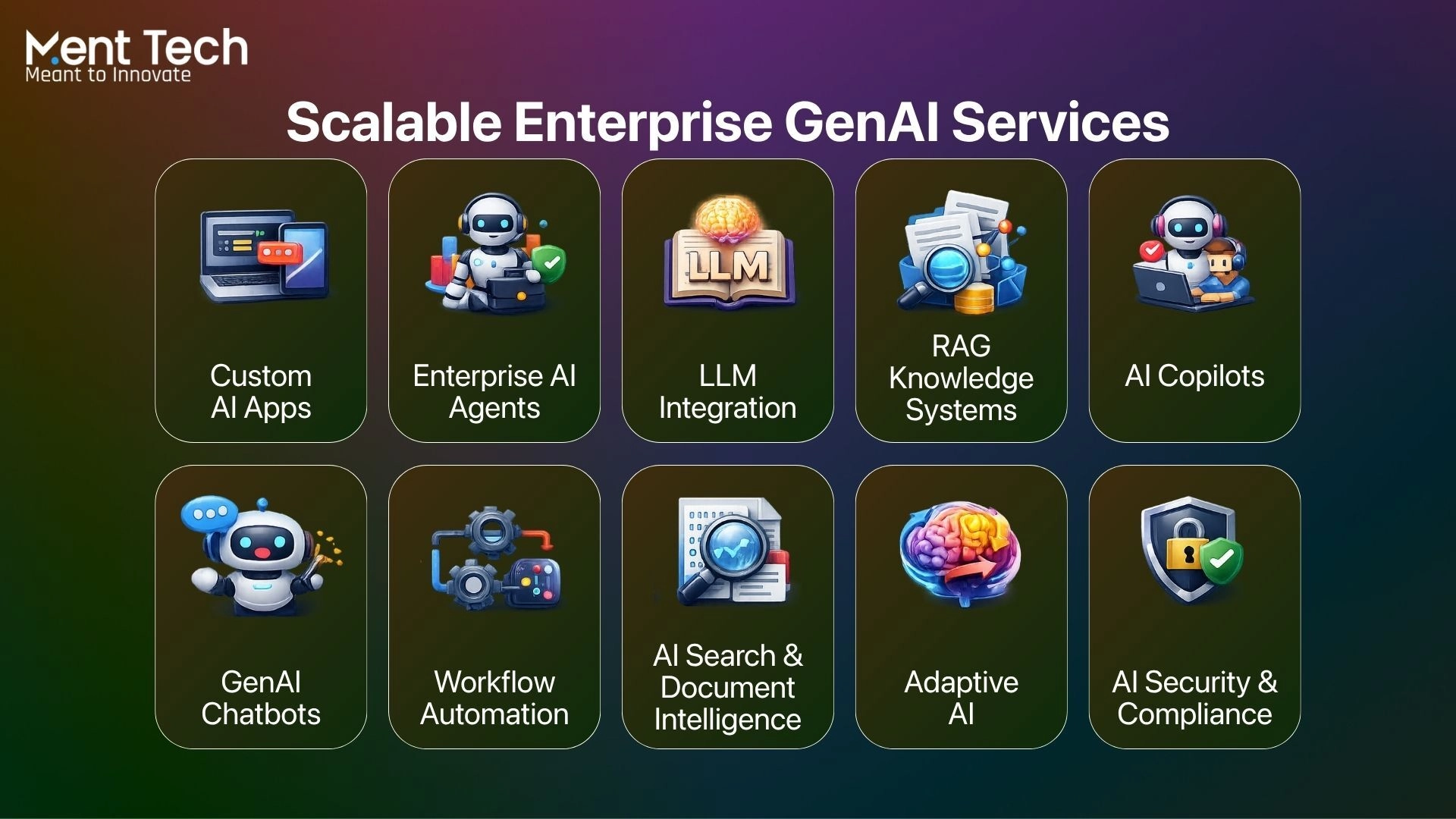
What falls under this umbrella: Custom AI assistants and internal copilots. AI agents that handle multi-step business tasks. RAG systems connected to internal documents, contracts, and SOPs. Document intelligence and enterprise search. Customer support automation. Workflow automation for HR, finance, operations, and sales. Data-connected chatbots with proper security controls. Compliance-ready AI platforms built for regulated industries.
The common thread is specificity. These systems are not borrowed from someone else’s use case. They are designed from the ground up for yours.
Why Enterprises Need Generative AI Development Services in 2026
The honest answer is that the pressure has become unavoidable.
Teams are being asked to handle more work without proportional headcount growth. Document-heavy workflows, repetitive customer queries, manual reporting, and cross-system data entry are draining productivity across every department. Leaders know AI can address this. The question is which AI, built how, and deployed where.
Ready-made tools have a ceiling. They do not know your internal processes. They were not designed for your compliance environment. They cannot connect to your proprietary data in ways that would actually make them useful. And when something goes wrong, there is no team with context on your specific deployment to fix it.
The demand for generative AI development services is being driven by several things happening at once. Automation pressure building across departments. Growing need for secure, private AI deployment in regulated industries. Internal productivity gaps that are getting harder to ignore. Large volumes of unstructured data that nobody can extract value from manually. Customer support costs rising while expectations for response quality go up at the same time.
For enterprises, 2026 is not about experimenting with AI. It is about building it properly.

10 Best Enterprise Generative AI Development Services to Build Scalable AI Solutions
1. Custom Generative AI Application Development
Generic AI applications are designed for the average use case. If your business is average, that works fine. Most enterprises are not average.
They have specific workflows, industry-specific data, internal terminology, and user expectations that no off-the-shelf product was designed to handle. A claims processing assistant for an insurance company looks nothing like a sales productivity tool for a SaaS business. Both are AI applications. The requirements are completely different.
Custom GenAI application development starts with the actual business problem and builds backward from there. Custom dashboards, AI-powered internal portals, industry-specific tools, and department-level productivity applications all fall here. This is the foundation of any serious enterprise generative AI development services engagement. Everything else depends on having a well-designed application underneath it.
2. Enterprise AI Agent Development
Chatbots answer questions. Agents take action. That is the distinction that matters most when enterprises are evaluating what kind of AI to build.
An AI agent handles a multi-step task across different systems without human input at every stage. It pulls data from one platform, makes a decision based on defined rules, updates a record in another system, triggers a downstream workflow, and generates a summary for the right team member. All without someone sitting in the middle orchestrating each step manually.
CRM updates after customer interactions. Ticket creation, routing, and resolution tracking. Automated report generation and distribution. Internal approval workflows. Sales outreach sequences triggered by specific signals. The applications are broad.
This is exactly why experienced AI agent development companies are among the most in-demand partners for enterprise AI projects right now. The architecture behind a reliable agent system is genuinely complex. It needs to handle failures gracefully, maintain context across steps, and integrate cleanly with the business systems your teams already use every day.
The AI Agent Development practise here is built specifically for enterprise-grade systems, handling failures, maintaining context, and integrating with the tools your teams already use.
3. LLM Integration and Customization Services
Very few enterprises need to train their own language model. The compute cost alone makes that impractical for most organizations. What enterprises actually need is to connect an existing model to their business systems in a way that is secure, customized for their context, and optimized for cost.
That is a different challenge from just calling an API.
LLM integration and customization covers model selection across providers like OpenAI, Claude, Gemini, Llama, and Mistral. Prompt engineering to get consistent, relevant outputs for specific business tasks. Fine-tuning for domain-specific language that general models handle poorly. Model routing to balance cost against quality across different query types. Private deployment for environments where data cannot leave your infrastructure.
Good generative AI development services treat the model as one component of a larger system, not the whole solution. How the model is configured, connected, and constrained matters as much as which model you choose.
4. RAG-Based Enterprise Knowledge Systems
Most enterprises have a knowledge problem. The information exists. It lives in internal documents, policy files, contracts, SOPs, product wikis, support tickets, and training materials. The problem is nobody can find it quickly, and even when they do, reading through twenty documents to answer one question is not a sustainable workflow.
The RAG Development Services cover end-to-end pipeline builds, from document ingestion to retrieval architecture and full production deployment.
Retrieval-Augmented Generation solves this directly. A RAG system lets an AI search your internal documents in real time and use that information to generate accurate, grounded answers. It does not guess. It pulls from your actual sources.
Enterprise search across internal knowledge bases. Policy assistants for HR and compliance teams. Legal document Q&A. Technical support bots connected to product documentation. Contract summary tools for procurement. For any organization sitting on large volumes of unstructured internal documentation, RAG is one of the highest-impact services in the entire enterprise generative AI development services landscape.
Further reading: Enterprise RAG System Cost Guide for 2026
Got a lot of internal documents but no easy way to search them? This guide breaks down what a RAG system actually costs to build in 2026.
5. AI Copilot Development for Enterprise Teams
A copilot is not a replacement for the employee. It is the AI layer that sits alongside them inside their daily work, surfaces the right information at the right moment, handles the low-value tasks, and frees them up for work that actually requires judgment.
Sales copilots help reps research accounts, draft outreach, and summarize call recordings without switching between five different tools. HR copilots answer policy questions, support onboarding, and handle routine employee queries. Support copilots give agents instant access to relevant information during live customer conversations. Finance copilots help analysts pull data, generate reports, and surface anomalies that manual review would miss.
Across every department the value proposition is the same. Less time on low-value tasks. More time on the work that actually moves things forward.
6. Generative AI Chatbot Development
The scripted chatbot era is over. Customers and employees have both been trained by years of bad chatbot experiences to expect something that breaks the moment a question falls slightly outside a narrow script. The bar for acceptable is now much higher.
A generative AI chatbot understands context. It handles follow-up questions. It knows when a conversation has moved from one topic to another. It connects to live business data to give answers that are actually current. It manages conversations in multiple languages without requiring separate builds for each market.
Finding the right generative AI development services company for chatbot work matters more than most teams expect. A chatbot that holds up in controlled testing but breaks under real-world conversation complexity does more damage to customer trust than no chatbot at all.
7. Workflow Automation with Generative AI
Traditional workflow automation tools are rule-based. They follow fixed logic and break the moment an input does not match the expected format. That works fine for highly structured, predictable processes. It falls apart the moment a workflow involves unstructured text, variable inputs, or language-dependent decisions.
Generative AI fills that gap. It reads an unstructured email and extracts the relevant data. It generates a draft report from raw figures. It categorizes a support ticket from a free-text description and routes it to the right team. It summarizes a meeting transcript and identifies the action items.
Email drafting and routing. Meeting summaries. CRM and ERP updates from unstructured inputs. Approval workflows with context-aware routing. Document review with exception flagging. For operations, finance, HR, and support teams dealing with high volumes of variable, language-heavy work, generative AI development services delivers some of its most direct return on investment right here.
Further reading: How to Build a RAG Chatbot for Enterprise (2026)
Thinking about building an AI chatbot? This guide walks you through the full process, step by step, in plain language.
8. Enterprise AI Search and Document Intelligence
A knowledge worker at a large enterprise spends a meaningful chunk of their week looking for information they know exists somewhere. The contract from three years ago. The policy that covers this edge case. The research report strategy commissioned last quarter. It is there. Finding it is the problem.
Enterprise AI search changes the interaction entirely. Instead of a keyword search returning a list of documents, employees ask a question in plain language and get a direct answer pulled from the right sources, with references. That is why a top generative AI consulting company helps enterprises improve knowledge access and efficiency.Enterprise AI search changes the interaction entirely. Instead of a keyword search returning a list of documents, employees ask a question in plain language and get a direct answer pulled from the right sources, with references. That is why a top generative AI consulting company helps enterprises improve knowledge access and efficiency.
Document intelligence goes further. Automatic extraction of key figures from invoices. Contract summaries that surface payment terms, renewal dates, and liability clauses. Compliance document review that flags issues before they reach legal. For legal, compliance, finance, and procurement teams especially, this is a direct productivity multiplier.
9. Adaptive AI Development Services
Most AI systems are static once deployed. They give roughly the same quality of output on their first day in production as they do a year later, regardless of how the business has changed, how users have behaved, or what feedback has accumulated about where they fall short.
Adaptive ai development services build systems that improve over time. They learn from user behavior and feedback. They adjust to changing business rules without requiring a full redevelopment cycle. They surface patterns in how the system is being used and where it is underperforming.
In practical terms this means AI responses that get more relevant as the system learns what works for your specific users. Recommendations that reflect actual behavior patterns. Context-aware assistants that get better at understanding your internal language over time. For enterprises making long-term AI investments, adaptive systems are the difference between a product that remains genuinely useful and one that quietly becomes a maintenance problem.
10. AI Governance, Security, and Compliance Engineering
Everything else on this list depends on this one being done properly. An enterprise AI system built without governance, security, and compliance at its core is not a business asset. It is a liability waiting to surface.
Role-based access controls so the right people can access the right capabilities. Prompt logging and audit trails so every interaction is traceable. PII detection and protection so sensitive personal data is handled correctly at every stage. Model monitoring to catch quality degradation before it becomes a user-facing problem. Human-in-the-loop review for decisions that carry real business or legal weight. Compliance-ready deployment for healthcare, fintech, legal, and insurance environments.
This is not a feature. It is the foundation. The AI Governance and Compliance service builds the access controls, audit trails, and compliance-ready infrastructure that enterprise AI deployments need from day one.
Key Features to Look for in a Generative AI Development Services Company

The market for AI development services has grown quickly. Not everyone offering these services has the enterprise experience to deliver at the level complex, regulated organizations need.
Enterprise AI architecture experience is the most important differentiator. Building AI systems that run reliably at scale inside complex organizational environments is different from building consumer applications. Ask for production examples, not case studies.
Strong LLM integration capability means the team works across model providers, manages cost routing, and deploys in private environments where your data cannot be exposed to external APIs.
AI agent development experience matters as multi-step automation becomes a core enterprise need. A mature generative AI development company has agent systems running in real enterprise environments, not just prototypes.
Data security and compliance focus should be visible from the first conversation. If a development team is not asking about your data environment and compliance obligations early, that is a red flag. A serious AI services company stays engaged after deployment and treats ongoing optimization as part of the service, not an upsell.
Industries Using Enterprise Generative AI Development Services
Healthcare organizations use GenAI for clinical documentation, medical knowledge search, patient query management, staff-facing policy assistants, and compliance reporting automation.
Fintech teams build AI systems for regulatory compliance documentation, customer support automation, fraud detection explanation tools, financial report generation, and internal analyst copilots.
SaaS companies embed AI directly into their products. In-app copilots, AI-powered onboarding, intelligent support automation, and usage-based recommendations all sit here.
Retail applies GenAI to customer support at scale, product recommendation engines, supply chain reporting, and content generation for large product catalogs.
Real estate uses AI for lead qualification, property inquiry management, document assistance for buyers and tenants, and investor communication automation.
Legal firms build contract review tools, legal research assistants, compliance document analysis systems, and internal knowledge search across case history.
Insurance teams use GenAI for claims document processing, policy Q&A automation, underwriting support, and compliance monitoring.
Manufacturing applies AI to equipment maintenance documentation, quality control reporting, SOP search, and supply chain communication management.
Logistics teams build AI tools for shipment tracking queries, route reporting, and customer communication automation across high-volume order flows.
Education institutions use GenAI for content development, student support assistants, curriculum research, and administrative process automation.
Benefits of Enterprise Generative AI Development Services

The business case for enterprise generative AI development services has moved from theoretical to proven.
Faster workflow automation removes hours of repetitive work from every department. Teams that spent significant time on manual reporting and document review see that time shrink quickly.
Lower manual workload lets employees focus where their judgment actually adds value. The volume of routine queries, document handling, and structured data work that used to consume expensive employee hours drops meaningfully.
Better customer support comes from AI systems that are always available, contextually aware, and connected to live data. Response times fall. Resolution quality improves.
Improved employee productivity is measurable across departments where copilots and AI search have been deployed properly. People find information faster. Tasks that previously required coordination with other teams now have answers at the point of need.
Scalable AI adoption means the systems built today grow with the business. No rebuilding from scratch every time requirements change or usage grows.
Common Mistakes to Avoid When Building Enterprise GenAI Solutions
These mistakes show up repeatedly. Most are avoidable.
Starting without a clear business use case. “We need AI” is not a use case. “We need to reduce the time our support team spends answering policy questions by 60%” is a use case. The difference in outcome is enormous.
Using generic AI without enterprise context produces outputs that are technically impressive and practically useless for your specific needs. The system does not know your data, your terminology, or your workflows.
Ignoring data quality guarantees poor results. AI systems reflect the quality of what they are connected to.
No security planning in a regulated industry is not a development gap. It is a deployment blocker. Compliance needs to be in the architecture from day one, not bolted on afterward.
No human review workflow for high-stakes outputs creates liability. AI should support decisions. It should not be the final checkpoint before a consequential action.
No cost monitoring is a surprise that hurts. As adoption grows, model usage costs grow with it. Build tracking and optimization in from the start.
No model evaluation after deployment means you will not know when performance starts to drift. Measure consistently. Act on what you find.
Why Choose Ment Tech Labs for Enterprise Generative AI Development Services
Ment Tech Labs helps businesses build enterprise generative AI development services solutions that connect directly with real workflows, business data, and the systems your teams already use every day.
The work spans everything enterprise GenAI requires. Custom generative AI development services designed around specific business problems, not adapted from a template. Enterprise AI agent development with the production-grade reliability that real workflow automation demands. RAG-based knowledge platforms connected to your internal document infrastructure. AI chatbot development built for the complexity of real enterprise conversations. AI copilot development across sales, support, HR, finance, and engineering. Workflow automation for variable, language-heavy business processes. LLM integrations across OpenAI, Claude, Gemini, Llama, and private deployments. Secure AI architecture with access controls, audit trails, and compliance-ready deployment.
As a generative AI development services company focused on enterprise outcomes rather than AI for its own sake, Ment Tech Labs builds things that work in production and stay working after launch.
Wrapping It Up
The enterprises building serious AI infrastructure right now are not doing it because it is interesting. They are doing it because the competitive gap between organizations that have built well and organizations that have not is widening faster than most people expected.
Enterprise generative AI development services are not a future investment anymore. They are the operational infrastructure that determines how efficiently your business runs today and how well it scales tomorrow.
Partner with Ment Tech Labs to build scalable enterprise generative AI solutions designed around your business goals, your users, your workflows, and a long-term AI roadmap that holds up as the technology and your business continue to evolve.


