More people are looking into how to start a hedge fund these days, and it’s not just Wall Street veterans anymore. Family offices, fintech founders, and even crypto investors are chasing alternative returns as traditional markets start to feel crowded and unpredictable. In fact, Preqin reports that global hedge fund assets under management crossed $4.3 trillion in 2024, showing just how much investor money keeps flowing into this space.
But here’s what most people don’t realize going in. A solid investment strategy is just the starting point. You also need the right legal structure, compliance in place, smooth operations, investor management sorted, and technology that can actually scale as your fund grows.
This blog breaks down exactly what it takes to launch a hedge fund in 2026, step by step, so you walk in knowing what to expect and where the real work happens.
What a Hedge Fund Means for Modern Investors?
It’s just a privately managed fund where a handful of investors pool their money together and chase bigger returns using strategies that regular funds can’t touch. Hedge fund explained in plain terms: it’s basically a mutual fund that broke free from the rulebook. It can bet against the market, borrow money to trade bigger, and move into almost any asset class it wants.
There’s a catch though. You can’t walk in with a few hundred bucks. These funds are built for accredited investors and big institutions, folks who already meet certain income or net worth requirements. Some investors even spread their money across a fund of hedge structures to hedge their bets across strategies (pun intended). Less red tape, more freedom to experiment, but also a lot more risk riding on it.
How Hedge Funds Earn Through Fees and Strategies
Ever wondered how hedge funds make money while everyone else is just trying to keep pace with the market? It really comes down to a mix of fees and some pretty clever strategy plays.
- Management fees
This is the fund’s bread and butter, usually around 2% of total assets, charged every year just to keep the lights on. Investors pay it whether the fund performs well or not.
- Performance fees
Here’s where it gets interesting. Fund managers typically take 20% of the profits, but only if they actually deliver returns. No profits, no fee, so incentives stay aligned.
- Capital appreciation
The simplest one on this list. Investments grow in value over time as the market moves in the fund’s favor, and that growth adds up steadily.
- Arbitrage and long/short strategies
This is where hedge funds really flex. They spot price gaps between similar assets and pocket the difference, or bet on some stocks rising while shorting others expected to fall.
- Quantitative and event-driven investing
Some funds lean on data and algorithms to catch patterns humans would miss, while others chase big moments like mergers, earnings surprises, or restructurings to time trades.
What Asset Classes Do Hedge Funds Invest In?
So what do hedge funds invest in exactly? Pretty much everything, honestly. That’s kind of the whole point of staying flexible instead of sticking to one lane.
1. Public and private equities
Stocks of publicly traded companies for quick liquidity, plus stakes in private companies bought for the long haul when a fund is willing to wait it out.
2. Bonds and commodities
Government and corporate debt for steady, predictable income, alongside gold, oil, and crops tied to good old supply and demand.
3. Real estate
Direct property ownership or real estate funds allow investors to get exposure to bricks and mortar without dealing with tenants or repairs themselves.
4. Cryptocurrencies and digital assets
Bitcoin, Ethereum, and other coins, plus NFTs and blockchain holdings, have gone from niche bets to real allocations for a lot of funds now.
5. Derivatives
Options, futures, and swaps let managers hedge their downside or double down on a view, basically more tools to play both sides.
6. Tokenized assets
Real-world assets like real estate or private equity turned into blockchain tokens, so ownership can move around way faster than old-school paperwork ever allowed.
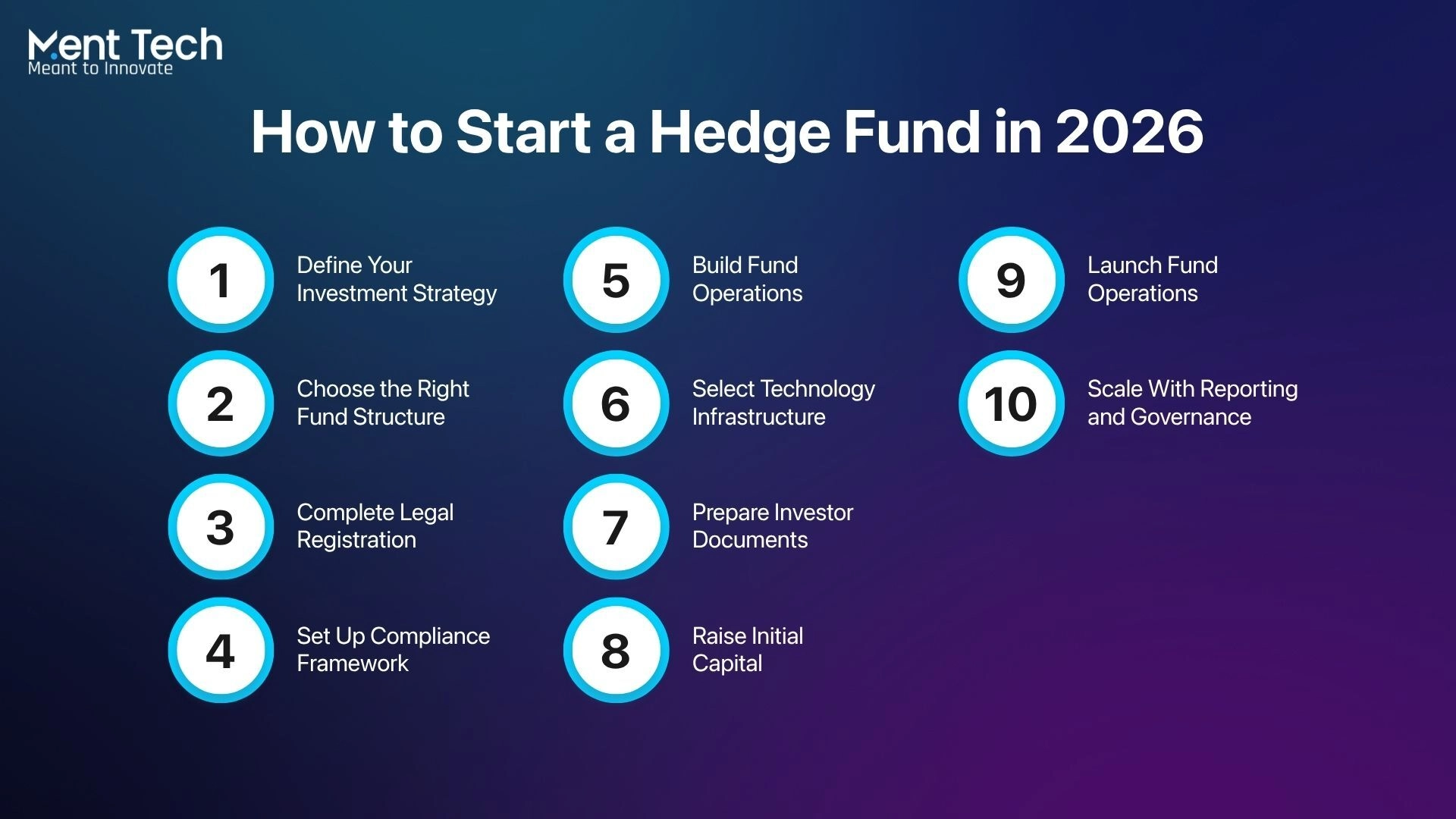
How to Start a Hedge Fund Step-by-Step
If you’re serious about how to start a hedge fund, here’s the real playbook, not the watered-down version everyone else copies.
Step 1: Define Your Investment Strategy
Before you touch paperwork or pitch a single investor, get crystal clear on what you’re actually trading. This one decision shapes your investor pool, your licensing path, and pretty much everything that comes after.
- Pick a lane: long/short, macro, quant, crypto, or event-driven.
- Back it with real data, not just gut feeling.
- Know your edge cold before you pitch anyone.
Step 2: Choose Your Fund Structure
There’s no one-size-fits-all here. The right structure depends entirely on who you’re raising from and where they’re based.
- Limited Partnership, the go-to choice for most US managers.
- LLC, a simpler option for smaller or single-strategy funds.
- Offshore structure in Cayman or BVI when courting non-US investors.
Step 3: Register the Fund
This is where a lot of first-time managers trip up, mostly because they underestimate how much paperwork and legal review it actually takes.
- Register with the SEC once you cross roughly $150M in AUM.
- File Form ADV and put compliance policies in writing.
- Loop in counsel early to review your offering documents.
Step 4: Build Your Operations
A brilliant strategy falls apart fast if your back office can’t keep up. This is the unglamorous part that investors quietly judge you on.
- Bring on a fund administrator for NAV and investor statements.
- Set up custody and a banking relationship built for fund-level activity.
- Work with a software developer hedge fund teams trust for custom reporting tools.
Step 5: Raise Capital
Raising money is as much about trust as it is about returns. People need to believe you can actually run this thing.
- Start with accredited investors before chasing institutions.
- Family offices often move faster than pension funds or endowments.
- Build a pitch deck that proves operational credibility, not just performance.
Step 6: Launch Operations
Going live is the real test. Everything you’ve built so far either holds up here or falls apart.
- Lock in reporting cadences before day one.
- Keep compliance monitoring running quietly in the background.
- Stress-test your tech stack for portfolio tracking and investor updates.
How Much Does It Cost to Start a Hedge Fund?
So how much does it cost to start a hedge fund, really? Honestly, nobody can give you one clean number. It depends on your structure, your strategy, and honestly how scrappy you’re willing to be in year one. But if you’re trying to figure out how much to start a hedge fund actually takes in real dollars, here’s a range most emerging managers end up somewhere in.
| Expense | Estimated Cost |
| Legal formation | $50,000 - $150,000 |
| Compliance | $20,000 - $75,000 |
| Fund administration | $30,000 - $80,000 (annual) |
| Technology | $15,000 - $60,000, more if you’re building out asset tokenization platform development early on |
| Operations | $25,000 - $60,000 |
| Marketing | $10,000 - $40,000 |
| Insurance | $10,000 - $25,000 |
| Total estimated launch budget | $160,000 - $490,000 |
If you’re betting on blockchain infrastructure from the get-go, don’t be surprised if your tech line runs higher than everyone else’s spreadsheet. It’s usually worth it though, since it tends to save you from admin headaches later and makes onboarding investors a lot smoother.

Technology Every Modern Hedge Fund Needs
Running a fund on spreadsheets and email chains doesn’t cut it anymore, whether you’re managing a single strategy or a whole fund of hedge structures. Here’s what actually matters on the tech side.
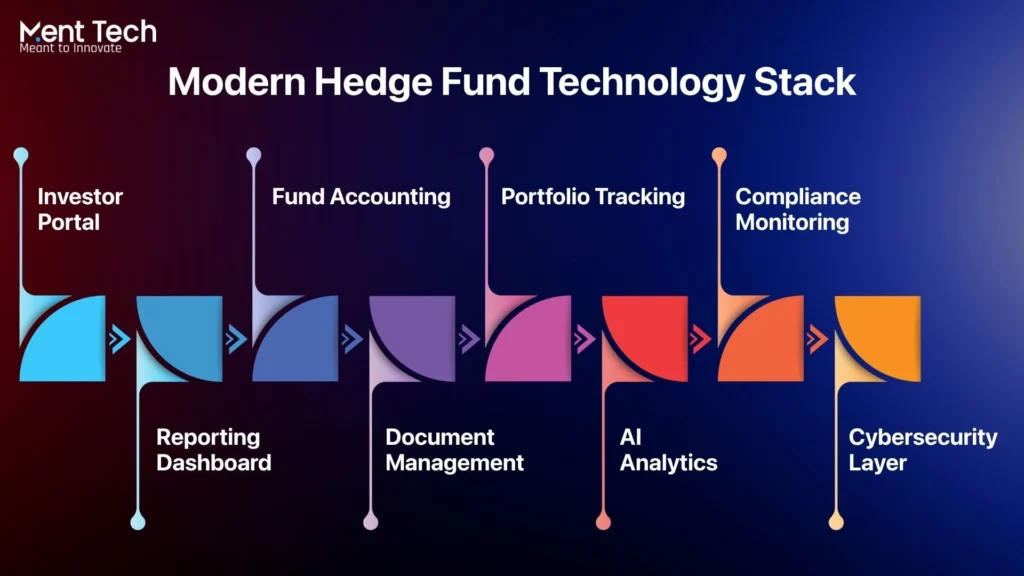
- Investor portal and CRM: Gives investors a single place to check statements and capital calls while keeping every conversation and commitment tracked so nothing slips through the cracks.
- Fund accounting and portfolio management: Handles accurate NAV calculations while letting you track positions and risk exposure in real time instead of piecing it together manually.
- Reporting dashboards and compliance monitoring: Turns raw data into clean reports investors actually want to see, while smart contract development services help automate parts of the compliance and reporting flow directly on-chain.
- Document management: Keeps contracts, subscription agreements, and compliance records organized and easy to pull up whenever you need them.
- AI-powered analytics: Helps spot risks and trends across the portfolio faster than any manual review ever could.
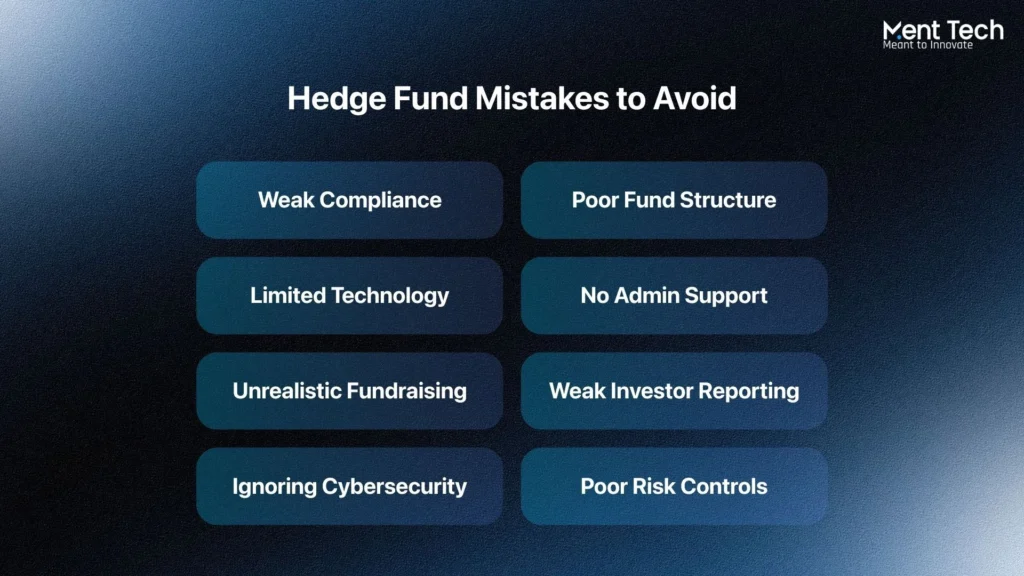
Common Mistakes When Starting a Hedge Fund
Anyone researching how to start a hedge fund eventually runs into the same warning signs. Here’s what trips up most first-time managers.
1. Weak Compliance
Treating compliance as an afterthought instead of building it in from day one, which almost always comes back to bite you during registration or audits.
2. Poor Technology
Going with cheap, patched-together tools instead of investing in a proper software developer hedge fund teams can rely on and then scrambling to rebuild everything once the fund actually scales is a recipe for disaster.
3. No Operational Partners
Trying to run administration, custody, and banking solo instead of partnering with a defi development company or traditional fund admin that’s already done this a hundred times over.
4. Unrealistic Fundraising
Assuming investors will show up just because the strategy sounds good, without accounting for how long due diligence and trust-building actually take.
5. Ignoring Cybersecurity
Underestimating how attractive a fund’s data and assets are to bad actors, especially once digital assets or asset tokenization platform development enters the picture.
Questions to Ask Before Launching a Hedge Fund
Before you go any further, sit down and actually answer these. They’ll save you months of backtracking later.
- Who are my target investors? Accredited individuals, family offices, or institutions, since this shapes almost every other decision.
- What regulations apply to me? SEC registration thresholds and state rules differ depending on your AUM and strategy.
- What technology stack do I actually need? Not every fund needs the same tools, so build around your strategy, not a template.
- How will investors subscribe and onboard? Manual paperwork or a digital, faster process affects investor experience from day one.
- Do I need tokenization? Worth considering if you want faster settlement, better liquidity, or easier ownership transfers down the line.
- How will compliance be managed day to day? In-house team, outside counsel, or a mix, someone needs clear ownership of this.
- What reporting tools do investors expect? Institutional investors especially will want dashboards and transparency, not quarterly PDFs.
Final Thoughts
So there you have it, the real picture of how to start a hedge fund in 2026. It takes more than a solid strategy. You need legal groundwork, real compliance, smooth operations, and a fundraising plan grounded in reality.
What’s changed lately is how blockchain and tokenization are reshaping fund operations. Instead of slow onboarding and paper-based ownership, funds now get faster settlement, better liquidity, and real transparency for investors.
If tokenization fits into your launch plan, that’s where Ment Tech comes in. Check out our Hedge Fund Tokenization Platform Development services to build fund infrastructure ready for where the industry is actually heading.