Right now, it feels like every business in the USA is trying to build something with AI, an agent, a chatbot, a generative AI tool, or some kind of automation that saves time. The investment is definitely there too. 84% of organizations are putting more money into AI this year. But here is the catch nobody talks about enough. Budget was never the hard part. Finding someone who can actually build the thing is difficult.
This is usually where companies trying to hire AI developers hit a wall. On paper, a candidate might tick every box: right frameworks, right buzzwords, right portfolio. Then real users show up, real data gets messy, and suddenly things break. What businesses actually need is someone who gets machine learning and LLMs, sure, but who also understands how AI is supposed to work inside a real business, not just look good in a demo.
Ment Tech helps businesses hire AI developers and dedicated AI teams who build things that are secure, scalable, and actually production-ready, not just something that works until the first real user logs in.
Why Businesses Need AI Developers in 2026
Honestly, the reasons keep piling up, but they all circle back to one thing. AI has stopped being a side experiment and started becoming part of how businesses actually run day-to-day.
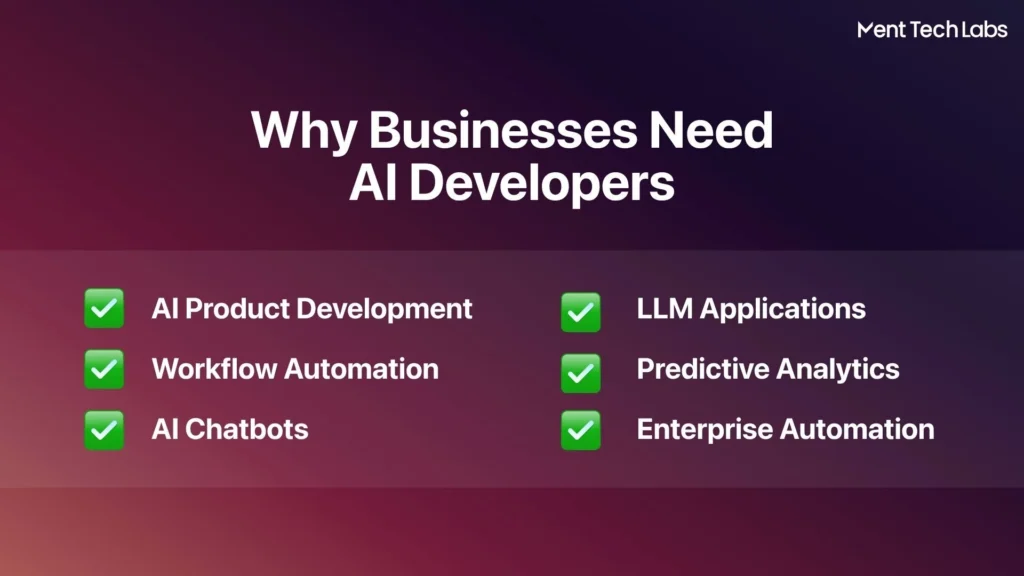
- AI Product Development
More companies are building AI-first products instead of just adding AI as an afterthought. That takes developers who get the whole picture, from messy data to the model that finally ships.
- Workflow Automation
Nobody wants to do the same repetitive task five times a day anymore. AI agents are stepping in here, and good developers make sure the automation actually helps instead of creating new headaches.
- AI Chatbots
Support bots, internal assistants, and e-commerce helpers. They are everywhere now. Making one that actually sounds human and solves the problem takes way more skill than it looks like from the outside.
- LLM Applications
Businesses keep finding new things to do with large language models, month after month. This is exactly why demand for solid AI development services keeps climbing so fast.
- Predictive Analytics
Reading documents, spotting patterns, and forecasting what happens next. These used to be a niche. Now computer vision and NLP show up in finance, healthcare, retail, and pretty much everywhere.
- Enterprise Automation
Bigger companies are not automating one task anymore; they are automating entire processes. That needs developers who think in systems, not just scripts.
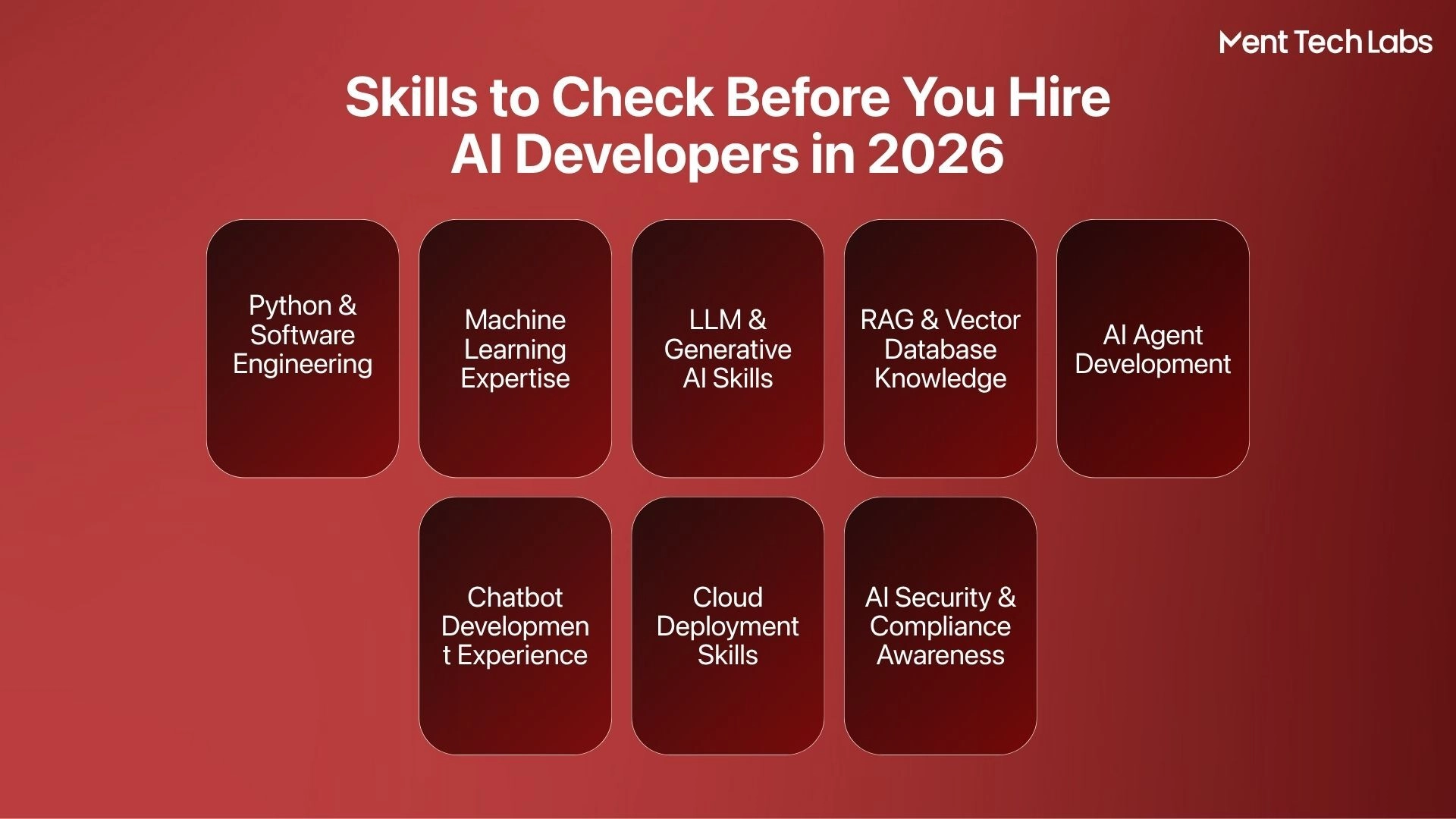
Skills to Look for When You Hire AI Developers
Let’s be real, a resume full of buzzwords does not mean much anymore. Anyone can list “LLMs” and “AI agents” on LinkedIn. What actually matters is whether this person can build something, ship it, and keep it working once real users start poking at it.
Programming and Software Engineering
Okay, this sounds boring, but it is the part that quietly makes or breaks everything else. Someone can throw around every AI buzzword in the book, but if their actual code is a mess underneath, that whole product is going to crack eventually.
- Solid Python and JavaScript, nothing flashy, just genuinely good at it.
- Knows their way around APIs without needing hand-holding.
- Write clean code and think about system design before things blow up later.
Machine Learning and Deep Learning
There’s a big difference between someone who can explain a model in an interview and someone who has actually trained one that worked. The good ones know when a model is genuinely ready, not just when it looks decent in a demo.
- Actual hands-on time with supervised and unsupervised learning.
- Comfortable in neural networks, not just familiar with the term.
- Knows how to test a model properly instead of hoping it holds up.
LLM and Generative AI Experience
This is the part of AI that changes almost monthly, so anyone relying purely on theory is going to fall behind fast. What matters is whether they’ve actually built something real with these tools.
- Real experience with OpenAI, Claude, Gemini, or Llama, not just tutorials.
- Genuinely good at prompt engineering and fine-tuning.
- Comfortable with RAG and vector databases; this alone tells you a lot about how strong their generative AI development services actually are.
AI Agent Development
Agents get thrown around like they’re just chatbots with extra steps. They are not. There is real logic that has to work underneath for any of it to hold together.
- Understands tool calling and how multi-step workflows actually run in practice.
- Gets memory and autonomous actions beyond the marketing language.
- Comfortable with MCP integrations and automation, honestly, the backbone of any decent AI agent development service.
AI Chatbot Development
Building a bot people don’t immediately want to close out of is harder than it looks. Every industry has its own annoying edge cases, and the good developers actually plan for those instead of pretending they won’t happen.
- Has built different types of support bots, internal tools, healthcare, e-commerce, the works.
- Handles messy, weird conversations without the bot falling apart.
- Knows what separates a decent AI chatbot development service from one that just feels robotic.
Cloud and Deployment Skills
A model just sitting in a Jupyter notebook helps nobody literally. Getting it live and keeping it running without constant 2 am firefighting is its own whole skill.
- Comfortable in AWS, Azure, or GCP, whatever the project needs.
- Knows Docker and Kubernetes well enough to actually scale things.
- Good habits around monitoring, because AI systems break in weird, unpredictable ways.
Data Security and Compliance Awareness
This one gets skipped way too often, and honestly, it shouldn’t be. A developer who actually cares about this will bring it up before you even ask.
- Actually understands data privacy and access control, not just checkbox compliance.
- Aware of HIPAA, SOC 2, and GDPR when the project calls for it.
- Keeps audit logs and treats responsible AI as a habit, not an afterthought.
Flexible Hiring Models to Hire AI Developers
Once businesses know what skills to look for, the next question is usually where to actually find these people. There is no single right answer here; it really depends on the project, the timeline, and how much control a business wants over the process.
Some companies want an in-house AI developer sitting in on every planning meeting. Others just need a freelancer to knock out one specific task and move on. And a lot of businesses these days are choosing to hire remote AI developers simply because the talent pool gets so much bigger once location stops being a constraint.
| Hiring Model | Best For | Pros | Limitations |
| In-House AI Developer | Long-term AI capability | Full ownership | Higher cost and slower hiring |
| Freelance AI Developer | Small, defined tasks | Flexible | Limited scalability |
| Remote AI Developer | Cost-effective technical support | Wider talent pool | Requires strong management |
| Dedicated AI Team | Ongoing AI product development | Scalable team | Needs a clear roadmap |
| AI Development Company | Production-ready AI systems | Strategy, team, and delivery in one place | Higher upfront planning |
Going in-house makes sense when AI is going to be a permanent, growing part of the business, not a one-off project, though it usually means slower hiring and a bigger price tag. Freelancers are great for smaller, well-defined tasks, but asking one person to carry an entire AI roadmap rarely works out well.
This is exactly why so many businesses exploring AI developers for hire end up leaning toward a dedicated team or a full AI development company instead. It costs more planning upfront, sure, but it also means one accountable team handling strategy, development, and delivery, instead of juggling freelancers or managing a remote hire without the right AI experience in-house.
How Much Does It Cost to Hire AI Developers in 2026?
This is usually the first question everyone asks, and fair enough. But honestly, there’s no single number that tells the whole story here. Still, let’s talk real numbers, so you have something to actually work with.
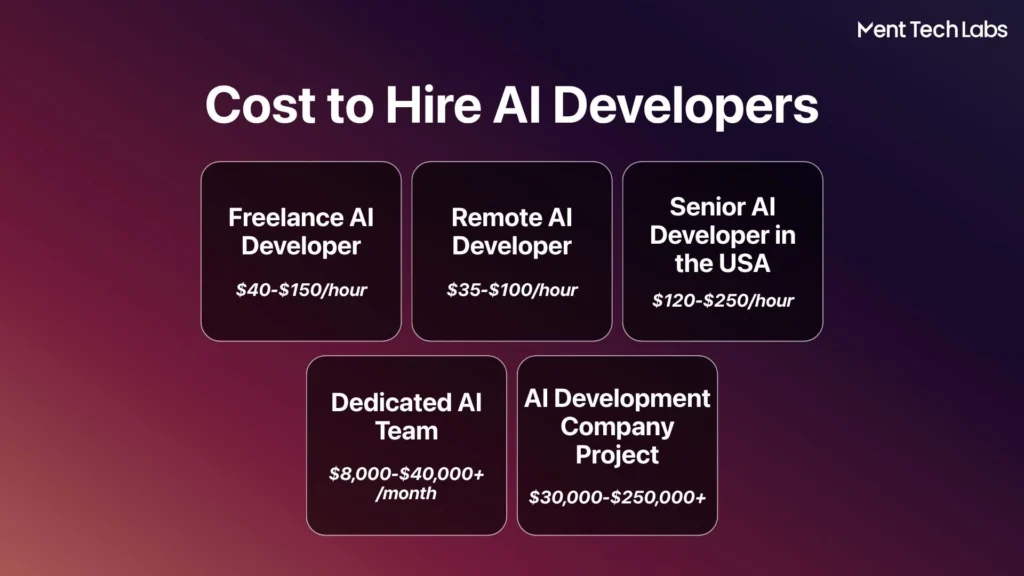
- Freelance AI developer: $40-$150/hour. Fine for smaller, well-defined tasks, though the price swings a lot depending on who you’re hiring and how tricky the work actually is.
- Remote AI developer: $35-$100/hour. A pretty solid cost-effective option, but region and experience level move this range around more than you’d think.
- Senior AI developer in the USA: $120-$250/hour. Yeah, it’s not cheap, but that kind of experience usually pays for itself on anything high-stakes.
- Dedicated AI team: $8,000-$40,000+/month. Makes sense once you need consistent, ongoing work instead of a one-off project.
- AI development company project: $30,000-$250,000+. Covers the whole ride, strategy, building, deployment, all of it, and scope is really what drives the final number.
These ranges are this wide because so much gets stacked on top of each other: experience level, how complex the project gets, which AI model is being used, how messy or clean your data is, what needs integrating, and what deployment actually looks like. So when you’re trying to hire AI developers, it really helps to think about the whole journey, not just whatever number shows up on the first quote.
Questions to Ask Before You Hire AI Developers
Interviews can get surface-level fast if you let them. Almost anyone can say “yes, I know AI” and sound convincing for ten minutes. The real signal comes from how someone answers these questions, not just whether they can answer them at all.
1. “Have you built production AI systems before?”
There’s a big gap between shipping something real and only experimenting in a notebook. Ask for specifics, not a general yes.
2. “What AI frameworks and models have you used?”
Their answer should sound like real experience, not a list of trendy names pulled off a job posting.
3. “How do you handle data quality?”
No real process here is a warning sign. Messy data quietly breaks everything downstream.
4. “Have you worked with LLMs, RAG, or AI agents?”
This tells you if they can build what most businesses actually need right now.
5. “How do you test model performance?”
Look for real metrics and methods, not just “it seemed to work fine.”
6. “How do you manage hallucinations?”
Anyone serious about LLMs should have a clear, specific answer, not a shrug.
7. “How do you handle AI security?”
Data privacy and access control should come up naturally, especially for sensitive user data.
8. “Can you integrate AI with existing systems?”
Most projects aren’t standalone, so this matters more than people expect.
9. “What post-launch support do you provide?”
AI systems need tuning after launch. This weeds out anyone who disappears once the build is done.
10. “How do you approach cost estimation for an AI project?”
A vague number without reasoning is a red flag. Good developers break down scope, model choice, and infrastructure costs clearly.
11. “What’s your process for choosing between building custom models and using existing APIs?”
This shows whether they think practically; not everything needs a custom model built from scratch.
12. “How do you handle version control and model updates over time?”
AI models change fast. Someone with a real process here will mention retraining, monitoring, and rollback plans.
13. “Can you share an example of a project that didn’t go as planned?”
Honest answers here reveal a lot more than polished success stories ever do.
Asking these upfront saves a lot of pain later. Businesses that vet properly before they hire AI developers usually end up with far fewer surprises once the project actually goes live.
Final Thoughts
By the end of the day, it’s not actually about hiring an AI developer who has superficial knowledge of machine learning. It seems simple enough, but it is rarely the case. The developers who make a difference know data, understand AI models, think about software architecture in the right manner, and don’t ignore security & integrations.
That’s really the whole point of custom AI development: building something that fits how your business actually works, not just a generic AI feature bolted onto existing software. It takes someone who gets both the technical side and the real business workflow sitting underneath it, and honestly, that combination is harder to find than most people expect going in.
Partner with Ment Tech to hire AI developers who can turn your AI idea into a secure, scalable, and production-ready solution, one that actually works long after launch day, not just in the demo.