Businesses across the US are moving fast on AI chatbots, copilots, knowledge assistants, and document automation. Customer support teams want faster resolutions, product teams want copilots that actually understand internal data, and operations teams want workflows that run without constant human input. Large language models sit behind almost all of it.
But the real question companies face in 2026 isn’t just “how much does this cost.” It’s “what type of LLM solution does the business actually need.” A basic MVP looks nothing like an enterprise platform built for multiple teams and daily high-volume usage. Cost follows scope, which is why working with the right LLM development company makes a real difference here.
Ment Tech helps businesses plan, build, integrate, and optimize custom LLM applications with secure architecture, RAG, AI chatbot development, and enterprise-ready deployment. The goal is to match the right architecture to the right business need, so companies invest in what actually moves the needle instead of overbuilding or underplanning.
What Is the Average Custom LLM Development Cost in 2026?
There’s no single number that fits every business here, but based on what companies are actually spending this year, here’s a realistic range to work with.
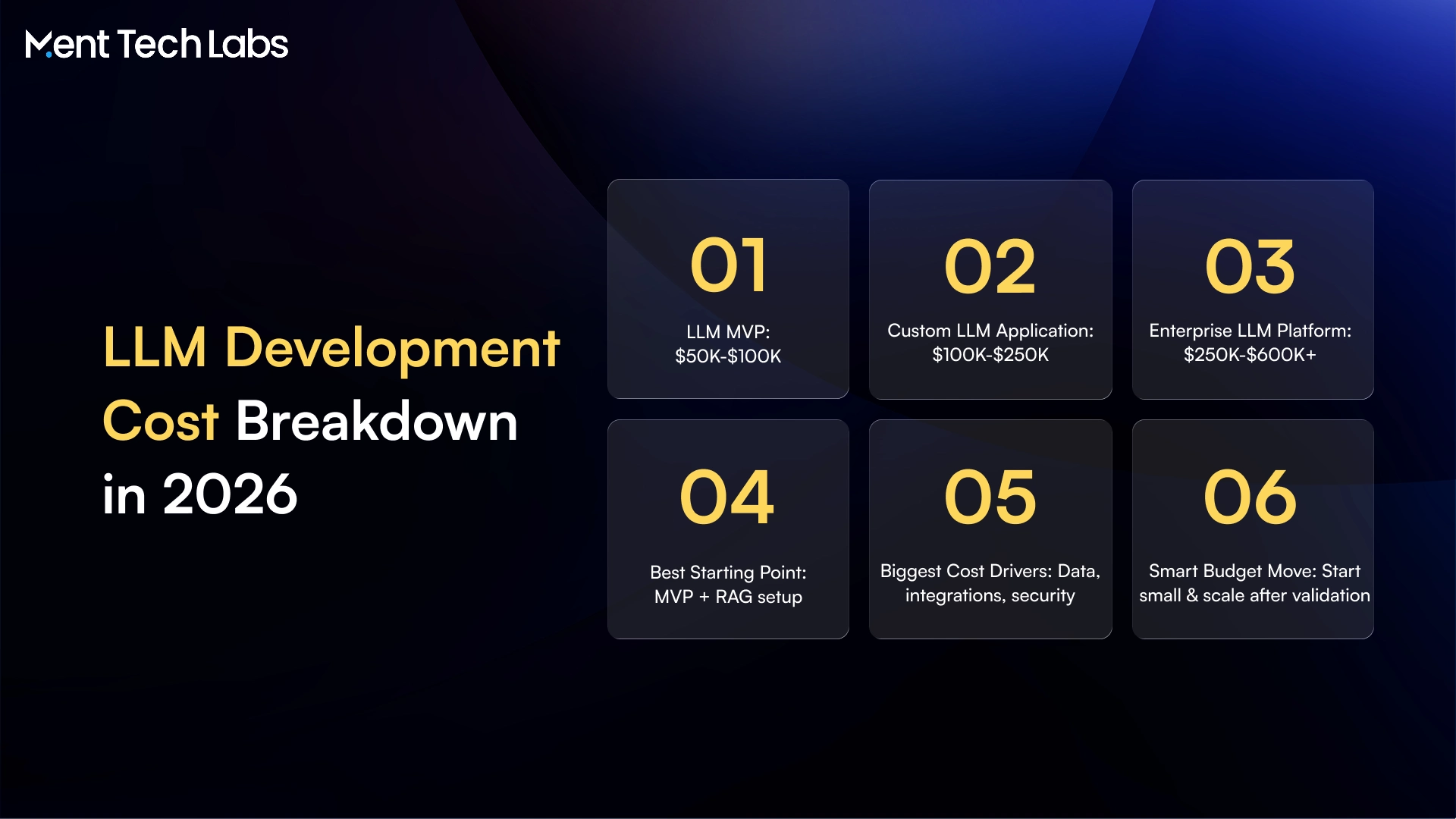
- Basic LLM MVP: $50,000-$100,000. This is for one clear use case: think of a support bot or an internal knowledge assistant built on top of an existing model with a fairly simple RAG setup.
- Mid-level LLM application: $100,000-$250,000. Once you start adding more features, tighter integrations, and a smoother user experience, the cost naturally moves into this range.
- Enterprise LLM platform: $250,000-$600,000+. This is what it takes to support multiple teams at once, handle heavy daily usage, and meet stricter security and compliance needs.
- Foundation model training from scratch: $1M+, often a lot more. You’re looking at massive proprietary datasets, dedicated AI infrastructure, and a specialist team just to train and keep the model running.
Here’s the thing, though: most businesses don’t actually need to go down that last road. Training a foundation model from scratch only makes sense if a company already has the data, the infrastructure, and the budget to match. For everyone else, teaming up with an experienced LLM development company to adapt models like GPT, Claude, or Llama gets you to a working product much faster, costs a fraction as much, and skips the headache of maintaining a model from the ground up.
Why does LLM development cost vary so much?
Ask five businesses what their LLM project cost is, and you’ll probably get five different numbers. That’s because the real cost isn’t about the model itself. It’s about everything built around it. Here’s what actually moves the needle.
Use case complexity: A simple FAQ chatbot and a copilot that pulls live data and triggers actions in other systems are two totally different builds. The more it’s expected to think and do, the longer it takes to get right.
Model choice: Go with GPT, Claude, Gemini, or an open-source option like Llama or Mistral, and your upfront cost and monthly running cost will look different each time. Some models are cheap to scale but need extra fine-tuning work; others cost more per token but ask for less customization.
Data readiness: This one tends to catch businesses off guard. If your data’s messy or scattered across a dozen tools, a good chunk of the budget just goes into cleaning it up before the LLM can even make sense of it.
RAG vs. fine-tuning: Whether you lean on RAG, fine-tuning, or a bit of both changes your cost quite a bit. RAG development services usually cost less since they connect the model to your data rather than retraining it from scratch, whereas fine-tuning takes more time and compute.
Enterprise integrations. Getting an LLM to actually talk to your CRM, ERP, or internal databases isn’t plug-and-play. It’s real engineering work. The more systems it touches, the more custom development goes into it.
Security and compliance. If you’re in healthcare, finance, or legal, you’ll need encryption, access controls, and compliance checks like HIPAA or SOC 2 sorted from day one, and naturally, that costs more than a basic bot would.
LLM Development Cost Breakdown by Project Type
Once you know the rough ranges, it helps to see them laid out against what you’re actually trying to achieve. Here’s how the numbers typically break down by project type.
| Project Type | Estimated Cost | Best For |
| LLM MVP | $50K-$100K | Testing one use case |
| Custom LLM Application | $100K-$250K | Business workflow automation |
| Enterprise LLM Platform | $250K-$600K+ | Secure multi-team deployment |
| Claude-like Foundation Model | $1M+ | Large enterprises with AI infrastructure |
Most businesses find their fit somewhere in the first three rows. An LLM MVP is a smart starting point if you’re testing a single workflow, while a custom LLM application makes sense once that MVP proves its value and needs more integrations and features. An enterprise LLM platform comes into play when multiple teams depend on it daily, and security becomes non-negotiable.
The Claude-like foundation model tier is really only for large enterprises with the data, infrastructure, and long-term strategy to justify owning the model itself, which is why working with an experienced LLM development company to figure out where you actually land matters more than chasing the biggest build.
Major Factors That Affect LLM Development Cost
Once you know your project type, here’s what actually drives the number inside that range.
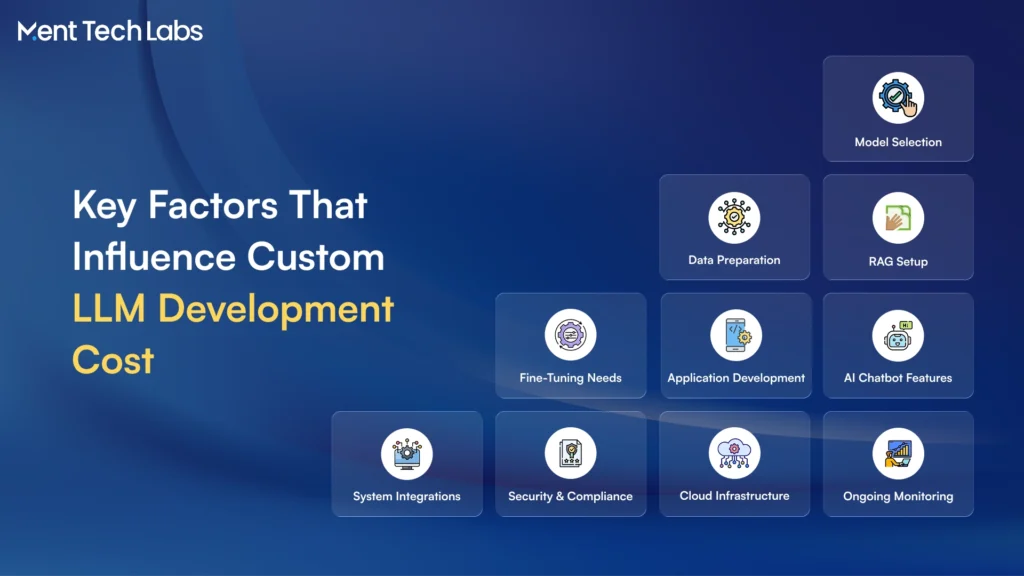
- Model Selection
This one’s part technical, part budget call. OpenAI is a solid all-rounder; Claude handles longer context and trickier reasoning well; Gemini fits naturally in the Google ecosystem; and open-source picks like Llama or Mistral give more control at scale but need more setup work. No single “best” here, just what fits your use case.
- Data Preparation
This is the part most businesses don’t see coming. Your data needs cleaning, chunking, tagging, and proper indexing before an LLM can actually use it well. Add privacy checks on top, especially with customer data, and this step often costs more than expected.
- RAG Setup
RAG development services have become the default way to connect an LLM to your business knowledge without retraining it. It means setting up a vector database, a retrieval pipeline, embeddings, and ranking, so the model pulls the right info at the right time.
- Fine-Tuning
Fine-tuning’s worth it when you need the model to consistently behave a certain way, like a specific tone or industry language. For most businesses, though, RAG alone does the job. Try RAG first; fine-tune only if it genuinely falls short.
- Application Development
The model’s only half the story. An LLM application development company also builds what people actually use: a chat window, a copilot, a dashboard, maybe reporting. This is where workflows and permissions get sorted, and often where a lot of the timeline goes.
- AI Chatbot Development
Not every chatbot’s built the same. AI chatbot development services can mean a support bot, a helpdesk assistant, a sales assistant, or a knowledge assistant for your own team, each with different accuracy needs that shift the cost.
- System Integrations
An LLM rarely works alone. It usually needs to talk to your CRM, ERP, or internal database. This is where artificial intelligence integration services come in, since connecting AI to your existing tools through APIs takes real work, and more systems mean more testing.
- Security and Compliance
If you’re handling sensitive data, security isn’t optional. Access controls, encryption, audit logs, and human review need to be baked in. Businesses under HIPAA, SOC 2, or GDPR need this from day one, since bolting it on later almost always costs more.
- Cloud and Infrastructure
The last piece is where the LLM actually runs. API-based deployment gets you live faster; self-hosted gives more control but adds GPU costs and overhead. Either way, budget for vector databases and monitoring, since infrastructure costs rarely stay flat once real users show up.
Hidden Costs of Custom LLM Development
The development quote is rarely the full picture. Once the product is live, a handful of ongoing costs start adding up, and most businesses don’t factor these in until the first invoice shows up.
1. API and inference costs
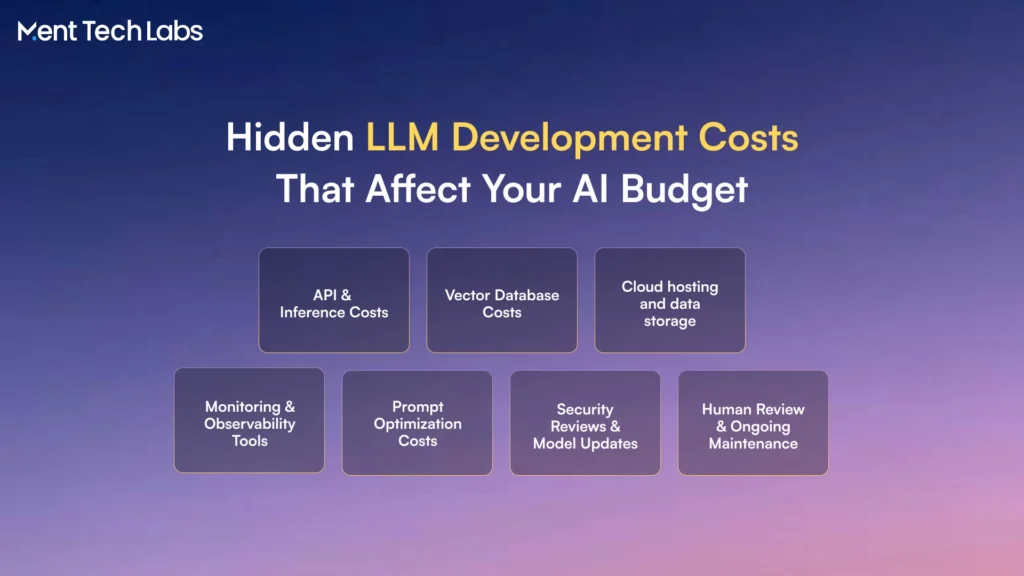
Every time your app calls the model, you’re paying for it, and token usage adds up fast once real users start relying on it daily. This cost scales directly with how much your product gets used, which is easy to underestimate during the planning stage.
2. Vector database costs
If you’re running RAG development services, your knowledge base needs to live somewhere searchable. Vector databases come with their own hosting and scaling costs that grow as your document library grows.
3. Cloud hosting and data storage
Whether you’re using a self-hosted model or an API-based one, you’re still paying for compute, storage, and bandwidth behind the scenes. This bill tends to creep up quietly as usage increases.
4. Monitoring tools
You need visibility into how the model is actually performing in production, catching errors, tracking response quality, and flagging when something’s off. Skipping this early usually means bigger problems later.
5. Prompt optimization
Getting prompts right isn’t a one-time task. As usage patterns shift, prompts often need tweaking to keep responses accurate and cost-efficient, and that ongoing refinement takes real time.
6. Security reviews and model updates
Businesses working with an LLM development company need periodic security checks and updates as new model versions roll out. Staying current isn’t optional if you care about performance and safety long-term.
7. Human review and maintenance
Especially in regulated industries, someone needs to periodically check the model’s outputs. Add in general maintenance, bug fixes, and small enhancements, and this becomes a steady, ongoing cost rather than a one-time expense.
LLM Development Cost by Industry
Cost also shifts depending on the industry, since each comes with its own use cases and compliance load.
Healthcare: Patient support, clinical documentation, and knowledge assistants are common here, but HIPAA compliance pushes costs higher than average, often requiring the best LLM development company with healthcare experience on board.
Finance: Risk summaries, customer support, and document processing dominate, with secure workflows as a must. Fintechs often lean on RAG development services to keep responses grounded in verified data.
Legal: Contract review, policy search, and compliance assistants top the list here. Accuracy matters more than usual, since small errors carry real consequences and add extra review time.
Ecommerce: Product recommendations, shopping assistants, and support bots are the norm. AI chatbot development services play a big role, since the bot often handles everything from product questions to order tracking.
SaaS: In-app copilots, onboarding assistants, and knowledge search are becoming standard, and this is exactly where a large language model development company adds value. Businesses here rely on large language model development services to build features that feel native to the product instead of bolted on.
How to Reduce LLM Development Cost Without Losing Quality
You don’t need the biggest budget to build something that works well; you just need the right sequence. Here’s how businesses actually keep costs in check without cutting corners.
1. Start with an MVP
Test one use case before you commit to a full build. It’s the fastest way to find out what really works before you’re spending on features nobody ends up touching.
2. Use existing models
Most businesses genuinely don’t need custom training. If you’re trying to figure out how to build LLM-powered products without burning through your budget, starting with GPT, Claude, or Gemini through API access gets you there live faster and a lot cheaper than building anything from the ground up.
3. Choose RAG before fine-tuning
RAG connects the model to your data without retraining it, so it usually costs less and gets you accurate answers sooner. Save fine-tuning for when RAG genuinely isn’t cutting it.
4. Clean your data early
Messy data has a way of slowing everything down later. Sort it out at the start, and it saves you both time and money down the road.
5. Limit scope in phase one
Trying to build everything at once is basically how budgets balloon. Pick the core workflow, ship it, then build out from there once you know it works.
6. Optimize prompts and token usage
Well-structured prompts cut down on wasted token spend, and that adds up more than people expect once real usage kicks in.
7. Use API-based deployment
It gets you live quicker and skips the infrastructure headache of self-hosting until you actually need that level of control.
8. Work with experienced LLM developers
This is really where large language model consulting pays off. Good LLM developers help you dodge costly rework, get the architecture right from the start, and add advanced automation only when you actually need it, not before.
Final Thoughts
At the end of the day, custom LLM development cost really just comes down to a handful of things: the scope you pick, the architecture behind it, how clean your data actually is, how many systems it needs to talk to, the security it demands, and how much it ends up getting used once it’s live. Change any one of these, and the number shifts right along with it.
No fixed price tag fits every business, and honestly, that’s kind of the point. You don’t have to go all in on some massive build right from day one. Start small with an MVP, see how people actually respond to it, and then grow from there with RAG, fine-tuning, or deeper integrations once you’ve figured out what’s genuinely worth putting money into.
Whether you’re looking at something as simple as an LLM MVP or planning a full enterprise platform, working with the right LLM development company is what keeps things on budget and on track. So if you’re ready to put an actual number on this, partner with Ment Tech to estimate your LLM development cost and build a secure, scalable AI solution for your business.