Insurance questions tend to be the worst timing while you’re filing a claim, renewing a policy, or trying to figure out what’s covered. An AI chatbot for insurance can simplify those frustrating moments with instant, accurate responses that reduce customer frustrations.
The market is already heading on that path. According to a Dimension Market Research estimate published by GlobeNewswire, the insurance chatbot market is expected to grow from USD 736.8 million in 2024 to USD 5.24 billion by 2033, reflecting a forecasted CAGR of 24.4%.
A helpful chatbot is more than scripted responses. We want it to read policy documents, integrate with insurance databases, safeguard customer information, and transfer complicated matters to an actual agent. This is how we transform mere automation into functional AI insurance solutions.
What Is an AI Chatbot for Insurance?
An insurance chatbot is a digital agent that can answer customer questions and provide support with routine actions such as viewing a policy, submitting or tracking a claim, or updating your address. It is not merely an FAQ bot that can respond to simple questions but a chatbot that can identify the intent of the customer, gather needed information from authorized insurance applications, and escalate to a live agent as needed.
Good insurance chatbot development is not about letting AI answer everything. The chatbot must use verified policy information, respect customer permissions, and avoid guessing about coverage or claim decisions. It should make routine support easier while leaving sensitive advice and final decisions to qualified insurance teams.
Types of AI Chatbots Used in Insurance
However, insurance chatbots vary. Some are only able to respond to basic questions, while others are able to handle more complex queries, search policy documents and help customers make straightforward requests.
1. Rule-Based Chatbots
These are programmed with fixed questions and multiple-choice options. They work well for renewal dates, document needs, policy links, or claim forms.
2. Conversational AI Chatbots
A conversational AI chatbot for insurance understands the way people normally ask questions. Customers can simply explain what they need instead of clicking through a long list of menu options.
3. Generative AI and RAG Chatbots
These insurance AI chatbots can use approved policy documents and internal information to answer more detailed questions about coverage, exclusions, and claims.
4. Task-Based Insurance Assistants
They are also capable of taking simple actions. For example, identifying a claim status, gathering documents, updating customer information, and forwarding the request to the appropriate support team.
Top Benefits of AI Chatbots for Insurance Companies
An insurance AI chatbot can speed up support for customers and help reduce repetitive workload for internal teams. The true value is providing an improved day-to-day service without removing human support from more significant cases.
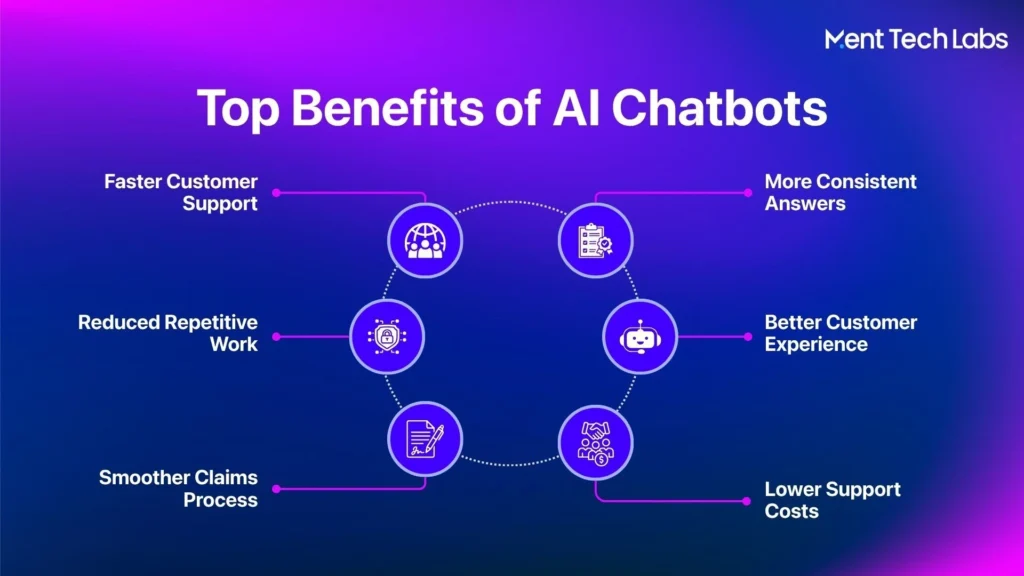
1. Faster Customer Support
Customers get assistance in viewing policy information, pre-approving a payment, or checking on the status of a claim, all without waiting on hold. Plus, the chatbot can transfer more advanced requests to the appropriate individual.
2. Less Repetitive Work
Support teams get asked the same questions, day after day. The chatbot takes care of these routine requests so your staff can focus on the cases that require genuine attention.
3. A Smoother Claims Process
The chatbot gathers early claim information, asks for documents, and provides updates on progress. This helps keep the customer engaged and reduces redundant interaction.
4. More Consistent Answers
When connected to approved policy information, the chatbot gives customers clearer and more reliable responses. This reduces confusion across different support channels.
5. More Relevant Conversations
The chatbot can use policy or claim details to suggest the next useful step. Customers receive guidance that feels more connected to their actual situation.
6. Better Control Over Support Costs
Well-planned AI insurance solutions can manage a high volume of routine queries without constantly expanding the support team. This can improve the ROI of chatbots in insurance customer service.
High-Impact Use Cases for Insurance AI Chatbots
The best insurance chatbot use cases address daily challenges in sales, policy servicing, and claims. A quality AI chatbot for insurance enables consumers to take action without requiring everything to be a support ticket.
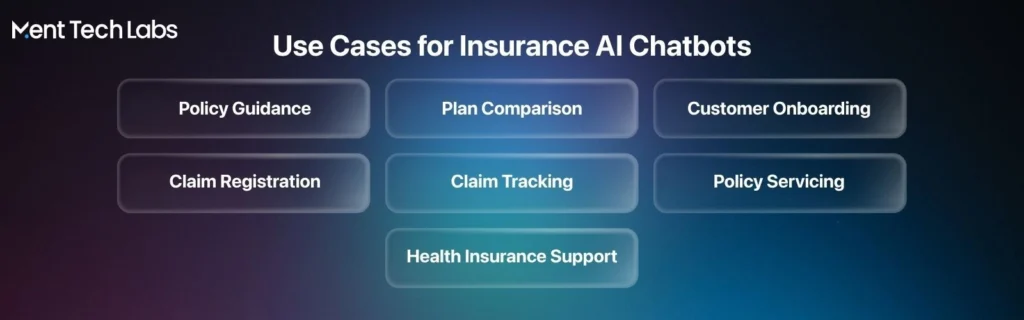
- Policy Guidance
The chatbot can explain coverage, exclusions, deductibles, and claim rules in simple language. With RAG development services, answers can come directly from approved policy documents.
- Plan Selection
Should be able to ask a few simple questions and guide the customer through selecting appropriate policies. More complex cases should then be elevated to an insurance advisor.
- Customer Onboarding
The chatbot can collect basic details, share document requirements, and guide customers through the application process step by step.
- Claim Registration
Customers can report an incident, upload documents, and receive a claim reference number without waiting for a support agent.
- Claim Tracking
Through API development services, the chatbot can pull live claim updates and explain what is still pending.
- Policy Servicing
Insurance AI chatbots can assist with renewal, reminders for renewal payment, address change, nominee change, and requests for policy documents.
- Health Support
A chatbot for health insurance can explain benefits, help find in-network providers, and guide members through claim or reimbursement steps.
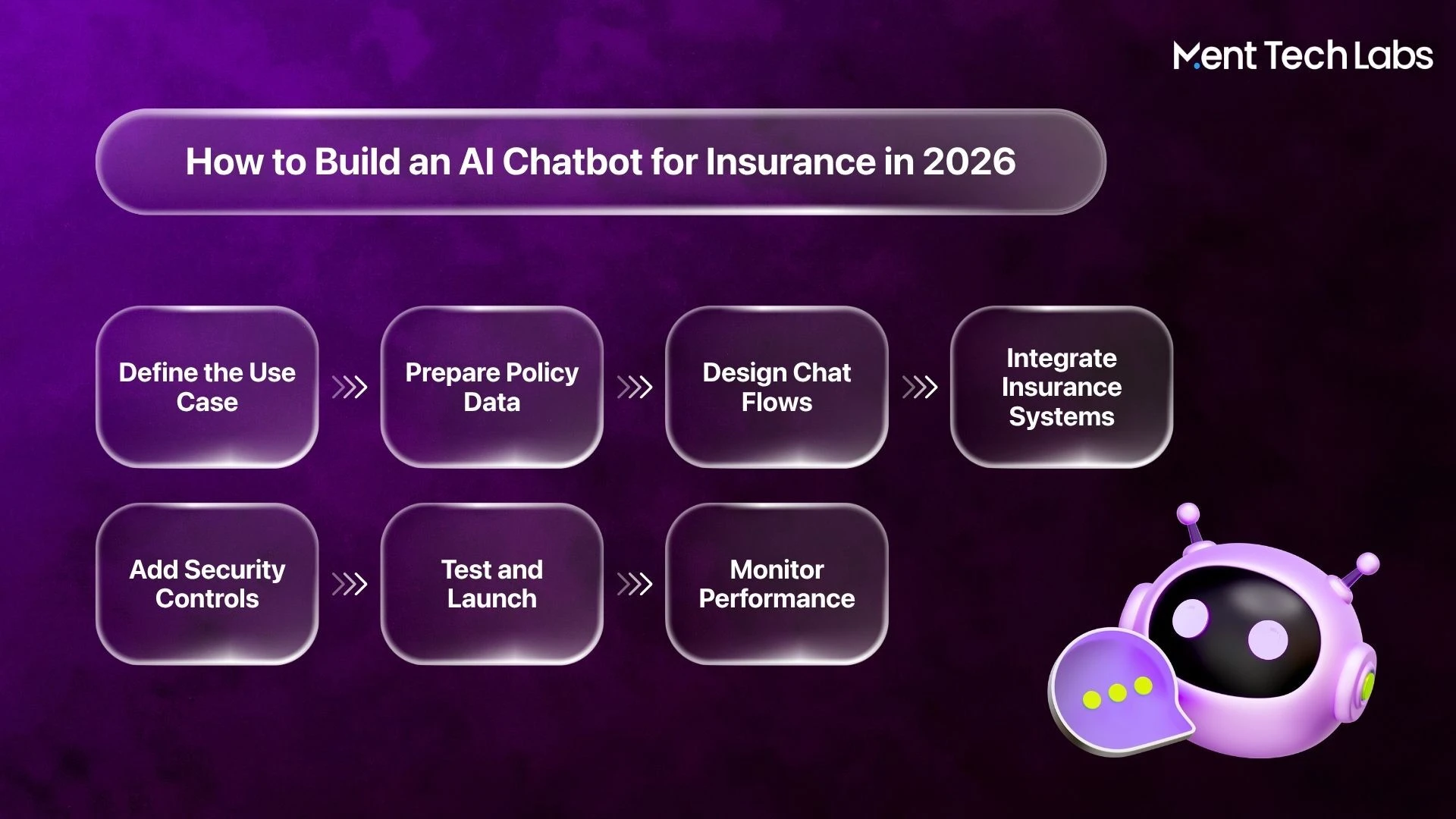
How to Build an Insurance Chatbot in 5 Steps
Successful insurance chatbot development starts with a clear customer problem, not the AI model. With the right Generative AI development services, insurers can build a chatbot that is useful, secure, and ready for real customer conversations.
1. Choose the Use Case
Start with one problem customers face regularly, such as policy questions or claim updates. Trying to automate everything at once usually makes the first version harder to manage.
- Review common support requests
- Choose one high-volume workflow
- Set a clear success target
2. Prepare the Knowledge
Bring together approved policies, FAQs, claim guides, and service documents. Remove outdated or duplicate content so the chatbot does not pull conflicting information.
- Organize content by policy type
- Add versions and effective dates
- Restrict access to sensitive data
3. Design the Conversation
Map how a real customer would explain their problem. Your AI chatbot for insurance should ask only necessary questions and make the next step easy to understand.
- Write clear and natural replies
- Plan fallback responses
- Add human handoff points
4. Connect Insurance Systems
Link the chatbot with policy, billing, CRM, and claims systems through secure APIs. A trusted chatbot development company can help build these connections without disrupting current workflows.
- Use secure API connections
- Apply role-based permissions
- Record actions in audit logs
5. Test Before Launch
Test the chatbot with real policy questions, incomplete requests, and unusual customer language. Insurance AI chatbots should never guess when the available information is unclear.
- Check answer accuracy
- Test privacy and security controls
- Monitor and improve after launch
Common Challenges in Insurance Chatbot Development
Insurance conversations are about a lot more than simple information exchange: they contain personal data, granular policy language, and decisions that have a real financial impact on people’s lives. Which is why insurance chatbot development is more complicated than general customer service chatbot development.
- Policy Accuracy
A chatbot can feign confidence even when giving a partial or wrong answer. In the insurance industry, one false explanation of coverage or exclusions can erode customer trust in an instant.
What helps: Ground answers in approved documents, show the source used, and block the chatbot from guessing when information is missing.
- Legacy Connections
Many insurers have legacy policy, billing, CRM, and claims systems. Integrating a chatbot with these systems can be more complicated than creating the actual conversation.
What helps: Use secure APIs and phased enterprise AI integration services instead of trying to replace every system at once.
- Customer Privacy
Insurance AI chatbots may handle identity details, payment information, medical records, or claim documents. Poor access controls can expose information to the wrong user or even include it in an AI response.
What helps: Apply strict permissions, encrypt sensitive data, limit what the model can access, and keep complete audit logs.
- Human Handoffs
Not every conversation should stay with the chatbot. Disputed claims, distressed customers, unclear coverage, and complaints often need a trained person who can understand the full situation.
What helps: Set clear escalation rules and pass the conversation history to the agent so customers do not have to explain everything again.
- Security Threats
Users may intentionally or accidentally enter instructions that push the chatbot outside its approved role. Prompt injection and unsafe outputs become more serious when the bot can access internal systems.
What helps: Validate inputs, restrict system actions, test attack scenarios, and add safeguards around both user messages and AI responses.
- Ongoing Maintenance
Policies, prices, regulations, and internal processes keep changing. A chatbot that worked well at launch can slowly become unreliable if its content and performance are not reviewed.
What helps: Assign content owners, track failed conversations, retest important workflows, and update the knowledge base whenever policies change.
Key Metrics to Measure Insurance Chatbot Performance
A high-volume chatbot isn’t necessarily a good one. Insurers have to evaluate if their insurance AI chatbot is helping customers and providing the right answer while saving support costs.
| Metric | What It Measures | Why It Matters |
| Resolution Rate | How many conversations are completed without human support? | Shows whether the chatbot is actually solving customer requests. |
| Escalation Rate | How often conversations are passed to an agent. | Helps identify missing information, weak flows, or complex cases. |
| Answer Accuracy | How often responses match approved policy information. | Prevents incorrect answers about coverage, claims, or exclusions. |
| Task Completion Rate | How many users finish actions such as filing a claim or uploading documents? | Shows whether the chatbot helps customers move forward. |
| Customer Satisfaction | How customers rate the chatbot experience. | Reveals whether the support feels clear, useful, and easy. |
| Response Time | How quickly the chatbot replies and completes a request. | Faster responses reduce frustration and improve the overall experience. |
| Cost per Resolution | The cost of each request successfully handled by the chatbot. | Helps measure the ROI of chatbots in insurance customer service. |
Final Thoughts
An insurance chatbot powered by AI can bring a quicker, simpler, and less frustrating experience to customer support. The real value is in delivering accurate answers, integrating with policies and claims systems, and enabling customers to find a way forward without delay.
Automating every conversation is not the goal. A decent chatbot easily manages to deal with common requests and is able to understand when a customer requires empathy, judgment, and support from a human being.
Partnering with an AI chatbot developer can enable insurers to design a robust and safe product that integrates seamlessly with other systems. Proper guidance and continuous enhancements can maintain the human element as the tool meets customers and employees. Contact us now to discuss your insurance chatbot requirements.