The greatest obstacle that accounting teams face isn’t actually the complexity of the work. It is the amount of time spent doing repetitive tasks such as entering invoices, matching transactions, reconciling records, and generating reports. This is where AI accounting software can make a difference by automating such processes and providing teams with quicker access to relevant financial data.
We can already see the trend. In Intuit’s 2025 survey of 700 accounting professionals, 46% reported using AI daily. This indicates that AI has moved beyond a test phase for many accounting teams and is beginning to be integrated into their daily tasks.
Not all platforms are equal, though. Some provide simple automation, and some, including the best AI accounting software in 2026, enable forecasting, reporting, compliance, and in-depth financial analysis. Here’s a breakdown of what companies need to know:
What Is AI Accounting Software?
AI accounting software allows companies to automate the common day-to-day tasks associated with accounting, removing the need for manual entry for each task. This can include categorizing expenses, processing invoices, reconciling bank transactions, generating reports, and identifying anomalies.
Instead of replacing accountants, it takes repetitive work off their plate. A good AI accounting platform gives finance teams more time to check the numbers, resolve exceptions, and focus on decisions that truly require human judgement.
How Does AI Accounting Software Work?
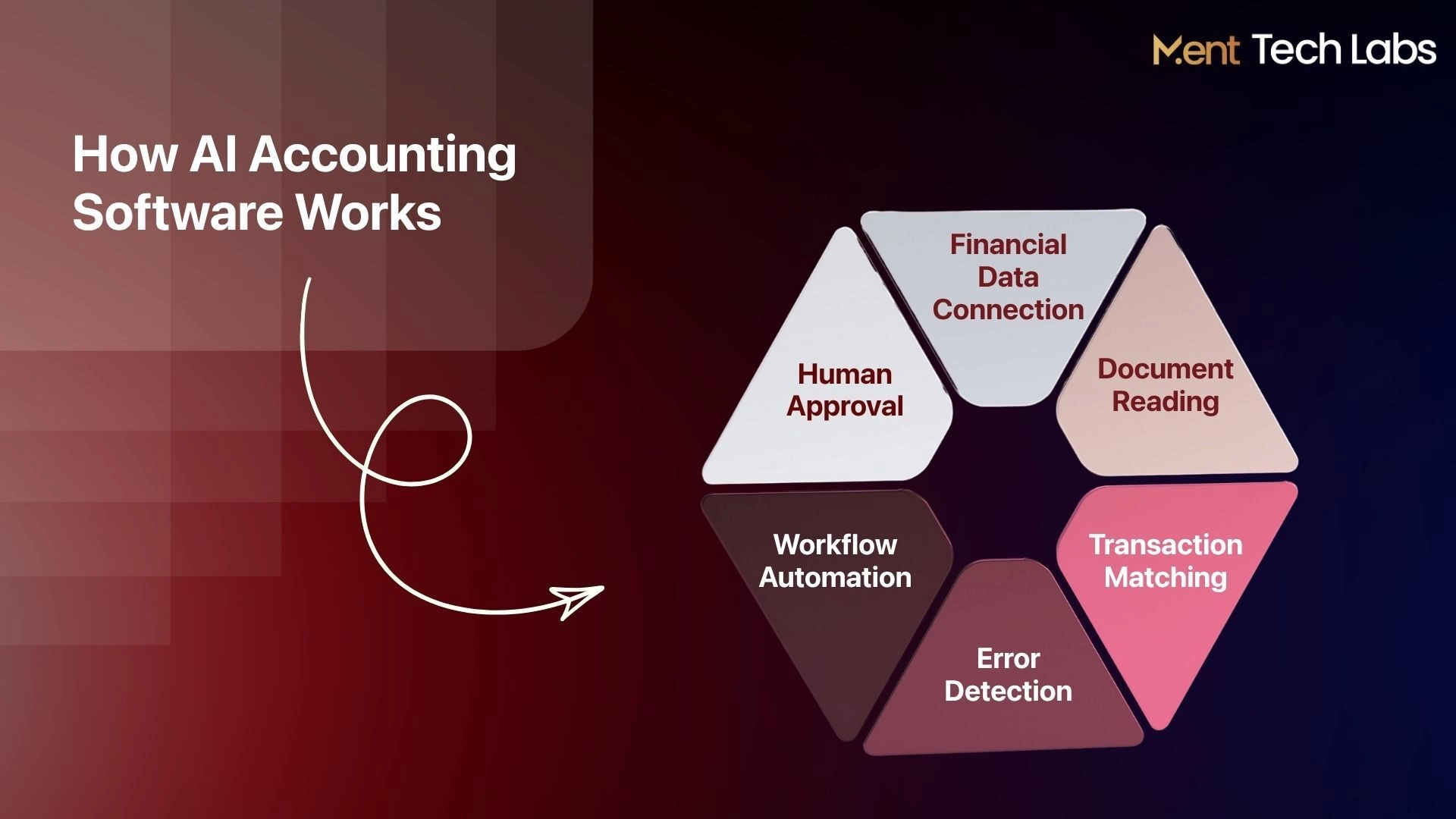
AI accounting software links up financial data, helping automate simple, repetitive processes and alerting users to anything requiring a person’s input. The process is as follows.
Step 1: Data Collection
The software pulls financial data from bank accounts, invoices, payroll tools, and other business systems. Some companies also use API development services to connect everything properly.
Step 2: Document Reading
Reads invoices, receipts, and statements using OCR and AI, then pulls out the key info automatically.
Step 3: Transaction Matching
The system categorizes the expenses, reconciles the payments, and identifies discrepancies with the bank.
Step 4: Pattern Detection
An AI accounting platform analyzes historical activity to detect duplicate invoices, questionable transactions, or missing entries.
Step 5: Workflow Automation
More advanced tools use agentic AI for finance and accounting to move tasks from one step to another, such as checking an invoice and sending it for approval.
Step 6: Human Review
The software handles repetitive work, while the finance team reviews exceptions and approves important decisions. This balance is what makes the best AI accounting software 2026 useful in real business settings.
Top Use Cases of AI in Modern Accounting
The best use of AI in accounting is when it performs the mundane tasks that consume hours of a finance team’s day.
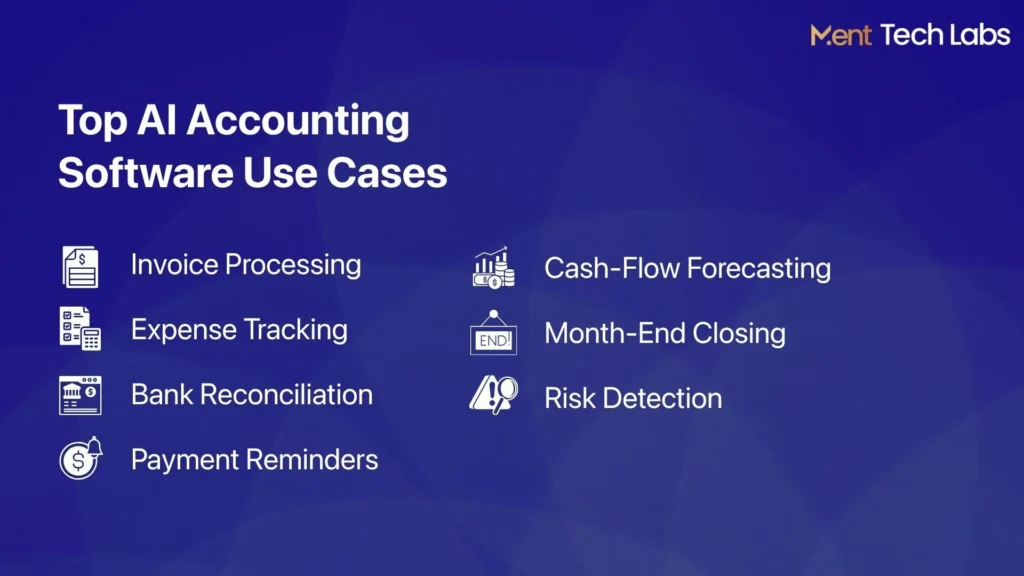
1. Invoice Handling
AI could read invoices, extract key information, compare to purchase orders, and alert us to duplicate payments.
2. Expense Tracking
Workers can take a receipt, and the system records the amount, date, category, and payment method for each receipt automatically. Then hand-typed.
3. Bank Matching
An AI accounting system can match bank transactions to entries in the accounts and immediately identify them accordingly.
4. Payment Reminders
AI can monitor overdue payments, identify clients that are consistently late, and help to trigger accurate reminders.
5. Cash Forecasting
By looking at past payments, current balances, and upcoming bills, the software can give businesses a clearer idea of what their cash position may look like.
6. Month-End Close
Agentic AI can handle reconciliations, journal entries, and reporting, and accountants will continue to review and approve final numbers.
7. Risk Checks
The best AI accounting software in 2026 can spot unusual payments, duplicate entries, and activity that does not match normal patterns. Businesses with scattered financial systems may also use enterprise AI integration services to bring everything into one place.
Key Benefits of AI and Automation in Accounting
The main advantage of the best AI accounting software is that it simplifies the day-to-day work of accounting. It removes all the tedious tasks that a finance team would otherwise spend hours on and allows them to focus more on reviewing the numbers and providing better insights to the business.
1. Manual Entry → Automatic Capture
Invoices, receipts, and transaction details are imported automatically so teams do not need to re-enter the same data multiple times.
2. Rechecking → Cleaner Books
AI helps identify missing information, duplicate entries, and suspicious transactions quickly. This helps keep records accurate without manually reviewing each record.
3. Slow Close → Faster Reporting
Reconciliation, journal entries, and month-end reporting can all be completed much quicker, reducing the pressure and stress of the closing period.
4. Guesswork → Better Planning
An AI accounting platform can look at current balances, past payments, and upcoming expenses to give businesses a clearer view of their cash flow.
5. Late Discovery → Early Warnings
AI can identify suspicious payments or potential errors in real-time rather than have teams identify them at the end of the month or during an audit.
Must-Have Features in AI Accounting Software
A good AI accounting platform should relieve the team from working on it, not give them another thing to work on.
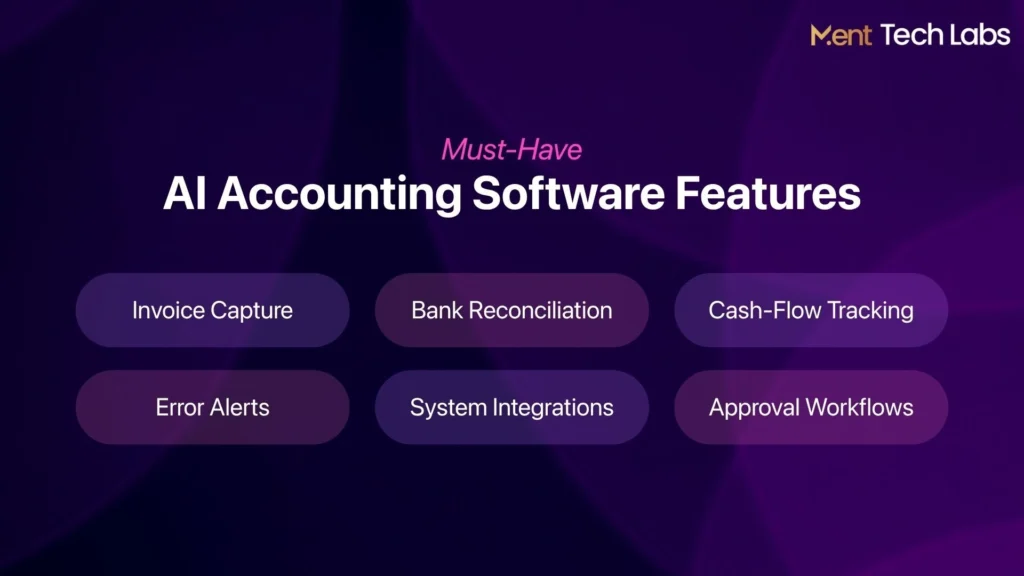
- Invoice and Receipt Capture: Reads invoices and receipts and extracts the relevant information to save the team from manually inputting everything.
- Bank Reconciliation: Reconciles bank transactions with the books and alerts you instantly to anything that appears to be out of line.
- Cash-Flow Tracking: Consolidates balances, incoming payments, and future expenses to give businesses an idea of where they are.
- Error Alerts: Flags duplicate entries, missing details, and unusual payments before they become harder to fix.
- System Integrations: Connects with banking, payroll, ERP, and payment tools. More complex setups may need AI development services for custom connections.
- Approval Workflows: Makes sure important payments and account changes are checked by the right person before they go through.
Ready-Made vs Custom AI Accounting Software Development
Pre-packaged tools are fine if a business simply needs generic accounting features. But custom accounting software development is more suitable if the business requires more advanced integrations, distinct approval flows, or additional control over the functioning of its AI accounting platform.
| Factor | Ready-Made Software | Custom AI Accounting Software |
| Best For | Businesses with standard accounting needs. | Companies with complex or industry-specific workflows. |
| Setup | Faster to launch with limited customization. | Takes longer but fits the business more closely. |
| Integrations | Connects with common banking, payroll, and payment tools. | Can connect with ERPs, internal systems, and custom databases. |
| AI Features | Includes built-in automation for invoices, reconciliation, and reporting. | Supports AI features built around business data and workflows. |
| Control | The provider controls updates, pricing, and platform limits. | The business has more control over features, data, and future growth. |
Explore Ment Tech’s AI Business Accounting Platform
Managing invoices, GST, stock, and pending payments through different tools can become confusing for small businesses. Ment Tech’s AI Business Accounting Platform brings these daily tasks into one simple dashboard built for Indian MSMEs.
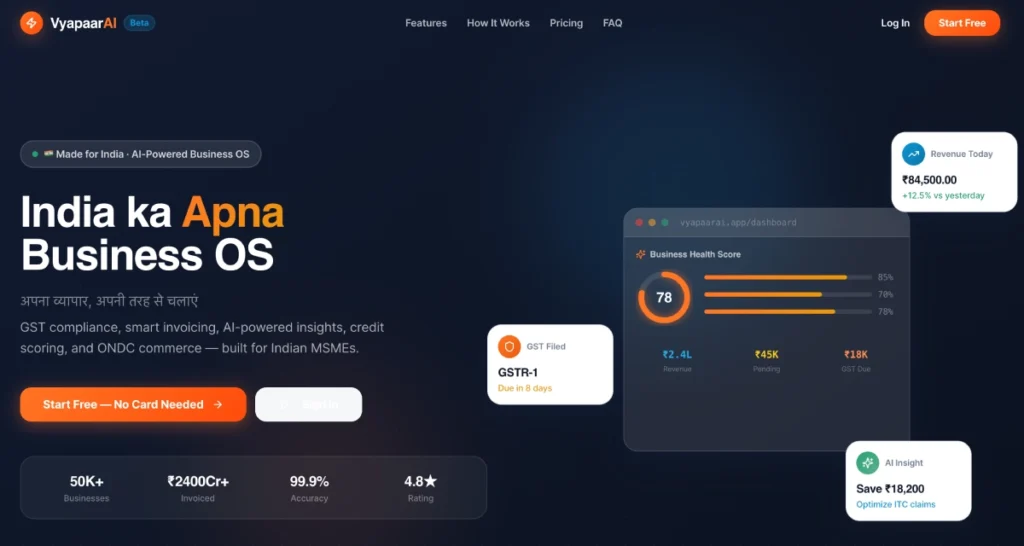
No more hopping between multiple spreadsheets, billing tools, and separate reports; business owners can take care of key accounting tasks from a single platform. Designed to make everyday accounting tasks intuitive, transparent, and more straightforward,
The platform helps businesses:
- Create GST-compliant invoices
- Manage GSTR-1 and GSTR-3B filing
- Track pending and received payments
- Check and manage available stock
- Get AI support in Hindi and English
It gives business owners a clearer view of their accounts without making everyday bookkeeping feel too technical.
Final Thoughts
AI accounting software can simplify many aspects of daily accounting life. Which is most appropriate for your business depends on how your business actually functions. While a small business might just need some basic invoicing, expense reporting, and bank matching, a developing business may require more automation and control.
The best platform is not necessarily the one with the most features. It integrates well with your existing tools, makes your data easy to analyze, and is more efficient for your team than being complicated.
If the existing tools don’t match your workflows, a SaaS developer can create a customized platform tailored to your reporting, approval, and accounting procedures. Let’s discuss your project with Ment Tech Labs!