Artificial intelligence agents are increasingly being embedded in normal business activities. They can make decisions, employ a range of tools, access corporate systems, and complete tasks with minimal human input. The extent of this autonomy is valuable but also presents new issues around control, accountability, and risk.
Agentic AI governance provides institutions with mechanisms for controlling that autonomy. It specifies the permissible actions of agents, the data they can process, when human approvals are necessary, and how the system observes their behavior.
This blog explores the key dangers of autonomous AI, the agentic AI governance framework, how to implement it, use cases for effective compliance, best practices, and the standards that will define AI agent governance in 2026.
What Is Agentic AI Governance and Why Is It Important?
Agentic AI governance comprises the policies, safeguards, and oversight mechanisms that define, monitor, and control autonomous AI agents capable of making decisions and acting on their own. It determines the scope of the agent’s functionalities and permissions across relevant systems and data and mandates human interventions where necessary. The AI risk management framework from NIST echoes similar themes of governance, continuous risk monitoring, and human supervision across the AI lifecycle.
This is becoming more critical as agents gain access to APIs, business applications, sensitive data, and other agents. Risks such as tool misuse, excessive permissions, and goal hijacking show why controls need to work while an agent is running, not just before deployment.
Good AI agent governance helps organizations:
- Set clear limits on agent access and authority.
- Keep humans involved in high-risk decisions.
- Track agent actions for audits and investigations.
- Detect unsafe behavior or changing patterns early.
- Scale AI adoption without losing visibility or control.
Agentic AI Governance vs Traditional AI Governance
Existing AI governance deals primarily with the development, evaluation, and production monitoring of models. Agentic AI governance goes beyond this because AI agents may have, in addition to human oversight, the ability to access tools, interact with systems, and take actions.
| Area | Traditional AI Governance | Agentic AI Governance |
| Main Focus | Model accuracy, fairness, data quality, and compliance | Agent actions, autonomy, permissions, and behaviour |
| Human Oversight | Humans usually review model outputs | Humans step in mainly for sensitive or high-risk actions |
| Access Control | Controls access to models and data | Controls access to APIs, tools, applications, and business systems |
| Risk Management | Risks are reviewed during development and deployment | Risks are managed before and during agent execution |
| Monitoring | Periodic model and output reviews | Continuous monitoring of agent actions and behaviour |
| Accountability | Usually linked to the model or development team | Clear ownership is needed for each agent and its actions |
| Governance Approach | Policies guide how AI systems should be used | Policies are backed by runtime controls, guardrails, logging, and oversight |
Major Risks of Agentic AI and Autonomous Agents
As AI agents gain more access to business systems, agentic AI governance has to address risks that go beyond inaccurate outputs. These include problems around agent goals, tool use, excessive permissions, memory, and interactions between multiple agents.
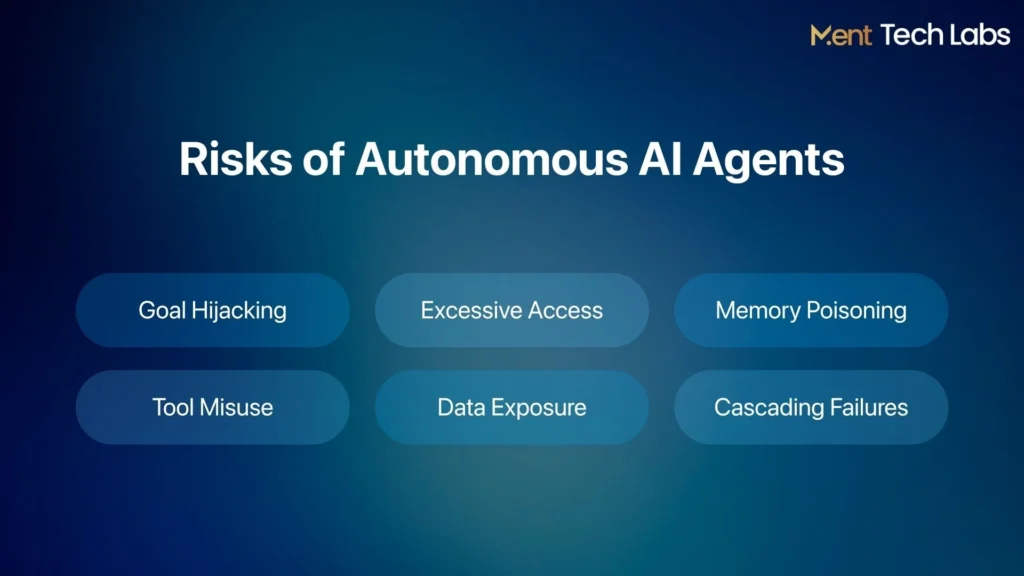
1. Goal Hijacking
Malicious or misleading instructions can push an agent away from its original task. Once its goal changes, the agent may take actions that were never intended or approved.
2. Tool Misuse
Agents connected to APIs, databases, or internal applications can use those tools incorrectly or outside their intended purpose. Strong AI agent governance should limit which tools an agent can call and what it can do with them.
3. Excessive Access
Giving an agent more permissions than it needs increases the damage a mistake or attack can cause. Whether agents are built internally or with an AI agent development company, access should follow least-privilege principles and stay tied to the agent’s actual role.
4. Data Exposure
Agents may handle sensitive customer, financial, or company data while completing tasks. Poor controls can expose this information through tool calls, external services, logs, or unintended outputs.
5. Memory Poisoning
Agents that use persistent memory can carry incorrect or malicious information into future tasks. This can influence later decisions even when the original harmful input is no longer present.
6. Cascading Failures
In multi-agent systems, one agent’s mistake can pass to other agents and affect an entire workflow. A strong agentic AI governance framework, therefore, requires controls at both the individual-agent and system levels.
Key Components of an Agentic AI Governance Framework
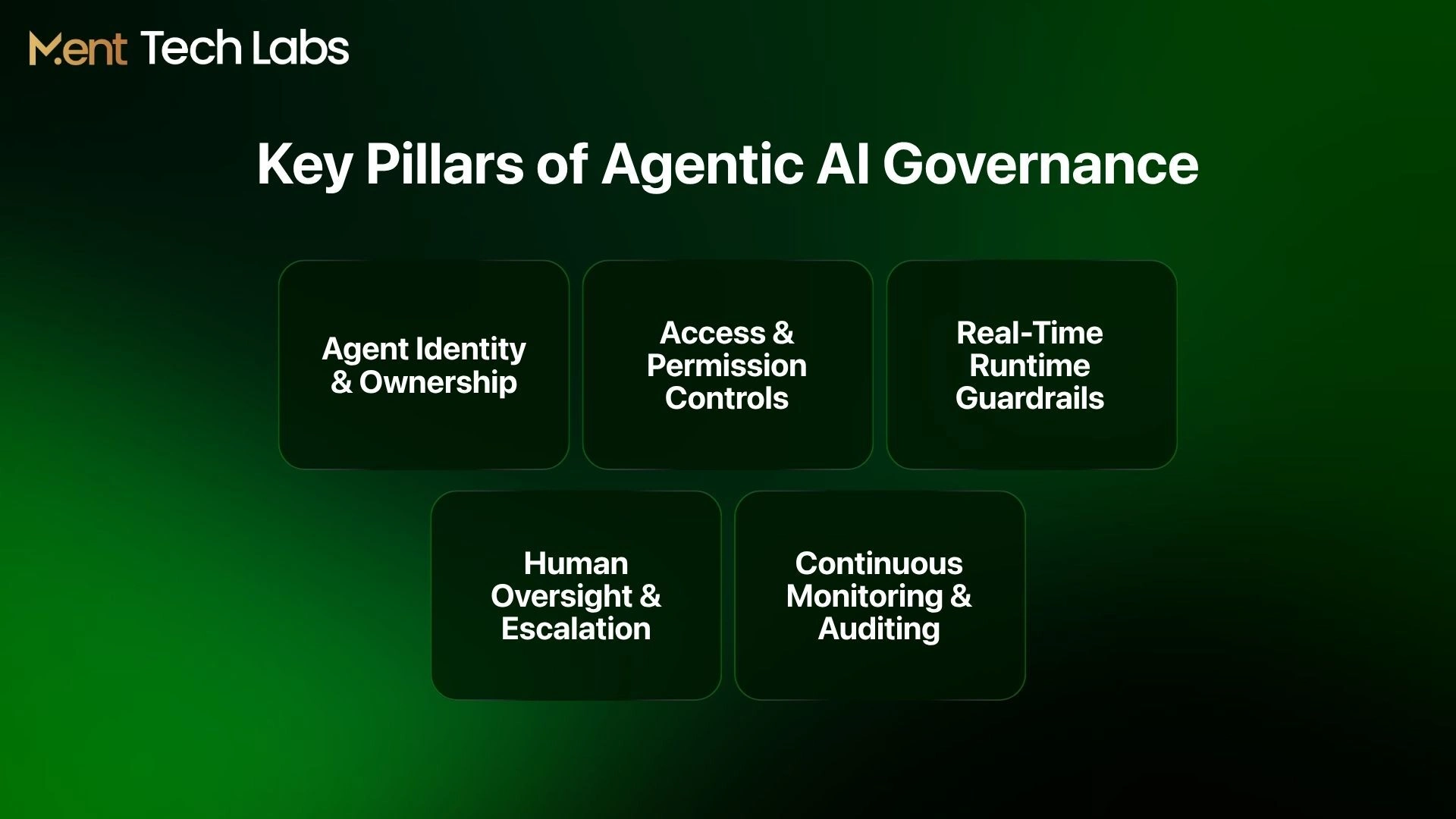
An operational agentic framework for AI governance requires more than policies. It should specify in detail who is in charge of monitoring and controlling the agents and how they do it across business systems. Effective governance requires defined ownership, continuous risk identification, and human participation during the whole AI lifecycle.
- Agent Identity and Ownership
Its identity, ownership, and function should be well defined. Teams should know the provider of the agent, the job it performs, and the scope of its authority.
- Access and Permission Controls
Agents must have access only to the APIs, tools, and data they use. If permissions are restricted, then even a rogue agent cannot access protected systems or perform unauthorized activities.
- Real-Time Runtime Guardrails
Controls need to work while the agent is running, not only during testing. Guardrails can restrict tool calls, block unsafe actions, and stop an agent when it moves outside approved boundaries.
- Human Oversight and Escalation
High-impact decisions should still have specific approval or escalation points. This becomes critical when deployment is intended for AI agents handling workflows such as compliance, finance, healthcare, or other domains where a wrong decision may have far-reaching impact.
- Continuous Monitoring and Auditing
One of the most important practices for governing agentic AI systems is keeping a clear record of what agents do. Logging actions, reviewing unusual behavior, and monitoring changes over time make it easier to investigate problems and improve controls.
Agentic AI Governance Across the AI Agent Lifecycle
Agentic AI governance should stay with an agent from planning to retirement. The controls needed during development will not be the same as those required once the agent starts working with real data, users, and business systems.
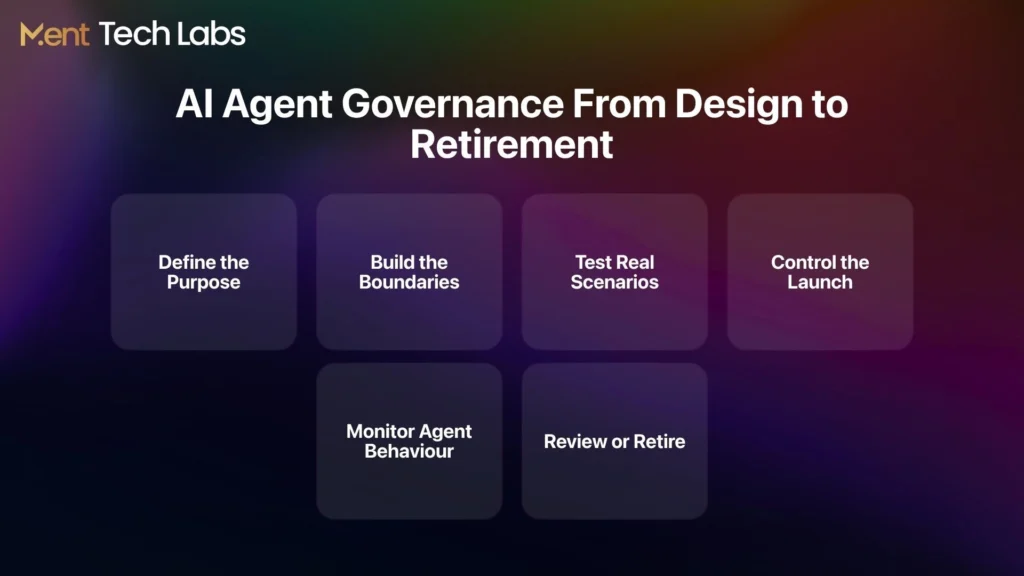
Step 1: Define the Purpose
Be specific about what the agent has to do, what it should never do, and who is accountable. The autonomy of an agent should always be at a level above the risk.
Step 2: Build the Boundaries
Set permissions, approved data sources, tool access, and API limits during development. Whether built internally or through AI development services, governance should be part of the system from the start.
Step 3: Test Real Scenarios
Test how the agent handles unexpected instructions, restricted data, failed tools, and requests outside its role. This helps uncover issues before they reach production.
Step 4: Control the Launch
Before going live, ensure access controls, logging, approval processes, escalation procedures, and emergency stops are enabled and functional.
Step 5: Monitor Agent Behaviour
Good AI agent governance continues after deployment. Teams should watch tool use, system access, unusual actions, and any changes in how the agent behaves over time.
Step 6: Review or Retire
As business needs and integrations change, review the agent’s permissions and controls. When it is no longer needed, remove its access and disable connected systems properly.

AI Agents for Compliance and Enterprise Use Cases
AI agents for compliance can take a lot of repetitive work off internal teams, but they work best when their role is clear and sensitive decisions still stay with people.
1. Compliance Monitoring
Agents can watch transactions, system activity, and policy events for unusual patterns. This helps teams catch potential issues earlier instead of waiting for a scheduled review.
2. Audit Support
AI agents can collect logs, organize records, and pull together evidence needed for audits. That saves time and gives teams a clearer trail of what happened.
3. Access Reviews
Agents can help review user roles, permissions, and access requests against company policies. Strong AI agent governance is important here so agents do not approve access outside defined limits.
4. Risk Checks
Agents can flag changes in behavior, permissions, or workflows that may increase risk. Higher-impact cases can then be passed to the right person for review.
5. Policy Enforcement
Agents can check actions against approved rules before they move forward. If something falls outside those rules, the agent can block it, ask for approval, or escalate it instead of acting on its own.
Agentic AI Governance Standards and Regulations
As AI agents take on more responsibility, agentic AI governance also needs to align with the rules and standards shaping enterprise AI use.
1. EU AI Act
The EU AI Act employs a risk-based approach. For more risky AI, there might be requirements for increased control related to documentation, oversight, human oversight, and responsibility.
2. NIST AI RMF
The framework provided here supports companies in managing AI risk across governance, assessment, monitoring, and continual learning. It can also help enable better governance of AI agents.
3. ISO/IEC 42001
ISO/IEC 42001 focuses on how organizations manage AI responsibly. It covers areas such as policies, ownership, risk management, and continuous improvement.
4. Agentic Security Guidance
New security guidance is also focusing on risks such as tool misuse, excessive permissions, goal hijacking, and unsafe agent-to-agent interactions. These controls become especially important when agents can take real actions inside business systems.
Final Thoughts
As AI agents take on more responsibility across business systems, companies need a clear way to control what those agents can access, decide, and execute. Agentic AI governance helps create that structure without slowing down adoption.
The most effective approach is to build governance into the system from the beginning. Clear ownership, limited permissions, human oversight, and continuous monitoring can help businesses scale AI agents with fewer security and compliance gaps.
If you are planning to deploy autonomous agents or strengthen your existing responsible AI governance approach, contact Ment Tech. Our team can help you design practical governance controls that fit your AI systems, business workflows, and risk requirements.