AI in investment banking is moving beyond experimentation and into everyday deal work. Bankers are using AI to speed up research, review large document sets, support financial analysis, and reduce the manual effort behind pitchbooks and other deal materials.
The real value isn’t letting AI make the deal decision. It lies in helping teams work faster on tasks, uncover useful information sooner, and spend more time on analysis and judgment. Human review still matters for valuation, due diligence, and other high‑stakes decisions.
As AI in investment banking becomes more practical, success depends on more than choosing an AI tool. Banks also need financial data, secure workflows, clear governance, and use cases that fit how deal teams actually work.
What Is AI in Investment Banking?
AI in investment banking is mainly about helping deal teams get through time-consuming work faster. It can support company research, pull useful details from financial documents, review large amounts of data, and help with valuation and early deal materials.
The point of investment banking automation is not to replace the banker. It is to cut down the repetitive work so teams can spend more time checking assumptions, understanding the deal, and giving clients better advice.
Top AI Use Cases in Investment Banking
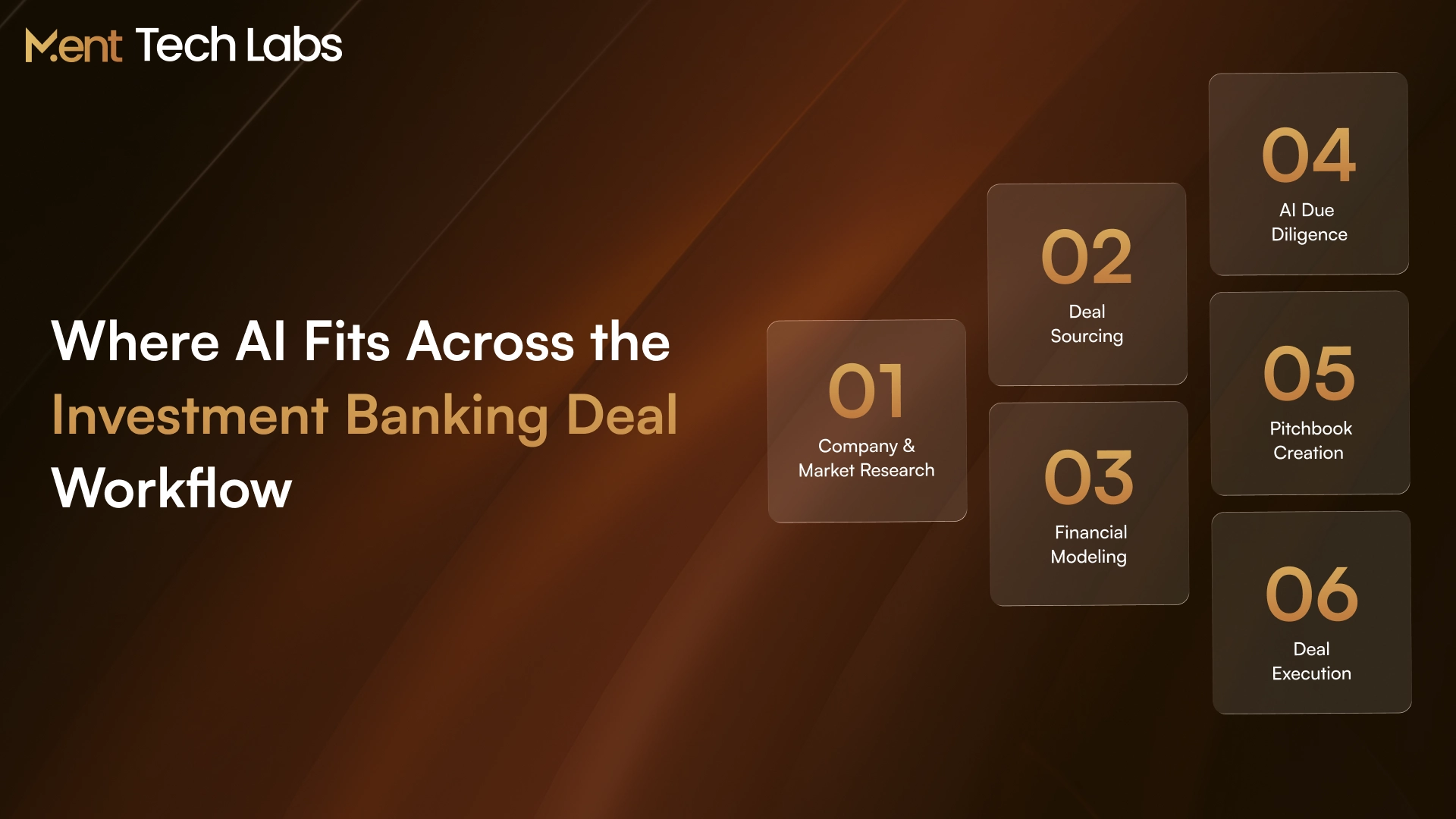
The strongest use cases for AI in investment banking are the ones that remove repetitive work without taking judgment away from the banker. Across current investment-banking workflows, AI is being applied to research, valuation, document analysis, presentations, and decision support.
1. Company & Market Research
AI can scan filings, earnings transcripts, market reports, and internal research to pull together the information a deal team needs. This makes AI in equity research useful when analysts need to understand a company, sector, or market quickly without manually working through hundreds of documents.
2. Financial Modeling
With AI financial modeling, teams can speed up data collection, organize historical financials, check model inputs, and support valuation work. The model still needs analyst review, but AI can reduce the time spent preparing and checking the information behind it.
3. Deal Sourcing
AI can help bankers screen companies, identify relevant targets, track market activity, and connect signals that may point to a potential transaction. A deal team can use this intelligence to focus its time on opportunities that deserve a closer look.
4. Pitchbook Preparation
Automated pitchbook creation can help teams build first drafts using company data, market research, previous materials, and approved templates. Instead of starting every presentation from scratch, bankers can spend more time refining the story, numbers, and client recommendations.
5. Connected Deal Workflows
These use cases become more useful when research, financial data, internal knowledge, and deal systems work together. Broader AI solutions for banking and finance can connect these workflows so bankers are not constantly moving information between disconnected tools.
AI Due Diligence and Deal Intelligence in Investment Banking
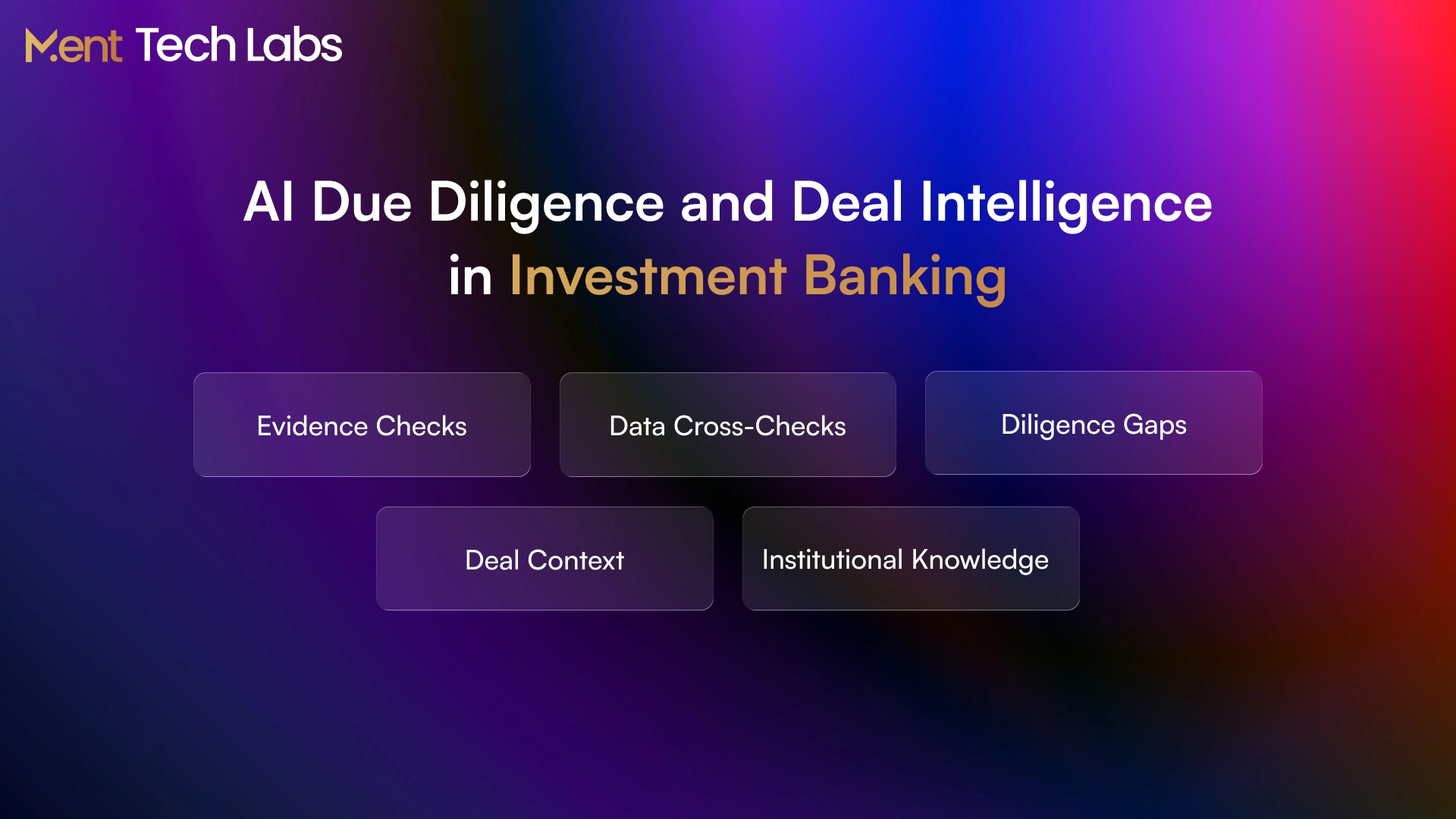
AI can help deal teams move through due diligence with more structure by checking evidence, comparing information across documents, and surfacing gaps that need closer review. It also gives bankers more context around a transaction by connecting current deal data with past deals, market intelligence, and internal knowledge.
1. Evidence Checks
AI can answer specific diligence questions and point reviewers back to the exact document or section supporting the answer. This makes important findings easier to verify instead of relying on a summary alone.
2. Data Cross-Checks
Deal information often appears across contracts, financial statements, management reports, and supporting schedules. AI can compare those sources and flag conflicting figures, changed terms, or inconsistent disclosures.
3. Diligence Gaps
AI due diligence can help identify missing documents, unanswered requests, unsupported claims, or areas where the available evidence is not strong enough to close a diligence question.
4. Deal Context
A deal intelligence platform can connect live deal information with previous transactions, market intelligence, relationship history, and internal knowledge, giving teams more context around important findings.
5. Institutional Knowledge
With enterprise RAG development, banks can make approved past deal materials, internal research, and institutional knowledge searchable for future diligence while keeping access controlled.
Financial Data Integration and AI Infrastructure in Investment Banking
Investment banks rarely have all the information for a deal in one place. Company data may sit in market-data platforms, relationship history in the CRM, previous work in shared drives, and active transaction documents in a data room. Financial data integration brings those sources together so AI can work with the same context the deal team is using.
The real advantage is continuity. An analyst can move from company research to valuation inputs, past transaction references, and current deal documents without repeatedly searching across separate systems. This makes AI in investment banking more useful for live deal work, where the quality of the output depends heavily on having the right data at the right time.
Banks can use enterprise AI integration services to connect AI with existing financial systems while keeping permissions and source access in place. That gives teams a stronger foundation for investment banking automation without forcing them to replace the tools they already rely on.
How AI Creates Value in Investment Banking
The value of AI in investment banking becomes clearer when it improves the economics and pace of deal work, not just individual tasks. McKinsey’s 2026 M&A research found that 40% of respondents using generative AI reported deal cycles becoming 30-50% faster, while users reported average cost reductions of roughly 20%.
- Faster Deal Cycles
When research, document review, and analysis move faster, teams can reach key deal milestones sooner. That matters when several parties are working against tight timelines and new information is arriving throughout the process.
- More Banker Capacity
Investment banking automation can take routine preparation work off analysts’ plates, giving them more time for reviewing assumptions, shaping the deal story, preparing for client conversations, and handling work that needs judgment. Deloitte has identified front-office productivity as one of the main areas where generative AI can create value in investment banking.
- More Consistent Work
AI can help teams apply the same research steps, templates, checks, and source requirements across multiple deals. That is particularly useful when firms want outputs such as research notes or AI financial modeling inputs to follow internal standards before senior review.
- Faster Client Response
Bankers can respond more quickly when a client asks for a market update, comparable-company view, transaction precedent, or a change to an existing analysis. The advantage is not simply producing more material. It is shortening the time between a client question and a well-supported response.
- Scalable Internal Tools
Once a firm knows which AI workflows consistently save time, it can turn them into tools built around its own processes and data. AI product engineering can help banks move from isolated AI experiments to reusable applications that deal teams can use across mandates.
AI Risk, Security, and Data Governance in Investment Banking
When AI starts touching live deal work, the main concern is not just speed or accuracy. Banks also have to protect sensitive information, make outputs easy to verify, and keep clear control over how AI is used.
Protect Sensitive Deal Data
- Limit access to MNPI, client files, and confidential transaction data.
- Keep information separated across deals, teams, and user roles.
- Make sure AI only works with data the user is allowed to access.
Check AI Outputs Before Use
- Link important figures and claims back to their source.
- Review AI-generated work before it goes into models or client materials.
- Flag anything unclear, unsupported, or inconsistent for manual review.
Keep AI Use Governed
- Set clear rules for where AI in investment banking can and cannot be used.
- Build approvals, review steps, and audit trails into the workflow.
- Use strong financial data governance and AI governance consulting services to scale AI without losing control.

How to Implement AI in Investment Banking
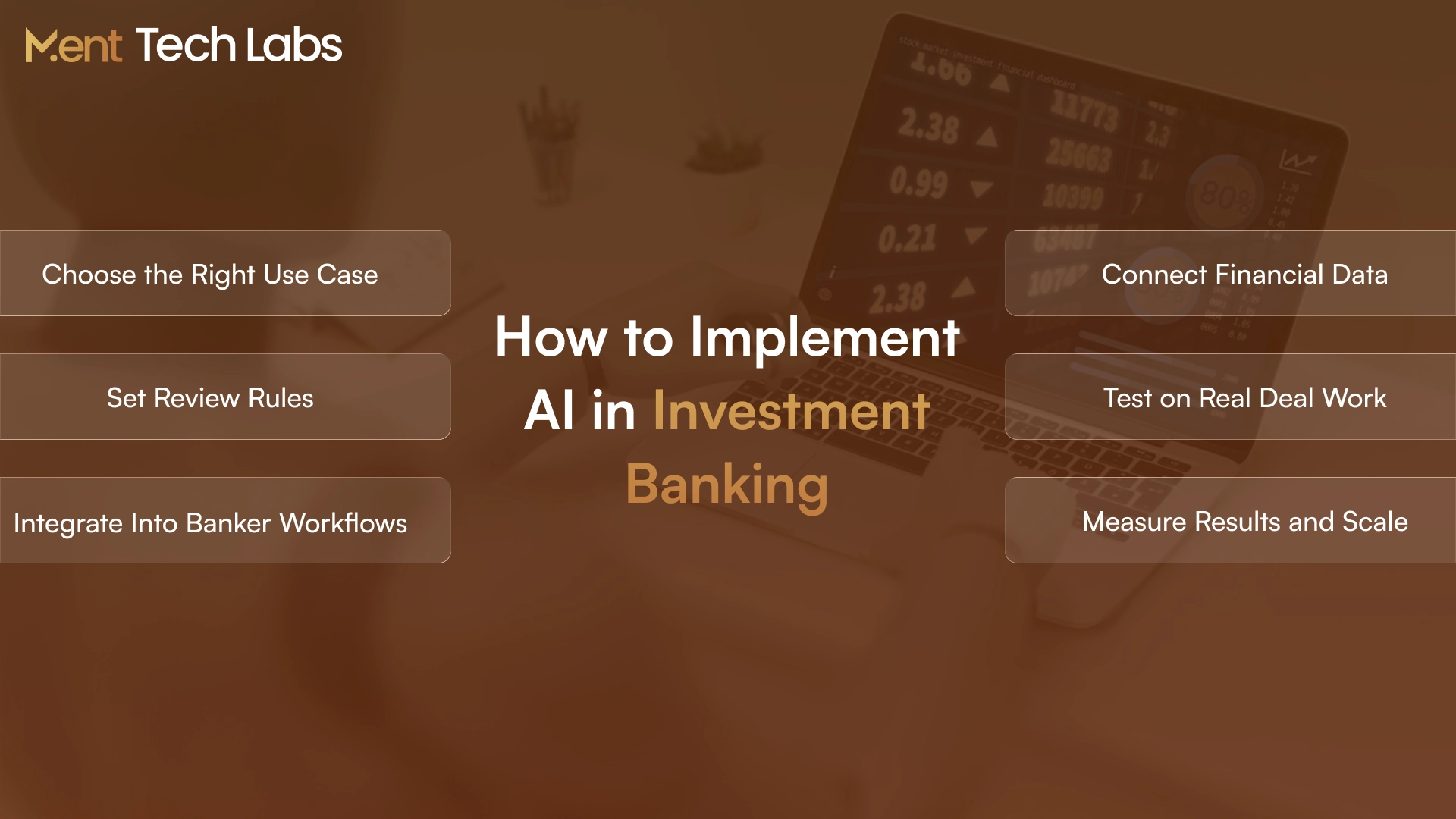
A successful rollout starts with the right use case, reliable financial data, clear review rules, and testing AI inside real deal workflows before scaling it across teams.
Step 1: Start With One Deal Workflow
Choose a task where the team already spends significant time, such as AI in equity research, company screening, or automated pitchbook creation. Define what AI should improve before choosing the technology.
Step 2: Map the Data It Needs
Identify the market data, internal research, CRM records, past deal materials, and other approved sources the workflow depends on. Build the required financial data integration early instead of trying to fix fragmented data after the pilot starts.
Step 3: Set Review Rules Upfront
Decide which outputs can be used as working drafts and which need analyst- or senior-level approval. Financial figures, valuation assumptions, and client-facing material should always have clear source references and review steps.
Step 4: Test It on Real Work
Run the solution on a controlled set of real or historical deals. Check whether it finds the right information, cites the correct sources, reduces preparation time, and produces work that bankers can actually use, not just impressive demo outputs.
Step 5: Fit It Into Banker Workflows
AI should work with the systems deal teams already use rather than create another place to copy information into. The goal is to make research, analysis, and document preparation easier inside the normal flow of a transaction.
Step 6: Measure, Improve, and Scale
Track practical results such as turnaround time, analyst hours saved, review corrections, and user adoption. Once the workflow is reliable, expand it to other teams and deal stages while continuing to monitor accuracy, access controls, and human oversight.
Conclusion
AI in investment banking works best when it improves real deal workflows rather than adding another layer of technology. Research, diligence, financial analysis, and deal preparation can all become faster when AI is built around how bankers already work.
The real value comes from combining AI with reliable financial data, clear review steps, and strong governance. That helps teams move faster without losing control over accuracy, confidentiality, or decision-making.
Ment Tech Labs helps investment banks design and build AI solutions around real workflows, data, and compliance needs. If you are planning to introduce AI into your investment banking operations, you can connect with our team to discuss the right starting point.