Introduction
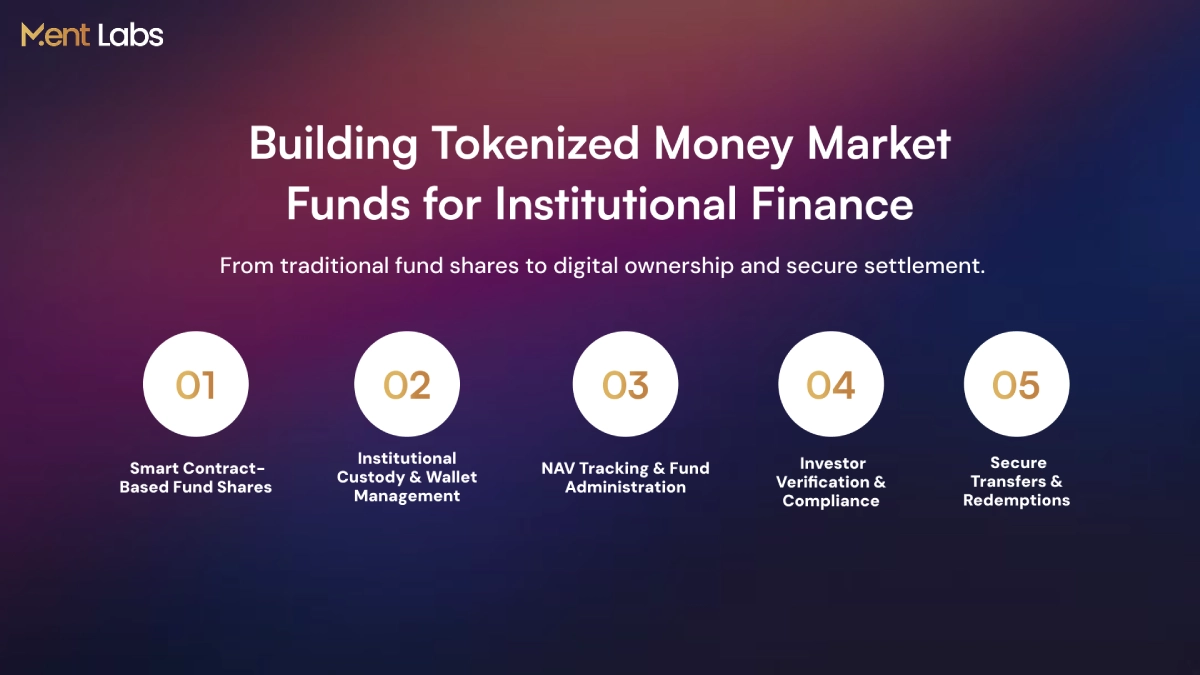
Money market funds invest in short-term assets such as Treasury bills and commercial paper. Tokenized Money Market Funds turn fund shares into tokens. Tokenized Money Market Funds make subscriptions, redemptions, and transfers easier, while Money Market Funds keep the traditional structure.
Financial institutions use tokenization to improve settlement and fund operations. However, launching a tokenized fund also requires ownership records, investor verification, compliance controls, and integration with existing systems.
This guide covers market growth, how tokenized funds work, platform architecture, key features, development stages, and the cost of building a money market fund platform.
What are tokenized money market funds?
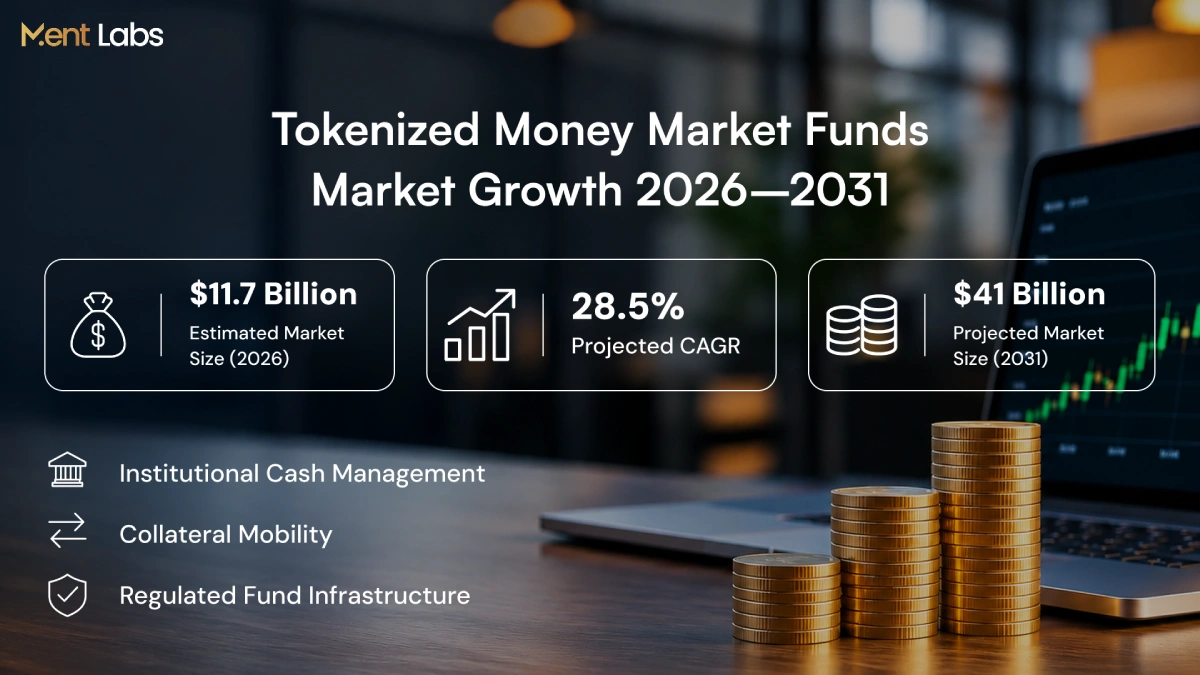
The tokenized money market fund (MMF) market is valued at approximately USD 11.70 billion in 2026 and is projected to grow at a CAGR of 28.5%, reaching an estimated USD 41 billion by 2031.
Tokenized money market funds are money market funds. Their shares are given out as tokens. The funds still buy short-term investments, like Treasury bills and repurchase agreements. The main difference is how ownership of the funds and the transactions are kept track of and handled.
A tokenized money market fund allows eligible investors to keep and transfer fund shares through wallets but only if the fund rules are followed. These tokenized money market funds can simplify transfers, improve transaction tracking, and help settlements happen faster while following financial regulations.
Tokenized Money Market Funds Market Trends and Growth in 2026
The market for money market funds is getting more attention from big institutions in 2026. Mordor Intelligence says the market was worth $11.7 billion in 2026. They think it will grow to $41 billion by 2031. The growth rate is expected to be 28.5% each year. These numbers are from market estimates and predictions.
Major asset managers are already putting tokenization to use. BlackRock launched two money market products in August 2026, while Franklin Templeton expanded the use of tokenized fund shares as trading collateral. These developments point to growing demand for digital fund infrastructure.
The tokenized money market fund (MMF) market is valued at approximately USD 11.70 billion in 2026 and is projected to grow at a CAGR of 28.5%, reaching an estimated USD 41 billion by 2031.
Key Market Trends Driving Growth in 2026
Institutional Cash Management: Tokenized funds help financial institutions manage short-term investments, improve liquidity, and track fund ownership more efficiently.
Collateral Mobility: Eligible fund shares can be used as trading collateral. Eligible fund shares do not require selling the underlying investment.
Faster Fund Transfers: Digital ownership records support quicker transfers between verified investors while maintaining compliance.
Regulated Fund Infrastructure: Asset managers integrate custody, investor verification, transfer agency, and regulatory reporting into digital platforms.
How Tokenized Money Market Funds Work from Subscription to Redemption
A tokenized money market fund goes through four steps, starting with buying fund shares and ending with redeeming them. In Tokenized Fund Development, every step needs to link investor actions with fund record checks, rules and regulations, and systems that handle money transfers.
1. Subscription
Investors finish their KYC checks and eligibility verification before buying fund shares. They use approved payment methods to complete the purchase. After the payment is accepted, tokens are sent to their authorized wallets.
2. Fund Servicing
It is reassuring to know that the fund administrator keeps an eye on income figures, calculates the NAV, and handles distributions or reinvestments. Investors can look at their holdings, see transaction history, and read fund statements.
3. Token Transfer
Investors can transfer their tokens to approved wallets. Before processing a transfer, the platform checks recipient eligibility and applies restrictions. Updates ownership records.
4. Redemption
Investors ask to get their money from the fund by trading their shares for cash or another allowed asset. The fund removes the tokens and pays them according to the rules set for redemptions.
Tokenized Money Market Fund Architecture from Shares to Digital Tokens
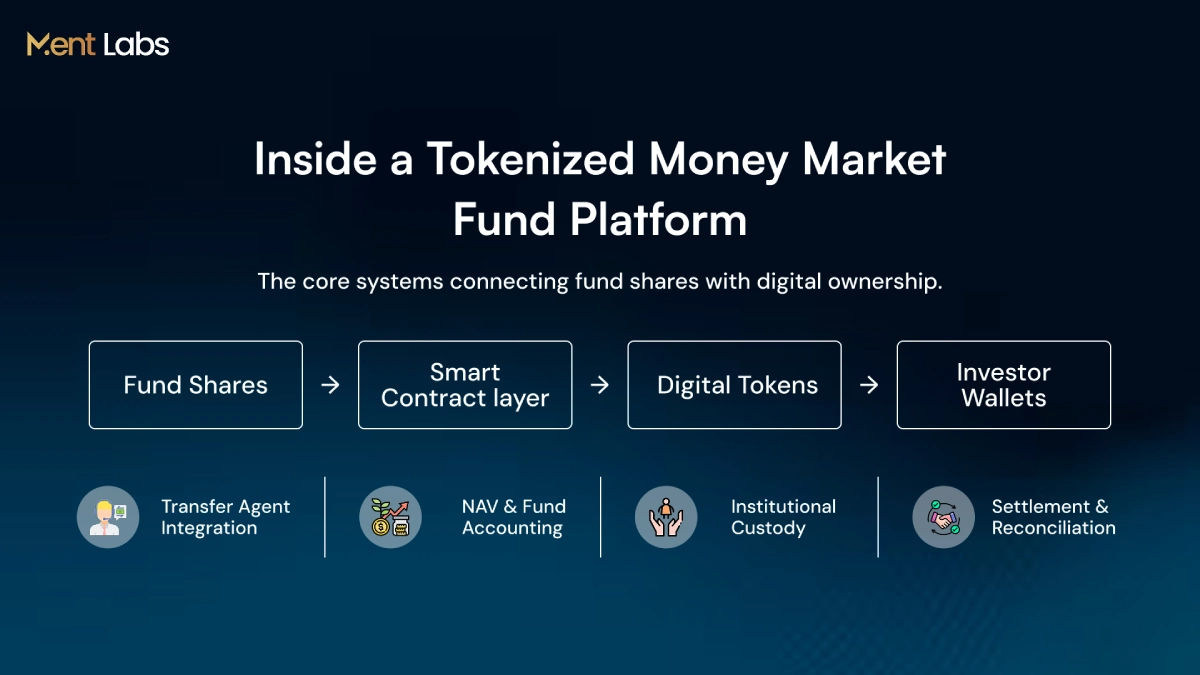
A tokenized money market fund links fund processes with digital ownership records, by using smart contracts, investor wallets, fund administration and settlement systems while keeping legal ownership rights.
1. Fund Share Structure
The fund invests in liquid, short-term assets like Treasury bills and repurchase agreements. Each digital token represents a fund share or ownership interest.
2. Smart Contract Layer
Smart contracts handle token issuance, transfers and cancellation. Smart contracts also enforce transfer restrictions to prevent wallets from receiving fund tokens.
3. Transfer Agent Integration
The transfer agent keeps track of who owns shares and connects each transaction to verified investors. This helps make sure the ownership records are always accurate.
4. NAV and Fund Accounting
Fund administrators calculate asset value and track income, while NAV Tracking for Tokenized Funds supports accurate valuations and transaction reconciliation.
5. Wallet and Custody Management
Digital wallets hold fund shares. Custody systems protect keys. Permission controls limit transactions to authorized investors and administrators.
6. Settlement and Reconciliation
Payment systems link Redemptions to banking or approved digital settlement networks. Reconciliation makes sure that cash movements match changes in fund ownership.
Key Features of a Tokenized Money Market Fund Platform
A tokenized money market fund platform must handle investor transactions, fund valuations and regulatory controls. These five features support fund operations from issuance, to redemption.
1. Investor Onboarding and KYC/AML
Verify investor identities and check investor eligibility and compliance before letting anyone join the fund. Automated checks help stop investments.
2. Token Issuance and Redemption
Issue digital fund shares when subscriptions are approved and cancel tokens during redemption. Smart contracts maintain token supply and transaction records.
3. NAV and Yield Management
Calculate net asset value, with fund accounting data and track investment income. Provide pricing, record income distributions and handle reinvestments.
4. Transfer Restrictions and Ownership
Allow transfers only between eligible investors and approved wallets keep shareholder records up to date. Enforce rules that are specific to each fund.
5. Custody and Compliance Reporting
Protect assets by using secure custody solutions and managing private keys safely. Keep transaction logs, audit records and reports ready for regulatory review.
Development Process for a Tokenized Money Market Fund Platform
A tokenized money market fund platform requires planning, secure development and regulatory compliance. A tokenized money market fund platform will go through six stages covering the process from requirements to platform launch.
1. Business and Regulatory Planning
First, define the fund structure, identify the target investors, outline the operating jurisdictions, and detail the regulations. After that, establish the compliance requirements before you start the development process.
2. Technical Architecture
Plan the platform infrastructure, including network selection, custody, and fund administration. RWA Tokenization Platform Development helps connect asset ownership records with token systems.
3. UI/UX and Platform Development
Design investor onboarding processes, portfolio dashboards and transaction flows. Build backend systems to handle NAV calculations, fund management and ownership records.
4. Smart Contracts and Integrations
Develop contracts that handle the creation of tokens, the moving of tokens and the returning of tokens. Link up bank systems, payment companies, storage solutions and information about market prices.
5. Security and Compliance Testing
Conduct contract audits, penetration tests, and transaction testing. Verify KYC/AML processes, transfer restrictions, and regulatory reporting.
6. MVP Launch and Monitoring
Launch with a group of eligible investors to test real transactions. Keep an eye on settlement, fund records, and compliance workflows before we launch wider for all investors.
How Much Does It Cost to Build a Tokenized Money Market Fund Platform?
Development costs can differ depending on the platform’s scope the rules it needs to follow and how much customization is needed. Here’s an estimate broken down by platform type.
| Platform Type | Development Scope | Estimated Cost |
| MVP / Pilot | Token issuance, basic KYC/AML, investor onboarding, and redemption | $80,000-$180,000 |
| Mid-Level Platform | Fund administration, NAV integration, investor dashboards, and custody integration | $200,000-$450,000 |
| Institutional Platform | Multi-jurisdiction compliance, advanced custody, banking integrations, and regulatory reporting | $500,000+ |
| Annual Maintenance | Security monitoring, system upgrades, compliance updates, and technical support | 15-20% of initial build cost |
These are estimated costs, not fixed quotes. The final budget depends on requirements, operating jurisdictions and third-party integrations. For a look at compliance-related requirements, explore our Tokenization Compliance Services.
Conclusion
Tokenized Money Market Funds are changing how financial institutions manage fund ownership and settlements. Tokenized Money Market Funds simplify transactions, improve transparency and reduce work while preserving traditional fund structures.
Creating a platform requires precise NAV tracking, careful investor verification, solid custody management and strict regulatory compliance. All of these systems must cooperate to keep fund operations reliable.
Ment Tech Labs creates fund solutions and adds Stablecoin Payments Platform infrastructure for digital settlements. Contact us today to discuss your tokenization project.