
Traders today are not dealing with a lack of information. They are dealing with too much of it. Live prices, breaking news, technical charts, crypto updates, and portfolio changes are all happening at once across different platforms. Keeping up manually is exhausting, and it slows down every decision that matters.
An AI trading assistant fixes that. It monitors markets, summarizes news, tracks signals, and filters out the noise so traders can spend less time gathering data and more time acting on it. A good trade assistant does not replace your judgment. It just means you show up to every session already prepared.
The global AI trading platform market is growing from $13.45 billion in 2025 to $33.45 billion by 2030. That number tells you everything about where the industry is heading. Here are 7 practical ways a trading assistant helps traders save time and analyze markets faster.
What Is a Trading Assistant?
A trading assistant is exactly what it sounds like. It is a tool that helps traders keep up with markets without having to do everything by hand. Think of watchlists, price alerts, news feeds, and portfolio tracking all sitting in one place. A traditional trade assistant saves time by keeping information organized so traders are not constantly switching between five different tabs to find what they need.
The modern answer to what is a trading assistant looks quite different, though. AI-powered versions bring in natural language queries, automated market summaries, sentiment analysis, and pattern detection. You can literally ask it why a stock is moving and get a straight answer in seconds. It is less like a tool and more like a research partner that is always on and always watching the markets for you.
What Makes an AI Trading Assistant Different?
Most trading tools just show you data and leave you to figure out the rest. An AI trading assistant actually processes that data, connects the dots, and surfaces what matters before you even think to look. It uses machine learning, NLP, and LLMs to work through market information faster than any manual research process can. The real difference is that a modern trading assistant AI brings live market data, technical signals, news, and your own preferences together into one place that actually makes sense.
Natural Language Queries: Just type your question in plain English. No need to dig through charts or reports to find a straight answer.
AI-Generated Market Summaries: Instead of reading five sources every morning, you get one clean briefing that covers what moved and why.
Technical Indicator Analysis: RSI, MACD, Bollinger Bands, and moving averages get read and explained automatically, so you spend less time interpreting signals.
News and Sentiment Scanning: Financial news, earnings updates, and social sentiment get scanned in real time, so nothing important slips past you.
Smart Alert Generation: Alerts fire when multiple signals line up together, not just when a price hits a number. Much more useful in practice.
Portfolio and Risk Monitoring: An AI-assisted trading platform tracks your exposure and risk signals continuously, so you always know where you stand without checking everything manually.
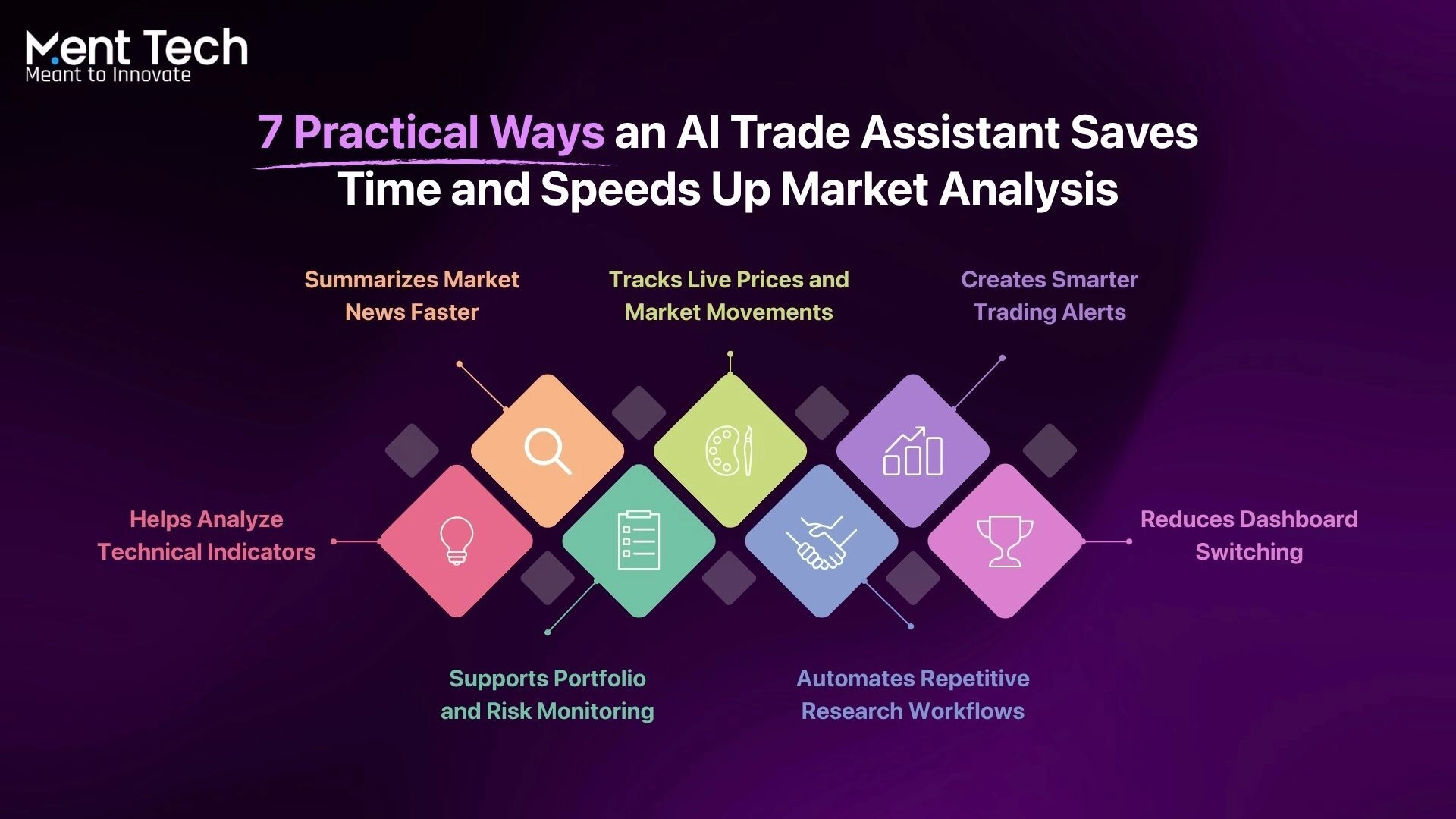
7 Practical Ways an AI Trade Assistant Saves Time and Speeds Up Market Analysis
Traders lose hours every day to tasks that should not take that long. An AI trading assistant handles the heavy lifting automatically so traders can focus on what actually requires human judgment. Here are 7 ways a trade assistant makes a real difference.
1. Summarizes Market News Faster
Most traders do not have time to read through every earnings report, analyst note, and macro update that drops before market open. An AI trade assistant solves this by scanning financial news, crypto market updates, and key economic events automatically and turning them into short, readable summaries. You get the context you need in minutes instead of spending an hour across multiple sources.
The practical difference is significant. Instead of Googling why a stock is moving, you just ask your trading assistant directly and get a clear answer with the key drivers already pulled together. Less reading, faster context, better decisions before the session even starts.
2. Tracks Live Prices and Market Movements
Tracking ten assets manually throughout a trading day is already hard. Tracking thirty is nearly impossible. An AI trading assistant monitors live stock prices, crypto prices, volume spikes, volatility shifts, support and resistance levels, and sector-wide movements continuously in the background without you having to watch every chart yourself.
This is especially useful for traders managing a broad watchlist. The assistant flags what is moving, what is breaking out, and what is quietly building momentum so nothing important slips through while you are focused elsewhere. It essentially gives you eyes across the entire market at once.
3. Creates Smarter Trading Alerts
Basic price alerts tell you when a stock hits a number. That is useful, but it is also the bare minimum. A trading assistant AI goes much further by triggering alerts only when multiple signals line up at the same time. Think price breaking resistance while volume spikes and RSI moves into overbought territory simultaneously.
This kind of layered alerting gives traders far more context than a simple notification ever could. Whether it is a news sentiment shift, a sharp move in a watchlist asset, or portfolio exposure crossing a risk threshold, the AI trade assistant makes sure the alerts you receive are actually worth acting on rather than just noise.

4. Helps Analyze Technical Indicators
Reading RSI, MACD, Bollinger Bands, and moving averages takes practice and time. An AI trading assistant helps by not just displaying these indicators but actually explaining what they are showing in plain language. Pattern recognition, momentum shifts, breakout signals, and volatility summaries all get surfaced in a way that is easier to act on quickly. Building this kind of intelligent analysis layer is exactly what an experienced LLM development company brings to the table when developing a trading product that goes beyond basic charting.
That said, it is important to be clear here. AI can explain what the indicators are showing and flag signals worth paying attention to. But traders still need to apply their own judgment before making any decision. Think of it as a well-informed second opinion rather than a final answer.
5. Reduces Dashboard Switching
The average active trader juggles a trading platform, charting software, a news app, a portfolio tracker, a crypto exchange, an on-chain dashboard, and possibly a spreadsheet or two on top of that. Switching between all of these constantly kills focus and wastes more time than most traders realize.
An AI-assisted trading platform brings much of this together into one interface. Instead of jumping between six tabs to piece together a market view, traders get a single place where prices, news, signals, and portfolio data all live together. The workflow becomes cleaner, research gets faster, and it becomes much easier to stay focused on what actually matters throughout the day.
6. Supports Portfolio and Risk Monitoring
Keeping track of position exposure, drawdowns, asset concentration, and risk thresholds manually is genuinely difficult at scale. An AI trading assistant monitors all of this continuously and sends alerts when something needs attention, whether that is a loss threshold being approached, a volatility spike in a held position, or a diversification imbalance building up quietly.
One important distinction worth making here. A trading assistant supports monitoring and research. It is not the same as an AI investment advisor, which involves regulated financial advice, suitability assessments, and compliance requirements. A trading assistant helps you stay informed. Investment advisory is a separate, regulated service entirely.
7. Automates Repetitive Research Workflows
Every trader has tasks they repeat every single day. Fetching market data, scanning news, checking indicators, updating watchlists, reviewing risk signals, and preparing a morning brief. These tasks are necessary, but they are also time-consuming and largely mechanical. This is exactly where AI agents built by an experienced AI agent development company make a real difference.
A well-built trading assistant AI can automate this entire research loop, running through each step in sequence and delivering a clean, organized output before the session begins. The key is that these agents should always operate with clear permissions, defined risk limits, audit logs, and human oversight in place. Automation should speed up your workflow, not remove you from the decision-making process entirely.
If you want to understand how AI agents are being used to automate complex business workflows beyond trading, read our guide on Best AI Agent Development Companies in the USA 2026.
AI Trading Assistant vs Trading Bot: What Is the Difference?
This is one of the most common points of confusion in the fintech space, and it is worth clearing up properly. An AI trading assistant and a trading bot are two very different tools built for two very different purposes. Understanding the difference matters before you build or adopt either one.
| Feature | AI Trading Assistant | Trading Bot |
| Primary Purpose | Research, analysis, alerts, and decision support | Executes predefined trading strategies automatically |
| User Control | The trader stays in full control | Runs independently based on set rules |
| How It Works | Summarizes news, tracks signals, monitors portfolio | Buys and sells when conditions are met |
| Best For | Traders who want faster research and better context | Traders running automated rule-based strategies |
| Risk Oversight | Flags risk signals for human review | Needs strict risk limits and audit logs built in |
| Compliance Need | Lower regulatory complexity | Requires compliance review and human oversight |
An autonomous trading system goes even further than a bot, but it comes with serious responsibility. Strict risk limits, audit logs, compliance review, and human oversight are not optional at that level. They are essential.
A good AI-assisted trading platform helps traders think faster, without giving up control. That distinction is what separates a tool that genuinely supports traders from one that simply replaces their judgment without the guardrails to do so safely.
For teams planning to build a full trading product instead of just an assistant layer, our guide on How to Develop an AI Trading App Like Swyftx AI breaks down the features, tech stack, and development approach behind AI-powered trading apps.
Real Benefits of Using an AI Trading Assistant for Traders and Platforms

The honest value of an AI trading assistant is not about guaranteed profits. It is about getting more done in less time, staying better informed, and making faster decisions. For fintech platforms building these capabilities, working with a generative AI development company means launching with a proven intelligence layer instead of starting from scratch.
Saves Research Time: News summaries, signal tracking, and market briefs are handled automatically, so traders spend time on decisions, not data gathering.
Reduces Dashboard Switching: Everything from prices to news to portfolio data sits in one place instead of five different platforms.
Creates Smarter Alerts: A trading assistant AI triggers alerts when multiple signals align together, giving traders far more useful context than a basic price notification.
Improves Market Awareness: The assistant monitors markets continuously so traders never miss a significant move even when they are not actively watching.
Supports Portfolio Monitoring: Exposure, drawdowns, and risk thresholds get tracked automatically without manual checking throughout the day.
Improves Platform Engagement: For fintech companies and brokers, embedding an AI-assisted trading platform increases user engagement, session depth, and overall customer experience in a market growing toward $33.45 billion by 2030.
Common Mistakes to Avoid When Building an AI Trading Assistant
Most AI trading tools do not fail because of bad ideas. They fail because of avoidable mistakes made during the build. If you are developing a trade assistant or an AI-powered trading product, these are the pitfalls worth knowing before they cost you.
Unreliable Market Data
Everything your assistant does depends on the quality of data feeding it. Bad data in means bad signals out every single time.
No Real-Time Integration
A trading assistant without live data is essentially useless. Markets move fast, and delayed information creates more risk than it removes.
Missing Risk Controls
Without defined risk limits built into the system, automated workflows can escalate problems instead of catching them.
No Audit Logs
Every action the assistant takes should be traceable. No logs means no accountability and no way to diagnose what went wrong.
Treating AI Output as Financial Advice
This is a serious one. AI-generated insights support research and analysis. They are not regulated financial advice and should never be presented as such.
Weak Alert Design
Alerts that fire too often become noise. Alerts that fire too rarely miss the point entirely. Good alert logic is something most teams underestimate.
No API Fallback
When a data source goes down, your AI trading assistant needs a backup plan. No fallback means gaps in monitoring at exactly the wrong moments.
Skipping Historical Testing
Deploying without backtesting against historical data is like launching a product without QA. The gaps will show up, just at the worst possible time.
See TradeAI in Action: Ment Tech’s AI Trading Assistant Platform

If you want to see what a well-built AI trading assistant actually looks like in practice, TradeAI is the clearest example. It is Ment Tech’s live trading intelligence platform built for traders, brokers, fintech startups, and prop firms who want real market intelligence without juggling five different tools at once.

TradeAI combines real-time market scanning, FinBERT-powered sentiment analysis, technical pattern recognition, personalized alerts, and strategy backtesting in one place. Signal to alert latency runs at 50 milliseconds, pattern recognition accuracy sits at 94 percent, and active traders report saving 2 to 3 hours of research time daily. That is what a properly built AI-assisted trading platform actually delivers when the signal logic, data integrations, and alert design are done right.
The results back it up. One fintech client scaled to 200,000 app users in 10 months, earned a 4.8 App Store rating, and saw a 23 percent improvement in user win rate. For any trading assistant AI product team looking to build something similar, Ment Tech Labs offers full customization around your brand, markets, and user experience with a live demo ready before a single line of code is written.
Explore TradeAI and request a live demo here.
Final Thoughts: AI Trade Assistants Help Traders Work Faster, Not Trade Blindly
An AI trade assistant does not make trading easier by predicting the future. It makes trading more manageable by handling the research, monitoring, and organization that eats into your time every single day. News summaries, live price tracking, smart alerts, technical analysis, and portfolio monitoring all happen automatically, so you can walk into every session prepared instead of scrambling.
The real value here is speed, context, and consistency. Markets move fast, and traders who have better information organized more clearly will always have an edge over those still piecing things together manually. A good trading assistant does not replace your judgment. It sharpens it by giving you cleaner inputs to work with every time.
Partner with Ment Tech to build an AI trading assistant that helps your users analyze markets faster, cut research time, and make more informed trading decisions with responsible AI support built in from day one.

