
Banks and fintechs have all these processes running somewhat disconnected across numerous systems. Agentic AI helps orchestrate these workflows across data, tools, and teams with humans in the loop.
As delays in onboarding lengthen, fraud alerts mount, and compliance workloads balloon, manual processes are becoming increasingly difficult to control, with fixed automation unable to handle multi-channel workflows and team handoffs beyond the simplest processes.
This blog covers real Agentic AI use cases in finance that can enhance efficiency, augment supervision, and plug the gaps.
What Is Agentic AI in Finance?
A finance AI agent not only provides answers but is also working to achieve a goal. When you task it to check a customer’s documents or investigate a fraud alert, it determines the sequence of actions, retrieves relevant data from other systems, and marches through the process using approved tools and APIs. It manages context throughout, ensuring that nothing falls through the cracks between steps, and builds a log of all actions taken.
Where it remains anchored is human endorsement. Anything delicate has to be approved by a human before it’s fully completed, and the whole process is monitored over time to ensure any slip-ups or unusual activity can be discovered early. That’s actually what differentiates agentic AI in money markets from a chatbot or a one-time automation routine: it has a workflow for the process, instead of merely providing a single solution.
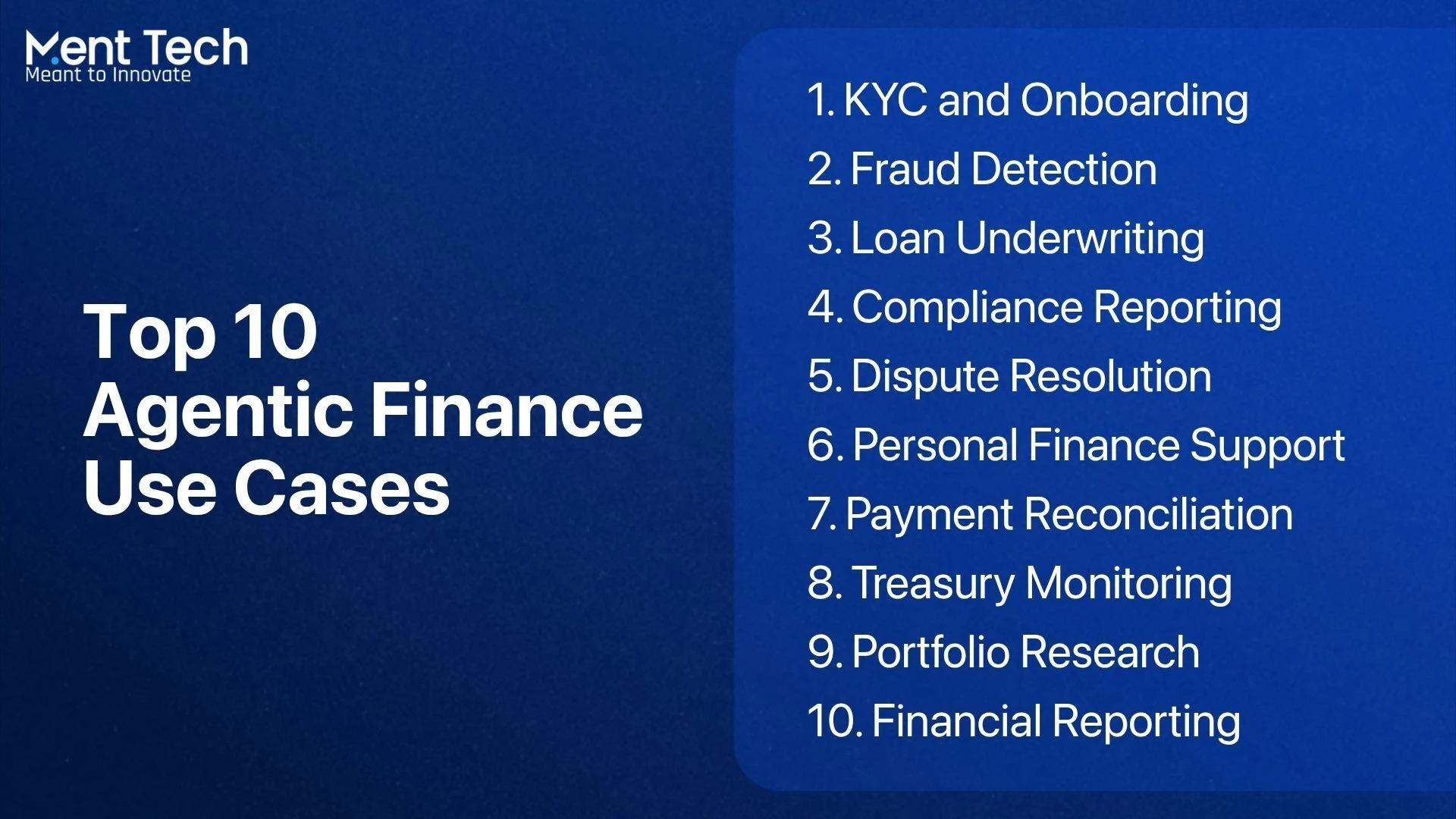
10 AI Agent Use Cases That Can Improve Finance Operations
Every use case here needs to solve a real operational bottleneck, not just add another chatbot to the stack. That’s the bar AI agents in finance need to clear before a bank or fintech should bother building one.
Use Case 1: Customer Onboarding and KYC Review
The Problem
- New customers wait days because staff is stuck chasing the same three documents over and over.
- Identity checks sit in a queue instead of clearing in real time.
- One missing form can stall an entire application.
- Exception cases pile up faster than compliance can review them.
How AI Agents Help
- Pull customer data straight from submitted documents instead of manual re-keying.
- Run KYC and sanctions screening the moment documents land.
- Flag exactly which document is missing instead of a generic “incomplete” status.
- Send only the genuinely complex cases to a compliance officer, not everything.
Results
- Onboarding that used to take days now clears in hours.
- Compliance teams stop fielding “what’s still needed” emails.
- Every case gets checked the same way, every time.
- A clean, timestamped trail for every decision made.
Use Case 2: Fraud Detection and Case Investigation
The Problem
- Analysts open dozens of alerts a day with barely enough context to act.
- Building a case means logging into five different systems.
- By the time evidence is pulled together, the fraud window has often closed.
- Most alerts turn out to be false positives, but someone still has to check.
How AI Agents Help
- Scan transaction history for patterns that don’t match a customer’s normal behavior.
- Pull linked account activity automatically instead of manual lookups.
- Draft an investigation summary with the evidence already attached.
- Push the genuinely high-risk cases straight to a fraud analyst.
Results
- Cases move from alert to decision much faster.
- Analysts spend their time on the alerts that actually matter.
- Less time lost to manual digging across systems.
- Case files arrive complete instead of half-built.
Use Case 3: Loan Application and Underwriting Support
The Problem
- Underwriters spend hours reading through pay stubs and bank statements before they even start assessing risk.
- Policy checks are done manually, line by line.
- Missing income documentation surfaces late, after work has already started.
- Underwriting prep eats into the time available for actual judgment calls.
How AI Agents Help
- Extract income and financial details directly from submitted documents.
- Cross-check applications against lending policy automatically.
- Compare applicant data against internal guidelines in seconds.
- Hand underwriters a structured risk summary instead of a stack of raw files.
Results
- Prep work that took hours now takes minutes.
- Underwriting inputs are consistent from one file to the next.
- Missing information gets flagged early, not at the finish line.
- Underwriters get more time to actually underwrite.
Final lending decisions stay with a qualified underwriter. The agent prepares the groundwork; a person makes the call.
Use Case 4: Regulatory Compliance and Reporting
The Problem
- Compliance data lives across a dozen disconnected systems.
- The same report gets rebuilt from scratch every reporting cycle.
- Internal policies change faster than manual processes can keep up.
- Audit prep turns into a scramble every single time.
How AI Agents Help
- Pull reporting data from every connected source automatically.
- Check records against the latest policy version, not last quarter’s.
- Flag conflicting or missing entries before a human ever sees the report.
- Draft the report itself, ready for review instead of starting blank.
Results
- Reports get built in a fraction of the usual time.
- Data stays consistent across reporting cycles.
- Auditors get a clearer picture without extra digging.
- Gaps surface weeks before the deadline, not the day before.
Use Case 5: Customer Dispute Resolution
The Problem
- Every dispute starts with someone figuring out what kind of case it even is.
- Transaction history lives in one system and customer notes in another.
- Customers repeat the same story to three different agents.
- Cases stall in the handoff between support and back-office teams.
How AI Agents Help
- Classify the dispute type the moment it’s filed.
- Pull the relevant transaction history without a manual search.
- Gather supporting evidence before an agent even opens the case.
- Build a full case summary so the next person isn’t starting cold.
Results
- Disputes get resolved noticeably faster.
- Customers stop having to repeat themselves.
- Handoffs between teams stop losing context.
- Resolutions look consistent no matter who handles the case.
Use Case 6: Personal Finance Assistance
The Problem
- Customers only find out about a cash-flow problem after it’s already happened.
- Alerts read like “low balance” with zero context on why or what to do next.
- Budgeting still means manually tracking spending in a spreadsheet or an app that doesn’t talk to the bank.
- Guidance feels generic instead of tailored to what’s actually happening in someone’s account.
How AI Agents Help
- Analyze spending patterns to spot trends before they become a problem.
- Track budgets and recurring bills automatically, without manual entry.
- Send cash-flow alerts that explain what’s changing and why, not just a number.
- Escalate genuinely complex financial questions to a licensed advisor.
Results
- Guidance that actually reflects the customer’s situation, not a generic template.
- Better day-to-day financial awareness for the end user.
- Cash-flow warnings that arrive early enough to act on.
- Stronger engagement with the bank’s digital tools.
This kind of Personal Finance assistance works best as a layer of financial awareness, not a substitute for regulated financial advice. Anything beyond spending patterns and budgeting still belongs with a licensed advisor.

Use Case 7: Payment Matching and Reconciliation
The Problem
- Transactions sit unmatched because no one has time to chase down every discrepancy.
- Duplicate payments slip through and only get caught weeks later.
- Reconciliation exceptions pile up faster than the finance team can clear them.
- Ledger updates still happen by hand, one line at a time.
How AI Agents Help
- Match invoices against payments automatically, flagging anything that doesn’t line up.
- Catch duplicate or missing entries before they reach the ledger.
- Investigate reconciliation exceptions and pull the supporting transaction data.
- Prepare correction recommendations instead of leaving the fix to guesswork.
Results
- Reconciliation cycles that used to take days now close much faster.
- Fewer transactions left sitting unresolved.
- Far less manual checking line by line.
- Cleaner, more reliable financial records.
Use Case 8: Treasury and Liquidity Monitoring
The Problem
- Cash positions shift across accounts faster than manual tracking can keep up.
- Liquidity signals often arrive after the window to act has narrowed.
- Treasury teams juggle several disconnected systems just to get a full picture.
- Transfers need tight control, but oversight slows every decision down.
How AI Agents Help
- Monitor cash balances across accounts in real time.
- Forecast short-term liquidity needs before a gap becomes urgent.
- Identify funding gaps as soon as they start to form.
- Prepare transfer recommendations for a treasury officer to approve.
Results
- Liquidity alerts that arrive early enough to matter.
- A clearer, unified view of cash across the organization.
- Faster treasury decisions without cutting corners on control.
- Stronger, more consistent funding controls.
Treasury teams get more of the strong agentic AI development company’s value here, since transfer execution always remains subject to a human approval step.
Use Case 9: Investment Research and Portfolio Monitoring
The Problem
- Analysts are buried under more market information than they can realistically review.
- Reading through filings manually eats up hours that could be devoted to actual analysis.
- Risk signals get identified later than they should.
- Research summaries vary depending on who wrote them.
How AI Agents Help
- Review filings and market data as it comes in.
- Monitor portfolio exposures continuously instead of on a fixed schedule.
- Flag threshold breaches the moment they occur.
- Prepare source-backed summaries analysts can actually rely on.
Results
- Research prep that takes a fraction of the usual time.
- Risk visibility that comes earlier in the process.
- More consistent reporting across the team.
- More time left for the analyst’s own judgment.
Investment decisions stay with qualified professionals. The agent handles the research groundwork; people make the calls.
Use Case 10: Forecasting, Financial Close, and Management Reporting
The Problem
- The same data gets pulled manually, month after month.
- Variance analysis lags when it’s actually needed.
- Report preparation eats up days that could go toward review instead.
- Month-end coordination between teams drags on longer than it should.
How AI Agents Help
- Gather data automatically from every connected system.
- Flag unusual variances as soon as they appear.
- Prepare forecasts and scenario models without starting from scratch.
- Draft management reports ready for review, not a blank page.
Results
- Reporting cycles that close noticeably faster.
- Discrepancies caught earlier instead of at the last minute.
- Forecasts that stay consistent month over month.
- Far less manual prep work for the finance team.
What Makes an AI Agent Ready for Finance Operations
Not every AI system is built to operate inside a bank or fintech environment. A reliable finance AI agent needs a specific set of technical foundations in place before handling real financial workflows.

- Reasoning Layer
Lets the agent break a goal into the right sequence of steps instead of just responding to a single prompt, all within strict, approved boundaries.
- Financial Data and RAG
Retrieval-augmented generation lets the agent reference real account data and policies instead of outdated or generic information, which matters when accuracy has compliance implications.
- API Integrations
Agents need direct connections to core banking systems, CRMs, and payment platforms to actually take action. This is usually where generative AI development services come in, since secure integrations take real engineering work.
- Role-Based Permissions
An agent should never have broader access than the task requires, keeping the blast radius small if something goes wrong.
- Human Approval Layer
Sensitive actions still need a person to sign off before anything is finalized, keeping a finance agent a support system rather than a decision-maker. The kind of foundation enterprise AI services are built around when scaling AI agents in finance beyond a single pilot.
From a Controlled Pilot to a Working Finance Product
Moving from an idea to a working finance AI agent works best as a sequence, not a single big launch. Here’s how banks and fintechs typically get there.
Step 1: Select One Bounded Workflow
Pick one use case you can actually measure, with risk you’re comfortable managing, not the toughest problem on the list.
Step 2: Map the Existing Process
Write down every system, user, approval, and exception involved before touching any code, ideally with AI consulting services guiding the scope.
Step 3: Review Data and Integrations
Look honestly at data quality, API access, permissions, and whatever legacy systems might slow the rollout down.
Step 4: Design the Workflow and Controls
Nail down the tools, memory, permissions, escalation rules, and human-review points that any solid AI agent development company builds in upfront.
Step 5: Build and Test the Pilot
Push it hard on accuracy, security, tool use, and failure handling before anyone outside the project ever sees it.
Step 6: Launch With Limited Users
Put it in front of a small, controlled group first, and hold off on rolling it out to everyone at once. The kind of measured rollout AI solutions for banking and finance teams rely on to keep agentic AI in finance projects grounded.
Step 7: Improve Before Expanding
Let real performance data and honest feedback shape the next version before handing the agent more autonomy or scope.
Final Thoughts
Finance teams shouldn’t jump straight into unrestricted automation. Start with one measurable workflow, get data and systems in shape early, and keep people involved in any decision that carries real weight.
Build permissions, audit trails, and monitoring from day one, not after something goes wrong. Expand autonomy only once a workflow has proven itself in a controlled setting. That’s what keeps agentic AI in finance practical rather than risky.
Ment Tech helps banks and fintech companies build finance agents the right way, starting small and scaling only once a workflow earns that trust. Worth talking through one high-impact workflow with the team.

