
Requesting something from a hospital by phone is often anything but complicated for the caller: scheduling an appointment, refilling a prescription, understanding a bill, or being redirected to an appropriate department. But excessive wait times, difficult-to-reach front Desk teams, and missed calls. These can turn the simplest call into a patient’s frustration.
This is the reason for the rise of AI voice agents in Healthcare. An estimate predicts the global market to grow from $650.65 million in 2026 to just about $11.70 billion by 2035, illustrating how fast providers are transitioning to voice-enabled patient engagement and workflow automation.
This blog covers how healthcare voice agents work, where they create the most value, their key use cases and benefits, implementation costs, revenue cycle applications, and what the future may look like for patient communication.
What Is an AI Voice Agent in Healthcare?
An AI voice agent in healthcare is a task-oriented conversational system that can interact verbally with a patient, interpret their request, and carry out some common procedures remotely. Compared to traditional IVRs, which only present callers with a limited menu of options leading to frustration, a healthcare voice assistant can understand natural language, learn based on the context, and steer an interaction more naturally and intuitively.
In the background, an AI speech agent platform integrates the latest speech recognition and natural language models and the power of healthcare system and carrier integrations in order to schedule, respond to FAQs, send SMS appointment reminders, collect self-reported patient information, and divert sensitive/emergency calls to appropriate human staff.
What Are the Key Benefits of AI Voice Agents for Healthcare Providers?
An AI voice agent in healthcare assists providers with everyday patient calls without increasing the workload of already overstretched teams. When integrated into a robust healthcare AI platform, it can take on basic requests and guide communication flow through the day.
- Faster Patient Support
Patients can book appointments, ask common questions, or update requests without spending long periods waiting on hold.
- Less Administrative Work
A healthcare voice assistant can handle confirmations, reminders, and repetitive calls, allowing staff to do more complex work.
- 24/7 Call Availability
Assistance with chronic disease management outside office hours, during weekends or busy periods.
- Fewer Missed Appointments
Automated reminders and easy rescheduling options help patients stay informed and reduce empty slots in provider calendars.
- More Consistent Communication
The agent delivers clear, approved information on every call, reducing confusion between patients, departments, and different clinic locations.
- Better Use of Staff Time
Routine calls are handled automatically, while sensitive or urgent requests are passed to staff who can provide personal support.
A specialized AI voice agent development company can tailor these workflows to match the provider’s systems, call volumes, and escalation requirements.
Real-World Use Cases of AI Voice Agents in Healthcare
An AI voice agent, if used in healthcare, can easily handle day-to-day small talk with patients that tends to occupy the front desk and other support staff. The most effective uses are ones that free up staff time but that, at the same time, provide quality engagement for the patient.
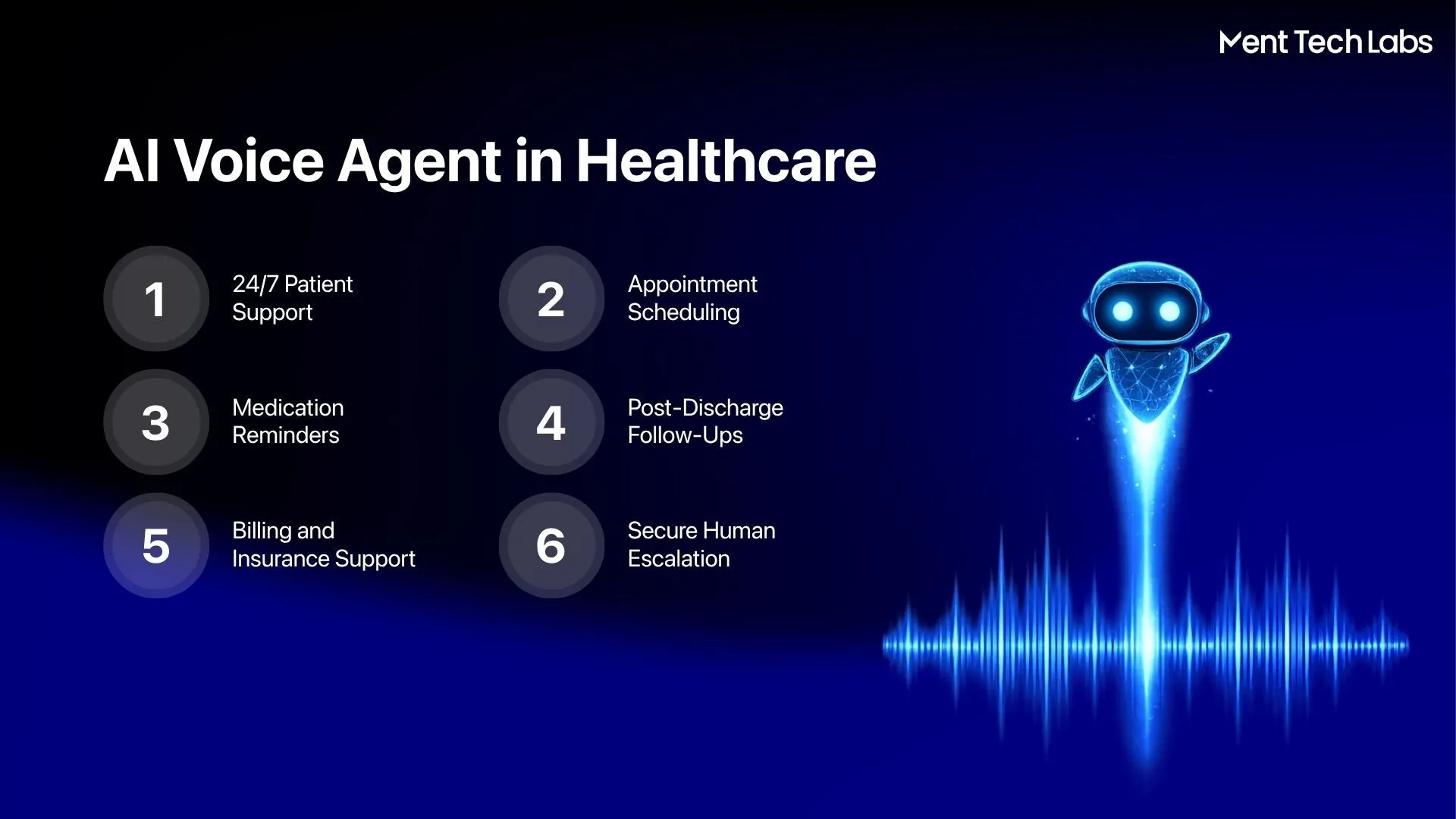
1. Appointment Scheduling
Patients can book, cancel, and reschedule an appointment during a simple conversation without having to wait on hold or call back during business hours.
2. Patient Intake
Collecting some info (such as the reason for the visit), verifying insurance info, and providing instructions to the visited office, all before the patient even arrives, accelerates the check-in process.
3. Medication Reminders
Patients can be kindly reminded of when to take the medication, when prescriptions need to be refilled, or when they should be following a treatment regimen.
4. Post-Discharge Follow-Ups
After a patient returns home, the agent can check on recovery, repeat care instructions, and alert the clinical team when something needs attention.
5. Call Routing and Triage
A healthcare voice assistant can understand why someone is calling and connect them directly with scheduling, billing, nursing, or urgent support.
6. Billing and Insurance Support
A healthcare software development company can connect the voice agent with billing and insurance systems, helping patients check claims, balances, and coverage more easily.
How AI Voice Agents Streamline Healthcare Revenue Cycle Management
The healthcare AI voice agent can take care of standard billing-related conversations, obtain any information that’s missing, and provide updates to patients, all without creating more work for billing.

1. Insurance Verification
The agent verifies coverage details and highlights errors.
- Confirm active coverage
- Collect policy information
- Identify eligibility issues
2. Patient Pre-Registration
Patients can verify personal and insurance information, as well as billing details, before arriving.
- Update patient records
- Reduce check-in delays
- Prevent data-entry errors
3. Cost and Balance Updates
The healthcare voice AI is able to verbalize what an authorized estimate is, what the balance due is, and how to pay for it.
- Share cost estimates
- Explain outstanding balances
- Answer billing questions
4. Claim Status Support
You can see if a patient has a claim submitted, approved, pending or denied without having to speak to any of our staff.
- Retrieve claim updates
- Explain current status
- Reduce repetitive calls
5. Payment Reminders
The agent will also be able to call the patients back in a friendly way and help the patients find the way to a secure payment channel.
- Send due-date reminders
- Share payment options
- Confirm completed payments
6. Revenue System Integration
Reliable API development services connect the voice agent with EHR, billing, insurance, and payment platforms.
- Sync patient information
- Retrieve real-time data
- Keep records consistent
Core Technology Behind an AI Voice Agent in Healthcare
A natural phone conversation may sound simple, but several technologies work together behind the scenes. A reliable AI voice agent platform needs the right mix of telephony, language understanding, integrations, and monitoring. An experienced AI agent development company helps connect these layers around real healthcare workflows.
1. Telephony and Live Audio
This layer manages inbound and outbound calls while streaming the patient’s voice to the AI system for real-time processing.
2. Speech Recognition
Speech recognition converts spoken words into text while handling different accents, background noise, medication names, and common healthcare terminology.
3. Intent and Context Understanding
The system identifies what the patient needs and remembers earlier details so the conversation stays relevant, natural, and less repetitive.
4. Workflow and System Integration
APIs connect healthcare voice AI with EHRs, scheduling tools, billing platforms, and patient records so it can complete real tasks.
5. Natural Voice and Monitoring
Text-to-speech creates clear responses, while call logs help teams review accuracy, missed requests, response quality, and escalation performance.

How to Implement an AI Voice Agent in Healthcare?
Launching an AI voice agent in healthcare into a hospital or practice isn’t simply about picking a voice and linking a phone number. The agent requires defined boundaries, integration to the appropriate systems, and enough testing to manage real patient interactions securely.
1. Choose a Focused Use Case
Start simple with volume. Set up low-investment, easy tasks like appointment booking, reminders, FAQs, or call routing. Once it works smoothly, scale it up, measure metrics, and discover issues quickly.
2. Map the Entire Conversation
Identify the questions most commonly asked by patients, the information the agent needs to gather, and the scenarios it won’t be able to understand. This will help to make the dialogue flow naturally rather than following a rigid script.
3. Set Privacy and Security Rules
Decide what the agent is allowed to answer and when it must involve a staff member. Urgent symptoms, sensitive cases, and medical advice should always follow clear escalation rules.
4. Connect Healthcare Systems
The agent should work with scheduling tools, EHRs, billing platforms, and patient databases. Without these connections, healthcare voice AI may answer calls but cannot complete the actual task.
5. Test Real Patient Conversations
Test different accents, interruptions, background noise, unclear answers, and unusual requests. The goal is to see how the agent responds when the conversation does not follow a perfect script.
6. Launch, Monitor, and Improve
Begin with a small, simple set of calls; identify what questions worked well and which places in the process needed human intervention; and see the increase in accuracy, the quality of the responses, and the increase in patient trust.
How Much Does It Cost to Implement an AI Voice Agent?
The cost of an AI voice agent in healthcare depends on the workflows it handles, the systems it connects with, call volume, and the level of security required. A simple scheduling pilot costs far less than a multilingual, HIPAA-compliant AI voice agent deployed across several facilities.
| Implementation level | Estimated cost | What it usually includes |
| Basic pilot | $15,000-$25,000 | FAQs, appointment booking, basic call routing, and limited integrations. |
| Integrated solution | $25,000-$50,000 | EHR or scheduling integration, reminders, analytics, and human handoffs. |
| Enterprise deployment | $50,000-$100,000+ | Multiple workflows, locations, languages, advanced security, and custom integrations. |
| Ongoing operations | $2,000-$10,000+ monthly | Call usage, hosting, monitoring, maintenance, and regular conversation improvements. |
Platform and telephony usage are normally charged separately. Published voice AI rates can range from roughly $0.07 to $0.31 per minute, while compliance features, phone services, and model usage may add to the final monthly bill.
Final Thoughts
An AI voice agent can also be a huge help in healthcare by taking some of the burden off of busy teams from a plethora of mundane, repetitive calls, appointment reminders, scheduling, billing questions, and follow-ups. We’re not looking to replace human support but simply make it more accessible when needed.
Need to integrate with existing healthcare systems, safeguard patient data, and recognize when a call should be escalated.
Partnering with a knowledgeable AI voice agent development company can position providers to create a secure platform for their existing workflows and grow fearlessly. Contact Ment Tech Labs today!

