
Dubai has become one of the most active testing grounds for real estate tokenization in the world. The city’s property market runs on large-ticket deals and heavy foreign investor interest, making it fertile ground for a real estate tokenization platform to work in practice. Property that once required lakhs or crores of upfront capital can now be split into digital tokens, letting smaller investors buy in.
For property owners and developers, this changes how capital gets raised and how liquidity gets created for an asset class that has always been slow to sell. A tokenized real estate platform brings fractional ownership, faster settlement, and transparent record-keeping into a single system, and Dubai’s regulators have begun laying the legal groundwork for it.
This blog covers what a real estate tokenization platform is, how the tokenization process works, and what it takes to build one that holds up legally in Dubai. We will also look at the compliance requirements, the regulators involved, and the roadmap for launching a platform in this market.
What Is a Real Estate Tokenization Platform?
A real estate tokenization platform gives property ownership a digital form. Instead of buying an entire apartment or building, investors purchase tokens that represent a share of it, and those tokens sit on a blockchain instead of a paper title deed. This is essentially what real estate tokenization is in practice: ownership broken down into smaller, tradeable digital units.
What makes a tokenized real estate platform work is everything running behind the scenes. There is usually a marketplace where people buy and sell these tokens, smart contracts that handle ownership transfers without paperwork, and identity checks to keep things compliant. For developers, it opens up a new way to raise capital from a wider pool of investors. For everyday buyers, it means getting into a property market that used to demand a lot more money upfront.
How Does Real Estate Tokenization Work?
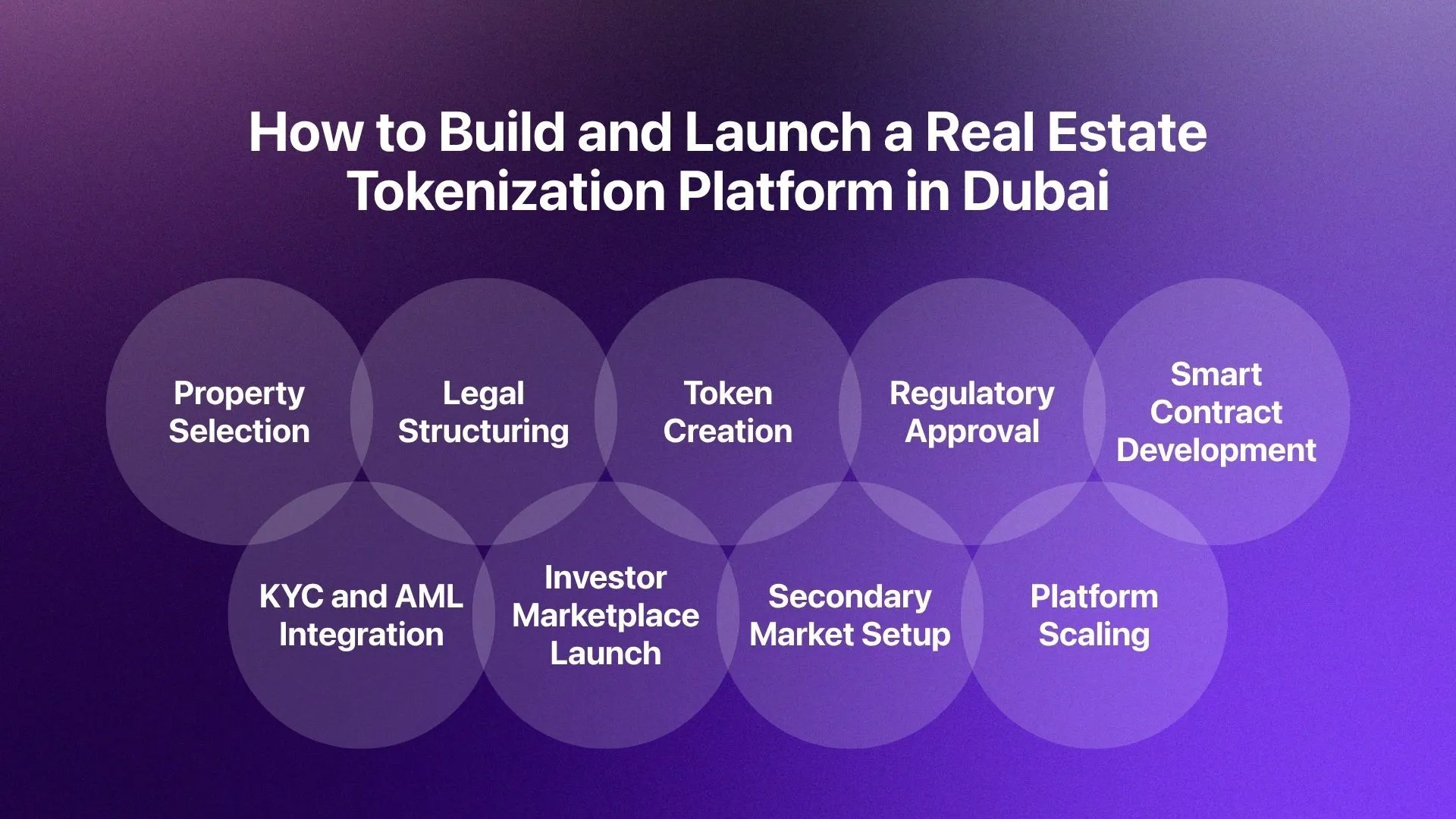
The process behind a real estate tokenization platform follows a fairly consistent flow, even though the technology stack can vary from one provider to another. If you have ever wondered how do you tokenize real estate, it usually comes down to these steps.
- Property selection and valuation. The asset gets identified and independently valued to determine its total worth before any tokens are created.
- Legal structuring. The property is placed under a legal entity, such as an SPV, so token holders have a clear and enforceable claim on the asset.
- Token creation. Digital tokens are minted on a blockchain, with each token representing a fractional share of the property’s value.
- Smart contract deployment. Smart contracts are coded to manage ownership rules, transfers, and payouts automatically, and most serious platforms run these through smart contract audit services before going live.
- Investor onboarding and KYC. Investors complete identity verification and compliance checks before they are allowed to purchase tokens.
- Token sale and distribution. Tokens are listed on the platform’s marketplace where investors buy fractional ownership.
- Ongoing management. Rental income, dividends, or resale proceeds are distributed to token holders based on the number of tokens they hold.
Key Features of a Real Estate Tokenization Platform
A real estate tokenization platform stands out based on the features running behind the scenes, not just the token launch itself. The platforms that earn investor trust tend to share a consistent set of capabilities.

- Ownership Tracking
Every time tokens change hands, ownership records update instantly, so nobody is left wondering who owns what share of the property.
- Smart Contract Automation
Rental payouts, transfers, and dividend splits happen automatically through code instead of someone manually processing payments every month.
- KYC and AML
No serious tokenized real estate platform lets people buy in without verifying who they are first, and this is where most platforms also plug in RWA compliance services to stay on the right side of regulators.
- Secondary Market Access
Instead of being stuck holding an investment until the whole property sells, investors can resell their tokens whenever they want a buyer.
- Investor Dashboard
Property owners and investors should be able to log in and see rental income, token value, and ownership breakdown without digging through spreadsheets.
- Legal Ownership Rights
A token is only worth something if it is tied to a real, enforceable legal right over the property, not just an entry on a blockchain.

Benefits of Real Estate Tokenization for Investors and Property Owners
Real estate has always been a solid investment, but it has also been one of the hardest markets to get into without serious capital. This is exactly where real estate tokenization changes the equation, for both the people buying in and the people who own the property in the first place.
1. Lower Entry Barrier
Instead of saving up for an entire property, investors can buy tokens for a fraction of the cost and still earn proportional returns.
2. Improved Liquidity
Real estate tokenization platforms let investors sell their tokens on a secondary market instead of waiting years for the property itself to sell.
3. Faster Capital Raising
Property owners are no longer limited to local buyers, since a tokenized real estate platform can list ownership shares to investors sitting anywhere in the world.
4. Faster Capital Raising
Developers and owners can raise funds for a project without relying entirely on banks or a single large investor.
5. Fewer Intermediaries
Working with an enterprise blockchain development company to build the underlying infrastructure means fewer brokers and intermediaries taking a cut at every stage.
6. Institutional Infrastructure
Owners get access to a proper asset tokenization platform built for compliance and scale, rather than a patched-together system that cannot handle serious investment volume.
Legal, Compliance and Security Requirements for Tokenized Real Estate
Building a real estate tokenization platform is not just a technology exercise. It is a legal one too. Getting the compliance layer wrong can undo an otherwise well-built platform, so this part deserves as much attention as the tech stack itself.

- Securities Classification: In most jurisdictions, property tokens are treated as securities, which means the platform needs to register or qualify for an exemption before selling tokens to investors.
- KYC and AML: Every investor must go through identity verification and anti-money-laundering checks before they can buy or trade tokens on a tokenized real estate platform.
- SPV Structuring: The underlying property is usually held through a special purpose vehicle, giving token holders a legal and enforceable claim rather than just a digital record.
- Data Protection: Investor information, KYC documents, and transaction history need to be stored and processed in line with regional data protection laws.
- Contract Security Audits: Before going live, the contracts governing token transfers and payouts should go through independent smart contract audit services to catch vulnerabilities before real money is at stake.
- Cross-Border Compliance: If the platform plans to onboard investors from multiple countries, it needs to account for different securities and tax regulations in each region, not just the one where the property is located.
Dubai Real Estate Tokenization Platform and Regulatory Landscape
Dubai has moved faster than most global markets in giving real estate tokenization real regulatory backing instead of leaving it in a grey area. A few different authorities are involved here, and each one covers a different piece of how a Dubai real estate tokenization platform is expected to operate.
1. Dubai Land Department (DLD)
The DLD has been piloting tokenized property initiatives alongside blockchain partners, bringing fractional ownership onto official land registry records. That gives token holders a government-backed link to the actual asset, not just a private ledger entry sitting somewhere.
2. Virtual Assets Regulatory Authority (VARA)
VARA oversees virtual asset activity across Dubai’s mainland, including how property-linked tokens get issued, marketed, and traded. Any real estate tokenization platform working here needs its token offering to fit VARA’s licensing rules.
3. Dubai Financial Services Authority (DFSA)
For platforms operating within the Dubai International Financial Centre, the DFSA steps in whenever tokenized assets qualify as securities, adding one more compliance layer for platforms courting institutional money.
Why does this matter for platform builders?
A best real estate tokenization platform built for this market cannot treat compliance as something to figure out later. It needs to identify early which authority its offering falls under, since larger projects often end up satisfying DLD, VARA, and DFSA requirements all at once. Getting this wrong early can delay or even block a platform launch entirely.
Challenges and Future of Real Estate Tokenization Platforms
Real estate tokenization is still an emerging model, and despite its potential, several structural and operational challenges continue to shape how quickly the market matures.
- Regulatory Uncertainty
Not every country treats property tokens the same way, so a real estate tokenization platform built for one market often needs a complete legal rework before it can expand into another.
- Limited Liquidity
The secondary market idea sounds great on paper, but in reality, finding a buyer for your tokens is still harder than it should be until more platforms and investors actually show up.
- Investor Awareness
A lot of people still do not fully understand how a tokenized real estate platform works, and that unfamiliarity slows adoption more than any technical limitation does.
- Security Risks
Tokens are only as safe as the systems holding them, which is why platforms are leaning harder on smart contract audit services to catch vulnerabilities before they become expensive problems.
- Platform Interoperability
Right now, tokens issued on one platform rarely work smoothly with another, and solving this is probably what decides which real estate tokenization platforms actually scale versus which ones stay stuck serving a single market.
Final Thoughts
Real estate tokenization is no longer just a concept people talk about at conferences. It is actually being built and tested in real markets, and Dubai is leading a lot of that momentum. A real estate tokenization platform gives property owners a new way to raise capital and gives investors a way into a market that used to demand far more money upfront.
That said, this is not a space where cutting corners works out well. Getting the legal structure, security and compliance right matters just as much as the technology itself, and the platforms that take this seriously from day one are the ones that will actually last.
If you are looking to build a Real Estate Tokenization Platform that holds up both technically and legally in Dubai, Ment Tech Labs can help design and develop a platform built around compliance, security, and long-term scale. Get in touch with Ment Tech Labs to discuss your tokenization project.

