Crypto has revolutionized how value flows online, but high price volatility still makes it too risky for the average transaction. Stablecoins were introduced as a solution by pegging their value to certain assets, such as the US dollar, gold, or other reserve currencies.
For firm customers, this establishes a more useful application of blockchain technology for international payments, remittance flows, settlement, treasury management, and digital financial services. They provide the leverage of crypto without the corresponding volatility.
In this blog, we walk through the details of what stablecoin development is, key stablecoin types, the infrastructure involved, the development lifecycle, and the revenue streams they can generate.
Why Were Stablecoins Developed?
Stablecoins were created to address one of the biggest challenges faced by cryptocurrencies: volatility. Previously, you could send assets such as Bitcoin across the blockchain, but since the value wasn’t static, using them for paying for goods and services, saving for the near future, and settling accounts was challenging.
Initially, they proved most useful in crypto markets, where traders needed a stable asset on-chain for transfers, collateral, and DeFi. As stablecoin development progressed, further usage emerged for business payments and digital finance.
- Faster cross-border payments
- More predictable blockchain settlements
- Access to dollar-linked digital value
- Automated payments through smart contracts
- Support for remittances and treasury transfers
- Better liquidity for trading and DeFi
- Integration with a stablecoin payment platform
How Are Stablecoins Different from Traditional Currencies?
Stablecoins and traditional currencies are both used to hold and transfer value, but the way they work is quite different. Traditional currencies move through banks and payment networks, while stablecoins operate on blockchain networks and can support faster, always-on, and programmable transactions.
| Factor | Stablecoins | Traditional Currencies |
| Format | Digital tokens issued on a blockchain | Physical cash and money held in bank accounts |
| Value | Usually linked to fiat currency, commodities, or other assets | Issued and managed by central banks |
| Availability | Can be transferred at any time | Transfers may depend on banking hours and payment systems |
| Settlement | Transactions are recorded directly on the blockchain | Payments move through banks and financial intermediaries |
| Programmability | Can support smart contracts and automated payments | Usually requires separate banking software |
| Cross-Border Payments | Can make global transfers faster and more direct | Often involves multiple intermediaries and currency conversion |
| Main Risks | De-pegging, reserve, issuer, and smart contract risks | Inflation, exchange-rate, and banking-system risks |
What Are the Main Types of Stablecoins?
The framework for which you adopt stable money takes place at the heart of the coin, establishing the stability model, collateral model, and risk behavior.
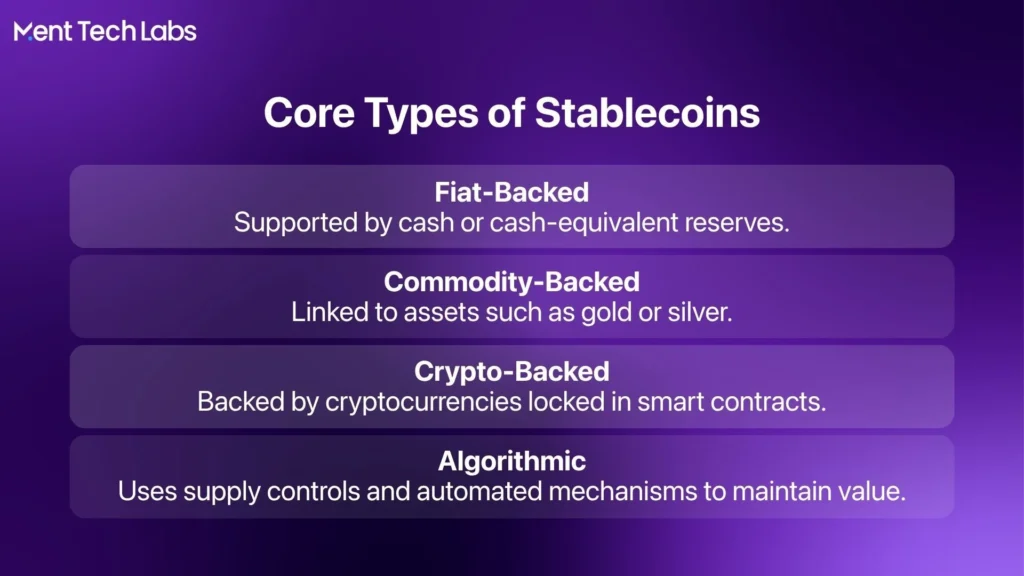
1. Fiat-Backed Stablecoins
These stablecoins are issued and supported by fiat currency or cash equivalent held in reserve. They are relatively simple but require robust custodianship, periodic audits, and transparent reserve disclosure.
2. Commodity-Backed Stablecoins
These tokens are linked to physical assets such as gold or silver. Their value depends on secure storage and proper verification of the underlying commodity.
3. Crypto-Backed Stablecoins
These stablecoins are backed by cryptocurrencies locked in smart contracts. Since crypto prices can change quickly, they usually require extra collateral, price oracles, and automatic liquidation rules.
4. Algorithmic Stablecoins
These stablecoins use smart contracts and supply controls to maintain their peg. They require less traditional collateral, but they are more complex and can lose stability during market stress. This makes smart contract audit services especially important during stablecoin platform development.
Which Are the Most Popular Stablecoins in the World?
The stablecoin space has grown rapidly, and a handful of projects dominate because they are accessible, liquid, and functional for both payments and DeFi. For companies considering an in-depth analysis of the development of stablecoins, these examples illustrate real-world use cases of various models.
1. Tether (USDT)
USDT is the most popular stablecoin in the world. Traders utilize USDT to transfer money between various exchanges, and individuals and companies use it for international remittance or holding digital dollars without repurchasing money through the bank.
2. USD Coin (USDC)
USDC is popular with businesses, institutions, and DeFi platforms. Its focus on reserve transparency and support across multiple blockchains makes it useful for payments, settlements, and treasury transfers.
3. USDS
USDS is within the Sky ecosystem and is mainly used to provide for lending and savings and as an on-chain resource. USDS maintains its peg to the US dollar through the use of collateral and has inherent stability from the mechanisms built in.
4. Dai (DAI)
DAI is a decentralized, crypto-backed stablecoin supported by escrowed crypto assets in smart contracts. It is most frequently used in DeFi for borrowing and lending, trading, and digital payments.
5. USD1
USD1 is a dollar-backed stablecoin for digital payments and blockchain settlement. Its reserve-backed implementation is an indication of the increasing demand for transparency in stablecoin platform development.
6. Ethena USDe
USDe adopts a different model. It practically substitutes cash with crypto assets and makes use of hedging strategies. It is primarily used for various liquidity, collateral, and other crypto-native financial products, for which developing a secure stablecoin payments platform is a must.
What Infrastructure Is Required to Build a Stablecoin?
Stablecoins seem straightforward from the outside, yet several systems need to pull together behind the scenes. The key to successful stablecoin development is a reliable technology, transparent compliance checks, sufficient liquidity, and a secure reserve.
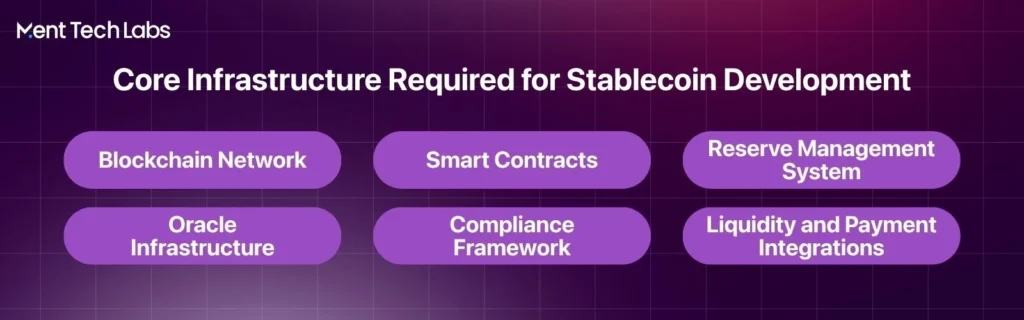
1. Blockchain and Smart Contracts
The speed and cost of transactions are a function of the blockchain. Everything related to the way tokens are minted/burned/transferred, permissions, and emergency state changes is a smart contract itself.
2. Reserve and Collateral Management
Fiat-backed stablecoins must have properly managed reserves. Crypto-backed stablecoins need a collateral vault, live price feeds, and a rule to rescue the coin if there’s a rapid market correction.
3. Minting and Redemption System
New tokens should only be issued after funds are confirmed. When users redeem them, the same tokens should be removed from circulation.
4. Oracles and Reserve Verification
Oracles provide the market data needed to track collateral value. Reserve verification helps confirm that enough assets are available to support the supply.
5. Security and Key Management
Critical actions should never depend on one person or one private key. Multisignature approvals, secure custody, access controls, and a trusted smart contract development company help reduce risk.
6. Compliance Infrastructure
KYC checks, wallet screening, monitoring of transactions and sanctions controls, and audit records should all be part of the process from the outset.
7. Liquidity and Integrations
A stablecoin would require wallets, exchanges, payment systems, on-ramps, and off-ramps. APIs and SDKs simplify its adoption by businesses.

How to Build a Stablecoin: Step-by-Step Process
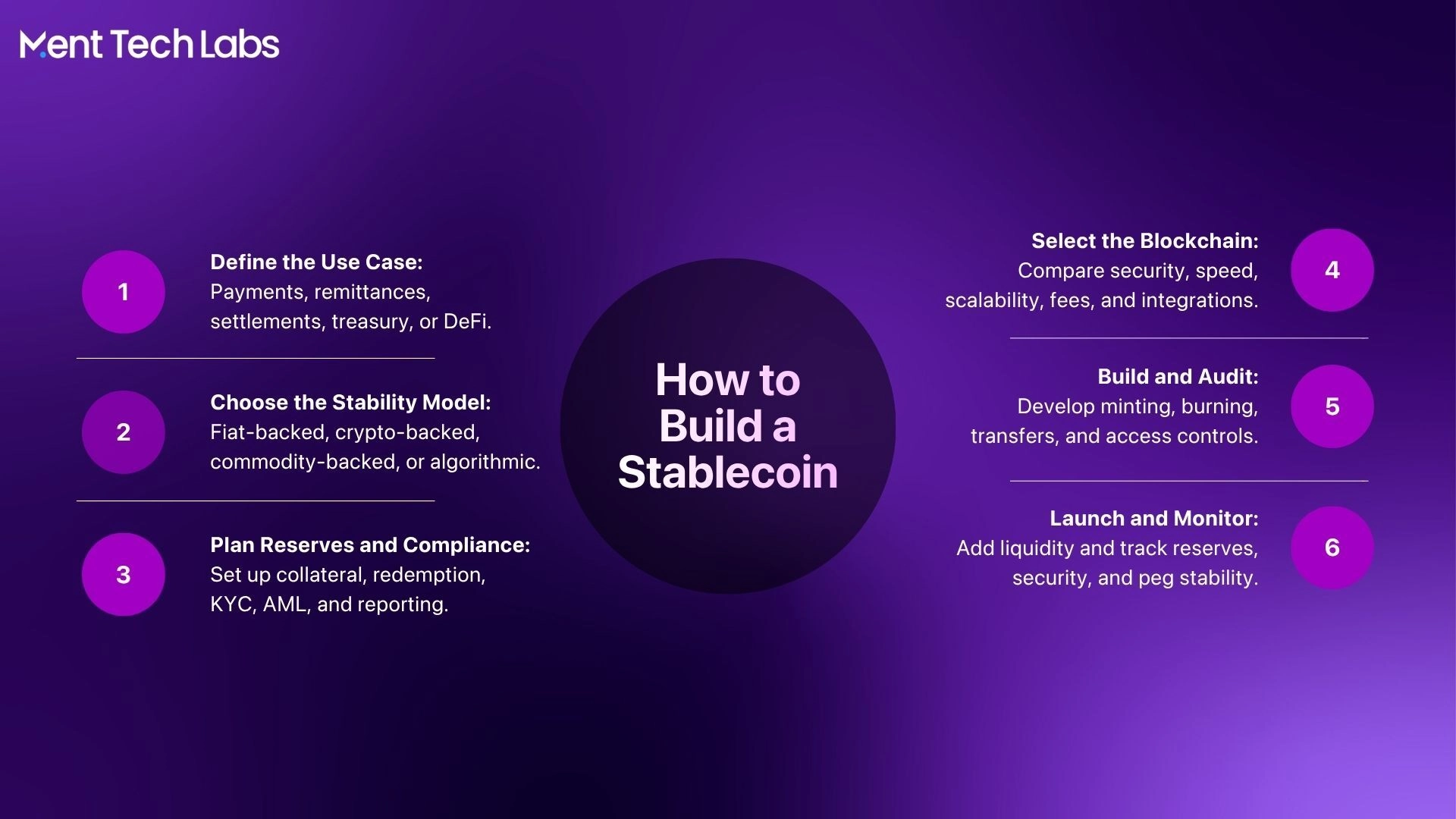
Understanding how to build a stablecoin starts with planning its purpose, backing model, technology, and compliance requirements.
Step 1: Define the Use Case
Decide whether the stablecoin will support payments, remittances, trading, treasury transfers, DeFi, or another business need.
Step 2: Choose the Stability Model
Select a fiat-backed, commodity-backed, crypto-backed, or algorithmic model based on your reserves, risk level, and target users.
Step 3: Plan Reserves and Compliance
Define how reserves, redemptions, reporting, and user verification will work. Add KYC and AML compliance solutions early in the process.
Step 4: Select the Blockchain
Choose a network based on transaction speed, fees, security, scalability, and support for wallets, exchanges, and payment applications.
Step 5: Build and Audit the Platform
Develop the minting, burning, transfer, permission, and redemption logic. Test and audit every critical part of the stablecoin platform development.
Step 6: Launch and Monitor
Deploy the token, add liquidity, and connect the required platforms. Continue monitoring reserves, transactions, security, and peg performance after launch.
What Does a Stablecoin Development Company Do?
A stablecoin development company develops an idea of a stablecoin into a fully secure, functional, and ready-to-launch product. It gathers in one place the technologies, the reserve mechanism, the applicable rules, and the integrations required for the system to work.
- Understands the business model and recommends the right stablecoin structure.
- Builds smart contracts for minting, burning, transfers, and access control.
- Sets up reserve management, custody, reconciliation, and redemption flows.
- Adds KYC, wallet screening, transaction monitoring, and compliance checks.
- Tests the platform thoroughly and supports independent security audits.
- Connects the stablecoin with wallets, exchanges, payment systems, and APIs.
- Provides ongoing support for monitoring, upgrades, and multichain expansion.
- An experienced blockchain development company also helps the platform scale securely as usage grows.
How Does Stablecoin Development Create Revenue for Enterprises?
A strategically planned stablecoin development model can generate additional revenue streams apart from plain token transfer. An enterprise can benefit through reserves, transactions, platform access, and new digital payment services.
1. Returns From Reserve Assets
Issuers backed by reserves may generate income by maintaining a portion of their reserves in cash or short-term government bonds.
2. Minting and Redemption Fees
Businesses can charge a small fee when users issue new stablecoins or convert them back into fiat currency.
3. Payment and Settlement Fees
A stablecoin payment platform can generate revenue from cross-border transfers, merchant settlements, supplier payments, and customer payouts.
4. API and Platform Access
Companies can offer payment APIs, wallets, treasury dashboards, and white-label infrastructure through subscription or usage-based pricing.
5. New Financial Services
Can be used for remittance, payroll, and international payments, as well as embedded finance products, enabling businesses to expand into new markets and acquire new customers.
Final Thoughts
Stablecoins are rapidly establishing themselves as an integral component of electronic payments, settlement of cross-border transactions, treasury management, and DeFi. They leverage the processing power of blockchain while providing an increase in price stability.
However, the development of a safe stablecoin is not just about designing and issuing a token. Reserves, smart contracts, compliance, security, liquidity, and a redemption system have to seamlessly function.
By collaborating with a reliable stablecoin development company, organizations can develop a flexible, open financial platform that stands the test of time. Contact Ment Tech Labs today to discuss your stablecoin project.