Your daily operations rely on dozens of intertwined systems: your CRM, your ERP, payment systems, analytical platforms, cloud computing, AI agents, etc. All of these talk to one another, exchanging information successfully through API calls.
A faulty API design and poor API security will result in serious consequences that require significant time and money to fix later on: disclosure of your customer information, malfunction of the business workflow, violation of laws and standards, etc.
This is why services for building secure APIs are essential. For companies developing enterprise software, AI agents, or other platforms that integrate with external systems, secure APIs should be an imperative in their overall security, functionality, and development strategy.
Explore More: Discover how Ment Tech Labs can help you build secure APIs and AI-ready integrations for enterprise software, automation, and intelligent agents.
What Are API Development Services?
Here is something most businesses do not realize until they are deep into a software project. Getting two systems to exchange data is the easy part. Getting them to do it securely, reliably, and in a way that still makes sense six months later, when your team has grown, and your stack has changed, that is where API development services actually earn their place.
It covers everything from the initial architecture decisions all the way through to security hardening, documentation, and ongoing maintenance. For companies building enterprise platforms or working with an AI agent development company, it usually looks something like this:
Custom API Development: APIs shaped around how your business actually operates, not generic solutions you have to work around.
REST API Development: The go-to architecture for web and mobile apps, simple to understand and built to scale.
GraphQL API Development: A smarter way to query data, systems get exactly what they ask for and nothing they do not need.
Third-Party API Integration: Bringing in external tools like payment gateways, CRMs, ERPs, and cloud platforms without opening up new security risks.
Internal Enterprise APIs: Clean, secure connections between the departments, systems, and data sources living inside your organization.
Mobile App APIs: The backend layer that keeps your mobile apps talking to your core systems without delays or data gaps.
Cloud API Development: APIs built for cloud environments where performance and reliability at scale are non-negotiable.
API Testing and Monitoring: Catching performance issues and security gaps continuously, not just at launch and never again.
API Documentation: Documentation that developers actually want to use, clear, organized, and easy to hand off across teams.
API Security and Authentication: OAuth, token management, encryption, and access controls baked in from the start, not bolted on at the end.
The Security Risks of Poor API Development
Nobody builds a weak API on purpose. It usually happens because the team was heads down, deadlines were pressing, and security felt like something to revisit once things settled down. The trouble is, things rarely settle down. And for businesses handling real customer data, live payment flows, and operational workflows that entire teams depend on, that delay can turn into something genuinely painful. Here is what tends to go wrong:
1. Unauthorized Access
The wrong people end up inside systems they were never meant to touch. Half the time, nobody realizes it until something has already broken or gone missing.
2. Data Leakage
Sensitive information slips out through API responses that were never properly reviewed. It sits there quietly until someone finds it, and that someone is not always on your team.
3. Weak Authentication
An API without solid authentication is an open invitation. It might not get exploited today, but it will eventually.
4. Overexposed Endpoints
Leaving endpoints open that do not need to be accessed gives attackers more to poke around in than they should ever have access to.
5. Broken Access Control
People and systems start seeing data and triggering actions that should have been completely out of reach. It happens more often than most engineering teams would like to admit.
6. API Abuse and Rate-Limit Attacks
No rate limiting means anyone can hammer your APIs repeatedly, either knocking things offline or quietly siphoning data without a single alarm going off.
7. Poor Logging and Monitoring
Flying blind is fine until it is not. Without visibility into what your APIs are doing, you are always the last to know when something goes wrong.
8. Unsecured Third-Party Integrations
Every external tool you connect to is another door into your systems. If those connections are not secured properly, you are trusting a lot to chance.
9. Compliance Risks
Regulators are not particularly sympathetic to “we were moving fast.” Insecure APIs put businesses on the wrong side of data protection laws, and cleaning that up takes far longer than preventing it would have.
Why Secure APIs Are Critical for Enterprise Software
Enterprise software is never just one system. It is a whole ecosystem of platforms, tools, and databases that someone, at some point, decided all needed to talk to each other. And for the most part, that works beautifully until one of those connections is not secure, and suddenly a problem that started in one corner of your stack has spread somewhere it really should not have. Here is where getting API security right tends to matter most:
- CRM and ERP Integrations
These are the systems most businesses genuinely cannot function without. An insecure API sitting between them is not just a technical problem. It is a quiet threat to the accuracy of every decision being made across your operation on a daily basis.
- Legacy System Modernization
Most enterprises are not starting fresh. There is older infrastructure that has been running for years and cannot just be turned off overnight. Secure APIs act as the bridge between what exists and what is being built, letting businesses modernize at their own pace without tearing everything down.
- Internal Workflow Automation
Approvals, reporting, and syncing data between departments. These things sound routine until they stop working. Secure internal APIs are what keep the everyday machinery of a business running without someone having to step in and fix things manually.
- Vendor and Partner Integrations
Bringing external partners into your data ecosystem is a necessary part of doing business. It also raises the stakes. Secure APIs make sure the right information gets shared, and nothing beyond that finds its way out.
- Real-Time Data Sharing
Nobody wants to make decisions based on data from an hour ago. Secure APIs make it possible to share live information across systems and teams without sacrificing the protections that should be around that data at all times.
How Secure API Development Supports AI Agent Workflows
AI agents are only as reliable as the systems they connect to. An agent with no guardrails is not a productivity tool; it is a problem waiting to happen. Secure APIs are what give businesses the confidence to actually put AI agents to work. Here is how:
1. Gives AI Agents Controlled Access to Business Data
Not every agent needs access to everything, and it should never have it. A well-built API lets you decide what the agent can see, when it can see it, and what it is allowed to do. That is what makes an AI agent something you can actually trust in a live business environment.
2. Protects Sensitive Enterprise Information
When AI agents are touching live business data, authentication, encryption, and permission-based access are not extras. They are the only thing standing between your systems and an agent reaching something it was never supposed to get near.
3. Enables Safe Tool and App Integrations
An AI agent needs to connect with CRMs, ERPs, databases, and internal tools to be genuinely useful. Secure APIs make that happen without every new integration turning into something the security team loses sleep over.
4. Supports Real-Time Workflow Automation
Creating tickets, updating records, triggering approvals. AI agents can handle all of this through secure APIs without anyone stepping in manually and without something quietly breaking in a system that was never built with automation in mind.
5. Improves Monitoring and Accountability
When an AI agent does something inside your systems, there should be a record of it. API logs show exactly what was accessed, what changed, and what was triggered. That visibility becomes incredibly valuable the moment something unexpected happens, and people start asking questions.
Core Security Features Every Enterprise API Should Have
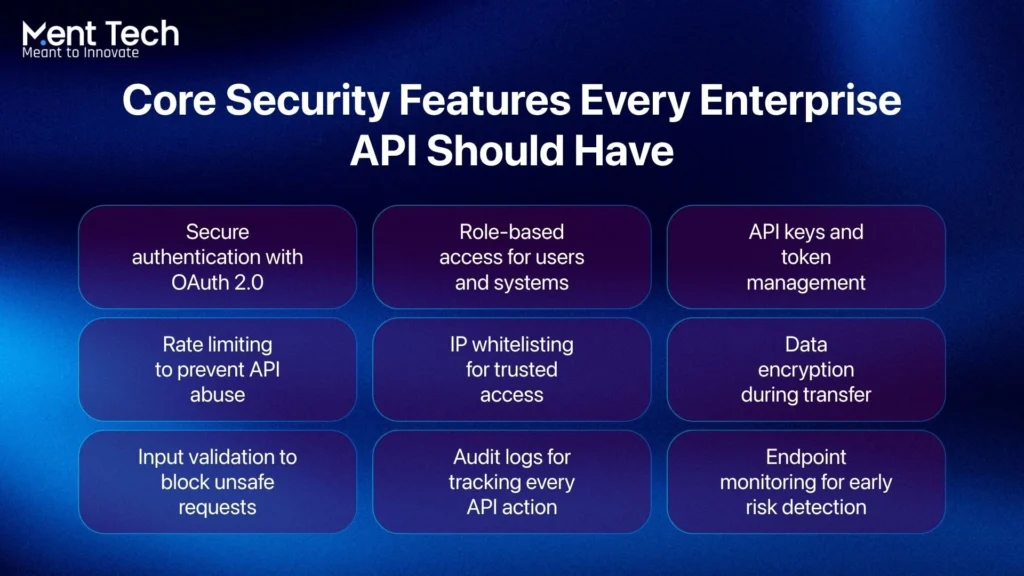
Building an API that works is one thing. Building one that holds up under real business conditions, handles sensitive data responsibly, and does not create problems down the line is a completely different challenge. For any enterprise software development company or custom software development company serious about long-term reliability, these are the security features that should be non-negotiable from day one:
OAuth 2.0 and Secure Authentication
Industry standard authentication that makes sure only verified users and systems can get through the door in the first place.
Role-Based Access Control
Not everyone needs access to everything. Role-based controls make sure people and systems only see what they are actually supposed to see.
API Keys and Token Management
Properly managed keys and tokens keep access traceable and make it straightforward to revoke permissions the moment something looks off.
Rate Limiting and IP Whitelisting
Putting a ceiling on requests and restricting access by IP address stops abuse before it has a chance to escalate into something serious.
Data Encryption and Input Validation
Encrypting data in transit and validating every input closes off two of the most commonly exploited entry points in any API.
Audit Logs and Endpoint Monitoring
A full record of what was accessed, changed, or triggered is not just good practice. For businesses deploying AI development services or running generative AI integration services, it is the only reliable way to know exactly what your AI agents have been doing inside your systems at any given point.
Role of MCP Server Integration Services in AI Agent Connectivity
MCP stands for Model Context Protocol, and in plain business terms, it is a structured way for AI agents to connect to tools, APIs, databases, and enterprise systems without having to build every integration from scratch. Instead of stitching together custom connections for every system your agent needs to touch, MCP handles it through a single controlled layer that covers tool access, secure data retrieval, and workflow automation. For businesses investing in MCP server integration services, this means less complexity and a much clearer view of what your AI agents are actually doing day-to-day.
The reason this is becoming harder to ignore is that AI agents are spreading across business operations fast, and uncontrolled system access is a risk that grows right alongside them. Without a proper connection layer, agents become difficult to monitor and even harder to hold accountable. For any business working with an AI agent development company to deploy agents at scale, MCP integration is what turns a powerful but unpredictable agent into something that actually fits safely into your enterprise environment.
How Generative AI Integration Services Depend on Secure APIs
A generative AI tool sitting in isolation is interesting. One that’s connected to your real business data and live workflows is actually useful. But that connection runs through APIs, and if those APIs are not secure, you are essentially handing an AI tool the keys to your internal systems and hoping for the best. Generative AI integration services are only ever as good as the API infrastructure behind them. Here is where that matters most:
- AI Copilots and Internal Knowledge Bases
Connecting an AI copilot to your internal documentation and knowledge systems makes it actually useful rather than just generically smart.
- Customer Support Assistants
Support agents powered by AI need live access to customer data and history to give answers that are relevant and accurate.
- Sales Enablement Assistants
AI tools that help sales teams work better need secure access to CRM data, product information, and deal history without that data sitting exposed.
- Enterprise Search Systems
Searching across internal systems, documents, and databases through AI requires APIs that retrieve the right information without unlocking everything else along the way.
- Report Generation and Document Review
Whether summarizing contracts, reviewing invoices, or generating reports, AI development services built on secure APIs ensure sensitive business documents stay protected throughout the process.
- AI-Powered SaaS Features
For any custom software development company embedding generative AI into a SaaS product, secure APIs are what make those features reliable and safe enough for enterprise customers to actually trust.
Secure API Development for Custom and Enterprise Software
Any enterprise software development company worth its salt will tell you that APIs are not something you figure out at the end of a project. By then, it is too late. They need to be thought through from the very beginning, built to handle real scale, locked down properly, and designed with the understanding that your business will look very different a couple of years from now. Cloud-native architecture, secure data exchange, legacy modernization, custom portals, and enterprise integrations. None of these are items to tick off a list. They are what separates software that keeps working as you grow from software that quietly becomes your next big headache.
When AI is part of the picture, that foundation becomes even more critical. Trying to layer AI development services onto software that was never architected to support them is genuinely painful and expensive. Getting things right from the start means your AI agents, automation workflows, and integrations have something dependable underneath them. Ongoing monitoring makes sure that dependability holds up as your systems get more complex and your data keeps growing.
Benefits of Secure API Development Services
Secure APIs are not just something the engineering team cares about. They shape how reliably your business runs, how safely you can bring AI into your operations, and how much friction your teams deal with daily. Here is what actually changes when API development services are done properly:
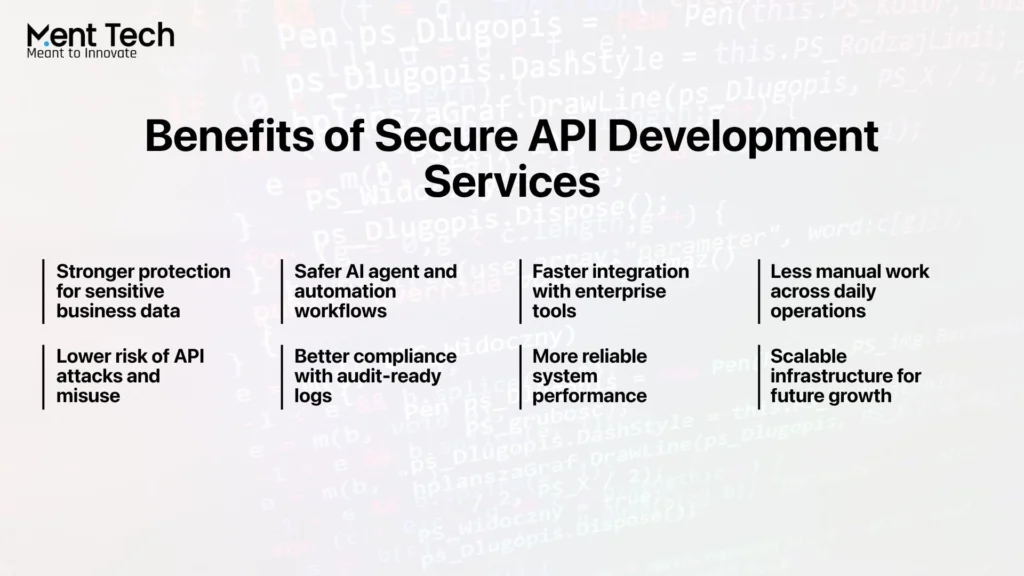
Stronger Data Security: Sensitive data stays protected at every point it moves, not just at the obvious entry points that most people think to secure.
Safer AI Agent Workflows: Agents work within boundaries that you define, which means far less risk of something being accessed or triggered that nobody intended.
Faster System Integration: Well-built APIs connect platforms and tools without the endless back and forth that always seems to come with integrations that were not thought through properly.
Reduced Manual Work: When APIs are solid and reliable, automation does what it is supposed to do, and your teams stop spending half their time firefighting broken workflows.
Lower Operational Risk: A smaller attack surface, cleaner audit trails, and a much easier time demonstrating compliance when someone comes asking for it.
Scalable Infrastructure: For any business working with an enterprise software development company to grow its digital footprint, secure APIs are what allow systems, teams, and customer experiences to scale without everything creaking under the pressure.
Final Thoughts: AI Agents Are Only as Reliable as the APIs Behind Them
Here is the truth. AI agents and enterprise software are only as good as what is connecting them. Secure APIs are what allow agents to reach the right data, trigger the right workflows, and actually deliver on the automation promise that everyone is excited about. Take that foundation away, and even the smartest AI tool starts breaking down the moment it hits a real business environment.
Weak API development does not announce itself. It shows up quietly as a security gap nobody noticed, a workflow that keeps failing at the wrong moment, a compliance issue that surfaces during an audit, or a performance problem that takes months to trace back to its source. None of it is inevitable. It is just what happens when API security gets pushed down the priority list one too many times.
Ment Tech Labs is a trusted technology partner helping businesses build secure, scalable API infrastructure for AI agents, enterprise software, and digital products that need to hold up under real pressure. If you are ready to get the foundation right, we would love to talk.
Contact Us: Partner with Ment Tech to build secure API infrastructure for AI agents, enterprise software, and scalable digital products.