Not long ago, businesses were comfortable with AI systems that did the job. They followed fixed rules, learned from past data, and gave decent results as long as the market stayed predictable. But that is not the world in which businesses are operating anymore. Customer behavior changes faster, demand shifts without much warning, and old AI models can quickly start making decisions based on outdated patterns.
In 2026, companies need AI that can keep up. Deloitte’s 2026 State of AI in the Enterprise report found that 34% of organizations are already using AI to deeply transform their business, while 30% are redesigning key processes around AI. That says a lot about where the market is heading.
That is where adaptive AI development services are becoming important. Instead of building AI once and letting it sit unchanged, companies are now investing in systems that learn, improve, and adjust over time. It is a more practical way to use AI in a market that keeps moving.
Explore how Ment Tech Labs can help you build adaptive AI systems that evolve with your business, customers, and industry needs.
What Are Adaptive AI Development Services?
Most AI systems are developed through a single construction process, which requires training with a specific dataset before they become accessible for public use. The system keeps delivering its best results until the moment when its operational data becomes obsolete. The development service for Adaptive AI enables you to create Artificial Intelligence systems that continuously learn from current information, user actions, and organizational performance evaluations.
The system consists of machine learning models that adjust to different situations and AI agents who change how they function, recommendation systems that learn from their experiences, generative AI assistants, adaptive AI chatbots, and predictive analytics, which sustain their precision.
None of this creates real value in isolation, though. Adaptive AI works best when it is connected to the systems your teams already use, and that is what enterprise AI integration services handle. When your AI is plugged into your CRMs, data pipelines, and support tools, it stops being a standalone feature and starts driving decisions across the whole business.
Why Adaptive AI Matters for Businesses in 2026
The main business obstacle that all companies encounter today exists because they lack access to essential business information and advanced technological systems. Business organizations built their current operational systems to meet their needs at that time, but these systems now fall short of handling today’s fast technological advancements. This is how things operate in real life.
1. Changing Customer Expectations: What worked for your customers last year probably does not land the same way today. People expect faster, more personal experiences, and they will switch to a competitor who delivers that without thinking twice.
2. Market Uncertainty: Nobody saw half of last year’s market shifts coming. Businesses that relied on fixed models were caught flat-footed. Adaptive AI at least gives you a system that moves with the market instead of lagging behind it.
3. Legacy Systems: Old infrastructure was never designed for the pace of today’s operations. Adaptive AI development services help businesses layer intelligence on top of what already exists instead of rebuilding everything from scratch.
4. Demand for Personalization: People are tired of the generic. Whether it is product recommendations, support interactions, or marketing messages, adaptive AI chatbots and intelligent systems make personalization actually scalable.
5. Need for Faster Response Times: Fraud happens in seconds. Customer frustration builds in minutes. Supply chain gaps compound daily. Speed is not a nice-to-have anymore. It is the whole game.
How Adaptive AI Works in Real Business Operations
Most people think AI is some complex black box that only engineers understand. Adaptive AI is actually pretty logical once you see it in action. Here is how it really works.
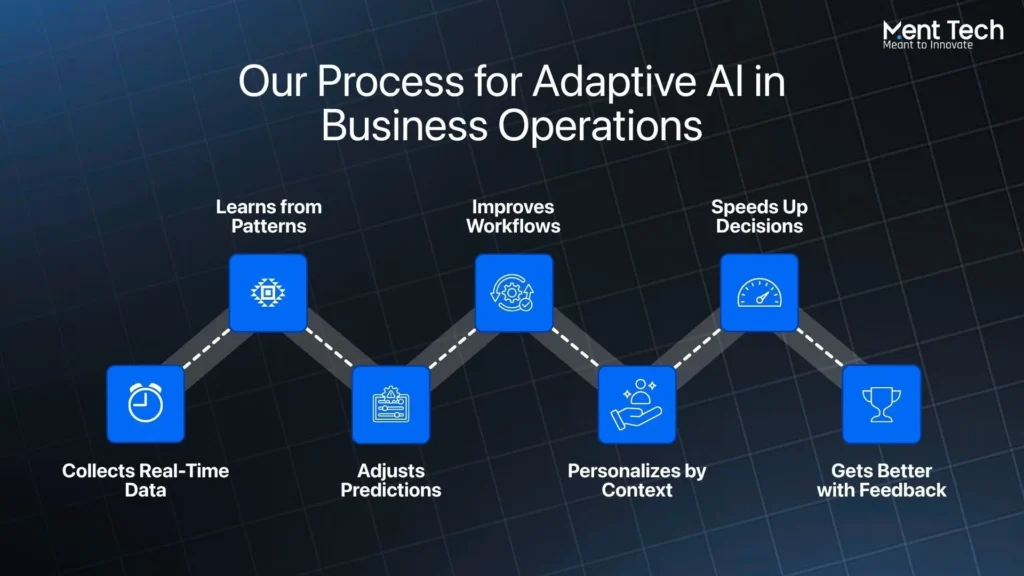
Step 1: Collect Real-Time Data
It starts by paying attention. Not to last month’s data or last quarter’s report, but to what is actually happening in your business right now, every transaction, every interaction, every signal.
Step 2: Learns from Patterns and Outcomes
It starts connecting dots you would never have time to connect manually. What worked? What did not? What showed up right before things went wrong? It keeps building on that knowledge every single day.
Step 3: Adjust Predictions and Recommendations
Here is where it gets valuable. When conditions shift, the system shifts with them. Adaptive AI development services make sure your AI is always working off current reality, not an outdated snapshot.
Step 4: Improves Workflows Automatically
It does not wait for someone to notice a better way of doing things. When it finds one, it adjusts on its own. That kind of quiet efficiency adds up fast across an entire operation.
Step 5: Personalizes Responses Based on Context
It knows who it is talking to and what has worked in similar situations before. That means every customer interaction, every recommendation feels relevant rather than copy pasted.
Step 6: Supports Faster Decision-Making
People today need information that they can access instantly because they do not have to wait until weekly reports are delivered. Adaptive AI uses its capabilities to deliver precise information to specific users at every moment, which enables organizations to take necessary actions at critical times.
Step 7: Gets Better with Feedback
Every interaction teaches it something new. Every outcome, every correction makes it a little sharper. That is what separates adaptive AI from everything that came before it.
Industries Using Adaptive AI Development Services in 2026
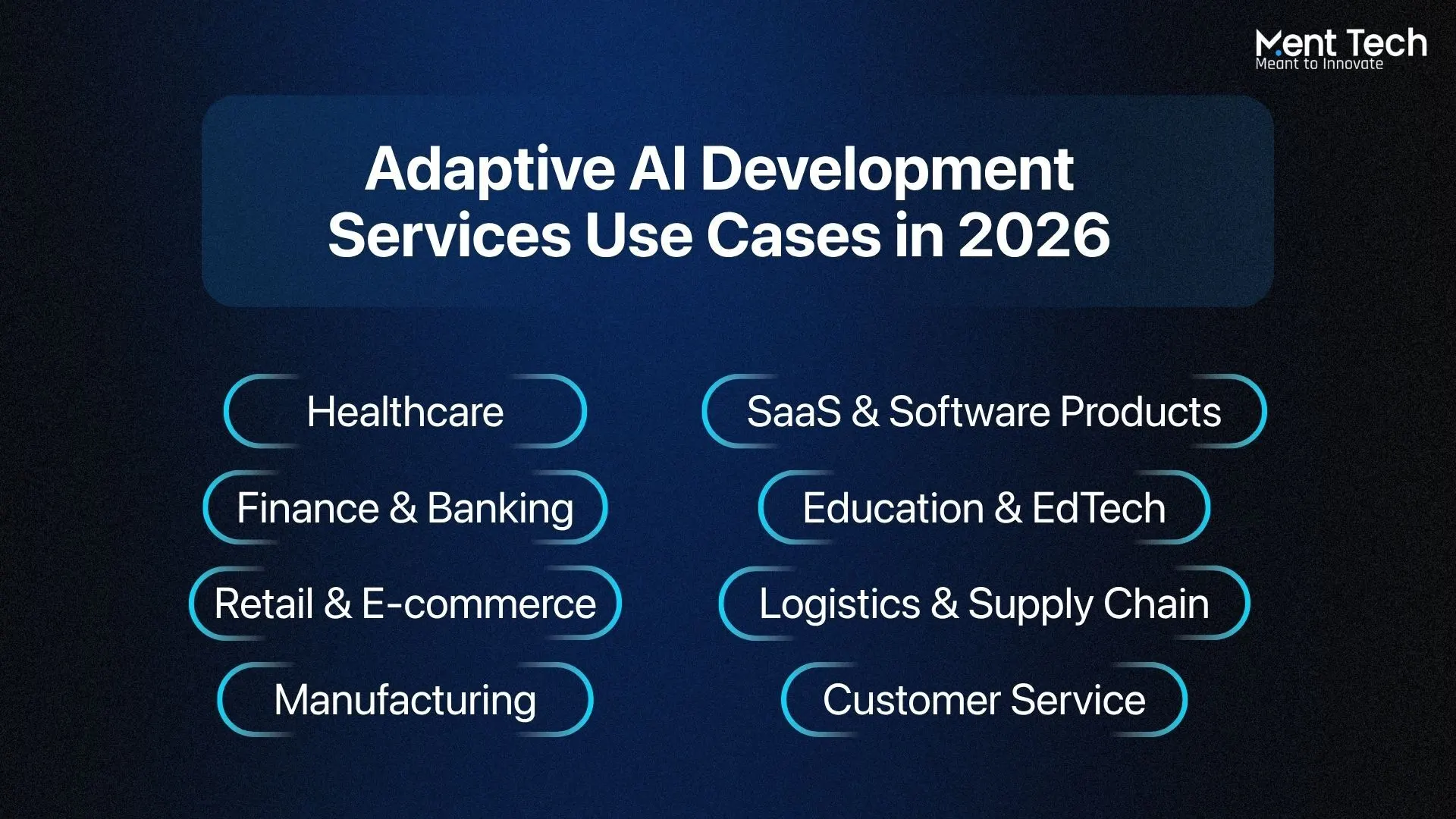
From healthcare to logistics, businesses across every sector are moving past static AI and building systems that actually adapt to how their industry operates. Here is where it is making the biggest impact right now.
1. Healthcare
Healthcare has always dealt with high-stakes decisions made under pressure with incomplete information. Adaptive AI is changing that by giving providers systems that actually keep up with how fast patient conditions and care needs evolve.
- Patient risk prediction that catches warning signs before a condition gets serious.
- Treatment planning that adjusts based on real patient history, lab results, and ongoing care data.
- An AI chatbot support that handles routine patient queries instantly without burning out the staff.
2. Finance and Banking
Money is one of those areas where being a few seconds too slow can cost you a lot. Fraud does not wait, markets do not pause, and customers definitely do not want to feel like just another account number. Adaptive AI helps financial institutions actually keep up with all of that.
- Real-time fraud detection that catches something suspicious the moment it shows up, before it turns into a real problem.
- Credit risk analysis that looks at how someone is behaving right now, not just what their score said six months ago.
- AI chatbot support that gives customers real answers instantly, so they are not sitting on hold for something that should take thirty seconds.
3. Retail and E-commerce
Retail is brutally competitive, and customers have zero patience for experiences that feel out of touch. If your recommendations are stale and your pricing is off, they will just buy it somewhere else. Adaptive AI makes sure that does not happen.
- Recommendations that actually match what someone is interested in right now, not some generic bestseller list.
- Pricing and demand forecasting that moves with the market, so you are never caught overstocked or underselling.
- AI chatbot development that feels like a helpful shopping assistant, not a bot reading from a script.
4. Manufacturing
Nobody on a factory floor wants to deal with a machine breaking down in the middle of a production run. It throws everything off, and the costs stack up fast. Adaptive AI development services help manufacturers get ahead of those moments instead of scrambling to recover from them.
- Predictive maintenance basically tells you a breakdown is coming before it actually happens, so you are fixing things on your own terms, not the machine’s.
- Quality control that catches something going wrong on the line the moment it starts, not after an entire batch has already been ruined.
- Supply chain forecasting that gives you enough of a heads up on disruptions that you can actually adjust before production feels the impact.
5. SaaS and Software Products
Most SaaS products lose users not because the product is bad, but because people never figure out how to get value from it. Adaptive AI fixes that by learning how users actually behave and shaping the experience around them.
- Smart onboarding that adjusts to how a new user navigates instead of throwing everyone through the same generic flow.
- Feature recommendations that show up when they are actually relevant, not buried in a menu nobody opens.
- AI agent development that quietly handles the repetitive stuff so users can focus on the work that actually matters.
6. Education and EdTech
Every student learns differently, and a platform that ignores that is going to lose them. Adaptive AI helps EdTech products actually adjust to each student’s pace, strengths, and gaps instead of pushing everyone through the same experience.
- Personalized learning paths that shift based on what a student knows and where they are getting stuck.
- Adaptive assessments that meet students where they actually are, not where the syllabus assumes they should be.
- An AI chatbot supports that answers student questions instantly, even at midnight when no one else is available.
7. Logistics and Supply Chain
Anyone who has worked in logistics knows that one small delay can unravel an entire chain of plans. Adaptive AI helps businesses stay ahead of those moments instead of constantly putting out fires after the fact.
- Route optimization that does not just plan the best path but actually adjusts when something goes wrong mid-delivery without anyone having to step in.
- Demand planning that spots inventory shifts early enough that you are not scrambling to explain to customers why their order is three weeks late.
- Delivery predictions that tell you and your customers what is genuinely going to happen, not just the best-case scenario everyone hopes for.
8. Customer Service
Bad customer service is remembered. A bot that misunderstands, a ticket sent to the wrong team, a response that misses the point entirely. Adaptive AI tackles exactly those moments that make customers lose patience.
- AI chatbot development that builds bots that actually learn from every conversation and get sharper over time, instead of giving the same wrong answer on loop.
- Sentiment-based escalation that catches when someone is about to lose their patience and gets a human involved before it turns into a complaint.
- Generative AI development that helps support agents pull up the right information instantly, so no customer is sitting there waiting while someone searches for an answer.
Benefits of Adaptive AI Development Services
The actual business inquiry regarding AI investments requires organizations to answer one fundamental question. What do we actually get out of this? The following advantages create significant value for our organization.
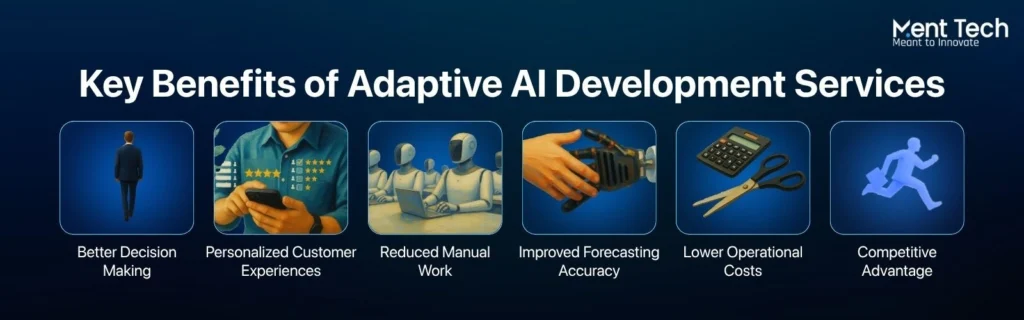
- Better Decision Making
When your AI is working off what is happening right now instead of data from six months ago, the decisions it supports are just better. Less second-guessing, fewer expensive mistakes, and a lot more confidence in the direction you are heading.
- Personalized Customer Experiences
People can tell when something feels built for them, and they can equally tell when it does not. Adaptive AI makes that level of personalization possible at scale without needing a whole team manually managing it behind the scenes.
- Reduced Manual Work
Honestly, there is still a lot happening inside most businesses that humans should not be doing by hand in 2026. AI agent development takes that off the plate so your teams can put their energy into work that actually needs a human brain behind it.
- Improved Forecasting Accuracy
Forecasts are only useful if they reflect reality. Adaptive AI builds predictions off live data and current market signals, which means your planning is based on what is actually going on, not what you hoped would happen.
- Lower Operational Costs
Most businesses are carrying more inefficiency than they realize, and it quietly costs them every single day. Generative AI development helps cut that waste by optimizing processes that have needed attention for a long time, but nobody has had the bandwidth to fix.
- Competitive Advantage
The businesses investing in enterprise AI integration services right now are not just solving today’s problems. They are building systems that get smarter over time, and that gap between them and everyone else is only going to grow.
Why Choose Ment Tech Labs for Adaptive AI Development Services
There are a lot of AI vendors out there making big promises. What actually matters is whether they can build something that works for your specific business, integrates cleanly with what you already have, and keeps delivering value long after launch. Here is what Ment Tech Labs brings to the table.
1. Custom Adaptive AI Solutions
No two businesses operate the same way, and Ment Tech Labs does not treat them like they do. Every solution is built around your specific workflows, data, and business goals rather than a template that kind of fits.
2. Enterprise AI Integration Services
Adaptive AI only creates real value when it is connected to the systems your business already runs on. Ment Tech Labs makes sure that the connection is seamless, secure, and built to scale.
3. AI Chatbot Development Expertise
From customer support to internal operations, Ment Tech Labs builds chatbots that actually learn and improve over time instead of giving the same scripted responses on loop.
4. AI Agent Development Capabilities
Ment Tech Labs builds intelligent agents that can handle multi-step workflows, connect with your existing tools, and make decisions autonomously, so your teams are not stuck managing every little process manually.
5. Generative AI Development Experience
Whether it is personalized content, automated reporting, or context-aware recommendations, Ment Tech Labs brings real generative AI development experience to every project and makes it practical for the teams actually using it.
Final Thoughts: Adaptive AI Is the Next Step in Business AI
The businesses that are pulling ahead in 2026 are not necessarily the ones with the biggest teams or the largest budgets. They are the ones who built AI systems smart enough to keep up with how fast everything moves. Static models and fixed automation had their moment, but that moment has passed.
Adaptive AI is what comes next. Systems that learn from real data, adjust when conditions change, and get sharper the longer they run. Every industry covered in this blog is already seeing what that looks like in practice, and the gap between businesses that have made that shift and those still running on outdated models is only going to widen.
If you are serious about building AI that actually grows with your business, now is the right time to start. Partner with Ment Tech Labs to build adaptive AI systems that evolve with your data, workflows, customers, and business goals.