Introduction
Teaching is hard but today it’s getting harder than ever. Teachers don’t just teach. They plan. They grade. They track progress. They answer the same questions again and again. They write parent emails, handle admin work, and still try to give every student individual attention. Every single day.
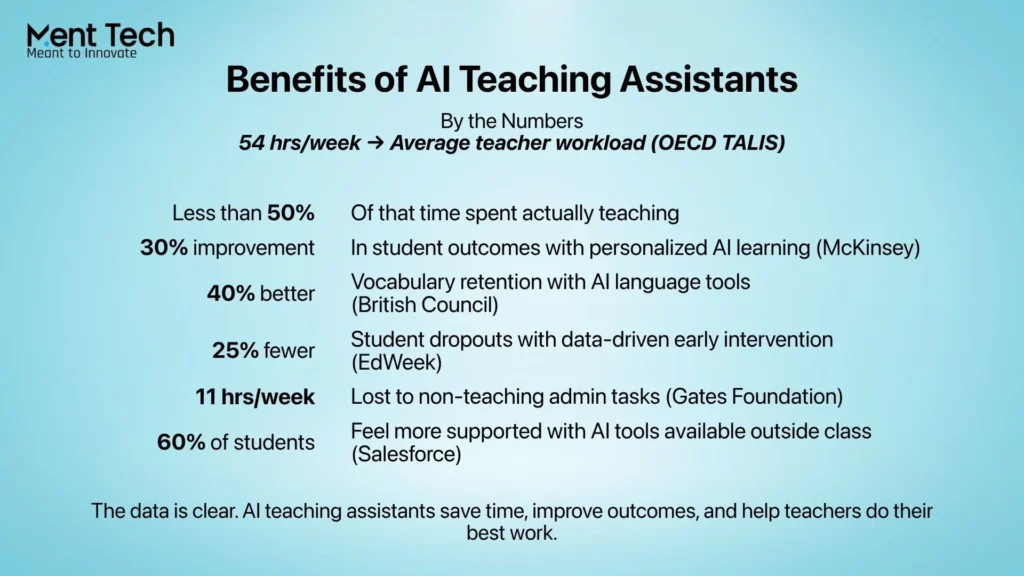
The OECD Teaching and Learning International Survey (TALIS) found that teachers work an average of 54 hours a week. Less than half of that time is spent actually teaching. That’s a problem worth solving.
An AI teaching assistant works like a smart digital partner. It handles the routine tasks. It answers common questions. It helps build learning materials. It gives teachers back their time, so they can focus on what matters most: their students.
Here’s what AI is not: a replacement for teachers.
Teachers bring empathy. Creativity. Judgment. Human connection. No technology replicates that. What AI does is lift the daily burden that drains teachers’ time and energy.
With thoughtful design and the right generative AI development, schools and EdTech platforms can build tools that actually fit how classrooms work, not the other way around.
What Is an AI Teaching Assistant?
It is a digital tool that helps teachers with their daily work. Not a robot. Not a replacement. Think of it as a smart colleague, always available, never tired.
It sits inside the tools teachers already use. A chat window. A school app. A learning management system. A classroom dashboard.
From there, it helps with everything. Planning lessons. Creating quizzes. Drafting feedback. Tracking student progress. Managing classroom communication.
It just gets things done.
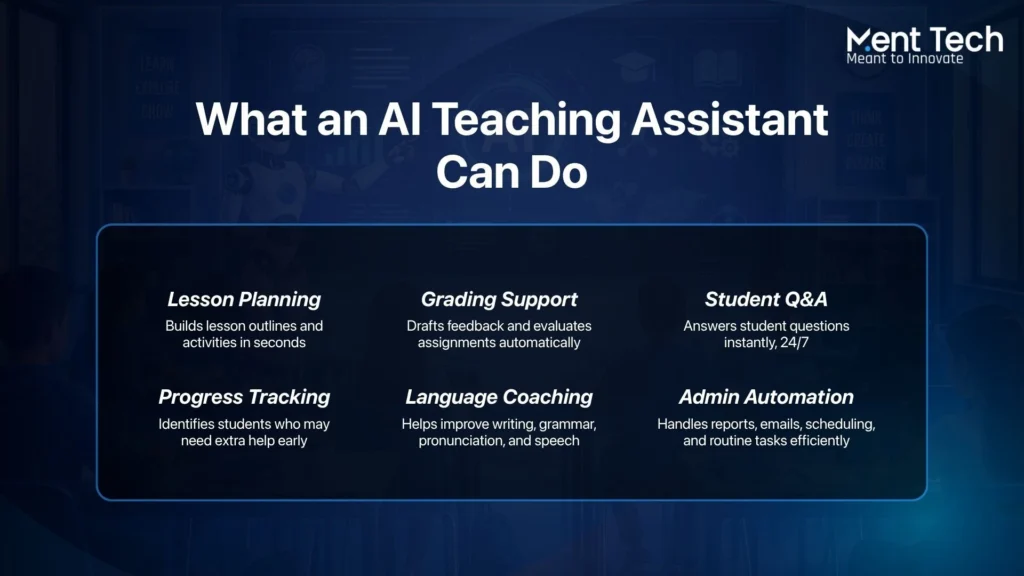
Here is what a well-built AI teaching assistant can do:
- Help teachers generate lesson outlines and classroom activities
- Answer student questions about topics, deadlines, and assignments
- Create quizzes, worksheets, and revision materials
- Suggest feedback on student work
- Track learning progress and flag struggling students
- Automate classroom reminders and admin tasks
- Support language learning and communication practice
An AI powered learning assistant can also help students practice concepts on their own outside class. And while students learn, the AI collects useful data that gives teachers better insight into who needs help and where.
7 Ways AI Teaching Assistants Are Making Life Easier for Teachers
1. Helping Teachers Create Lesson Plans Faster
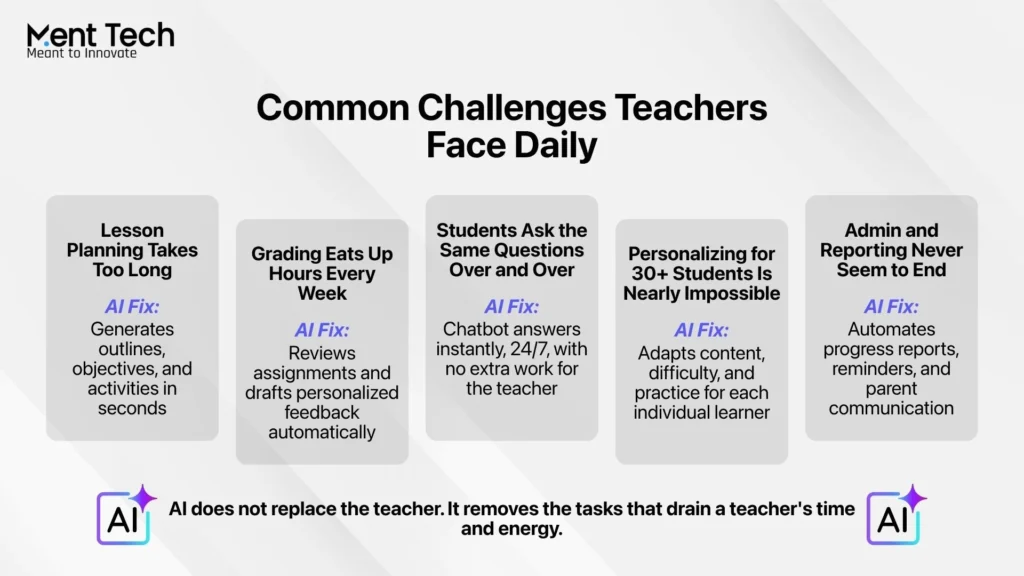
Lesson planning takes hours. Teachers research topics, write learning objectives, design activities, find examples, and adjust everything for different grade levels. It is creative work, but a big part of it is just repetitive structure.
An AI teaching assistant can generate a full lesson outline in seconds. It can suggest discussion prompts, classroom activities, age-appropriate explanations, and even homework ideas. The teacher reviews it, adjusts it to fit the class, and it is ready to use.
This does not take the teacher out of the process. It gives them a strong starting point instead of a blank page. Teachers save time without losing creative control.
For EdTech companies, this is a strong product opportunity. Using generative AI development, platforms can build lesson planning tools that let teachers create full, customized lesson plans in minutes, not hours.
2. Reducing Time Spent on Grading and Feedback
Grading is one of the most time-heavy parts of a teacher’s week. Reading through assignments, writing individual comments, and identifying patterns in mistakes takes a huge amount of effort, especially in large classes.
An AI teaching assistant can review student assignments and suggest feedback. It can highlight common mistakes across the class, create a summary of recurring errors, and draft personalized improvement notes for each student. The teacher reads the suggestions, edits them as needed, and sends them out.
The final judgment always stays with the teacher. AI does not replace that judgment. It makes the process faster and helps teachers give feedback that is more consistent and more detailed than they could manage alone.
Research from McKinsey shows that students using personalized, AI-driven learning tools show up to 30% improvement in learning outcomes compared to traditional methods. Students get better feedback. Teachers save hours every week. That is a clear win for everyone.
3. Answering Repetitive Student Questions
Every teacher knows the feeling. You explain an assignment clearly. You send the instructions. And then the questions start.
“What is the deadline?” “Can you explain that again?” “Which chapters do we need?” “What does this word mean?”
These questions are not bad. Students need support. But answering the same question thirty times takes real time and energy away from deeper teaching moments.
An AI teaching assistant can handle these repetitive questions automatically. Students ask. The AI answers, using information the teacher has already provided. It covers homework details, class topics, deadlines, assignment instructions, and basic concept explanations.
This is exactly where AI chatbot development adds strong value for schools, learning platforms, and EdTech apps. To understand how chatbots can be built with deep contextual knowledge for complex platforms, read our guide on - How to Build an AI Chatbot with RAG Integration for Enterprise Applications.
4. Supporting Personalized Learning
No two students learn at exactly the same pace. Some students grasp concepts quickly and need more challenges. Others need more time, more examples, or a different way of explaining the same idea.
In a class of thirty students, it is nearly impossible for one teacher to create separate learning materials for every student. That is where an AI powered learning assistant changes the game.
The AI can adapt explanations, practice questions, and study materials based on each student’s progress. It can identify skill gaps and offer targeted revision. It can give struggling students extra practice and give advanced students more challenging material, all at the same time.
Here is what personalized AI support can cover:
- Different learning speeds within the same class
- Targeted practice for specific skill gaps
- Revision support before tests and exams
- Concept reinforcement for students who need it most
- Extra challenge for students who are ahead
Teachers do not have to build all of this manually. The AI handles the personalization engine. The teacher focuses on guiding the class and mentoring individual students. This kind of adaptive, data-driven personalization is at the heart of modern AI systems. See how - Adaptive AI Development Services are already transforming learning and other industries in 2026.
5. Improving Language Learning and Communication
Language learning needs a lot of practice. Students need to speak, write, listen, and read in the target language as much as possible. But one teacher cannot practice one-on-one with thirty students at the same time.
An AI language coach fills that gap. It can help students practice speaking, writing, vocabulary, grammar, pronunciation, and reading comprehension. It gives instant feedback and adjusts the difficulty as the student improves.
This is especially valuable in multilingual classrooms where students come in with very different language backgrounds. Some students may need basic vocabulary support while others are working on fluency. An AI language coach can support all of them at their own level.
AI-powered language learning tools can improve vocabulary retention by up to 40% compared to traditional study methods.
Teachers can also use AI to adapt their own content. An AI tool can simplify instructions for students with lower reading levels or translate key concepts into language that is easier to understand. This makes classrooms more inclusive without adding more work for the teacher.
6. Automating Classroom and Administrative Tasks
Admin work is one of the biggest drains on a teacher’s day. Attendance summaries. Progress reports. Parent communication emails. Assignment reminders. Weekly learning updates. These tasks are important, but they do not require a teacher’s expertise to complete.
Teachers spend an average of 11 hours per week on non-teaching tasks like grading, reporting, and communication.
An AI teaching assistant can handle all of it. It can pull together attendance data and generate summaries. It can draft parent communication emails based on student progress. It can send classroom reminders and assignment notifications. It can create weekly learning reports and student performance notes.
This is where AI agent development becomes very powerful. An AI agent does not just answer questions. It completes multi-step tasks across different systems. For example, an AI agent can check student grades in the LMS, draft a progress report, and prepare a parent email summary, all in one automated flow. The teacher reviews and approves. The agent does the heavy lifting.
For school systems and EdTech platforms, this kind of automation means teachers spend more time in the classroom and far less time in front of admin screens.
For a deeper look at how AI agents automate complex, multi-step workflows across industries, see our breakdown of the Best AI Agent Development Companies in the USA - 2026.
7. Giving Teachers Better Insights into Student Progress
Teachers make hundreds of instructional decisions every week. Which students need extra help? Which topics need more classroom time? Which students are quietly falling behind without saying anything?
Without data, these decisions rely on intuition. With AI, teachers get clear, real-time insights.
An AI teaching assistant can analyze student performance patterns and surface the information teachers need. It tracks quiz scores, assignment completion, participation, and engagement trends. It flags students who are falling behind before they fall too far.
Schools that use data-driven tools to identify at-risk students early see a 25% reduction in dropout rates.
Here is what good AI insights can show a teacher:
- Which students are consistently struggling with specific topics
- Common mistakes across the whole class
- Students who have dropped in engagement or effort
- Learning gaps that need more classroom attention
- Students who may need additional one-on-one support
With this information, teachers can make smarter instructional decisions. They spend less time guessing and more time acting. Students get the right support at the right time.
How AI Teaching Assistants Fit Into EdTech Platforms
An AI teaching assistant is not just a standalone tool. It can be built into almost any education platform.
Here is where AI teaching assistants fit naturally:
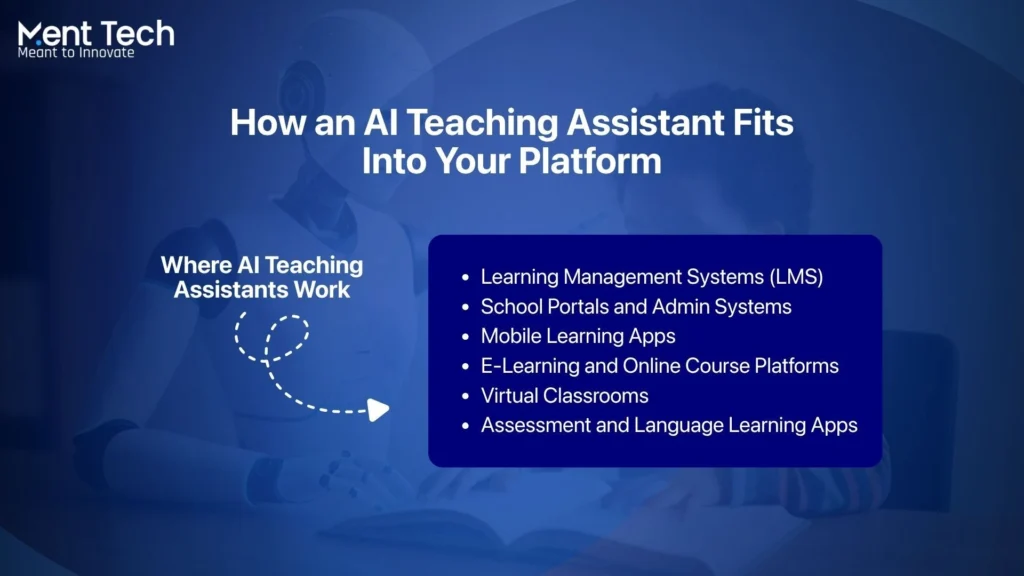
- Learning management systems (LMS)
- School portals and admin platforms
- E-learning and online course platforms
- Mobile learning apps
- Virtual classrooms
- Assessment and quiz platforms
- Language learning applications
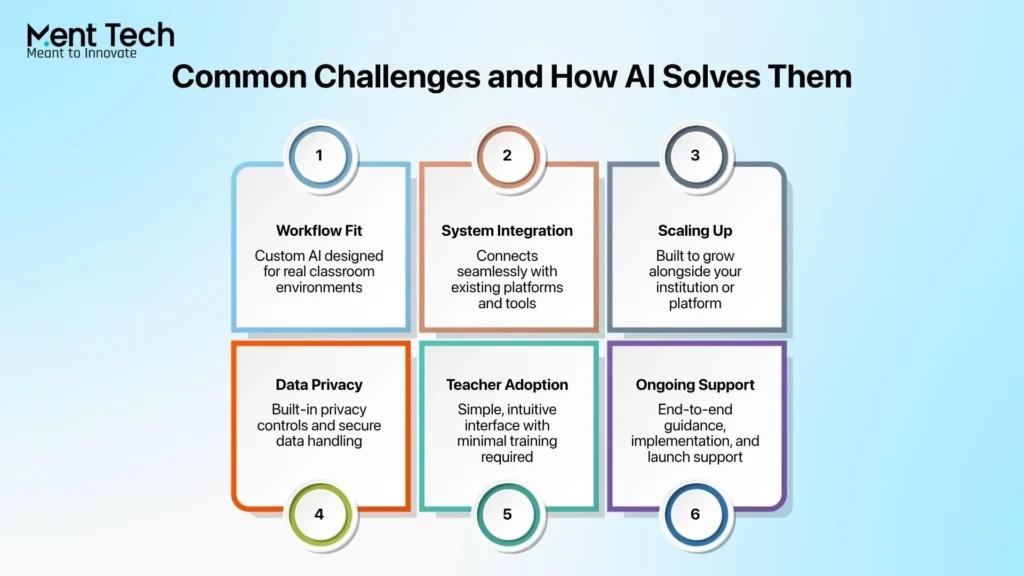
The key is custom integration. A generic AI tool might help a little. But a purpose-built AI teaching assistant designed for a specific platform and workflow delivers real results.
Ment Tech Labs specializes in building exactly this kind of custom solution. Whether you need AI chatbot development for a student-facing support bot, AI agent development for workflow automation, or full generative AI development for a content generation engine, the team can build it end to end. Integrating AI into existing platforms requires more than an API call. Read how AI Integration Services help businesses make AI work within their real operational systems.
Benefits of AI Teaching Assistants for Schools and EdTech Businesses
The benefits are practical and measurable. Here is what schools and EdTech companies gain with a well-built AI teaching assistant:
- Reduced teacher workload across lesson planning, grading, and admin
- Faster lesson preparation without cutting quality
- Improved student support through instant answers and personalized content
- Better learning personalization for students at every level
- Higher student engagement through more responsive learning tools
- More scalable learning platforms that can support larger student bases
- Stronger teacher productivity so educators focus on high-value work
- Improved learning outcomes driven by better data and faster feedback
- Stronger product differentiation for EdTech companies in a competitive market
The global AI in education market is projected to reach $32.27 billion by 2030, growing at a CAGR of 36% from 2023.
These are not just benefits for teachers. They are benefits for students, schools, and the companies building the next generation of education technology.
Why Choose Ment Tech Labs to Build AI-Powered Education Solutions
Building an effective AI teaching assistant requires more than a basic chatbot. It requires a deep understanding of classroom workflows, education data, student behavior, and platform integration.
Ment Tech Labs brings all of that together.
Here is what Ment Tech Labs offers:
- Custom AI education solutions built around real classroom needs
- Strong AI chatbot development expertise for student and teacher-facing tools
- AI agent development for multi-step workflow automation across school systems
- Generative AI development for content creation, lesson planning, and assessment tools
- Scalable EdTech product development from early concept to full deployment
- Secure data handling that meets education privacy standards
- End-to-end support covering strategy, design, development, and deployment
- Custom integrations with LMS platforms, school portals, and third-party education tools
The goal is not to build something that looks impressive in a demo. It is to build something that actually works in a real classroom for real teachers and students.
Final Thoughts: AI Should Support Teachers, Not Replace Them
The best classrooms are built on human connection. Teachers inspire curiosity, build confidence, support struggling students, and create the kind of learning environment that no algorithm can replicate.
An AI teaching assistant works best when it takes the repetitive, draining work off a teacher’s plate. When it handles the admin. When it answers the a questions. When it generates the first draft of the lesson plan. When it flags the student who is quietly falling behind.
That is when teachers get their time back. And with that time, they can do what they became teachers to do. Connect with students. Mentor. Inspire. Teach.