
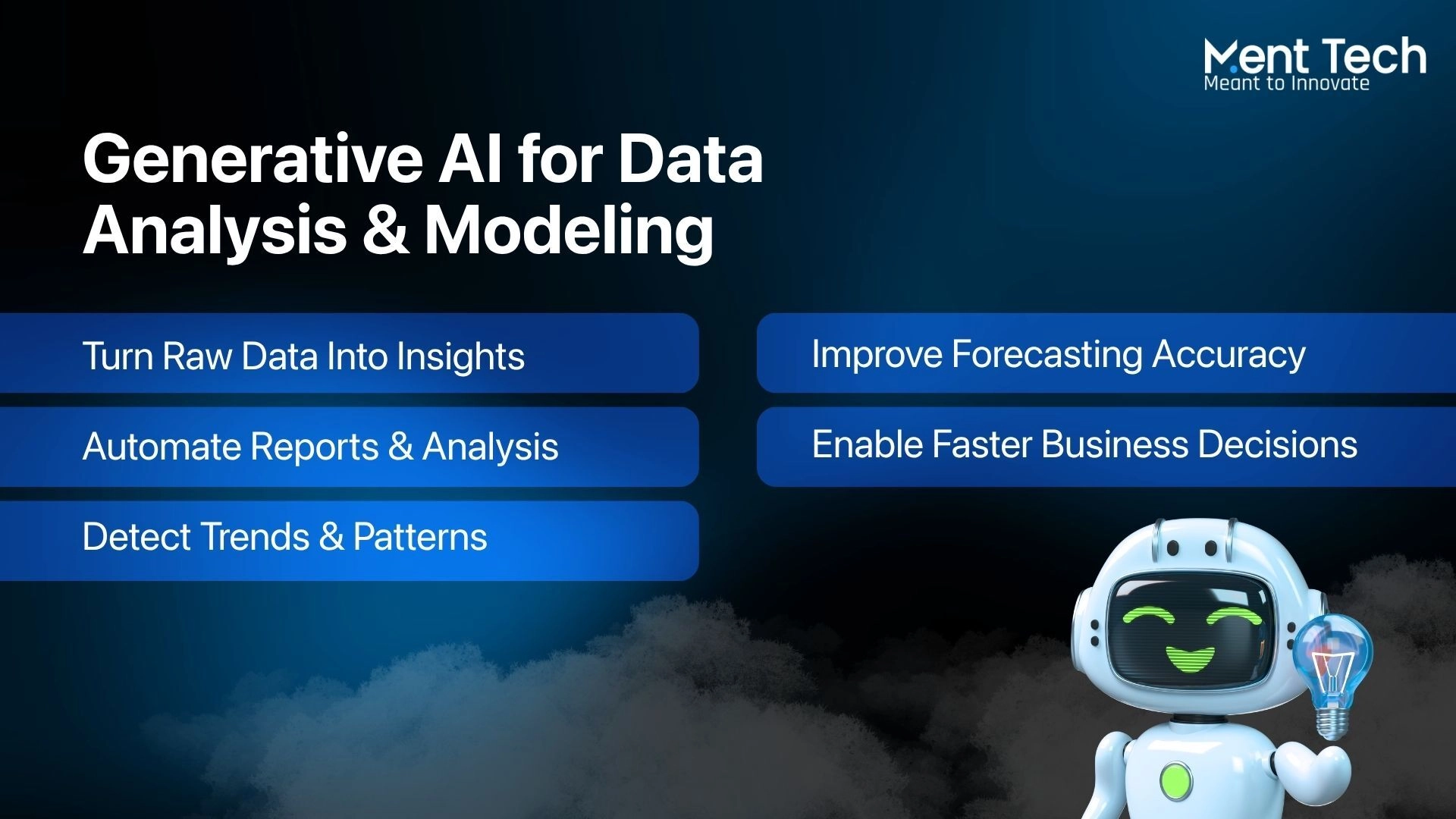
Most businesses today have more data than they know what to do with. Customer records, sales logs, marketing numbers, operational reports, product usage data. It piles up fast.
But here is the thing. Having data and actually using it are two very different things.
A lot of teams are still stuck in the same cycle. Someone needs a report, they ask the data team, the data team is already buried, the report comes back three days later, and by then the decision has already been made with guesswork anyway. The data backs this up - 73% of business leaders admit that data overload and lack of trust in their data has stopped them from making decisions at all.
That cycle is exactly what generative AI for data analysis is built to break. It helps businesses get real answers from their data, faster, and without needing a technical expert involved every single time.
Ment Tech Labs helps businesses build generative AI analytics solutions that connect with real data systems, automate reporting, and support faster business decisions.
What Is Generative AI for Data Analysis?
So what does it actually mean?
Generative AI for data analysis uses large language models, machine learning, and natural language processing to help people work with data in a much more practical way. Instead of writing queries or waiting on a report, a business user can just ask a question in plain English and get a direct answer.
But it goes beyond question and answer. It can summarize entire datasets, write reports automatically, flag unusual patterns before anyone notices them manually, support demand forecasting, and even explain what a dashboard is showing in simple language.
Here is what it typically handles:
- Natural language questions on live data
- Automated summaries and reports
- Pattern detection and anomaly alerts
- Predictive modeling support
- Synthetic data generation for testing
- Data quality and cleaning assistance
- End-to-end workflow automation via AI agents
The bottom line is that data stops being something only the technical team can touch.
Businesses looking to move fast can explore generative AI development services built around their existing data infrastructure.

How It Actually Improves the Way Teams Work
Let’s skip the theory for a minute and talk about what actually changes day to day.
Finance managers stop waiting two days for a report. They ask their question, they get their answer. Marketing leads can check campaign performance without pulling someone from the data team. Operations can get a daily briefing without anyone building it by hand.
That is the practical shift generative AI for data analysis creates.
Reports that used to take hours are generated in minutes. Anomalies that would have gone unnoticed until end of month get flagged the same day they appear. Dashboards that used to sit open on someone’s screen while they tried to figure out what the numbers meant now come with a plain-language explanation.
And for non-technical teams, this is honestly a bigger deal than most people realize. HR, finance, marketing, operations. These teams have always needed data. They just never had easy access to it. That changes with the right GenAI setup.
Key Use Cases of Generative AI for Data Analysis

Automated Data Summaries
Nobody wants to spend their Friday afternoon building a weekly report in Excel. GenAI can pull the data, write the summary, and have it ready before the team even logs on.
Sales performance, customer trends, product usage, financial variance. All of it, summarized automatically, in a format that is actually readable.
Natural Language Business Intelligence
This one is huge. Generative AI for data analysis lets people ask real questions and get real answers without any technical knowledge needed.
“Which sales rep closed the most deals last quarter?”
“What is our churn rate this month compared to last month?”
“Which region had the highest average order value in Q2?”
Used to be those questions needed a SQL query and a data analyst with availability. Now they take seconds.
Predictive Modeling Support
Forecasting demand, projecting revenue, predicting which customers are likely to churn. GenAI can support all of this. It helps prepare the data, explains what the model outputs mean, and presents forecasts in plain language that a leadership team can actually act on.
A SaaS business, for example, can use it to spot disengaged customers early. Drop in logins, fewer feature uses, unanswered support emails. The AI connects those signals before the customer cancels.
Anomaly Detection and Risk Signals
Sometimes a spike in returns is just a seasonal blip. Sometimes it is a product quality issue that needs urgent attention. The problem is, by the time someone spots it manually, it has already cost money.
GenAI monitors data continuously and flags unusual patterns early. Cost spikes, conversion drops, suspicious transactions, sudden shifts in customer behavior. This matters a lot in fintech, healthcare, and logistics where catching something late is expensive.
See how AI trading tools handle real-time financial signal detection.
AI-Generated Reports and Dashboards
Not everyone has time to sit with a BI dashboard. Generative AI can take the same underlying data and turn it into a clear, readable summary with the key points highlighted and the important changes called out.
Marketing teams get automated weekly summaries. The CFO gets a plain-language financial overview before a board meeting. The operations lead gets a daily briefing without it taking anyone’s morning to put together.
Synthetic Data Generation
Privacy regulations make it tricky to use real customer data for testing or model training. Synthetic data solves that problem. GenAI generates realistic datasets that behave like your real data but contain zero actual personal information.
Useful for GDPR-compliant testing, AI model training, and simulations where touching production data is not an option.
Data Cleaning and Preparation Support
Before any analysis happens, the data usually needs work. Missing values, duplicates, inconsistent formats, labeling errors. It is boring, time-consuming, and it holds everything else up.
GenAI can identify these issues, suggest fixes, and handle a lot of it automatically. That alone saves data teams a meaningful chunk of their week.
AI Agents for Analytics Workflows
AI agents take things a step further. They handle an entire workflow from start to finish, no human involvement needed.
Pull the data. Clean it. Run the analysis. Write the report. Send a summary to the right people. All of it, automatically, on a schedule.
An e-commerce team could have an agent that runs every morning, compares yesterday’s numbers to the same day last week, flags anything unusual, and drops a summary into Slack before the team starts their day. That is what good workflow automation actually looks like.
Purpose-built AI agents can automate full analytics workflows from data pull to final report, no manual input needed.
Generative AI Tools for Data Analysis
Did you know only 45% of business data actually gets used for decision-making?
There are a good number of options when you are looking at generative AI tools for data analysis. Here is a practical breakdown.
ChatGPT is good for ad hoc exploration, writing summaries, and answering questions about uploaded datasets. Works well for smaller teams doing one-off analysis.
Microsoft Copilot connects directly with Excel and Power BI. If your team already works in the Microsoft stack, this is one of the easier places to start.
Google Gemini integrates with Google Workspace, Sheets, Looker, and BigQuery. A natural fit if your data infrastructure runs on Google Cloud.
Tableau AI adds generative capabilities to visual analytics. Helps users understand what a chart means without needing a data background.
Power BI Copilot supports natural language queries and automated report generation inside Power BI.
Databricks AI is built for larger enterprise data and machine learning workflows.
Snowflake Cortex brings AI directly into the Snowflake data cloud for search, summarization, and model deployment at scale.
Custom LLM-powered analytics assistants are often the right call for businesses with specific data structures, security requirements, or workflows that off-the-shelf tools just cannot handle properly.
People often ask what is the best generative AI for data analysis. Honestly, there is no single answer. It depends on where your data lives, how your team works, and what you actually need it to do. A purpose-built solution connected to your real systems will almost always beat a generic tool for anything that matters to the business.
Looking to scale further? Read about the top enterprise GenAI services in 2026.
Generative AI for Data Analysis vs Traditional Analytics
| Traditional Analytics | Generative AI for Data Analysis |
| Needs manual queries | Supports plain English questions |
| Dashboards need interpretation | Generates written summaries |
| Reports take time | Automates report generation |
| Limited personalization | Role-based insights |
| Needs technical users | Works for business users too |
| Mostly descriptive | Supports predictive modeling |
| Manual anomaly detection | Flags anomalies automatically |
| Static outputs | Dynamic, context-aware responses |
The Real Benefits Businesses See

When generative AI for data analysis is set up properly, here is what actually changes.
Reporting gets faster. Reports that took a day or more now take minutes. Teams make better decisions because they have clearer, more timely information to work with. Data teams spend less time on repetitive tasks and more time on work that needs their expertise.
Non-technical teams become more independent. Finance, HR, operations, and marketing leads stop waiting on the data team for every question. Forecasting becomes more accessible. Anomalies get caught earlier. And business intelligence tools actually get used, because they are no longer too complicated for the average person on the team.
Challenges and Risks Worth Knowing About
No guide is complete without the honest part.
Data quality is everything. If the data going in is messy or incomplete, the outputs will be too. AI does not fix bad data, it just makes the problems harder to spot.
Hallucinations are real. LLMs can generate confident-sounding answers that are factually wrong. Without a human review step in the process, those errors can end up driving real decisions. That is a problem.
Privacy and compliance are serious. Sending sensitive business or customer data to a third-party AI platform raises real questions. You need a clear data governance policy in place before anything gets deployed.
Bias does not disappear. If historical data carries bias, the AI outputs will too. This matters most in areas like lending, hiring, and healthcare.
Integration is harder than it looks. Getting AI tools to connect cleanly with real business systems takes work. A lot of the value depends on getting this right.
Governance cannot be an afterthought. Without clear rules around how AI-generated insights are reviewed and acted on, errors slip through. It happens more often than people expect.
How Ment Tech Labs Can Help
Ment Tech Labs builds generative AI data analysis solutions that actually connect with your systems, not just polished demos. Whether you need a custom analytics assistant, a reporting automation system, a dashboard copilot, or a full AI-powered BI platform, the team builds around your specific data structure and business goals.
A good starting point is a generative AI consulting engagement to map your data environment before building anything.
Services include:
- Generative AI development services for custom analytics platforms and data tools
- Generative AI consulting to assess your data environment and map out the right approach
- Artificial intelligence integration services to connect AI with your existing BI tools, CRMs, ERPs, databases, and cloud platforms
- AI agent development for automated analytics workflows
- NLP-powered data tools from an experienced NLP development company team
- Dashboard copilots that explain data in plain language
- Predictive analytics and forecasting solutions
- Secure AI deployment with governance built in from day one
The right AI integration services ensure your solution connects cleanly to existing BI tools, CRMs, ERPs, and cloud platforms.

Final Thoughts
Generative AI for data analysis is not about replacing your analysts. It is about making data faster to use, easier to access, and more useful across the whole business. People often ask what’s the best generative AI for data analysis, the answer depends on your data setup, team, and goals
The businesses that get the most from it are the ones that pair it with clean data, proper integration, human review, and a governance framework that actually gets followed. The AI handles the volume. Your team handles the judgment.
And if you are still running on slow, manual reporting cycles, the gap between you and competitors who have already moved on this is growing.
Partner with Ment Tech Labs to build a generative AI data analysis solution that helps your business automate insights, improve reporting, and make faster decisions.

