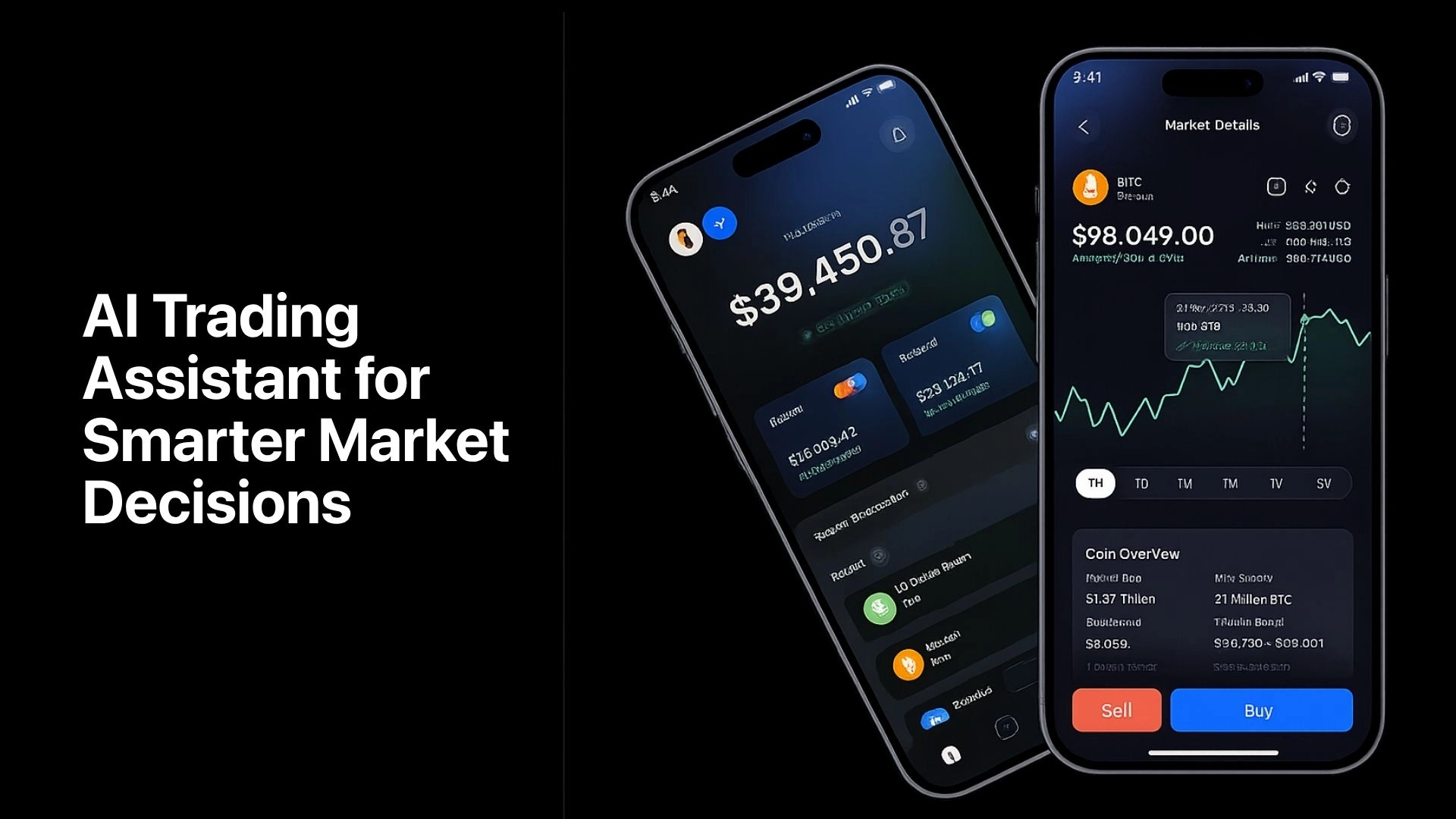
Today’s traders are pulling data from everywhere: live prices, technical indicators, financial news, social sentiment, on-chain activity, and portfolio dashboards. The information never stops. And the more screens you’re switching between, the slower your decisions get. Missed signals become missed opportunities.
That’s exactly where an AI trading assistant changes the game. Instead of juggling five tools at once, traders get market data, alerts, and decision support pulled into a single, intelligent interface.
To be clear from the start, a trading assistant is not a profit machine. It won’t replace your judgment or guarantee returns. What it does is help you research faster, spot signals earlier, and stay on top of markets without the noise.
Explore how Ment Tech Labs can help you build AI-powered trading tools with live market data, smart alerts, and secure fintech AI architecture.
What Is a Trading Assistant?
A trading assistant is a tool that helps traders research markets, monitor assets, track signals, and make more informed decisions without drowning in data. Traditional versions give you watchlists, charts, news feeds, and basic price alerts. Useful, sure, but when markets move fast, and information is flying in from every direction, they start to show their limits pretty quickly.
That is where an AI-powered version makes a real difference. Instead of just displaying data, an AI trading assistant actually helps you make sense of it. It brings in natural language interaction, pattern recognition, sentiment analysis, and personalized insights, so you are not staring at raw numbers trying to connect the dots yourself. From technical indicator analysis and news summaries to risk reminders and trade idea organization, it keeps everything in one place and works with you, not just for you.
Why Traders Need Smarter Tools with Live Market Data
Markets do not wait. A price can shift, a news headline can drop, or a whale wallet can move liquidity in the time it takes you to switch tabs. For anyone building or using a stock-trading assistant or crypto-trading tool, static data is essentially useless. By the time it loads, it is already old.
Here is what traders are actually dealing with in real time:
- Markets move in seconds. Price action does not pause for slow dashboards or delayed feeds.
- News hits sentiment instantly. One earnings report or macro announcement can flip a trend before most traders even see it.
- Crypto never sleeps. Unlike stock markets, crypto runs 24/7, and on-chain activity can signal liquidity shifts that no traditional feed will catch in time.
- Multiple assets, multiple signals. Tracking stocks, tokens, and portfolios simultaneously without a unified system means things will get missed.
- Alerts without context are just noise. Getting a ping that a price has moved is not enough. Traders need to know why it moved and what it means.
The real challenge for any AI-assisted trading platform is not just pulling live data. It is processing that data fast enough, cleaning it, and turning it into something a trader can actually act on. That is where smart architecture and AI-powered analysis make all the difference.
How to Build an AI Trading Assistant with Live Market Data
Building an AI trading assistant is not just a development project. It is a product decision that touches data architecture, AI design, risk management, and user experience all at once. Here is a practical breakdown of how to approach it.
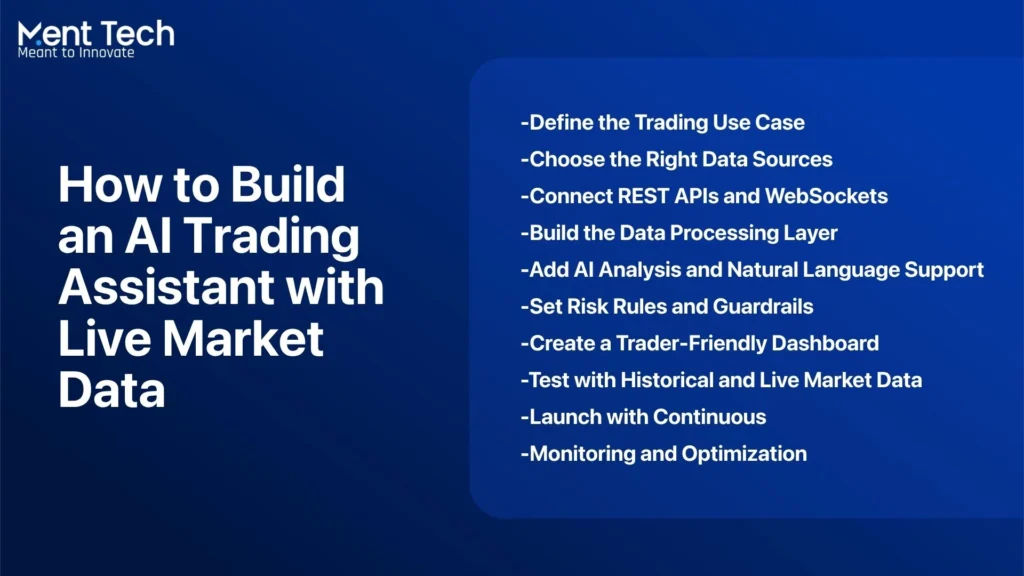
Step 1: Define the Trading Use Case
Before writing a single line of code, get clear on what the tool is actually for. Are you building for stock traders, crypto investors, options desk, forex, DeFi protocols, or portfolio monitoring? Each use case pulls different data, needs different signals, and serves a different type of user. A focused scope from the start saves months of rework later.
Step 2: Choose the Right Data Sources
Your AI trade assistant is only as good as the data feeding it. Depending on your use case, you will likely need a combination of:
- Stock market APIs for price, volume, and historical data
- Crypto exchange APIs for live token prices and order book data
- On-chain data providers for wallet activity and liquidity movement
- News APIs for real-time financial headlines and event tracking
- Social sentiment feeds to gauge market mood and retail activity
- Fundamental data sources for earnings, ratios, and company financials
- Technical indicator libraries for RSI, MACD, Bollinger Bands, and similar signals
Getting the right data mix early is what separates a useful tool from a noisy one.
Step 3: Decide Between REST APIs and WebSockets
This is a choice every trading platform team eventually has to make, and the answer is usually both.
REST APIs work well for historical data, account information, reference data, and anything that does not need to be updated every second. WebSockets are built for live streaming. If you need real-time price feeds, order book updates, or instant market event triggers, WebSockets are the right call. Most solid trading assistant AI architectures use REST for the foundational layer and WebSockets to keep the live experience fast and responsive.
Step 4: Build a Data Processing Layer
Live data is messy. Feeds arrive at different speeds, timestamps do not always align, and some sources send duplicate or incomplete records. Before AI can do anything useful, you need a processing layer that handles:
- Data normalization across multiple sources
- Cleaning and filtering noisy or incomplete feeds
- Timestamp alignment so events are sequenced correctly
- Caching to reduce redundant API calls
- Rate limit handling to avoid getting cut off by data providers
- Market data storage for historical reference and model training
- Feature engineering to prepare data for AI analysis
- Event processing to trigger alerts and downstream actions
This layer is unglamorous but absolutely critical. Without it, your AI is working with garbage in and producing garbage out.
Step 5: Add AI Analysis and Natural Language Layer
Once your data pipeline is clean and reliable, this is where the AI trading assistant starts to show its real value. AI can summarize market patterns in plain language, explain what a signal actually means, answer trader questions in natural language, and generate real-time market commentary without the trader having to interpret raw charts themselves.
Think of it as giving traders a knowledgeable co-pilot that has already read every chart, every headline, and every signal update and can explain what it all means in seconds.
Step 6: Add Risk Rules and Guardrails
This step is non-negotiable. AI should never freely execute trades or take financial actions without a clear rule-based framework sitting on top of it. Think of the AI as a hypothesis generator or a junior trader with good instincts but no authority to act alone.
Your guardrails should include position size limits, action permissions, risk thresholds, multi-step approval flows for high-value actions, and full audit logs of every decision the system touches. The AI surfaces the insight. A human or a verified rule set confirms the action.
Step 7: Create a Trader-Friendly Dashboard
Even the smartest backend means nothing if the interface is confusing. A good AI-assisted trading platform dashboard should bring everything together cleanly:
- Live charts with real-time price feeds
- Signal cards showing key alerts and pattern flags
- An AI chat window for natural language queries
- Risk alerts with clear context and thresholds
- Market summaries updated throughout the session
- Watchlists organized by asset class or strategy
- Portfolio insights showing exposure and performance
- Trade notes and activity logs for review and accountability
The dashboard is where traders spend their time. It needs to reduce friction, not add to it.
Step 8: Test with Historical and Live Data
Before going live, put the system through its paces properly. Backtest AI signals against historical market data to see how they would have performed. Run paper trading sessions to simulate real conditions without real money on the line. Evaluate model accuracy and latency under load. Stress test the data pipeline during high-volume market events. Check signal accuracy across different market conditions, not just the ones your training data was built on.
Testing is where you find out whether your stock trading assistant is actually ready or just looks ready.
AI Trading Assistant vs Trading Bot: What’s the Difference?
A lot of people use these terms interchangeably, but they are actually very different things. Understanding the difference matters before you decide what to build.
| AI Trading Assistant | Trading Bot | Autonomous Trading Agent | |
| What it does | Supports research, alerts, analysis, and decision-making | Automatically executes predefined trading strategies | Performs multi-step decisions across markets with minimal human input |
| Human involvement | High. Trader stays in control | Low. Executes rules automatically | Varies. Depends on the permission boundaries set |
| Best for | Decision support, signal discovery, market monitoring | Repeating a fixed strategy consistently | Complex, multi-market workflows with strict guardrails |
| Risk level | Lower. No automatic execution | Medium. Depends on strategy rules | Higher. Requires strong risk controls and audit logs |
| Where to start | Yes, start here | After the assistant model is proven | Only when full controls are in place |
Most businesses should honestly start with an AI trading assistant model before jumping into full automation. Get the data right, get the signals trusted, and get traders comfortable with how the AI thinks before you let it act on its own.
A strong trade assistant helps traders think faster. It should not remove the trader’s responsibility from the process. Automation without discipline is just a faster way to make expensive mistakes.
Role of AI Agents in Trading Assistants
If a standard AI trading assistant is the co-pilot, AI agents are the crew running things behind the scenes. They take on the repetitive, time-sensitive workflows that eat up a trader’s day, and building them responsibly inside a financial product is exactly where an experienced AI agent development company makes all the difference.
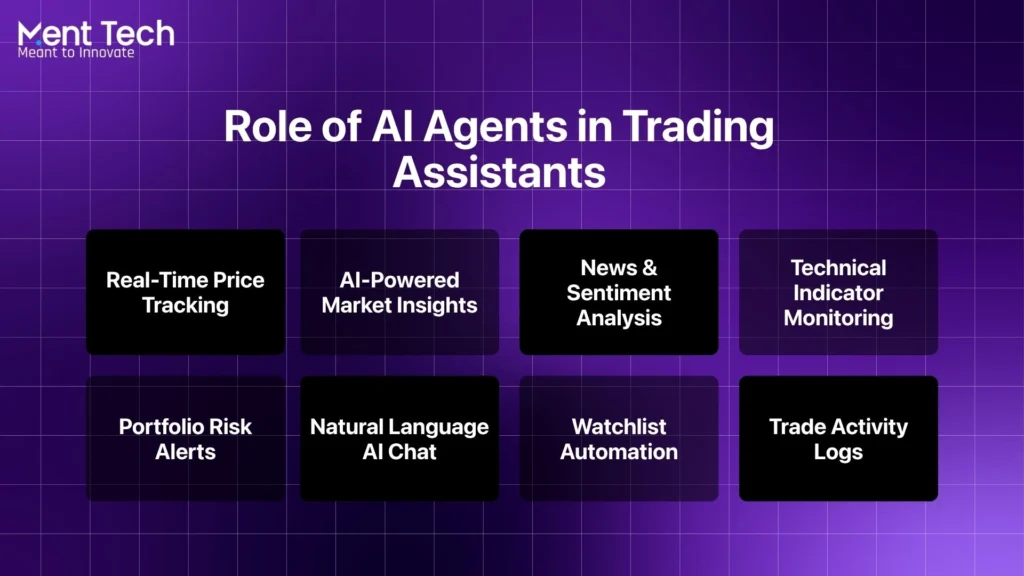
- Monitoring multiple markets
No trader can realistically watch stocks, crypto, forex, and commodities across multiple exchanges all at once. Agents do exactly that, quietly tracking price movements, volume spikes, and pattern shifts in the background and only surfacing what actually needs attention.
- Summarizing daily market activity
Instead of spending the first hour of your morning piecing together what happened overnight, you get a clean, structured brief covering key moves, sentiment shifts, and anything worth knowing before the session starts.
- Triggering alerts
When a price hits your level, a signal fires, or a risk threshold gets crossed, the agent catches it immediately and sends the right alert to the right person. No delays, no manual watching required.
- Preparing trade research
Before a trader even asks, agents are already pulling relevant news, technical signals, sentiment data, and historical context around an asset and packaging it into something actually useful rather than a wall of raw data.
- Updating watchlists
Markets change, and watchlists should too. Agents automatically adjust, add, or reprioritize assets based on what is actually moving right now, so traders are never working off a stale list.
- Checking risk thresholds
Every action gets checked against predefined risk rules, position limits, and exposure caps before it moves forward. Nothing slips through without going through the right filters first.
- Routing high-risk decisions
When something crosses a risk boundary, the agent does not act on it alone. It stops, flags it, logs it, and routes it to a human who can make the final call. That boundary is there for a reason.
- Generating portfolio summaries
Instead of digging through multiple screens to figure out where you stand, agents pull together a clear snapshot of performance, allocation, risk exposure, and key movements whenever you need it.
How AI Integration Services Power Real-Time Trading Tools
No matter how smart your AI is, it is only as powerful as the systems connected to it. Stale data, missing exchange feeds, or a disconnected trading environment make even the most advanced AI essentially useless. This is exactly why solid AI integration services are not an afterthought in trading platform development. They are the foundation on which everything else is built.
1. Market data APIs
This is the lifeblood of any trading tool. Without clean, fast, reliable price feeds and historical data flowing in continuously, the AI has nothing real to work with. Get this integration wrong and everything downstream suffers.
2. Brokerage APIs
Traders do not want to jump between platforms to act on a signal. Connecting directly to brokerage systems means the gap between insight and execution gets as small as possible, which in fast markets actually matters.
3. Crypto exchange APIs
Generic market feeds do not cut it for crypto. Exchange-specific integrations bring in live token prices, order book depth, trading pairs, and real-time liquidity data that you simply cannot get anywhere else.
4. Wallets and on-chain data sources
For crypto traders, what happens on-chain often tells the story before price even moves. Wallet activity, liquidity shifts, and transaction flows give traders a visibility edge that off-chain data alone cannot match.
5. Portfolio systems
When the AI knows what a trader actually holds, it stops giving generic market commentary and starts giving advice that is actually relevant to their specific situation and exposure.
6. News feeds
markets react to headlines within seconds. Real-time news integration means the AI is already factoring in breaking developments by the time most traders have even seen the notification.
7. CRM and user management systems
For fintech platforms serving thousands of users, keeping everything connected, personalized, and organized at scale is not optional. It is what makes the product feel like it was built for each user.
8. Payment systems
Nobody wants friction around deposits, withdrawals, or billing. Clean payment integrations keep that part of the experience invisible so traders stay focused on what they came to do.
9. Notification tools
An alert that arrives late or goes to the wrong channel is worse than no alert at all. Integrating push notifications, email, and messaging properly means the right person gets the right information at exactly the right moment.
10. Mobile and web dashboards
All of this needs to come together in an interface that works just as well on a phone at 6 am as it does on a multi-monitor desktop setup during peak trading hours. If the experience breaks on mobile, you have already lost half your users.
How an AI-Assisted Trading Platform Helps Different Users
A good ai assisted trading platform is not a one-size-fits-all tool. Different traders come with different goals, different risk appetites, and different ways of working. Here is how the right platform shows up for each of them.
- Retail Traders
For someone just getting comfortable with markets, understanding what a trading assistant AI can actually do changes everything. Instead of staring at charts trying to figure out what they mean, retail traders get plain-language market summaries, clear chart explanations, timely alerts, and watchlist insights that actually make sense. It lowers the learning curve without dumbing anything down.
- Active Day Traders
Speed is everything for day traders, and a stock trading assistant built for this audience needs to reflect that. Faster alerts, real-time volume spike detection, sharp technical signals, and instant market movement summaries mean day traders spend less time hunting for information and more time acting on it while the window is still open.
- Crypto Traders
Crypto moves differently, and a generic trading tool simply does not cut it here. Crypto traders need live token prices, on-chain movement tracking, liquidity data, and sentiment signals all feeding into one place. When markets are running 24/7 and on-chain activity can signal a move before price even reacts, having the right trading assistant in your corner is not a nice-to-have. It is a necessity.
- Long-Term Investors
For long-term investors, the game is less about speed and more about clarity. Portfolio monitoring, stock summaries, fundamental analysis, and risk exposure insights help investors stay informed without having to check in every hour. Think of it as having a personal AI investment advisor running quietly in the background, keeping an eye on the bigger picture so nothing sneaks up on you.
- Fintech Platforms
For companies building financial products, embedding an AI-assisted trading platform feature directly into their product creates a meaningfully better user experience. Trading dashboards, portfolio assistants, AI-powered alerts, and smart engagement tools help fintech platforms retain users, drive activity, and stand out in an increasingly crowded market.
Benefits of Building an AI Trading Assistant
A good AI trading assistant does not try to take over. It makes traders sharper, faster, and more consistent while keeping them firmly in the driver’s seat. Here are the benefits that actually matter.
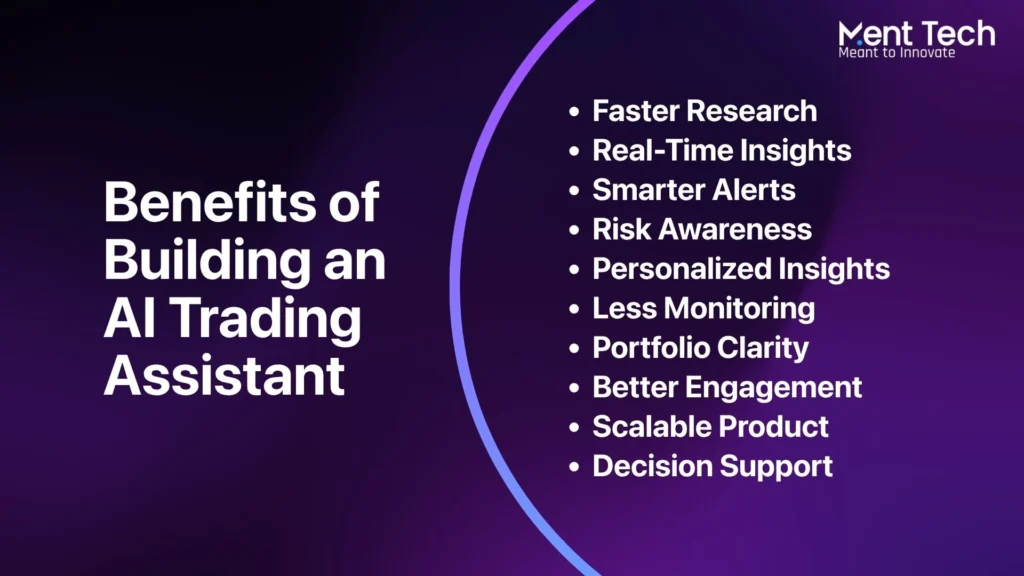
Faster research, better data: instead of jumping between five tabs, traders get live market feeds, news, sentiment, and signals pulled into one place. Stop searching, start deciding.
Smarter alerts with real context: a good AI investment advisor-style assistant does not just tell you something moved. It tells you what moved, why it matters, and whether it fits your strategy. That context is what turns a notification into an actual decision.
Better consistency and risk awareness: emotions and fatigue kill consistent trading. When an AI is quietly checking risk thresholds and flagging unusual exposure, traders make fewer impulsive calls. The discipline gets built into the tool itself.
Personalized insights that actually mean something: generic market summaries help nobody. A properly built assistant with the right AI development services behind it delivers analysis relevant to each trader’s positions, watchlist, and risk tolerance specifically.
A scalable product your users will not outgrow: for fintech platforms, this is the long game. Whether you are working with an AI agent development company to automate workflows or using AI integration services to connect live data, the result is a product that grows with your users and keeps them engaged long-term.
Final Thoughts: Smarter Trading Tools Should Support Better Decisions
The most valuable thing an AI trading assistant can do is make traders better at their job, not replace them at it. Faster research, clearer signals, smarter alerts, and real-time market visibility are what actually move the needle. Not blind automation.
The goal was never to hand everything over to a machine. The goal is better tools, better context, and the kind of responsible decision support that keeps traders informed, disciplined, and in control even when markets get chaotic.
If you are building a trading platform, a fintech product, or an investment tool and you want AI that genuinely works in real market conditions, Ment Tech Labs can help you get there. Partner with Ment Tech Labs to build an AI trading assistant that brings live market data, intelligent alerts, and responsible AI workflows into one powerful trading platform.