AI adoption is moving fast, but governance is still catching up. Gartner reports that AI governance platform spending will reach $492 million in 2026, showing why the right AI compliance solution is now essential for risk control, audit readiness, and responsible AI growth.
That gap is where real business risk lives. AI gets deployed, documentation lags behind, and suddenly audit prep becomes a fire drill nobody saw coming. A solid AI compliance solution brings everything into one place: risk tracking, policy controls, monitoring, evidence collection, and regulatory mapping so teams are not scrambling when it matters most.
Getting the right software is not about finding the longest feature list. It comes down to understanding your actual AI use cases, your regulatory exposure, and how your team needs to work day to day.
Explore how Ment Tech can help you build compliance-ready AI systems with responsible AI consulting, secure architecture, governance workflows, and enterprise AI development support.
What Is an AI Compliance Solution?
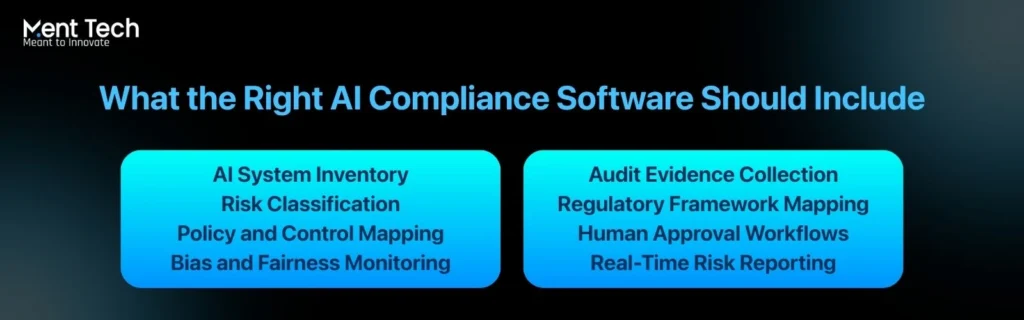
An AI compliance solution is software that helps organizations actually stay in control of the AI systems they build and deploy. Think of it as the operational backbone of your entire AI governance and compliance program. It brings together everything that would otherwise live in scattered spreadsheets and disconnected team inboxes, including AI model inventory, risk classification, policy and control mapping, bias and fairness checks, explainability documentation, data usage tracking, human oversight workflows, compliance evidence collection, audit-ready reporting, incident monitoring, vendor risk, and regulatory framework mapping. All of it, in one place.
Here is what most teams get wrong, though. They treat AI compliance like a paperwork exercise, something you handle before a big audit and then forget about. Real AI compliance and governance do not work that way. It requires responsible system design from day one, clear ownership across engineering, legal, and product teams, and ongoing monitoring of how your AI models are actually behaving in production. Build it in from the start, and compliance becomes manageable. Bolt it on at the end, and you will always be playing catch-up.
What Risks Should AI Compliance Software Help Manage?
Every AI system your business runs carries risk. The real question is whether you have a structured way to spot it before it turns into an actual problem. Here are the six risk areas any solid AI compliance solution needs to cover.
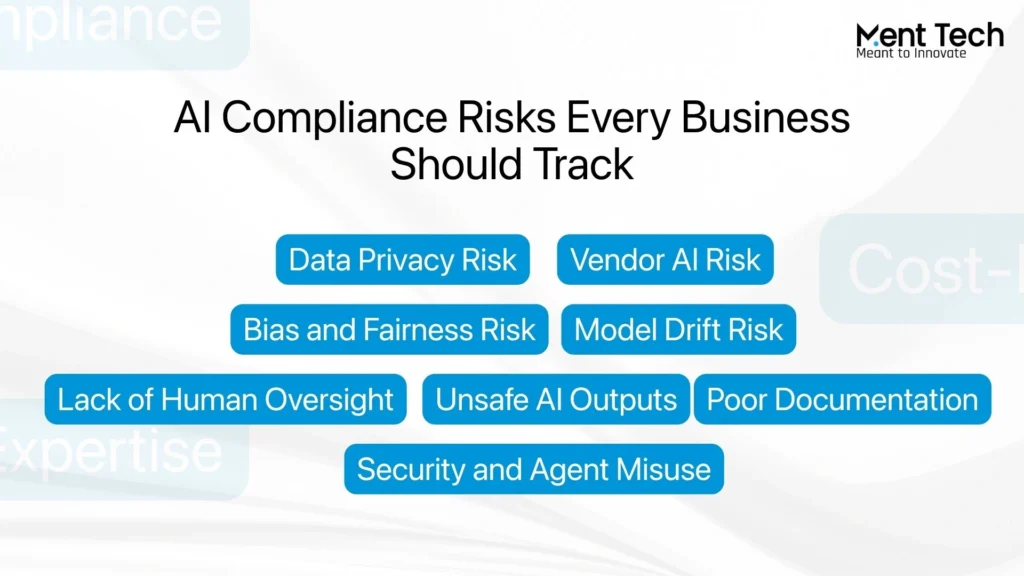
- Data privacy and bias risk
AI systems process huge amounts of sensitive data. Without the right controls in place, that data can be misused or produce biased outcomes that land you in serious legal trouble.
- Model performance drift and unsafe outputs
AI models do not stay accurate forever. They drift, they hallucinate, and they produce outputs nobody expected. If nobody is monitoring them, you will not find out until something goes wrong.
- Security vulnerabilities and unauthorized AI agent actions
AI systems can be exploited like any other software. AI agents especially can take actions they were never meant to take when proper boundaries are not built in from the start.
- Poor documentation and lack of human oversight
If an AI decision cannot be explained and no human is accountable for it, auditors will flag it immediately. Clear documentation and oversight workflows are simply not optional anymore.
- Regulatory non-compliance and third-party vendor risk
Your compliance exposure does not stop at your own systems. Third-party AI tools and vendor models bring their own risk gaps, and those gaps become your responsibility too.
- Unclear ownership and accountability
When nobody clearly owns an AI system or its outcomes, everything else falls apart. Every AI system needs a defined owner, a risk profile, and a team responsible for keeping it in check.
That is what ai governance risk and compliance is really about. Giving legal, risk, product, security, and engineering teams one structured way to manage AI use across the business, not just at launch but every day after that.
How to Choose the Right AI Compliance Software
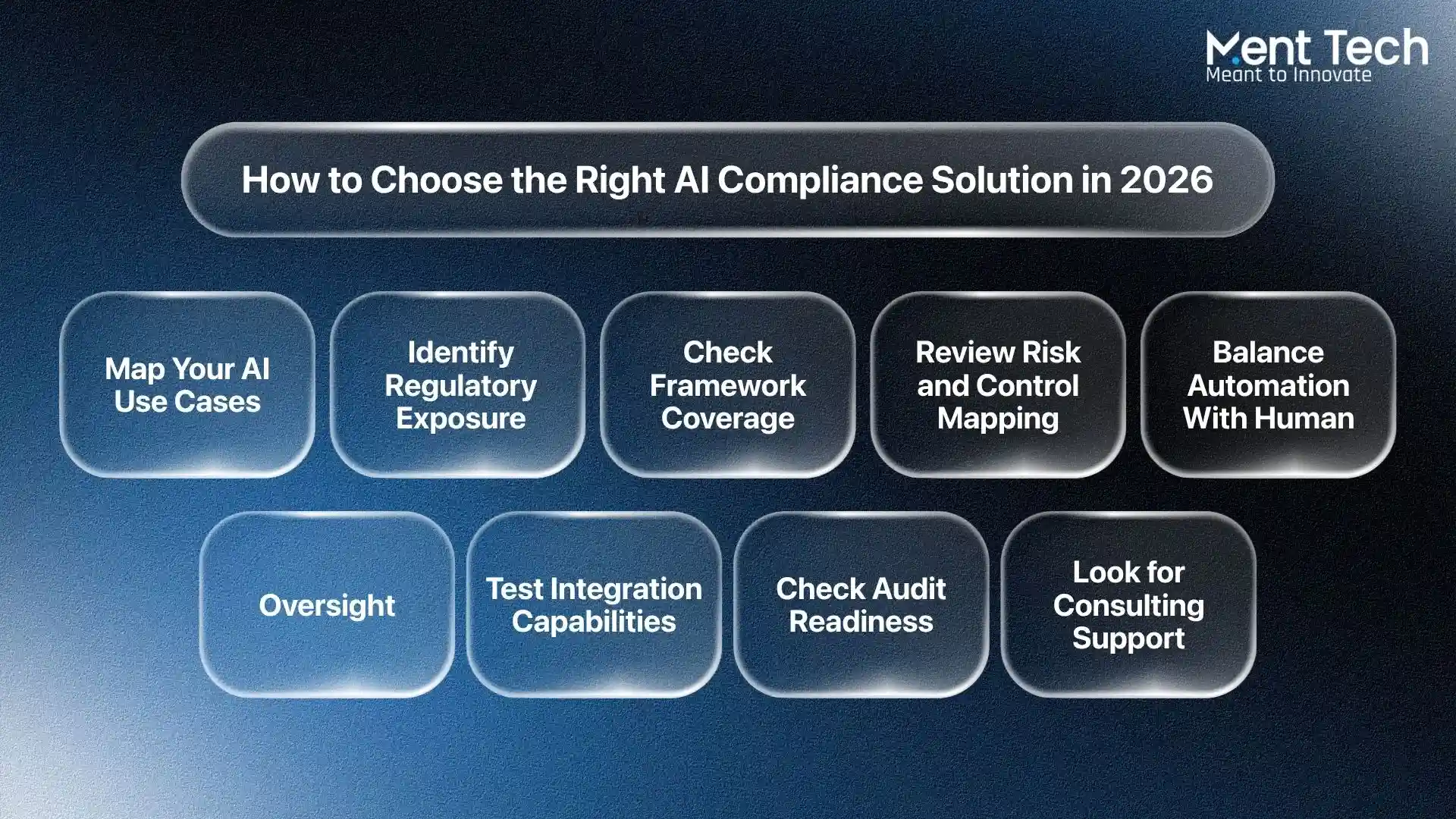
Picking the right platform is not about finding the most talked about tool on the market. It is about finding the one that fits how your business actually runs, what AI systems you are operating, and where your real risk sits. Here is how to think through it.
1. Start with Your AI Use Cases
Not all AI systems need the same governance controls, and that is something teams get wrong constantly. A healthcare AI chatbot, a fintech risk model, an HR screening tool, a customer support bot, and an internal AI copilot all carry different risks and face different regulatory expectations. Before you evaluate any AI compliance solution, get clear on what AI you are actually running and what could realistically go wrong with each one.
2. Identify Your Regulatory Exposure
Your compliance requirements depend on your industry, the geographies you operate in, the type of data your AI touches, who is affected by its decisions, and how much weight those decisions carry. A company processing health data in Europe faces a very different landscape than a SaaS startup running an internal AI assistant in the US. Know your exposure before you start shopping.
3. Check Framework Coverage
Look for a platform that supports the frameworks your business actually needs. That typically means NIST AI RMF, ISO/IEC 42001, the EU AI Act, GDPR, SOC 2, and HIPAA depending on your sector. Solid ai governance and compliance software should also support custom internal frameworks because most mature organizations have requirements that go well beyond standard templates.
4. Review Risk and Control Mapping
A good platform does not just list risks and call it a day. It connects them to policies, controls, evidence, owners, and remediation actions in a way your team can actually act on. If the tool cannot clearly show who owns a risk and what is being done about it, it will create more confusion than the spreadsheet you are trying to replace.
5. Evaluate Automation Without Losing Human Judgment
Automation can genuinely speed up monitoring, flag issues faster, and take the grunt work out of document analysis. But as Optro rightly points out, AI does not replace policy interpretation, complex regulatory judgment, or final decisions on high-risk activities. The best ai governance services platforms use automation to support human decision-making, not quietly bypass it.
6. Check Integration Capabilities
A compliance tool that sits in isolation is a tool nobody will actually use. Make sure it connects with your data sources, product systems, cloud environment, DevOps workflows, legal tools, and existing GRC platforms. Good AI development services teams will tell you the same thing. Compliance only works when it becomes part of how your team already operates, not something they have to switch tabs to find.
7. Review Reporting and Audit Readiness
The platform needs to produce reports that make sense to compliance teams, security leaders, product owners, executives, and auditors alike. If generating a clean audit report still requires a week of manual cleanup work, the tool is simply not doing what it promised.
8. Compare Usability and Ownership
Usercentrics makes a point worth taking seriously. Choose compliance software based on how your organization actually operates, where risk exposure really sits, and whether multiple teams can take clear ownership of their workflows inside the platform. A tool that only your compliance team can navigate will always leave blind spots everywhere else.
9. Consider Scalability
Your AI footprint is going to grow whether you plan for it or not. The software you choose today needs to support more AI systems, more users, more departments, more regions, and more regulatory frameworks without falling apart. As any experienced Genai consulting team will tell you, locking yourself into a tool that cannot scale is a decision that catches up with you faster than expected.
10. Check Consulting and Implementation Support
Software alone rarely solves a governance problem on its own. Many businesses also need AI compliance consulting or AI governance consulting services to design the right policies, risk classification methods, and team workflows before the platform can deliver real value. If a vendor cannot support that or point you toward a partner who can, that is absolutely worth factoring into your final decision.
Role of AI Compliance Consulting in Software Selection
Software can support governance, but it cannot decide your policies, risk rules, ownership model, or audit process on its own. That is where responsible AI consulting helps businesses choose tools that actually fit their AI use cases, compliance needs, and internal workflows.
1. AI Policy Design
- Defines what AI teams can and cannot do
- Sets approval rules for high-risk AI use cases
- Keeps ai compliance and governance clear from day one
2. Risk Classification Methods
- Helps classify AI systems by risk level
- Maps models to business, legal, and user impact
- Supports stronger AI governance. What Risks Should AI Compliance Software Help Management? risk, and compliance decisions
3. Framework Selection
- Chooses the right governance standards and controls
- Aligns software with regulations, audits, and internal policies
- Makes AI governance consulting services more practical and measurable
4. AI System Audits
- Reviews model behavior, data use, and decision logic
- Finds gaps before regulators or customers do
- Strengthens documentation, traceability, and human oversight
5. Workflow and Operating Model
- Designs approval flows, review cycles, and owner responsibilities
- Connects legal, compliance, product, and engineering teams
- Makes governance easier to manage inside daily operations
6. Vendor and Implementation Roadmap
- Reviews vendor risks, security claims, and integration fit
- Plans rollout steps across teams and AI systems
- Connects AI consulting services with generative AI development services for smoother implementation
Benefits of the Right AI Compliance Solution
Getting your AI compliance solution right does not just keep auditors happy. It actually makes your business stronger. As Vanta points out, AI compliance directly supports risk mitigation, data protection, customer trust, innovation, and broader business opportunities. Here is what that looks like in practice.
1. Stronger AI governance and clearer accountability
When every AI system has a defined owner, a risk profile, and a governance workflow behind it, teams stop guessing and start operating with confidence. Good AI governance services make accountability the default, not the exception.
2. Reduced compliance risk and better audit readiness
Instead of scrambling before every audit, your team has evidence, documentation, and reports ready to go. That is what proper AI compliance consulting actually delivers in day-to-day operations.
3. Improved customer trust and data protection
Customers notice when businesses handle AI responsibly. Strong compliance controls around data usage, model transparency, and human oversight build the kind of trust that is genuinely hard to earn back once it is lost.
4. Faster enterprise AI adoption
Governance bottlenecks slow AI projects down more than most teams realize. When compliance is built into the process from the start, business leaders and AI consulting services teams can move faster because the guardrails are already in place.
5. Better model oversight and scalable risk management
Whether you are running three AI models or three hundred, the right platform grows with you. Teams working with an AI agent development company or scaling generative ai development services need oversight that scales without adding headcount every time.
6. Stronger decision-making for AI leaders
When risk data, audit trails, and compliance status are visible in one place, CTOs, product leaders, and risk teams make better calls. Less guesswork, fewer surprises, and more confidence in every AI investment the business makes.
Final Thoughts: Choose AI Compliance Software That Fits Your Risk, Not Just Your Checklist
The best AI compliance solution is not the one with the longest feature list or the most impressive sales deck. It is the one that actually fits your AI use cases, your risk exposure, your governance model, your regulatory requirements, and how your teams work day to day. A tool that checks every box on paper but does not match how your business operates will sit unused, and your compliance gaps will stay exactly where they are.
AI compliance in 2026 is no longer just a legal obligation. It is becoming a real business enabler. Organizations that get AI governance and compliance right are deploying AI faster, building more customer trust, and making better decisions because they have visibility and control that their competitors simply do not have yet.
The time to build that foundation is before the audit arrives, not after. Partner with Ment Tech to build AI governance and compliance workflows that help your business scale AI responsibly, with the right architecture, the right controls, and the right team behind you from day one.