Google doesn’t roll out core updates in a vacuum, and Google Core Update 2026, arriving in May, is a clear example of that. Search was already shifting. AI Overviews are changing how results look, AI Mode is handling longer conversational queries, and more users are getting answers directly from AI-generated experiences without ever clicking a link.
That shift is already visible in the numbers. BrightEdge’s February 2026 The AI Search report found that AI Overviews now appear for about 48% of tracked queries, up from 30% a year earlier.
For businesses, that makes this update bigger than a rankings shuffle. It’s about how your content performs across both traditional SERPs and the AI-powered search experiences that are increasingly sitting above them.
This blog breaks down what the latest Google core update of 2026 means for your rankings, what impact to expect, and the practical steps to take next.
Explore how Ment Tech Labs can help businesses prepare for the next phase of SEO, AI Search, and content visibility.
How the Google Core Update 2026 Can Impact SERP Rankings
The Google core update doesn’t flip a switch overnight. It rolls out gradually, and the ranking shifts it causes can feel uneven and unpredictable during that window. Before your team starts making content decisions based on early data, it’s worth understanding what types of movement are actually normal.
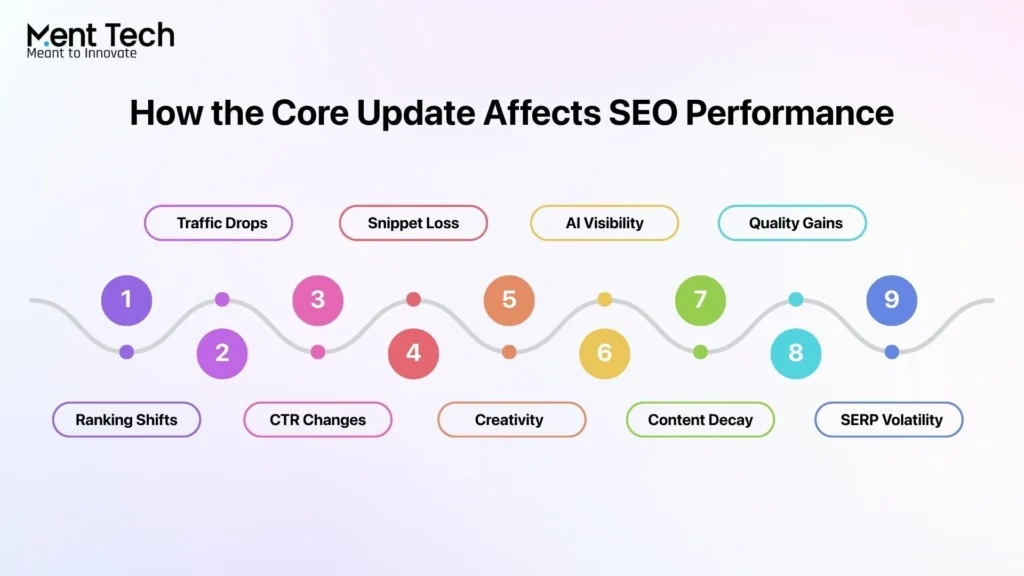
Here’s what this Google core algorithm update can realistically affect:
- Keyword position changes—Pages that held stable positions for months may shift up or down without any changes on your end.
- Pages moving up or down in SERPs—Competitors may outrank you, or you may outrank them, purely based on how Google now weighs content quality.
- Organic traffic fluctuations—Position swings directly affect clicks, so expect traffic to move during the rollout period.
- Changes in impressions and CTR —Even small position changes can significantly impact how often your page is seen and clicked.
- Featured snippet changes—Snippets can be won or lost as Google reassesses which content best answers a query directly.
- AI Overview visibility—With AI Overviews now deeply integrated into Search, which content gets cited in those summaries is increasingly tied to quality and trust signals.
- Old content losing rankings—Outdated pages that haven’t been refreshed are vulnerable after every Google core update 2026.
- Helpful content gaining visibility—Pages that genuinely serve user intent tend to benefit when the dust settles.
- Thin or generic content losing traction—Surface-level pages with no real depth or original perspective are consistently the biggest losers after Google core updates.
One important thing to keep in mind: ranking volatility during a rollout doesn’t always mean something is wrong. Google’s own guidance recommends waiting at least a full week after the update completes before pulling Search Console data and drawing any conclusions. React too early, and you risk making changes based on noise, not signal.
How the Update May Impact Google Searches and User Behavior
Google Search stopped being just a list of blue links a long time ago. But what’s happening now with the latest Google core update 2026 feels different. AI summaries are answering questions before users even scroll. Conversational search paths are replacing quick keyword lookups. And the way people actually interact with Search is changing faster than most SEO strategies can keep up with.
- Basic queries no longer drive clicks
Someone searches a simple question, Google answers it right there in the AI Overview, and your page never gets visited. The traffic opportunity now lives in queries that need real depth and context, not ones Google can wrap up in two sentences.
- Getting cited in AI answers is the new page one
Ranking third and getting referenced in an AI summary can outperform ranking first without one. If your content isn’t built to be trusted and cited by AI systems, you’re already behind.
- Shallow content is losing its footing fast
Generic pages that repackage the same information everyone else has are getting harder to sustain. What’s working is content that actually knows something specific and useful and is backed by real experience
- People are searching for the way they talk
Google’s redesigned Search box is built for longer, more natural queries. If your content still reads like it was written for a keyword tool rather than a human being, that gap is going to show.
- The playing field is bigger than rankings now
Traditional positions, AI Overviews, AI Mode responses, and background search agents are all part of visibility today. Chasing one metric while ignoring the rest means leaving a lot of discoverability on the table.
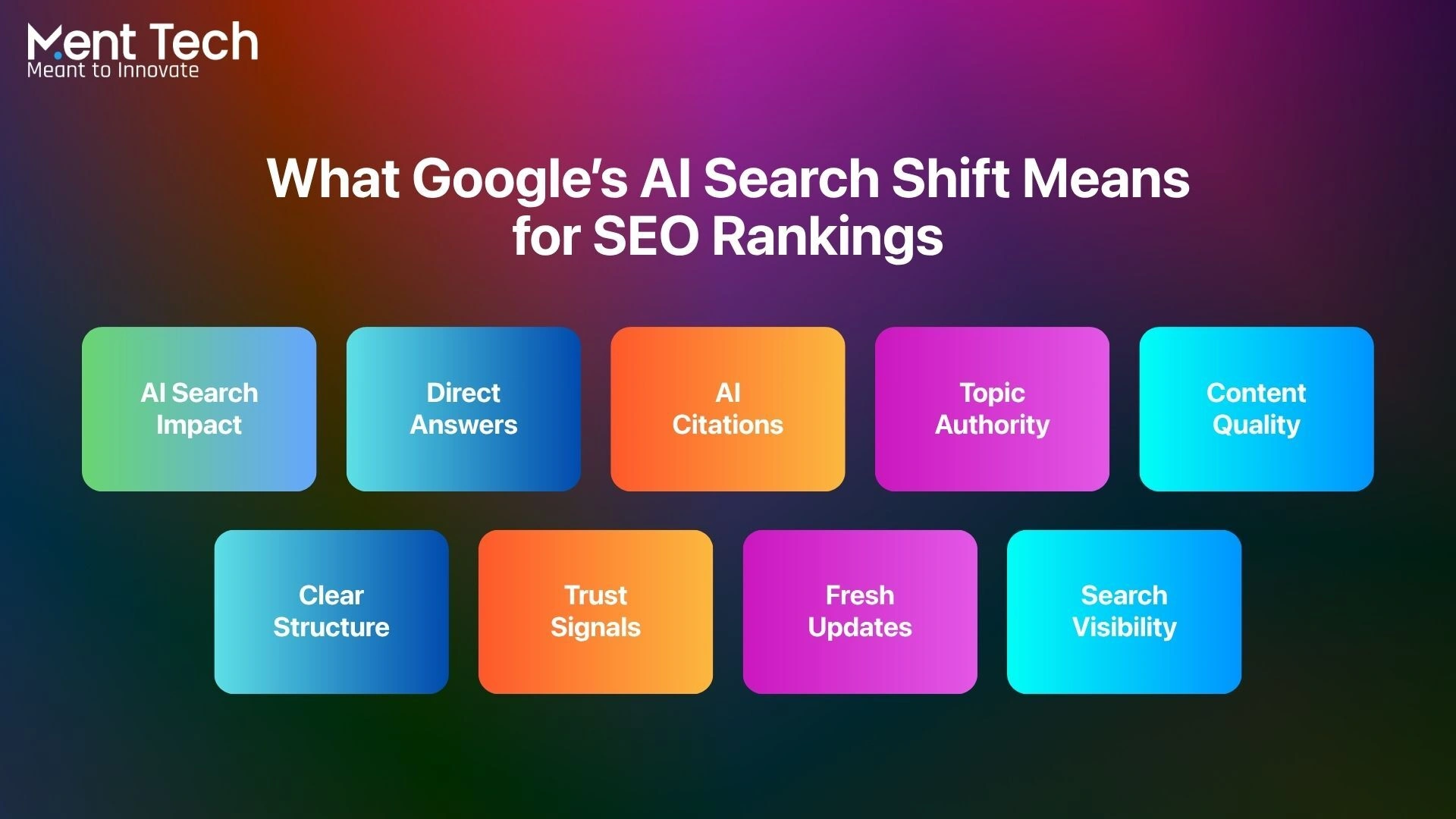
What Google’s AI Search Shift Means for SEO Rankings
The rules of SEO are being rewritten, and the Google core algorithm update of May 2026 makes that impossible to ignore. Ranking for a keyword used to be the finish line; now it’s barely the starting point. Your content needs to earn trust from a human reader and be structured clearly enough for an AI system to cite it. Here’s what that actually looks like:
1. Direct Answers
AI Search rewards content that gets to the point. If a reader has to dig three paragraphs in to find the answer, an AI system likely won’t surface it either.
2. Topical Authority
One good page on a subject doesn’t cut it anymore. Google wants to see that your site genuinely covers a topic through guides, comparisons, FAQs, and use cases that connect.
3. Entity Optimization
It’s not just about keywords. Google understands people, brands, concepts, and relationships between them. Making sure your content clearly associates your business with the right topics and entities is becoming essential.
4. E-E-A-T Signals
Experience, expertise, authoritativeness, and trustworthiness aren’t just quality guidelines. After every Google core update, they become a stronger filter for what earns visibility and what doesn’t.
5. AI-Friendly Structure
Clear headings, summary sections, FAQ blocks, and comparison tables don’t just help readers navigate. They make it easier for AI systems to extract, understand, and cite your content.
6. Original Expertise
The latest Google core update 2026 is a reminder that AI-assisted content without real expert input, original perspective, or genuine depth is becoming harder to sustain in search.
What Businesses Should Monitor After the Google Core Update
Once the rollout settles, the real work begins. But knowing what to look at matters just as much as looking. A lot of teams make the mistake of jumping into Search Console mid-rollout and drawing conclusions from data that’s still moving. Wait for the dust to settle, then run through this list with a clear head.
- Search Console clicks: First checkpoint. If clicks dropped after May 21, cross-reference with position changes before assuming the worst.
- Impressions: A drop here without a ranking change often points to AI Overviews or SERP features pushing organic results further down.
- Average ranking position: Track this at the page level, not site-wide. One high-traffic page dropping five positions can skew everything.
- CTR: If impressions held but clicks fell, something changed in how your result appears in the SERP.
- Top pages and queries affected: Start with your highest-traffic and highest-converting pages, then identify which search terms drove the change.
- Indexed pages and crawl issues: Confirm important pages are still indexed with no new coverage errors after the Google core updates.
- Content decay: Pages untouched for 12 months or more are a quiet liability after every Google core update 2026.
- Internal linking gaps: Pages losing visibility are often under-linked from stronger pages on your site.
- AI Overview visibility: If your content was previously cited in AI summaries and no longer appears, that’s a visibility loss worth investigating.
- Conversions from organic traffic: Rankings tell part of the story. Conversions tell you whether the traffic you kept actually matters to the business.
Content Quality Signals That Matter After Google Core Updates
Here is the truth about Google core updates that most SEO articles skip over. Google is not just getting better at ranking pages. It is getting better at reading them the way a person would. And if your content feels like it was written to check boxes rather than actually help someone, that gap is becoming harder to hide with every update cycle.
| Signal | What It Actually Means |
| Clear topic depth | Write as if you have actually worked in this space. Cover the angles that matter, including the uncomfortable ones, not just the safe talking points that every other page already has. |
| Original insights | Your content should have something in it that could only come from you. A real observation, a lesson learned, a perspective shaped by experience. If anyone could have written it, it probably would not rank for long. |
| Helpful examples | A concept without an example is just an idea floating in the air. Ground it in something real, and your content immediately becomes more useful and more memorable. |
| Expert author perspective | Readers can feel the difference between someone who has lived a subject and someone who researched it for an afternoon. So can Google. Author credibility is not a nice-to-have anymore. |
| Updated facts and references | An outdated stat does not just look careless. It actively erodes trust. If your page is still citing research from two or three years ago, it is working against you every day it stays unchanged. |
| Strong structure | People do not read web content the way they read books. They scan, jump around, and leave quickly if they cannot find what they came for. Good structure respects that reality. |
| Relevant internal links | Connecting your content is how you show Google that your site has genuine depth on a topic, not just a handful of pages that happen to share a keyword. |
| Readable formatting | Dense, unbroken text is one of the fastest ways to lose a reader. If your page is hard to navigate, people will not bother to move through it. |
| Clear answers | Stop making people scroll to find what they actually asked. Lead with the answer and support it afterward. That is what users want and increasingly what AI systems reward. |
| Trustworthy sources | Backing up what you say with credible references is one of the simplest ways to build E-E-A-T signals. It shows you did not just make it up. |
| No keyword stuffing | Forcing keywords into sentences where they do not belong makes your writing feel robotic. It also signals to Google that the page was built for an algorithm rather than a reader. |
| No generic filler | If a sentence is not earning its place by adding something useful, it is just noise. And noise is exactly what the Google core update 2026 is designed to filter out. |
For AI, Web3, blockchain, and software businesses specifically, strong content means getting specific. Real use cases, honest implementation details, actual business impact, the risks worth knowing about, and next steps someone can genuinely act on. That is the bar, and it keeps getting higher.
Why AI Companies Should Pay Attention to AI Search Visibility
AI companies are not just competing for Google rankings anymore. The real competition is happening inside AI-powered search experiences that summarize and cite sources without the user ever clicking a single link. If you offer large language model development services, operate as an LLM development company, or position yourself as an AI solutions provider, traditional SEO alone is no longer enough.
Topical authority is non-negotiable: AI search systems favor sources that cover a subject consistently and deeply. One strong page with nothing supporting it is not enough anymore.
Service pages need to be specific: Vague capability descriptions get overlooked. Pages that explain what you do, how you do it, and who it is for are far more likely to be cited in AI-generated responses.
Buyer-focused content builds trust: Blogs that answer the real questions your buyers are asking signal credibility to both human readers and AI systems evaluating which sources deserve to be surfaced.
Case studies close the credibility gap: Documented results demonstrate expertise in action. They are one of the strongest proof signals any AI brand can have in its content library.
Structure matters as much as substance: Clear headings, direct answers, and logical flow make it easier for AI systems to extract and cite your content. Good writing that is poorly structured often goes unnoticed.
The best LLM development company positioning is not won by publishing a single optimized service page. It is built through a body of content that consistently demonstrates knowledge, answers real questions, and gives AI systems every reason to treat your brand as a credible source.
How LLM and Generative AI Companies Can Adapt Their SEO Strategy
The companies that will win in AI Search are not the ones with the biggest budgets. They are the ones that actually show up with something worth reading. If you are offering generative AI development services or building your reputation as a large language model development company, here is where your energy should go:
Step 1: Build Topical Clusters Around Your Services
One service page sitting alone on your website is not enough anymore. Surround it with use-case guides, technical explainers, and FAQs that all connect back to that core page. That is what genuine topical authority looks like.
Step 2: Write Content That Answers Real Buyer Questions
Your buyers are searching for answers long before they fill out a contact form. Be the page that gives them honest, specific answers, and you earn trust before the first conversation happens.
Step 3: Create Comparison and Use-Case Content
Someone choosing the best LLM development company to work with is not looking for a sales pitch. Comparison guides and real-world use cases give them the clarity they need to make a confident decision.
Step 4: Add FAQs for AEO and GEO
Being the clearest and most direct answer to a question someone is actually asking is what AEO and GEO come down to. A well-written FAQ section is one of the most underrated ways to show up in AI-generated responses.
Step 5: Strengthen Author and Company Credibility
Put real people behind your content. Author bios, team credentials, and client results tell Google and AI systems that there are actual experts here, not just a publishing schedule being filled.
Step 6: Keep Service Pages Current
An outdated service page does quite a lot of damage over time. Keep it accurate, keep it fresh, and make sure it reflects what your business actually delivers today.

SEO Checklist After the Google Core Update 2026
Most teams know they should audit after a core update. Very few actually sit down and do it properly. The Google core update 2026 is still rolling out, so hold off on making big decisions until it fully settles. Once it does, work through this list with a clear head.
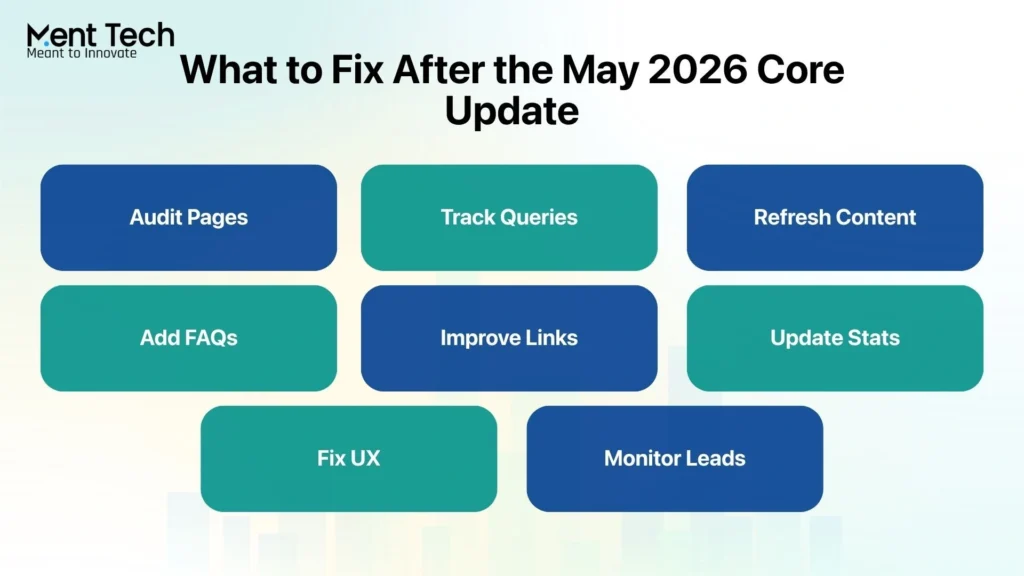
- Review Search Console after rollout completes: Compare stable pre and post update date ranges. Concluding data that is still moving will only lead you in the wrong direction.
- Track ranking movement by page and query: Look at individual pages and the specific queries driving them, not just overall traffic numbers. That is where the real story is.
- Identify content losing visibility: Prioritize pages that were driving real business value before the update. Those are the ones worth fixing first.
- Compare the competitors’ ranking above you: Do not just notice they outrank you. Understand why. What does their content do better, deeper, or more clearly than yours?
- Improve weak content sections: Add depth, real examples, and original perspective to pages that are thin or surface-level. Generic content is exactly what the latest Google Core update 2026 is built to filter out.
- Update outdated stats and examples: If your page is still referencing data from two years ago, that is the first thing to fix before anything else.
- Strengthen internal linking: Pages losing visibility are often underlinked from stronger pages on your site. A focused internal linking audit can surface quick wins without touching a single word of content.
- Add FAQs where useful: Especially on service and blog pages, where buyers are likely searching for follow-up answers.
- Improve page speed and UX: A slow or frustrating page experience quietly cancels out even the best content.
- Remove duplicate or thin content: A smaller number of strong pages will always outperform a large number of weak ones.
- Track conversions, not just traffic: Rankings and clicks are indicators. Revenue and leads are the actual outcomes worth measuring.
Final Thoughts: SEO Rankings Now Depend on Quality, Trust, and AI Search Readiness
The Google core update 2026 is not just another ranking shuffle to wait out. It is part of a much bigger shift in how Google decides what deserves to be seen. Helpful content, trusted sources, and AI-readable structure are no longer bonus points. They are the baseline.
Businesses that treat this update as a one-time event to recover from will find themselves in the same position after the next one. The ones that use it as a signal to build something genuinely better, stronger content, cleaner technical health, tighter internal linking, real E-E-A-T signals, and a presence in AI Search are the ones that compound their visibility over time.
Search is not going back to what it was. The direction is clear, and the Google core updates will keep pushing in the same way. The question is not whether your business needs to adapt. It is how quickly you get started.
Partner with Ment Tech Labs to build a future-ready digital strategy that supports SEO rankings, AI Search visibility, and long-term organic growth.