Enterprises are increasingly cautious about how much control they’re willing to grant a single platform. Privacy of data, transparency of transactions, and reliance on a third party are all legitimate issues… particularly in the realm of ever more complicated digital goods.
Web3 Development provides businesses an alternative approach to development. It can enable peer-to-peer payments, digital assets, smart contracts, and digital ownership, as well as user-owned communities and other third-place sharing platforms.
For businesses seeking to leverage Web3, the primary concern isn’t the technology’s novelty but the profitable use cases it enables. This blog post discusses its main features, use cases for Web3 businesses, the development process, tech stack, challenges, and cost.
What Is Web3 Development?
Web3 development involves creating applications and digital platforms on decentralized networks like blockchains. By distributing the data across a network instead of a single entity, Web3 applications allow for direct interactions and transactions through smart contracts and digital wallets.
This introduces new possibilities for the business value of an application. Applications built with Web3 development may enable programmable payments, tokenized assets, and decentralized markets and applications whose ownership or transactions can be validated on-chain instead of relying on a centralized database.
Key Components of Web3 Development
Web3 is a collection of technologies operating together to create more open, more secure, more user-controlled digital services.
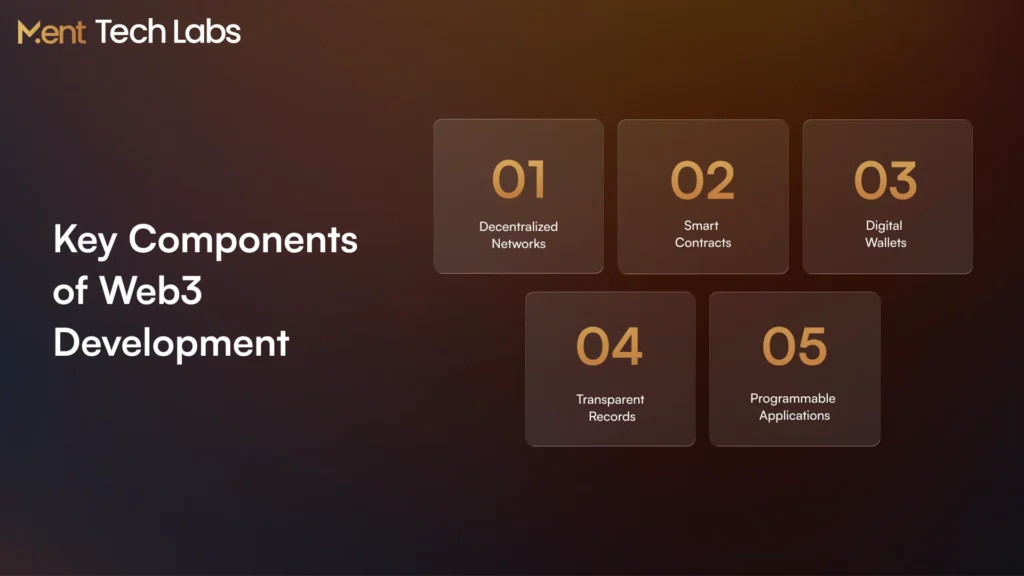
1. Decentralized Control
Web3 Development shifts control away from one corporation or server. Users are empowered with more autonomy as data and transactions run on decentralized networks.
2. Smart Contracts
Smart contract development helps automate payments, approvals, and agreements once set conditions are met, reducing manual steps.
3. Digital Ownership
Users can directly own and control tokens, digital assets, and identities through their wallets instead of relying on a platform.
4. Transparent Records
Blockchain records are easier to verify and trace. This can help businesses build systems where transactions and ownership are clearer.
5. Programmable Apps
Web3 application development allows businesses to create apps with automated rules, asset transfers, wallet interactions, and blockchain-based features built into the product.
Web2 vs Web3: What Is the Difference?
Web2 usually puts platforms in control of accounts, data, and transactions, while Web3 shifts more ownership and interaction toward users through blockchain-based systems. This is one of the biggest changes businesses need to understand when considering Web3 development.
| Area | Web2 | Web3 |
| Control | Platforms control most services and data. | Control can be distributed across networks and users. |
| User Data | Data is mainly stored and managed by companies. | Users can have greater control over their data and identity. |
| Ownership | Digital assets usually stay tied to a platform account. | Users can directly hold blockchain-based assets through wallets. |
| Transactions | Payments often depend on banks or payment providers. | Blockchain can support direct, native digital transactions. |
| Applications | Apps mainly run on company-controlled infrastructure. | Web3 application development can use decentralized applications and smart contracts. |
| Access | Platforms decide who can use or participate in services. | Many Web3 networks are designed to be permissionless and open to participation. |
Benefits of Web3 Development for Businesses
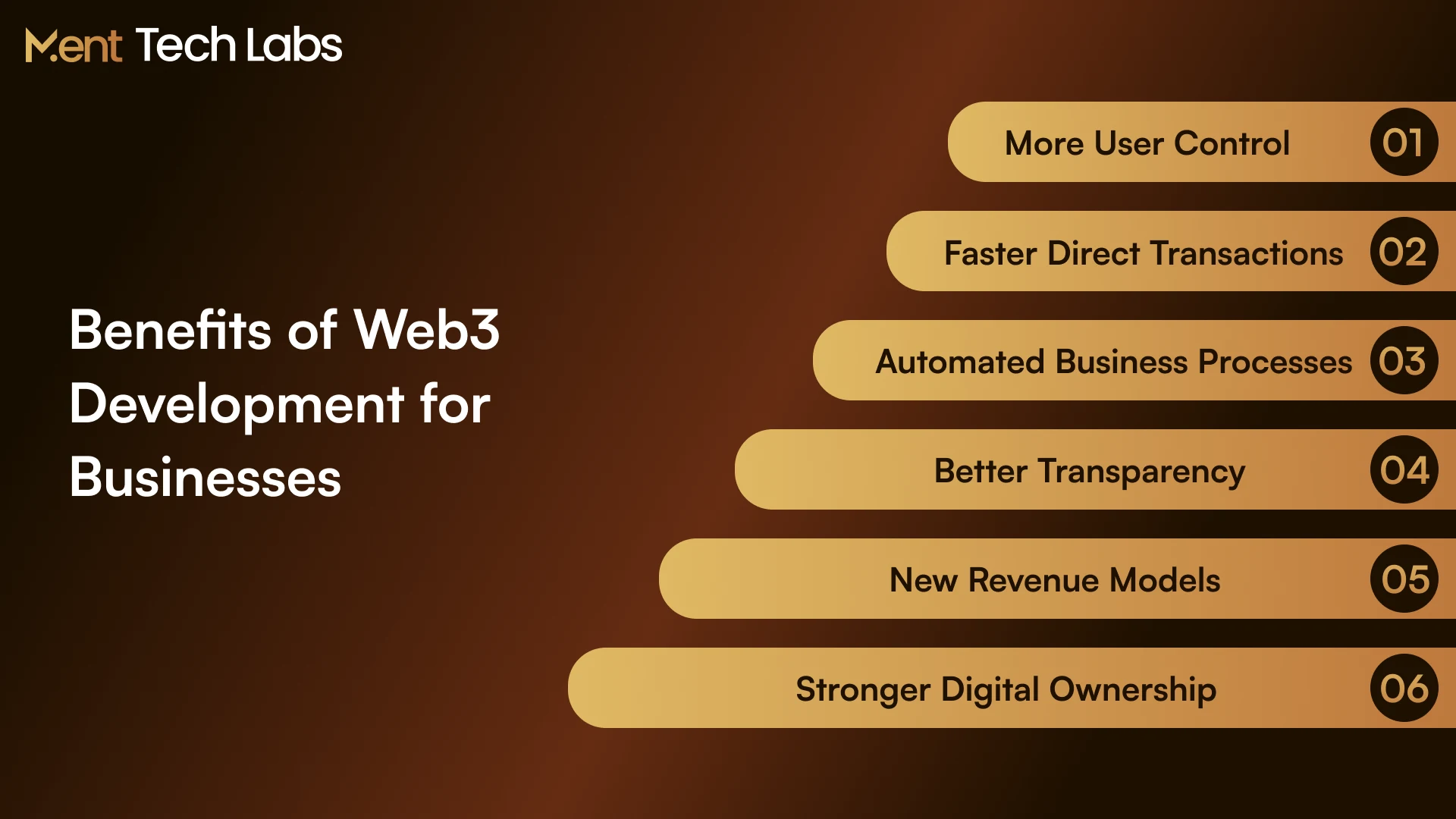
The benefits of Web3 go beyond decentralization. For businesses, it can improve ownership, automation, transparency, and the way digital products create value.
More User Control: Users can manage their data, identity, and digital assets with less dependence on a central platform.
Direct Transactions: Web3 for business can support faster peer-to-peer payments and asset transfers with fewer intermediaries.
Automated Workflows: Smart contracts can automate payments, approvals, and agreements based on predefined conditions.
Better Transparency: Blockchain records make transactions and ownership easier to verify across different parties.
New Business Models: Businesses can create tokenized assets, digital memberships, and decentralized marketplaces with support from a blockchain development company.
Wider Access: Web3 application development can help businesses build services that users can access directly through wallets and decentralized networks.
Top Web3 Business Use Cases Across Industries
The most useful Web3 business use cases are those where ownership, payments, or transactions need to be handled directly and transparently. Here are some practical ways companies are using Web3 for business.
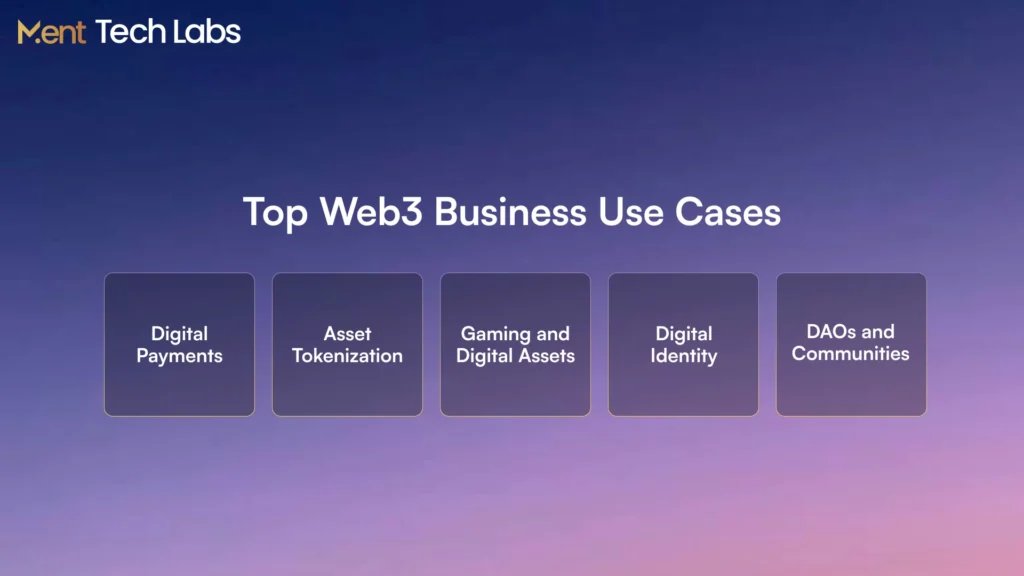
1. Finance and Payments
Web3 enables digital payments, lending, trading, and other forms of finance without intermediaries.
2. Asset Tokenization
Businesses can represent real estate, collectibles, and other assets as blockchain-based tokens, making ownership easier to verify and transfer.
3. Gaming and Assets
Games can use blockchain to give players real ownership of in-game items that can be collected, transferred, or traded.
4. Digital Identity
Blockchain technology for business can support digital identities and credentials that users control and use across different applications.
5. Communities and DAOs
Businesses and online communities can use DAOs for shared voting, treasury management, funding, and collective ownership.

How Does the Web3 Application Development Process Work?
A good Web3 application development process starts with the business problem, not the blockchain. The technology, contracts, and user experience should all support a clear use case.
Step 1. Define the Use Case
Start with what the product actually needs to solve, whether that is payments, tokenization, digital ownership, or another Web3 business use case.
Step 2. Choose the Blockchain
Select a network based on transaction costs, speed, security, ecosystem, and the type of application being built.
Step 3. Design the Architecture
Plan how the frontend, wallets, blockchain network, smart contracts, and off-chain services will work together. A dApp typically combines a frontend interface with smart contracts running on a decentralized network.
Step 4. Build Smart Contracts
Develop the contracts that handle transactions, permissions, assets, and other on-chain rules. Businesses building on Ethereum can also work with an Ethereum development company for this part of the project.
Step 5. Connect the Application
Integrate the user interface with wallets and smart contracts so users can interact with blockchain features without making the experience unnecessarily complicated.
Step 6. Test and Deploy
Test contracts, transactions, security, and user flows across browsers and devices before launch, using additional testing environments such as AWS Device Farm alternatives when needed.
Web3 Development Tech Stack and Architecture
A Web3 product usually combines a normal user-facing app with wallets, smart contracts, blockchain networks, and decentralized storage. The exact setup depends on what needs to happen on-chain and what can stay off-chain.
Frontend Layer: The website or app where users browse, connect wallets, and interact with Web3 features.
Wallet Layer: Wallet connections let users sign transactions and access blockchain-based services directly.
Smart Contract Layer: Smart contracts hold the rules for payments, ownership, permissions, and other on-chain actions.
Blockchain Layer: The blockchain processes transactions and stores the on-chain state behind the application. This is the core of using blockchain technology for business.
Storage Layer: For files or larger data, Web3 development can use decentralized storage such as IPFS alongside the blockchain.
Challenges and Risks of Web3 Development
Web3 Development can open new opportunities, but it also brings technical choices that traditional applications rarely have to deal with.
- Smart Contract Risk
Once a contract is live, mistakes can be difficult to undo. Strong testing and security reviews need to happen before deployment.
- Network Costs
Transaction fees and speed can change when a network gets busy. Layer 2 networks are often used to keep costs and performance more predictable.
- Wallet Experience
Wallet connections, transaction signing, and key management can feel unfamiliar to everyday users, so the experience needs to be designed carefully.
- Off-Chain Data
Smart contracts cannot pull real-world information on their own. Applications that need prices, events, or external data usually depend on oracles.
- Architecture Choices
Using blockchain technology for business does not mean everything belongs on-chain. Teams need to decide what should stay on the blockchain and what is better handled by traditional infrastructure.
How Much Does Web3 Development Cost?
There is no fixed price for Web3 application development because the budget depends heavily on what needs to happen on-chain, how many integrations are involved, and how much security the product requires. Current 2026 estimates put many blockchain-based products anywhere from about $30,000 to $300,000+ depending on complexity.
- Basic MVP: $30,000-$60,000
- Mid-level dApp or token platform: $60,000-$150,000
- Complex enterprise or DeFi platform: $150,000-$300,000+
The biggest cost drivers are smart contract complexity, blockchain choice, wallet and API integrations, security testing, compliance needs, and multi-chain support. Businesses adopting blockchain technology for business should also budget for post-launch maintenance and network costs rather than treating development as a one-time expense.
Final Thoughts
Web3 is more manageable for companies looking to have tighter control over digital assets, payments, ownership, and interactions with users. But ultimately it’s about the right use case, not cramming the use of blockchain into the mix.
A sound Web3 product will not compromise on security, usability, cost, and scalability. And this is even more critical where smart contracts and actual money transactions are concerned.
Working with an experienced Web3 development company can help turn the right idea into a secure and scalable product without making the technology more complicated than it needs to be.