AI agents are now able to gather information, leverage tools, perform tasks, and make autonomous decisions. This is a great benefit but a huge security concern.
AI agent security: Ensuring the safe operation of these agents and the security of the information, applications, and systems they interact with.
With adoption on the rise, many organizations are now realizing that deploying AI agents will require a focus on security in order to safely leverage autonomous systems without opening new security vectors.
What Is AI Agent Security?
AI agent security refers to securing autonomous AI agents that have the ability to plan tasks, call tools, interact with data, and perform actions within connected applications. Because these agents can affect actual systems, unlike a regular chatbot, their permissions, inputs, memory, and actions must be secured.
Operationally, defining ownership of AI agents requires explicitly delineating the scope of what an agent may access and do, and maintaining traceability and control over agent behavior across the various stages of operation to mitigate risks like improper use, sensitive data leaks, and manipulation of integrated utilities.
AI Agent Security News: Recent AI agent security news shows these risks are already appearing in real deployments. NIST’s 2026 findings highlight the need for stronger controls around agent identity, access, and autonomous actions.
How Does AI Agent Security Work?
AI agent security involves designing constraints on how an agent can be given directions, interact with systems, utilize tools, maintain context, and take actions. The goal is to enable autonomous operation while avoiding giving the agent unfettered control or leaving vulnerable behavior unmonitored.
1. Agent Identity and Access
Each agent should have its own identity, defined permissions, and access limited to the systems and data required for its role.
2. Tool and API Controls
APIs, databases, browsers, and external tools should be approved and scoped so an agent cannot call sensitive functions outside its assigned task.
3. Input and Memory Protection
Prompts, retrieved content, and memory writes should be validated to reduce prompt injection, poisoned context, and manipulation of future agent behavior.
4. Action Guardrails
High-risk actions such as payments, account changes, or data deletion should have policy checks or human approval before execution.
5. Runtime Monitoring
Teams should log agent decisions, tool calls, access attempts, and unusual behavior so suspicious activity can be identified and contained quickly.
6. Security Testing Before Deployment
Regular adversarial testing helps uncover weaknesses in prompts, permissions, tools, and workflows. AI security and red teaming services can be used to test these attack paths before agents are exposed to production systems.
Types of AI Agents and Their Security Requirements
Different agents carry different levels of access and autonomy, so ai agents security should be designed around what each agent can actually do.
- Simple Reflex Agents
These agents follow fixed rules. Security mainly focuses on safe inputs, limited permissions, and controlled actions.
- Model-Based Agents
They use stored context to understand their environment. That context needs protection from tampering or unauthorized access.
- Goal-Based Agents
These agents plan steps to reach a goal. Strong access controls are needed to prevent unsafe tool use or unintended actions.
- Utility-Based Agents
They compare options before choosing an action. An agent based security approach should protect the data and logic influencing those decisions.
- Learning Agents
These agents improve from new data and feedback. Their training inputs, memory, and updates need ongoing checks to prevent behavior from drifting.
For complex autonomous systems, AI product engineering can help bring security controls into the product architecture from the start.

AI Agent Attack Surface: Key Areas of Exposure
AI agents connect to data, tools, credentials, memory, and other systems as they complete tasks. That makes the attack surface much wider than that of a standard application, so agent AI security and governance need to cover every point where an agent can be influenced or misused.
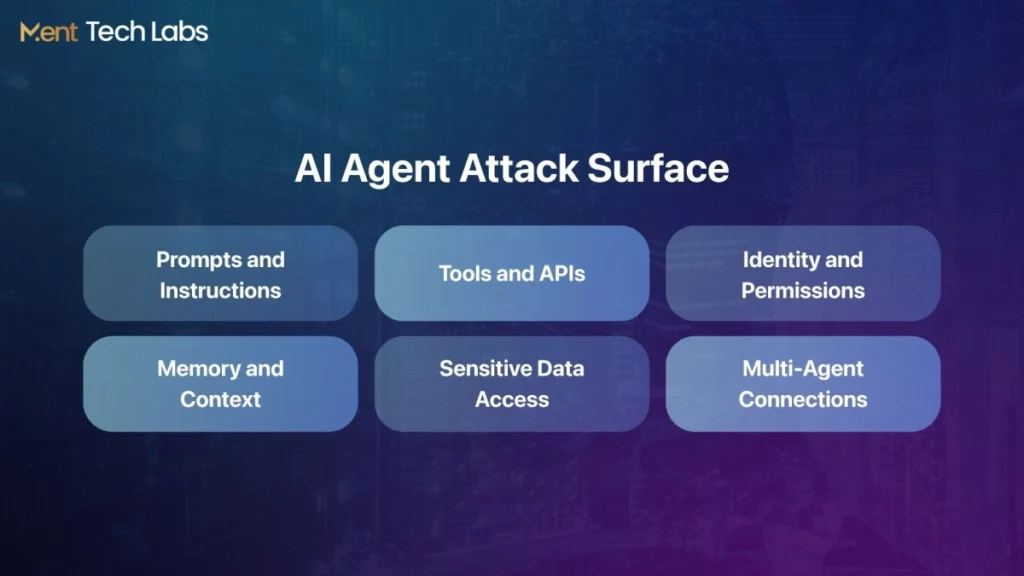
1. Prompts and Instructions
Malicious or misleading inputs can change how an agent understands a task and push it toward actions outside its intended scope.
2. Tools and APIs
Every connected tool adds another risk point. Weak controls can allow agents to call unsafe functions, access the wrong system, or pass sensitive data where it should not go.
3. Identity and Permissions
Agents often operate with delegated access. If permissions are too broad, a compromised agent can reach systems, records, or actions far beyond what its role requires.
4. Memory and Context
Stored context can shape future decisions. Poisoned or inaccurate memory may keep influencing the agent even after the original interaction has ended.
5. Data Access
Agents may work with customer records, financial data, or internal documents. Poor access rules can lead to accidental exposure, oversharing, or deliberate data leakage.
6. Multi-Agent Connections
Securing AI agents also means validating agent-to-agent handoffs so one compromised component cannot quietly affect the rest of the workflow.
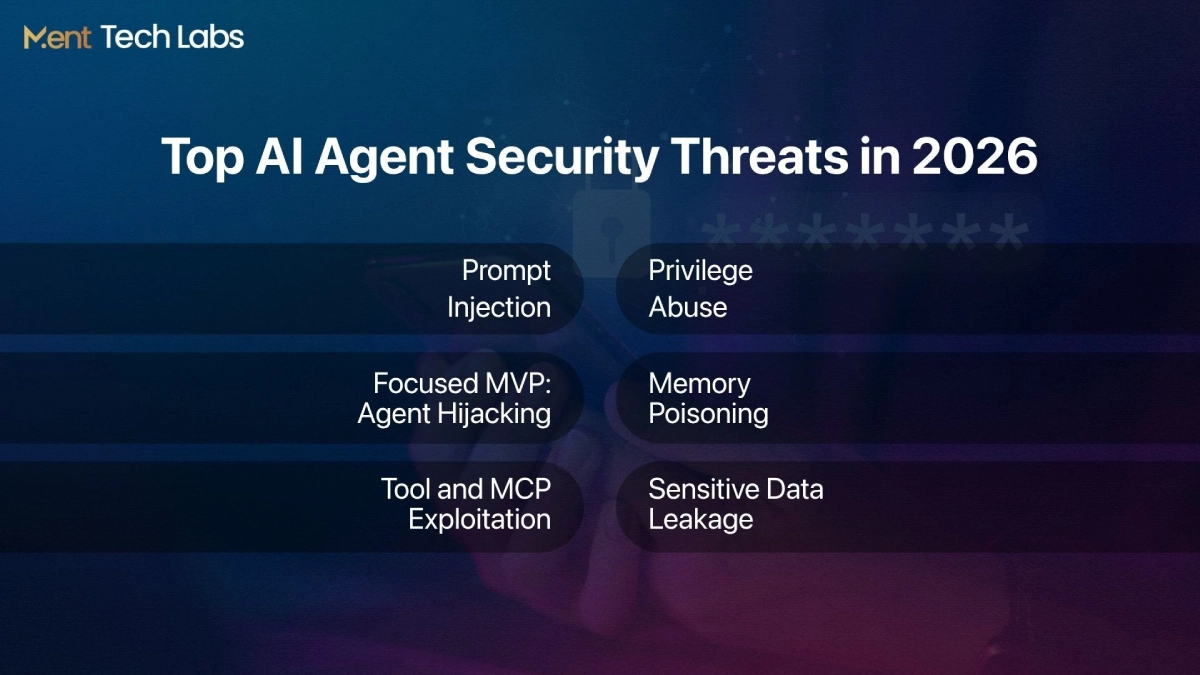
Top AI Agent Security Threats and Vulnerabilities
The biggest AI agent security risks appear when attackers can influence what an agent reads, accesses, or executes. As autonomous systems gain more permissions, securing AI agents means controlling both their decisions and the systems around them.
| Threat | Risk |
| Prompt Injection | Malicious instructions push agents outside their intended task. |
| Agent Hijacking | Attackers alter the agent’s goal or decision path. |
| Tool and MCP Exploitation | Unsafe tools can expose data or trigger harmful actions. |
| Privilege Abuse | Excessive permissions expand what a compromised agent can access. |
| Memory Poisoning | Corrupted memory can influence future agent behavior. |
| Data Leakage | Sensitive information may be exposed through responses or tools. |
| Unsafe Code Execution | Coding agents may run harmful commands or scripts. |
| Multi-Agent Failures | One compromised agent can affect connected agents and workflows. |
Core Principles of AI Agent Security
A strong agent based security approach starts with clear rules around identity, access, actions, and accountability.
Verify Every Agent Identity: Give each agent a unique identity so its actions and permissions can be traced.
Keep Permissions Minimal: Limit access to only the data, tools, and systems needed for the task.
Control High-Risk Actions: Sensitive actions such as payments or deletions should require policy checks or human approval.
Make Agent Activity Traceable: Log tool calls, access requests, decisions, and handoffs for easier investigation.
Monitor Agents at Runtime: Watch for unusual access patterns, unexpected tool use, or sudden behavior changes.
Connect Security With Governance: Responsible AI governance helps define ownership, oversight, and acceptable agent behavior.
AI Agent Security Frameworks and Compliance Standards
No single framework covers every AI agent security risk. Most teams use a mix of security guidance, governance standards, and regulatory requirements when securing AI agents.
OWASP Agentic AI Guidance
- Prompt injection risks
- Unsafe tool use
- Excessive agent autonomy
NIST AI Risk Management Framework
- Risk identification
- Control assessment
- Ongoing risk management
MITRE ATLAS
- Adversarial attack mapping
- Threat modeling
- Penetration testing services
ISO/IEC 42001
- AI management policies
- Accountability controls
- Continuous improvement
EU AI Act
- Risk management
- Human oversight
- Transparency requirements
Best Practices for Securing AI Agents in Production
Strong AI agent security depends on controls that remain active after deployment. As agents connect to more tools, data, and workflows, teams need to keep access limited, behavior visible, and testing continuous.
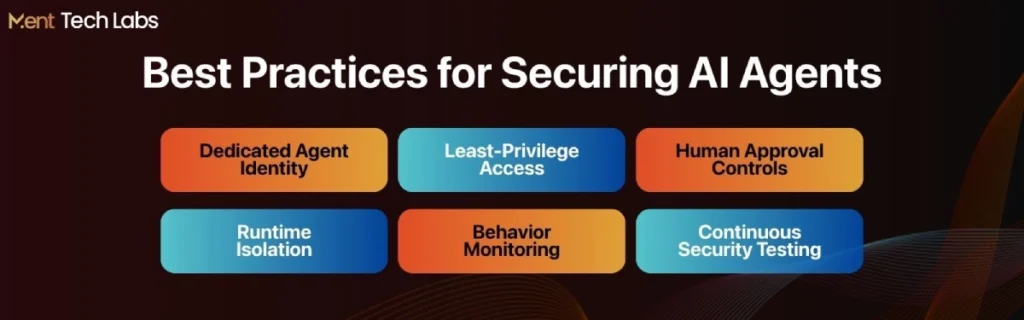
1. Agent Identity
Give every agent its own identity and credentials so access can be controlled, traced, and revoked without affecting other systems.
2. Least Privilege
Allow agents to access only the tools, data, and systems they actually need for the task they are performing.
3. Human Approval
Require approval for sensitive actions such as payments, account changes, data deletion, or other decisions that are hard to reverse.
4. Runtime Isolation
Run code execution and high-risk tool actions inside isolated environments to reduce the impact of errors or compromise.
5. Behavior Monitoring
Track unusual tool calls, failed access attempts, and unexpected changes in agent behavior so issues can be caught early.
6. Continuous Testing
Retest agents whenever prompts, models, tools, or permissions change. Regular AI security and red teaming services help uncover new weaknesses before they affect production.
Conclusion
AI agents can deliver real value, but their autonomy also creates new risks across tools, data, memory, and connected systems. That is why AI agent security needs to be built in from the start.
Clear identities, limited permissions, runtime monitoring, and regular testing help keep agent behavior within safe boundaries as deployments grow.
If you are planning to deploy secure, production-ready agents, contact Ment Tech Labs today to build stronger security and governance into your AI systems from day one.