Introduction
Traditional RAG can find information, in documents and databases. It often struggles when a question needs information from multiple sources. Agentic RAG works differently. It can decide what to search check the results and search again if something is missing.
For businesses that handle amounts of data this makes finding the right information faster and easier. It also allows teams to work with information scattered across systems without depending on one search to give the full answer.
This blog explains how the retrieval process works, what separates it from traditional RAG, and the technology behind it. We’ll also look at its business applications, practical benefits, and adoption trends for 2026-2027.
What Is Agentic RAG and How Do AI Agents Use It?
Agentic RAG (Retrieval-Augmented Generation) lets AI agents look for information, check what they find, and decide if they need to keep searching before giving an answer. It’s different from a retrieval process because it can gather data from many places like company files, databases and connected apps. This means it can handle questions that don’t have an answer, from just one source.
AI agents handle questions by working through them in smaller steps and checking different sources for answers. Take a company that is reviewing supplier contracts after a change, in compliance rules. I see that AI agents can read through the agreements compare them with the policies and point out anything that needs a closer look. If a document is missing or something does not add up AI agents can check records before sharing their findings. The team can then review those findings. Decide what needs to be done.
What’s Driving Agentic RAG Growth in 2026-2027
Businesses need more than chatbots that pull up answers. A single question might need checking contracts reviewing company records or locating data that is spread across systems. This is one reason why agent-based retrieval is gaining attention among companies that manage a lot of internal data.
According to a Research and Markets report the worldwide agentic AI market is expected to grow from $19.33 billion in 2026 to $205.88 billion by 2033 with a growth rate of 40.2 percent. These numbers show the agentic AI market, not just agentic RAG.
As businesses look toward 2027 the challenge will be putting these systems into use, beyond trials. Companies must think about how they connect with current software how they protect sensitive records and how they keep costs down. These practical concerns will play a part in wider adoption.
Technical Overview of Agentic RAG
The system works through three main layers: retrieval, generation and agent-based decision-making. Each handles a task from finding relevant information, to preparing responses and deciding when further research is needed.
1. Retrieval Layer
The retrieval layer searches company documents, databases and knowledge bases for information. The retrieval layer can access updated policies, internal records and other approved sources. The retrieval layer helps the system work with information rather than relying on stored knowledge alone.
2. Generative Layer
Once the relevant information is found the generative layer turns it into understandable words. It can take points from a long report explain a complicated document or combine findings from many different sources. With RAG development services the goal is to create answers that’re helpful and practical while still keeping all the important facts and the original context intact.
3. Agentic Decision-Making Layer
This layer checks if the information that is available is enough to answer a question. An AI agent that works on its own can find out if something is missing look for information or point out when there are conflicting facts. This helps the system to keep looking for details before it shows its results.
Agentic RAG vs Traditional RAG: Key Differences Explained
Traditional RAG finds information and uses it to answer questions, making it useful for basic searches. Agentic RAG goes further. If the first search falls short, it can check other sources, fill in missing details, or break complex questions into smaller steps.
| What to compare | Traditional RAG | Agentic RAG |
| Retrieval | Searches for relevant information using a predefined process. | Reviews search results and decides whether another search is needed. |
| Question handling | Suits direct questions that need a single lookup | Breaks a complicated question into parts and works through each |
| Data sources | Points at one knowledge base or document set | Picks among approved sources: databases, documents, internal APIs, external tools |
| Accuracy | Answers from the first batch of chunks, so anything the search missed is simply absent | Cross-checks and retries when a detail is missing, though no setup guarantees a right answer |
| Speed and cost | Fewer steps, simpler to run, cheaper per question | More model calls, longer wait, a bigger bill |
Neither one wins every time. For routine searches, traditional RAG is cheaper and far less to look after. Agentic retrieval suits the harder questions that reach across several sources, as long as you watch the cost and check what comes back.
How Does the Agentic RAG Workflow Work?
An AI agent development company typically designs this process around five steps, from understanding the request to preparing an answer using the available records. Here’s how each step works.
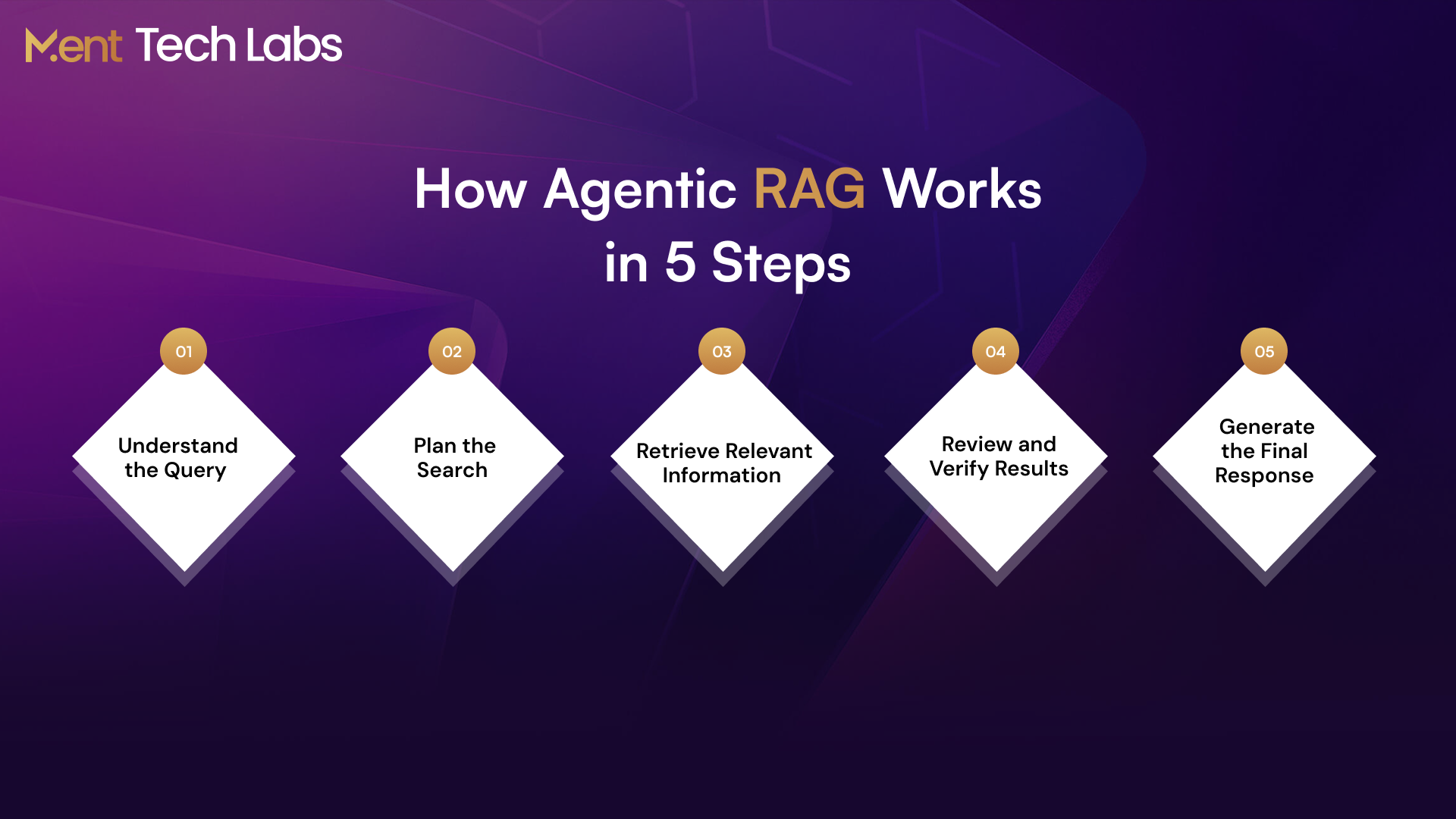
1. Understand the Query
Agentic RAG Workflow reads the question to figure out what needs to be answered. If the question covers parts, Agentic RAG Workflow splits them into smaller tasks.
2. Plan the Search
Before searching, the Agentic RAG Workflow decides which sources are worth checking. These sources could be company files, internal databases or other connected systems.
3. Retrieve Relevant Information
Agentic RAG Workflow searches the chosen sources and pulls out details that relate to the question. Information that does not help is left out.
4. Review and Verify Results
Sometimes the first search does not answer the question fully. Agentic RAG Workflow checks for missing or conflicting details. Looks at other records when needed.
5. Generate the Final Response
After reviewing the findings Agentic RAG Workflow brings them together into an answer. It can also provide source references so that readers can check where the information came from.
Agentic RAG Architecture: Key Components Explained
This setup brings together five parts that work together to help a system find, understand, and check information. Each part has its job when dealing with tricky or detailed questions. Through enterprise AI integration services, these components can be connected to existing business systems.
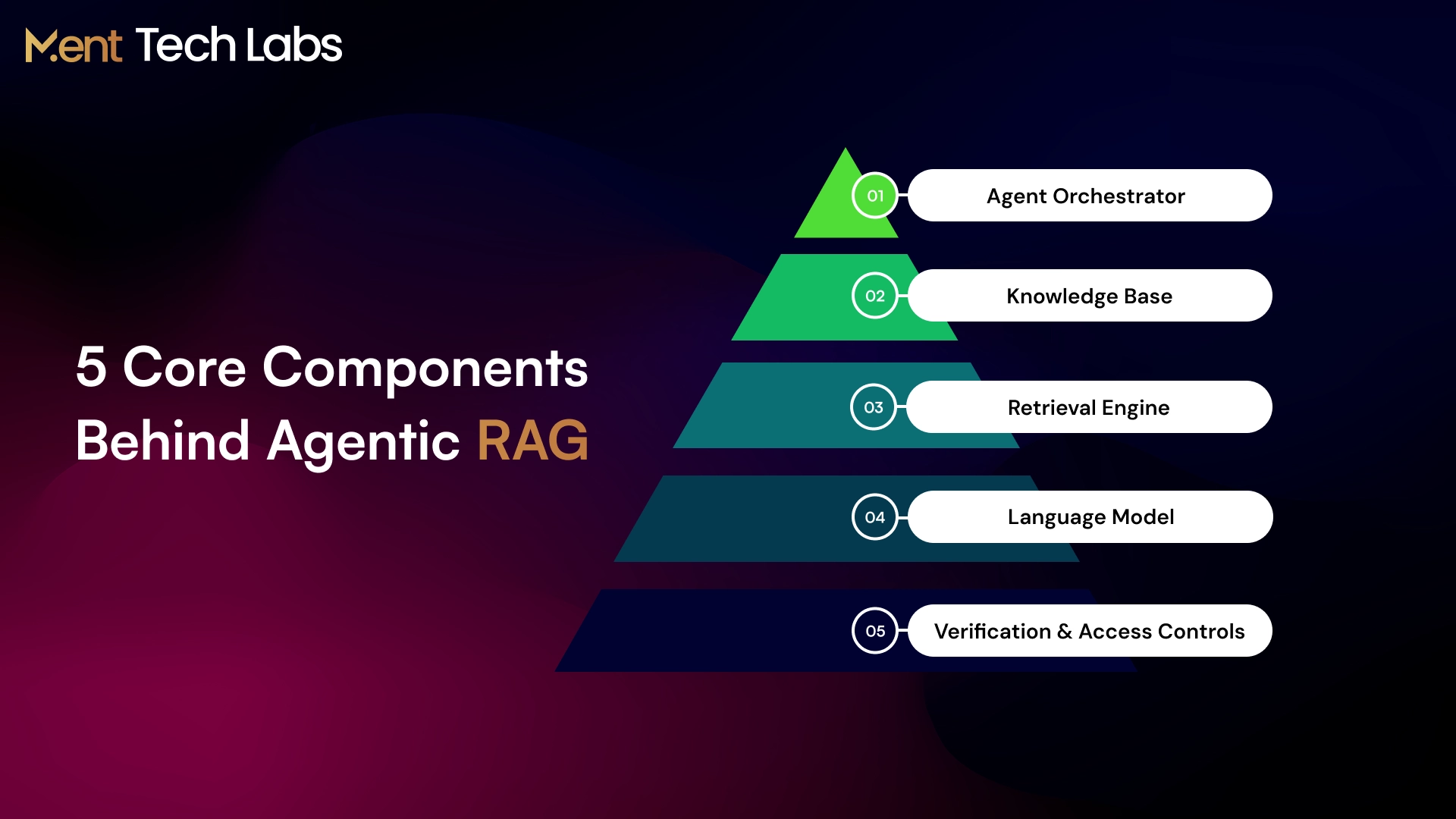
1. Agent Orchestrator
The agent orchestrator is like the planner. It figures out what tasks need to be done and picks the tools for each one. It also decides when to look for info from other sources.
2. Knowledge Base
The AI agent knowledge base holds things like company documents, rules and records. It’s the place where agents go to get the facts they need to answer work-related questions.
3. Retrieval Engine
The Retrieval Engine looks through linked data sources. It uses methods, like vector search and keyword search to find matches. Then it sorts the results to show the useful ones first.
4. Language Model
The Language Model reads the question. Combines it with the info found. It uses what it has to create answers, summaries or clear explanations. It’s the part that talks to users in a way.
5. Verification and Access Controls
Verification checks make sure answers are backed by evidence. If something is missing or not supported the system flags it. Access controls decide which data and systems an agent is allowed to use. This keeps info safe.
Top 5 Key Benefits of Agentic RAG
Finding information at work often means jumping between files, databases and different applications. Agent-based retrieval can take some of that searching off employees hands. Here is where businesses can benefit.
1. Better Decision-Making
A business decision may depend on reports, policies or past records. Having those details together makes it easier for businesses to compare the facts and spot anything that needs a look.
2. Less Manual Work
Going through dozens of files just to find one detail can eat up time. Agents can search those records. Pull out what matters leaving employees with less routine work.
3. More Accurate Answers
Sometimes the first result is. Does not tell the whole story. Checking sources can bring missing facts to light and help prevent incomplete answers.
4. Easier Access to Company Data
HR, finance and operations do not always store their information in the place. Employees with the permissions can search across connected systems without opening each one separately.
5. Better Customer Support
A customer issue might involve a support ticket, account history or a recent policy change. Access, to those records helps support staff understand what happened before deciding how to respond.
Real-World Use Cases of AI Agents Across Industries
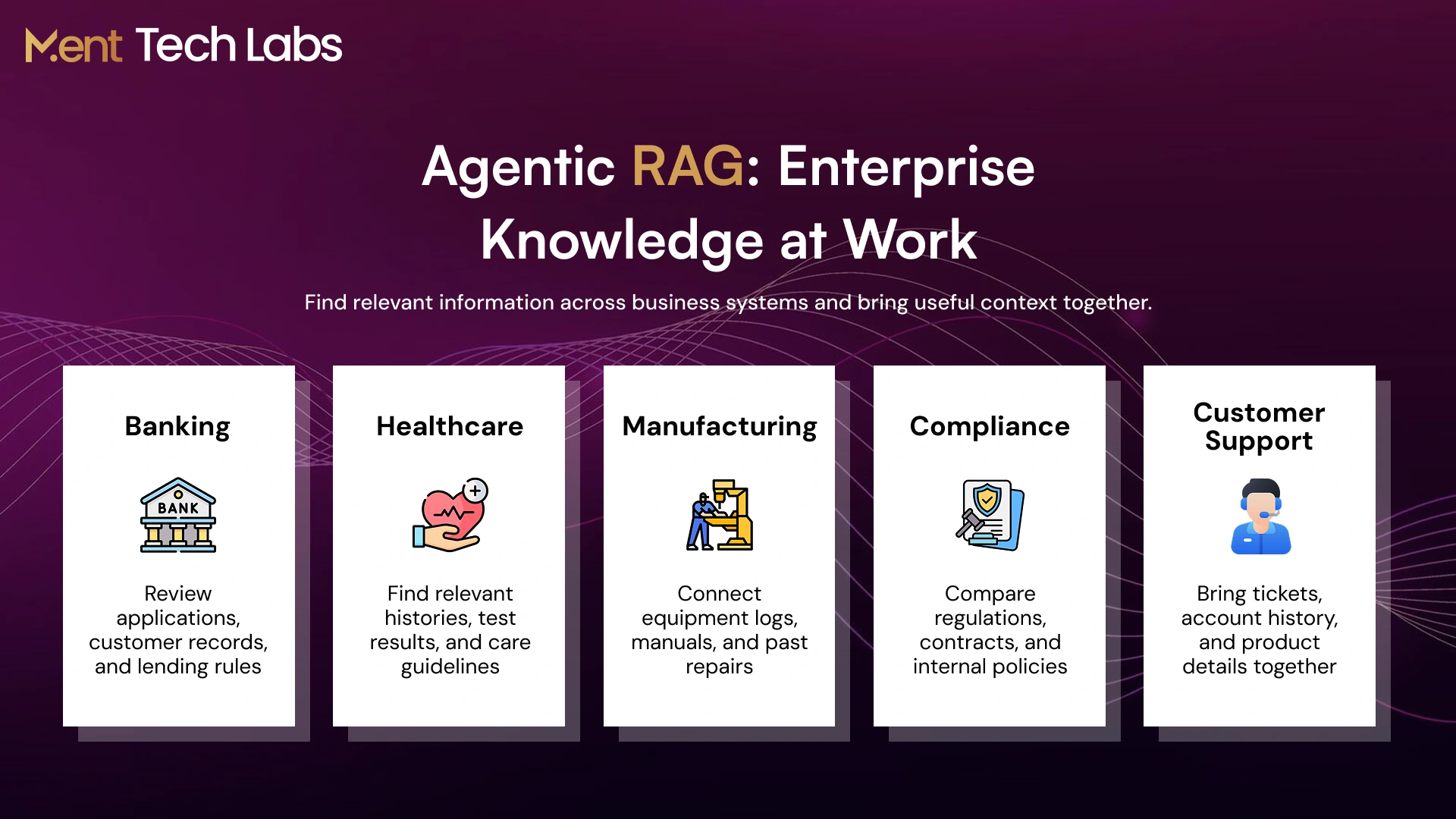
Whether it’s a contract review or a customer complaint finding the right information can take longer than you think. Here’s how different industries are using agents to make that work
1. Banking and Financial Services
Reviewing a loan application often means digging through credit reports lending rules and customer records. Agents can pull all those details together. Point out missing paperwork so the banking team doesn’t have to search for it themselves.
2. Healthcare
Doctors often need to check histories, test results and treatment guidelines before making a decision. Agents can help authorized staff find those records without having to log into each system one by one.
3. Manufacturing
When a machine stops working technicians have to look through service logs and equipment manuals to figure out what’s wrong. Agents can bring up past faults and previous repairs to help them narrow down the issue faster.
4. Compliance
A change in regulations can mean going over dozens of contracts and internal policies. Agents can compare those documents. Highlight clauses that might need a closer look, from the legal team.
5. Customer Support
Resolving a customer complaint may require checking tickets, account records and product details. With MCP server integration services agents can access approved business systems. Help support teams investigate the issue more quickly.
Conclusion
Agentic RAG helps businesses find information across different systems, handle complex questions, and reduce manual research. With reliable data and proper integration, teams can access the information they need without searching through multiple sources.
Ment Labs develops retrieval systems that work with your existing business tools. Our AI security and red teaming services help businesses identify security risks, protect sensitive data, and keep their systems reliable.
Looking to improve how your business manages and retrieves information? Contact us today to discuss your requirements and find a solution that works for your team.