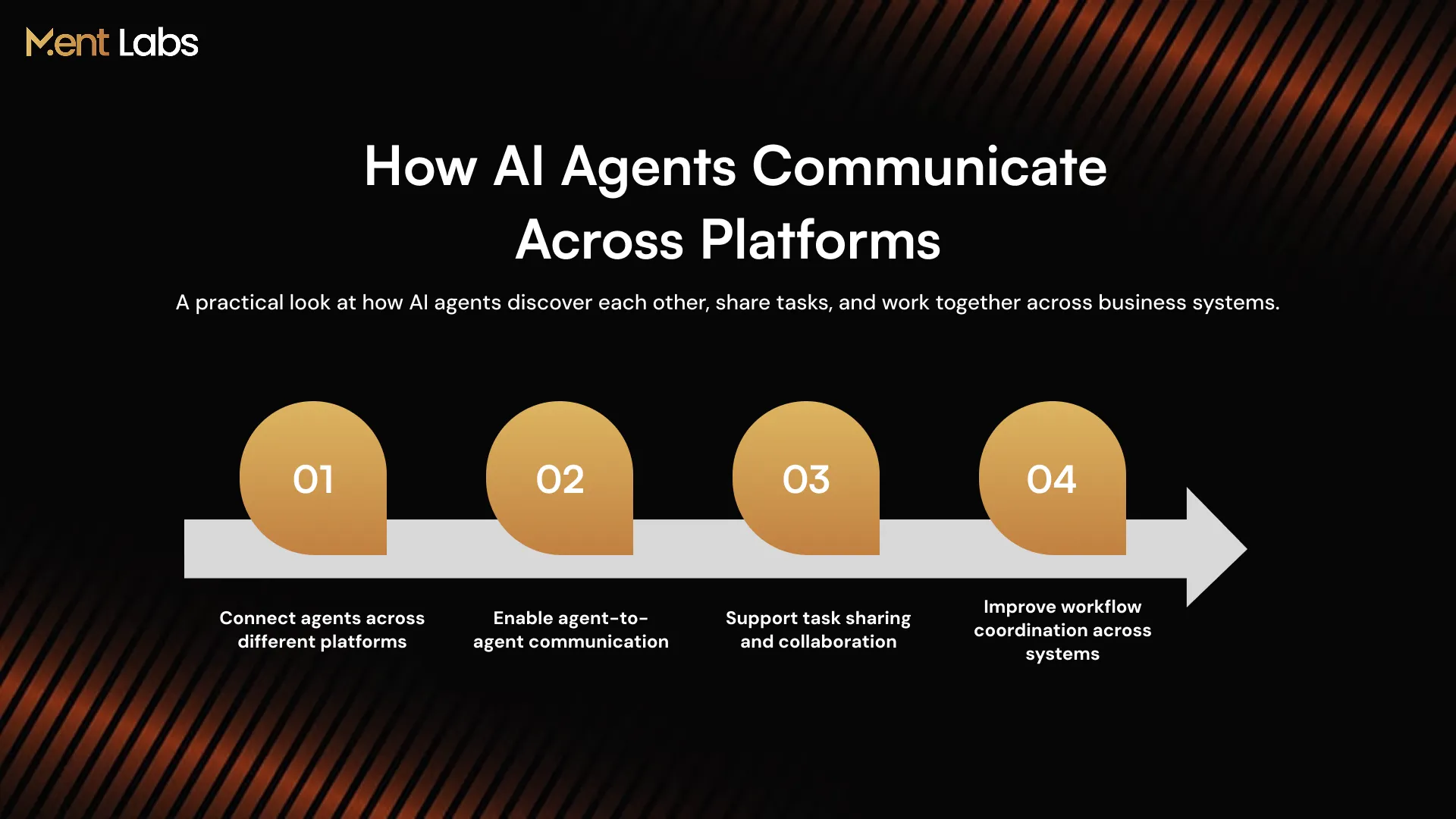
AI agents can answer customer questions, process payments, and handle routine work. But getting two agents on different platforms to work together isn’t always easy. One might need information from another, yet there’s no simple way for them to exchange it.
Google introduced the A2A protocol to address this gap. It lets agents find each other, share information, and pass tasks between systems without exposing how they’re built. Companies can use it to connect agents developed with different tools and technologies.
In this blog, we’ll look at how the A2A protocol works, its architecture, and how it differs from MCP. We’ll also discuss development costs, upcoming trends, and how Ment Labs helps businesses connect their AI agents.
A New Era of Agent Interoperability
Businesses are using AI agents to handle customer support, employee onboarding, financial operations and other daily activities. The problem comes when these agents need to work across departments. One system might have the information another one needs. These systems aren’t always built to share that information. Because of this employees still spend time sending requests looking for updates and chasing tasks that should already be done.
The A2A protocol closes this gap by giving agents a way to talk no matter which platform they use. For example an HR agent can ask an IT agent to create an account for an employee. The HR agent will then receive an update when the account is ready. This agent-to-agent communication cuts the need, for follow‑ups. It also lets companies get more out of the systems they already use.
What Is Google’s Agent2Agent (A2A) Protocol?
Google introduced the A2A protocol to help AI agents built on platforms communicate with one another. The A2A protocol is a standard that allows agents to discover what other agents can do send requests and track tasks without sharing their internal code or data. The A2A protocol is now governed by the Linux Foundation with contributions, from technology companies.
For example when a customer asks about a delivery a support employee can reach out to a logistics employee to find out where the package is. The logistics employee looks up the information. Sends it back without anyone having to move between different programs. With AI agent development services companies can create agents that work together across different programs even if those programs use different ways of working or different tools.
Core Components of the A2A Protocol Architecture
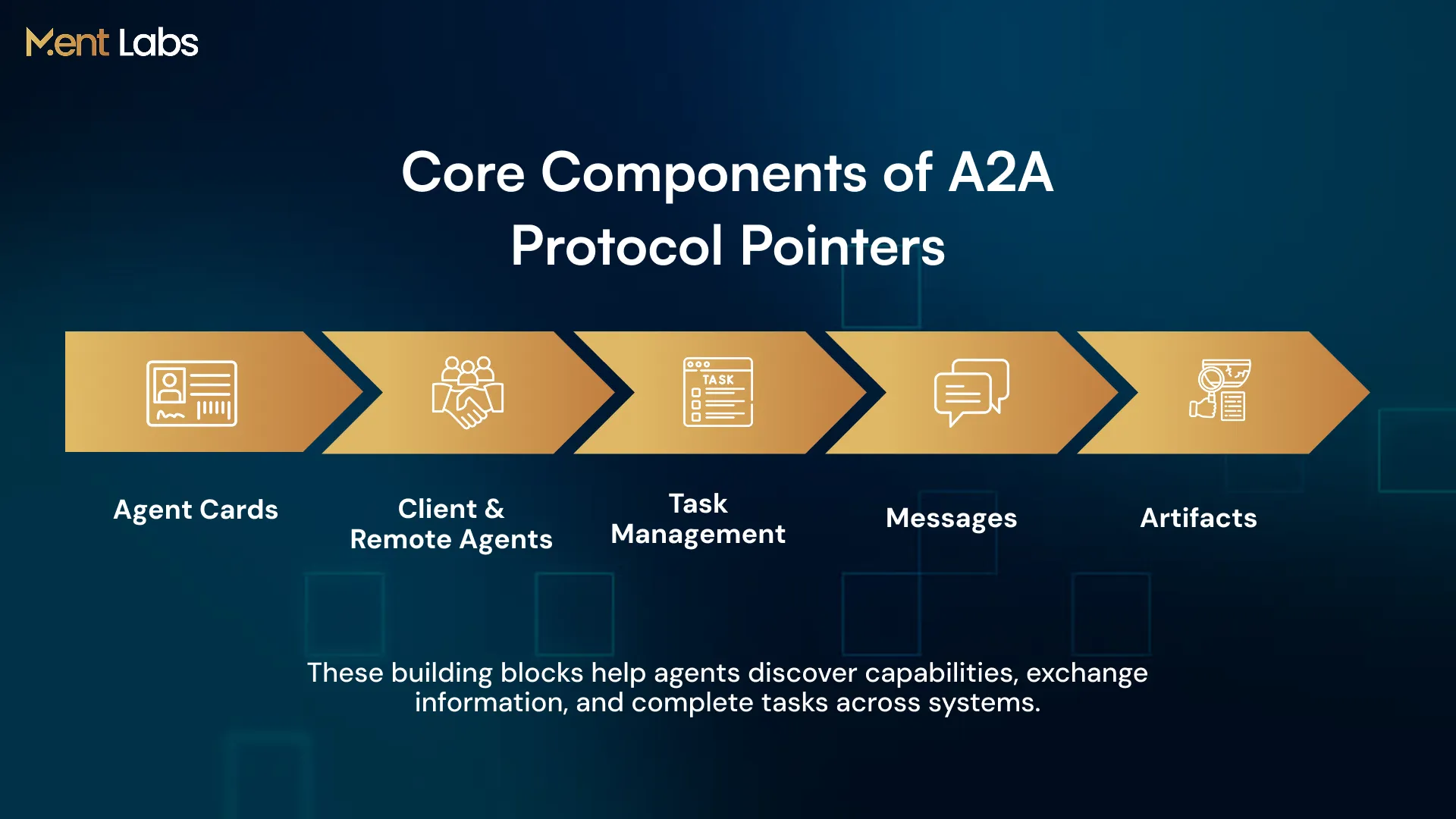
The A2A protocol uses parts to help agents locate each other share information and finish tasks across many systems. Here is how every part works.
1. Agent Cards
An Agent Card tells what an agent can do, where it can be reached and how to prove identity. Other agents read this card to decide if they can use that agent to handle their requests.
2. Client and Remote Agents
The client agent sends a request, for a user or another system. The remote agent gets that request does the needed work. Then sends back a response.
3. Task Management
Each task has a code so the progress can be followed. People working on the task can say when they are starting the work when they need help or when the work is done.
4. Message Components
Components hold the content that is shared between agents, such, as text, files or organized data. This lets agents handle kinds of information.
5. Artifacts
Artifacts are the results that an agent creates, such as a report, a document or a data file. Artifacts give the requesting agent access, to the work.
A2A vs MCP: Key Differences and How Both Protocols Work Together
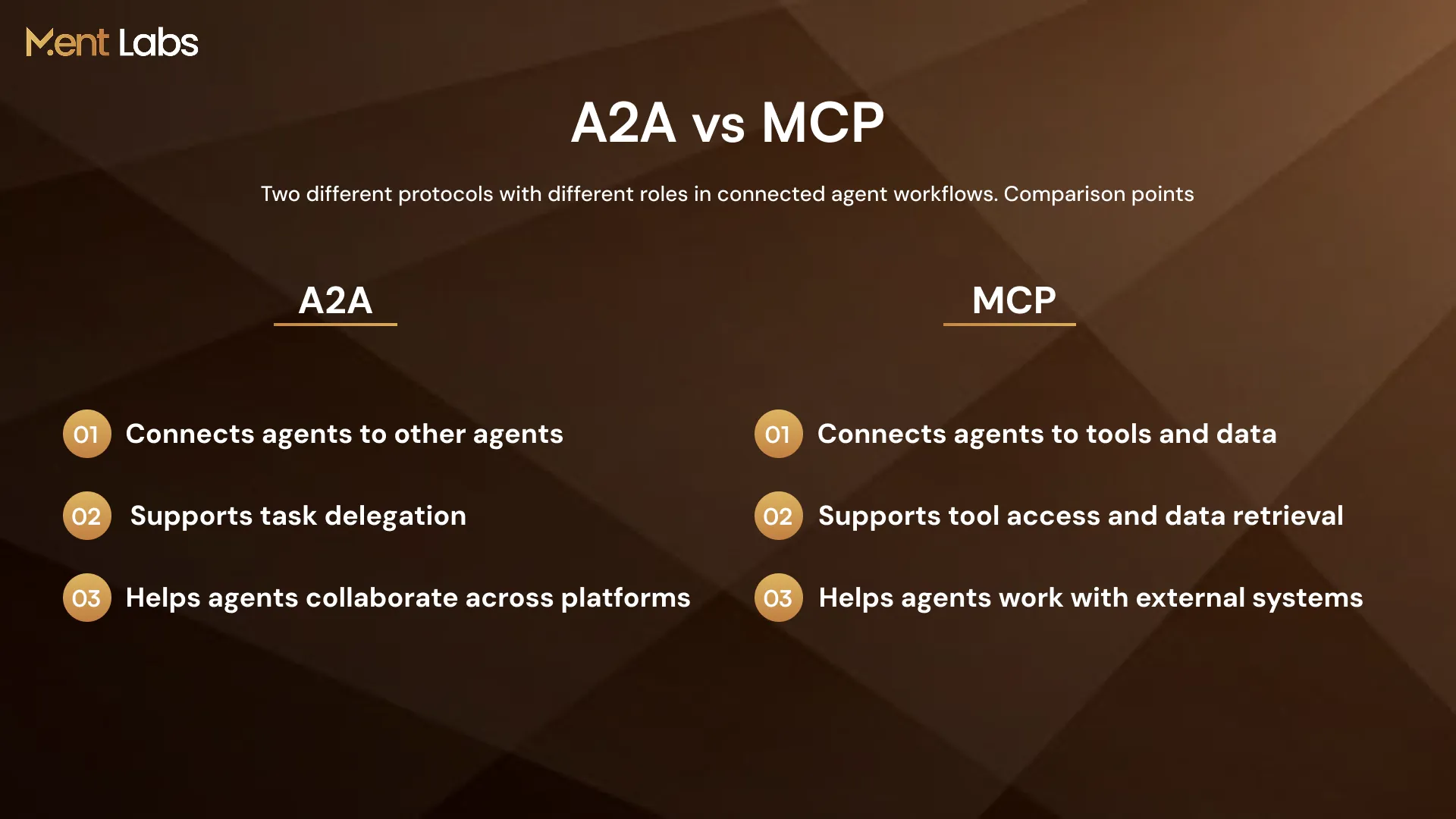
A2A and MCP serve different purposes. MCP (Model Context Protocol) connects agents to tools, databases, and applications, while the A2A protocol lets independent agents communicate, delegate tasks, and share results across different platforms.Feature
| Feature | A2A (Agent2Agent Protocol) | MCP (Model Context Protocol) |
| Main Purpose | Connects independent AI agents | Connects agents to tools and data |
| Communication | Agent-to-agent interaction | Agent-to-tool interaction |
| Primary Function | Task delegation and collaboration | Data access and tool execution |
| Architecture | Connects agents across different systems | Uses a client-server architecture |
| Task Handling | Supports multi-step tasks and progress tracking | Supports tool calls and resource access |
| Example | An HR agent requests support from an IT agent | An HR agent retrieves employee records from a database |
How A2A and MCP Work Together
Suppose a procurement agent needs to check whether a purchase is within budget. It sends a request to the finance agent through A2A. The finance agent then uses MCP to pull the latest spending records, checks the available budget, and sends the details back to the procurement agent.
Both protocols have different jobs. MCP gives agents access to business tools and data, while A2A helps them exchange requests and results. With MCP server integration services, companies can connect agents to their existing systems and use A2A to coordinate work between them.
AI agent Protocol Development Cost and timeline
The price of developing an AI agent protocol changes based on how many agents are involved how the systems connect and how secure everything needs to be. Linking agents usually costs less, than creating a full multi-agent system from scratch.
What Affects Development Costs?
- Number of Agents: More agents need connections and testing which can raise Development Costs.
- System Integrations: Using systems and custom APIs can add to Development Costs.
- Security: Adding authentication, access controls and compliance requirements increases Development Costs.
- Workflow Complexity: Tasks that involve steps and approvals need more work, which can raise Development Costs.
Businesses using AI workflow automation services should also consider integration and maintenance costs.
Estimated Cost and Timeline
| Project Scope | Estimated Cost (USD) | Timeline |
| Proof of Concept | $40K-$75K | 6-10 weeks |
| Controlled Pilot | $75K-$150K | 10-16 weeks |
| Production System | $150K-$300K | 4-7 months |
| Enterprise Multi-Agent | $300K-$500K+ | 7-12+ months |
The Future of A2A: Agent Interoperability and Emerging Trends
The A2A protocol is going past the tests as companies try to find better ways to link agents from different companies. Version 1.0 came out in March 2026. By April over 150 groups were backing the rule. The next problem is ensuring these links are strong enough, for work. Security, who can access what and what happens when tasks fail all need focus.
- Cross-Platform Support: Many technology providers are now adding A2A support so companies will no longer need to build a connection each time they add a new agent.
- Improved Security: Signed Agent Cards and authentication controls help confirm which agents are communicating and what they are allowed to access.
- Real-Time Updates: Planned improvements to streaming may allow agents to share information while a task is still in progress of waiting for the final answer.
- Human Oversight: Improved support for approvals and, for tasks could help employees review decisions before agents perform more actions.
When companies add agents it becomes tough to keep track of their permissions and activities by hand. That is why AI governance consulting services can help businesses set rules for access, data sharing and accountability while keeping their current operations intact. AI governance consulting services can do so without disrupting work.
How Ment Labs Helps Build Interoperable AI Agents
Building an AI agent is one thing. Getting an AI agent to work with agents, business applications and existing software requires careful planning. At Ment Labs we help businesses build AI agents and connect AI agents so that AI agents can share information handle tasks and work, across systems without disrupting current operations.
- Agent Strategy: Find places where agents can do manual work and help with the things the business is already doing.
- Multi-Agent Development: Build agents that can divide tasks, exchange information, and work together.
- A2A Integration: Connect agents that are created on platforms so they can send requests, share updates and finish tasks as a team.
- System Connectivity: Connect agents to the CRMs, ERPs, databases and business applications that your teams already have.
- Workflow Orchestration: Set up how tasks move between agents when approvals are needed and what happens if something goes wrong.
- Security and Governance: Decide what each agent can see and do and make sure that big choices are always made by people.
- Testing and Deployment: See how agents work in life fix any problems with how they talk to each other and keep an eye on them once they are out, in the world
We help businesses link agents to the systems that businesses already use whether it is two agents working together or a full multi‑agent platform. Our team takes care of the integrations, access permissions and workflows that keep everything running smoothly.
Conclusion
AI agents are becoming part of business operations but getting AI agents to work across different systems is not always easy. The A2A protocol helps AI agents communicate, exchange information and manage tasks together. The A2A protocol reduces the need for follow‑ups and makes it easier to connect existing business applications.
While A2A handles communication between agents, RAG development services help them find relevant information from business data. Using both allows companies to build workflows where agents can access information and coordinate tasks across systems.
At Ment Labs, we help businesses connect agents, integrate existing applications, and develop workflows suited to their needs. Looking to build an interoperable AI agent system? Contact us to discuss your project.