Introduction
A demo can make an AI agent look great. The real world is a different story. Agents make choices, use tools, and work through tasks in many steps. That leaves plenty of room for things to go wrong. An AI agent evaluation framework helps companies spot these problems. It lets them measure how well the agent performs and decide if the agent is ready for production.
In this blog post, we will explore the basics of AI agent evaluation. We will look at how AI Agent Evaluation differs from LLM evaluation, and we will cover the evaluation methods. We will also talk about the AI agent evaluation tools in 2026, explain how to build an evaluation harness, and outline the steps needed to create a strong evaluation framework.
What Is AI Agent Evaluation?
AI agents can handle tasks, interact with tools, and make decisions with limited human involvement. However, completing a task does not always mean completing it. AI Agent Evaluation is the process of testing how well an AI agent performs in real-world scenarios, from understanding user instructions to selecting the tools and delivering the expected outcome. AI Agent Evaluation helps developers identify errors, measure reliability and understand where an AI agent needs improvement.
Agent evaluation is not like AI testing. Agent evaluation looks at the execution process. That means actions, tool calls, decision-making, and final results. Take a research agent. A research agent should give information. A research agent should also retrieve relevant sources and complete the task as instructed. Evaluating these steps helps businesses figure out whether their agents are reliable enough for production use.
How Agent Evaluation Differs From LLM Evaluation
LLM evaluation and agent evaluation may seem similar at first, but they focus on different things. LLM evaluation checks whether a model can understand a prompt and provide a relevant answer. Agent evaluation goes a step further by looking at how an agent handles tasks, makes decisions, uses tools, and manages each step along the way. This matters when businesses rely on AI agents to handle everyday operations
Key Differences Between LLM Evaluation and Agent Evaluation
| Evaluation Factors | LLM Evaluation | Agent Evaluation |
| Primary Focus | Response quality and accuracy. | Overall task completion and performance. |
| Testing Scope | Individual prompts and responses. | Complete workflows and multiple actions. |
| Decision-Making | Evaluates generated answers. | Evaluates decisions and action selection. |
| Tool Usage | Tests basic tool-calling capabilities. | Tests tool selection and execution. |
| Performance Metrics | Accuracy, relevance, and coherence. | Task success, reliability, and execution time. |
| Error Handling | Identifies incorrect or irrelevant responses. | Checks how agents detect and recover from errors. |
Both evaluations are important when building AI systems that businesses can actually rely on. While LLM evaluation helps improve the quality of responses, agent evaluation checks whether the agent can complete tasks without getting stuck or making unnecessary mistakes. Combining both gives businesses a better understanding of how their AI systems perform in real-world situations. This is equally important when building reliable solutions through AI Agent Development Services.
Key Methodologies for Evaluating AI Agents
Evaluating an AI agent is not about checking the answers that an AI agent gives. It is about seeing how well an AI agent handles tasks, makes decisions, and works with tools. These checks help businesses notice problems and improve processes with AI Agent Workflow Automation Services.
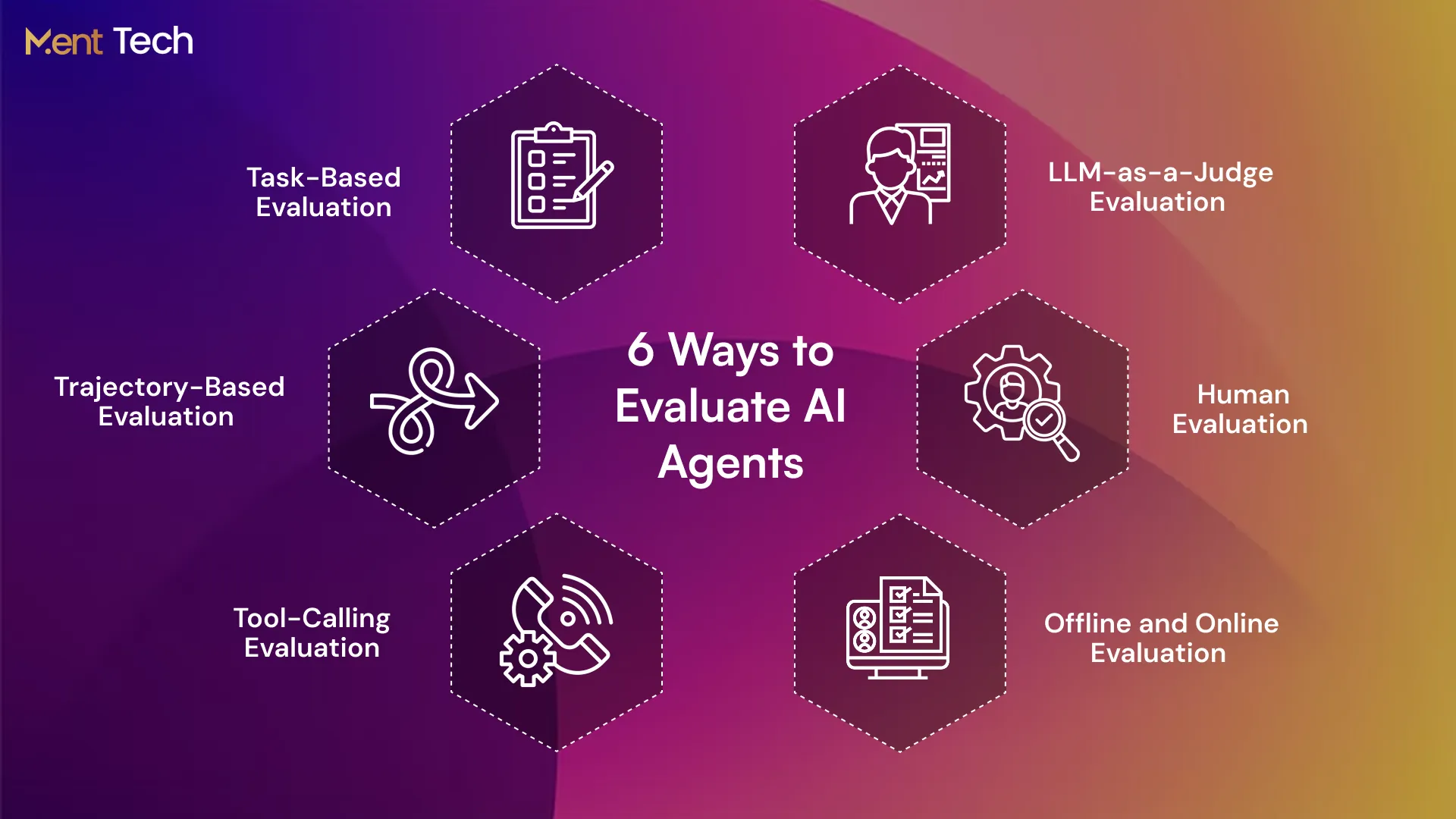
1. Task-Based Evaluation
Task-based evaluation checks if an agent can finish the job it was given. Task-based evaluation is verified by developers who look at the result and compare it to the expected outcome to confirm that the task-based evaluation was done correctly.
2. Trajectory-Based Evaluation
This method watches the steps that an agent takes while completing a task, from the decisions that the agent makes to the actions that the agent takes. This method helps spot steps that’re unnecessary, decisions that are wrong and delays that happen during the process.
3. Tool-Calling Evaluation
This checks whether an agent picks the tools and uses them correctly. This also helps identify issues when agents use APIs, databases, or external platforms. I hope this helps.
4. LLM-as-a-Judge Evaluation
This method uses another language model to review an agent’s responses and actions against set criteria. This method helps check whether the results are accurate, relevant, and aligned with the given instructions.
5. Human Evaluation
Sometimes, automated tests alone are not enough to judge whether an agent has done a job. Human reviewers check the agent’s responses and actions, especially when a task requires context, experience, or business knowledge.
6. Offline and Online Evaluation
Offline evaluation tests the agent with existing datasets before the agent goes live. Online evaluation watches the agent’s performance while the agent is in use. Using both helps developers find problems during testing and after the agent is deployed.
Choosing the Right Evaluation Approach
Not every possible issue can be covered by a testing method. By combining approaches, developers can see how an agent performs, where an agent struggles, and what a developer must change before an agent is ready for real business use.

Top 5 AI Agent Evaluation Tools in 2026
Choosing the evaluation tool helps developers see how their AI agents perform in real life. With an evaluation tool, it is easier to spot mistakes, review the AI agent’s actions, try workflows and improve the AI agent before it is launched. Here are five evaluation tools worth looking at in 2026.
1. LangSmith
LangSmith helps developers test and monitor AI agents. LangSmith tracks the execution of agents, the calls to tools, and the overall performance. LangSmith is especially useful for teams building agents with LangChain and LangGraph.
Key Features:
- Agent tracing and monitoring
- Dataset-based evaluation
- Experiment tracking
2. Braintrust
Braintrust helps teams test AI applications, compare results, and spot performance problems. Braintrust’s evaluation and scoring features make it easier to see if changes are improving agent performance.
Key Features:
- Custom evaluation scoring
- Experiment comparison
- Production monitoring
3. Arize Phoenix
Arize Phoenix shows developers how agents work by following each step an agent takes, the tools it calls, and the outputs the model gives. With Arize Phoenix, developers can spot mistakes. See why an agent might act in an unexpected way.
Key Features:
- Agent execution tracing
- Custom evaluation metrics
- Dataset and experiment tracking
4. Langfuse
Langfuse helps teams keep an eye on AI applications. It does this with traces and performance data. Langfuse also supports evaluation scores, datasets and prompt management.
Key Features:
- Agent tracing
- Dataset-based evaluation
- Prompt management
5. DeepEval
DeepEval is an open-source framework that lets developers test AI agents with evaluation metrics. DeepEval supports task completion, tool usage, and automated testing.
Key Features:
- Task completion testing
- Tool usage evaluation
- Automated evaluation metrics
How to Build an AI Agent Evaluation Harness
Building an AI agent is a challenge. Ensuring that the AI agent works reliably is a different challenge. An evaluation harness is a tool that lets developers test how the AI agent performs, spot mistakes, and decide if the AI agent is ready for use in the world.
1. Define Evaluation Goals
Determine what the agent must accomplish and how to measure the agent’s performance. Pay attention to completing tasks, being accurate, using tools properly and keeping response time.
2. Prepare Test Datasets
Create test cases that cover typical and unusual situations the agent may encounter, including user requests, complex instructions, and unexpected inputs.
3. Set Up the Testing Environment
Provide the agent with the tools, APIs, and data the agent needs for testing. MCP Server Integration Services can help link agents with tools and systems.
4. Track Agent Execution
Record the agent’s actions, tool calls, errors, and final results. Recording will help developers see where the agent struggles while performing tasks.
5. Apply Evaluation Metrics
Measure performance using task success rate, accuracy, tool-call reliability, and execution time. Use automated checks and human reviews where needed.
6. Test, Review, and Improve
Run tests on a basis. Compare the results across agent versions. Use what you find to fix any errors and make the performance better before you deploy.
Step-by-Step Guide to Building an AI Agent Evaluation Framework
Building an AI agent is part of the work. You also need to check whether an AI agent handles tasks correctly, an AI agent makes decisions and an AI agent performs reliably. A structured evaluation process helps developers find problems and improve performance before deployment.
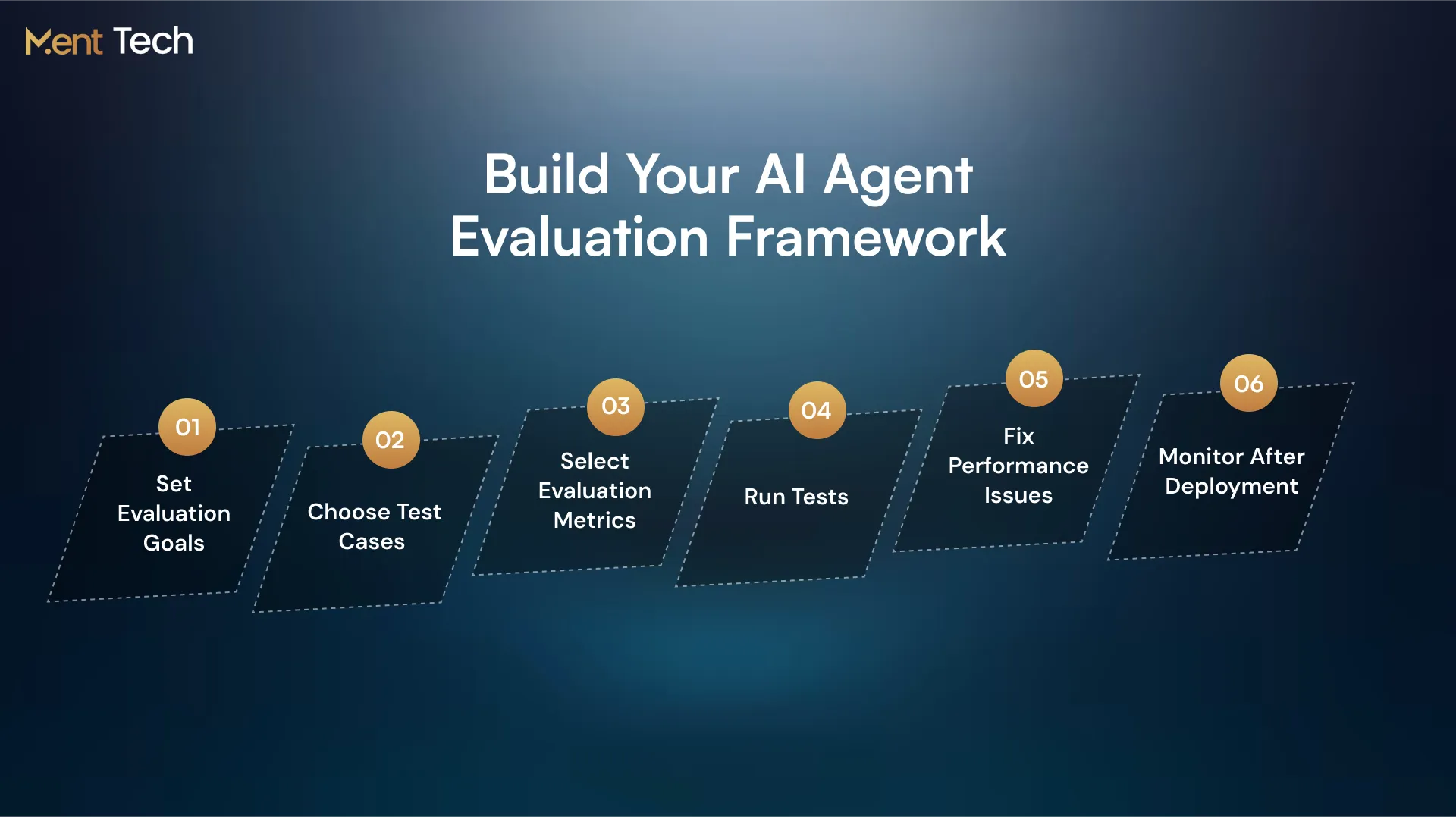
1. Set Clear Evaluation Goals
Figure out what the agent needs to do. Then work out how you will judge its work. Pay attention to a few things: did it get the task done, was it right, how fast did it reply, and did it use its tools well.
2. Choose Real-World Test Cases
Build test cases from the jobs the agent will take on. Cover daily asks, tricky cases, and odd inputs too.
3. Select the Right Evaluation Metrics
Pick numbers that fit what the agent is meant to do. Things like how often it gets the job done, how correct its tool calls are, how many errors it makes, and how long it takes to run.
4. Run Tests and Review Results
Test the agent with the scenarios you have chosen and see where the agent has trouble. Look at the agent’s actions. The tool calls the agent to understand what went wrong.
5. Fix Issues and Repeat Testing
Adjust prompts, tools, or workflows after reviewing the results. Perform the tests again to determine if the changes have improved performance.
6. Monitor Performance After Deployment
Keep track of interactions, errors, and user feedback after launch. AI Pilot to Production Services can help businesses move agents into production environments while maintaining performance and reliability.
Conclusion
Evaluating an AI agent is not about checking if the AI agent gives the correct answer. You also have to see how the AI agent handles tasks, how the AI agent makes decisions, and how the AI agent deals with problems that happen unexpectedly. The correct testing methods and tools help developers spot problems early, and they help developers make sure that the AI agent can meet business requirements.
As businesses start relying on AI agents, keeping AI agents secure and reliable becomes as important as the performance of AI agents. If you are planning to build or deploy AI agents, Ment Tech can help you spot risks and strengthen your systems through AI security and red teaming services. Contact us today to discuss how we can help make AI agents more secure and dependable.