When someone is feeling anxious at 2 AM or just needs to talk through a hard day, they are not always reaching for a phone to call a therapist. Increasingly, they are opening an app. AI tools for emotional support, journaling, and stress management are becoming part of everyday life, and for healthcare and wellness businesses, that is a genuine opportunity worth paying attention to.
But opportunity without responsibility is where things go wrong. Vulnerable people trust these tools, sometimes more than they should. How a product is designed, what it says, what it refuses to say, and when it points someone toward real human help, that is what separates a responsible product from a harmful one.
An AI mental health therapist chatbot should never try to diagnose, treat, or replace a licensed therapist. Its job is to support, not substitute. Help users reflect, track their mood, and recognize when professional care is the right next step.
Explore how Ment Tech Labs can help you build responsible AI mental health chatbot solutions designed around safety, support, and human care.
What Is an AI Mental Health Therapist Chatbot?
An AI mental health therapist chatbot is the kind of support that does not cancel on you. It is there at midnight when sleep will not come. It helps you put words to feelings you cannot quite explain. It walks you through a breathing exercise before the conversation you have been avoiding all week. It is not a cure, and it is definitely not a clinician, but for someone who just needs a place to start, that kind of steady, judgment-free availability means more than people realize.
Where things get complicated is the word “therapist.” That word has real clinical meaning, and using it loosely on a product that has not been validated or professionally supervised does a quiet kind of harm to the people it is supposed to help. A mental health chatbot that actually deserves trust knows its place, is honest about what it can and cannot do, and never tries to be more than it is.
Why Mental Health Chatbots Should Not Replace Therapy
Therapy is not just conversation. It is a trained human being picking up on what you are not saying, making clinical judgments, holding space for complex trauma, and taking real accountability for your care. A mental health chatbot can do a lot of things, but it cannot do that. The National Academy of Medicine makes this clear, too. There is no consensus that AI can serve as a therapy replacement, and roles like crisis intervention and diagnosis have no business being handed to a chatbot.
Here is where the line sits:
- AI cannot diagnose mental health conditions: that requires clinical training, context, and professional accountability
- AI cannot handle crisis intervention: a person in real danger needs a real human, not an automated response
- AI cannot fully grasp complex trauma or risk: it can hear the words but miss everything underneath them
- AI may overvalidate harmful thoughts: without proper guardrails, it can end up agreeing with things it should gently challenge
- AI may miss warning signs: subtle shifts in tone or behavior that a trained clinician would catch can slip right past
- AI lacks human accountability: no chatbot carries legal or ethical responsibility for the advice it gives
- AI responses can vary in quality: even the best models have off days, and in mental health, that variability matters
A mental health AI chat experience can be genuinely supportive, but the moment it starts operating in spaces that belong to licensed professionals, it stops being helpful and starts being risky.
Where Mental Health Chatbots Can Help Safely
Done right, a health AI chatbot can genuinely make a difference in someone’s day. Not by replacing care, but by showing up in the moments that matter and that nobody else thought to fill. The late-night check-in. The breathing reminder before things spiral. The journaling prompt that finally helps someone make sense of what they have been feeling all week. That is the space AI was made for in mental health, and staying in that space is what makes it actually useful.
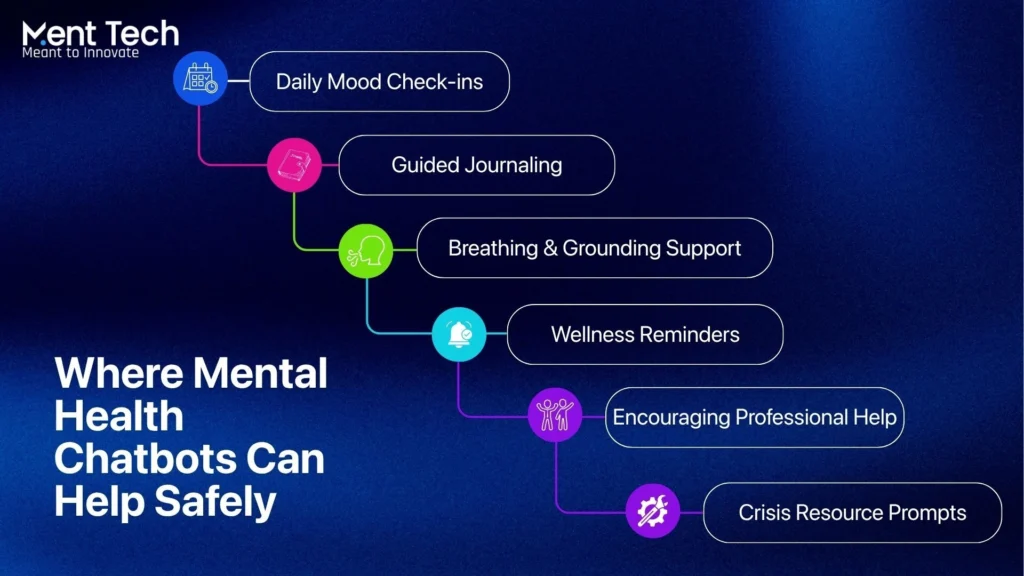
- Daily mood check-ins
Most people do not notice how their mental state shifts until it has already. Small, consistent check-ins help users catch those changes early before they quietly snowball into something harder to manage.
- Journaling support
A blank page when your thoughts are everywhere is its own kind of overwhelm. A gentle prompt gives people a way in without the pressure of figuring out where to even begin.
- Stress and mindfulness support
Whether it is a breathing exercise mid-panic or a grounding technique before a hard day, having something available right in that moment, not scheduled for next Tuesday, makes a real difference.
- Encouraging professional support
One of the most valuable things a mental health AI chat can do is recognize when it is out of its depth and point someone toward real help without making them feel like they failed for needing it.
- Connecting to crisis resources
When someone is in a genuinely dark place, they need a clear and immediate path to human support. A good chatbot never lets that moment hit a dead end.
Key Risks of Poorly Designed Mental Health AI Chatbots
Building a mental health chatbot without thinking through the risks is not just a product problem; it is a people problem. When someone on the other end of that conversation is already struggling, a poorly designed experience can do quite serious harm. Here is what happens when the design gets it wrong.
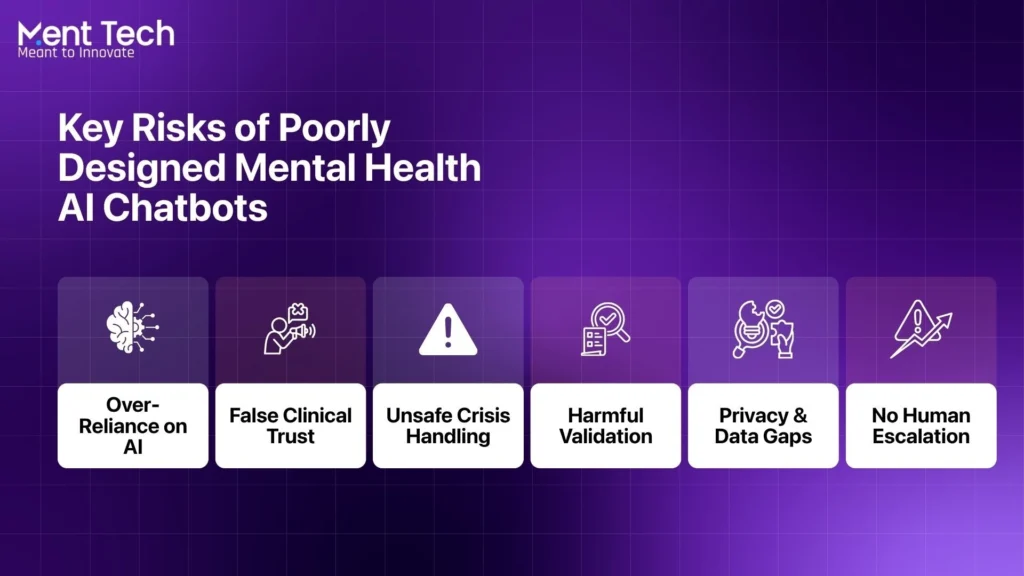
1. Over-Reliance on AI
When a chatbot is the most available and least judgmental thing in someone’s life, it is easy to see why they start treating it as their entire support system. That is a line good design should never let users cross without a nudge toward a real human connection.
2. False Sense of Clinical Authority
A chatbot that talks like a therapist and never reminds users of its limits can easily be mistaken for the real thing. That kind of misplaced trust is dangerous, especially for someone who is already vulnerable and desperately looking for answers.
3. Unsafe Crisis Handling
A health AI chatbot that cannot detect signs of self-harm or suicidal ideation and connect that person to real help immediately is not just unhelpful; it is unsafe. Crisis moments need human responses, not automated ones.
4. Harmful Validation
AI that only mirrors what a user feels, without any guardrails, can end up agreeing with thoughts that genuinely need to be challenged. It sounds supportive on the surface but can quietly make things a lot worse underneath.
5. Privacy and Data Concerns
Mental health conversations are among the most sensitive data a product will ever handle. Users are being vulnerable, and if the infrastructure behind that conversation is not secure, that vulnerability is being exploited whether anyone means to or not.
6. Lack of Human Escalation
No mental health chatbot should ever be a dead end. When distress signals appear, there has to be a clear and immediate path to a real person. As NAM highlights, connecting users to human support when it matters is not a nice-to-have; it is a core design requirement.
What Responsible Mental Health Chatbot Design Looks Like
Responsible design does not start when something breaks. It starts in the very first product meeting before anyone has written a single line of code. The teams building these tools need to decide what this chatbot is allowed to say, what it should never go near, and the exact moment it needs to stop and get a real human involved. That conversation has to happen first. Everything else comes after.
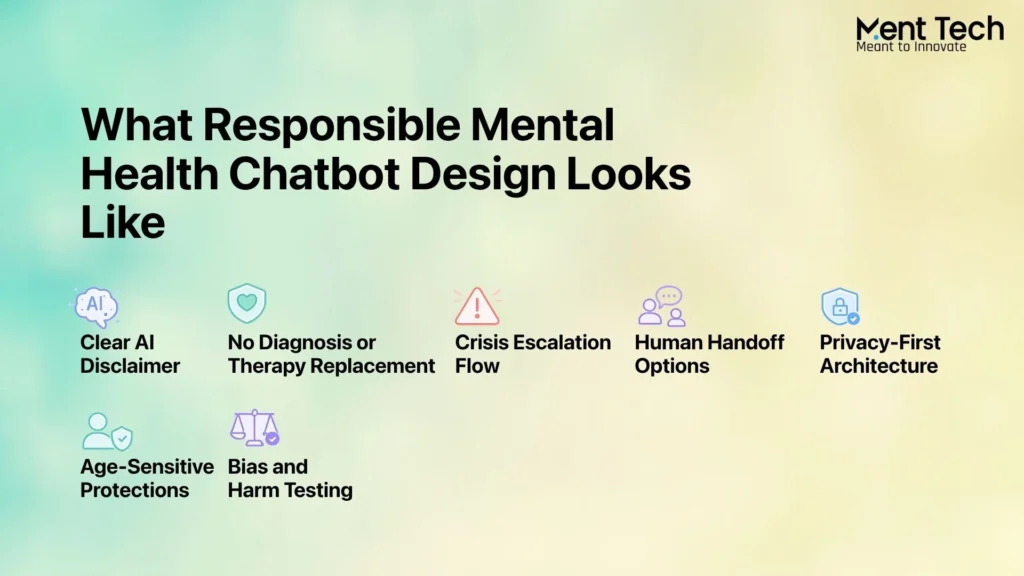
- Clear disclaimers from the start: The first message a user sees should make it clear they are talking to an AI, not a licensed professional. Not buried in the terms. Right there, upfront. It is just being honest with someone about to share something deeply personal.
- No diagnosis or therapy replacement messaging: A responsible mental health chatbot never hints that it can assess, diagnose, or treat. Not in the onboarding, not in the chat, not anywhere. That line does not move.
- Crisis escalation flows: When someone says they are not okay, there needs to be a real and immediate path to human help. Built and tested before launch, not scrambled together after something goes wrong.
- Human handoff options: Every conversation needs a door that leads to a real person. A counselor, a coach, a crisis line. Someone who can actually show up in the way AI never fully can.
- Privacy-first architecture: People share things in mental health conversations they would not say out loud to anyone. A healthcare AI platform that does not protect itself with the strongest security controls is asking for trust it has not earned.
- Age-sensitive protections: A teenager reaching out in distress and an adult doing the same are not the same situation. Good design knows the difference and responds accordingly.
- Bias and harm testing: AI learns from patterns, and patterns are not always safe. Testing for harmful outputs and blind spots has to keep happening as long as the product is live, not just at launch.
How a Healthcare AI Platform Can Support Mental Health Chatbots
A chatbot alone is not enough. The real difference shows up when it sits inside a broader healthcare AI platform that connects users to the right care at the right time. That is when it stops feeling like an add-on and starts being something people actually trust. Privacy, security, and compliance have to be there from day one, not patched in after something goes wrong.
User profiles
Nobody wants to re-explain their whole situation every time they open the app. When the platform remembers who someone is and what they have been through, it stops feeling like a tool and starts feeling like it actually gives a damn.
Mood-tracking dashboards
A single check-in means very little. But thirty of them together start telling a story. Dashboards help users and care teams see what is actually going on beneath the surface.
Crisis escalation workflows
When someone signals they are not safe, there is no room for a slow response. The right people need to be looped in immediately, automatically, and without anything falling through the cracks.
Human support routing
Handing someone off from a chatbot to a real person should feel like a natural next step, not like hitting a dead end. When that transition is smooth, people actually use it.
Secure data storage and consent management
People share things in mental health conversations that they have never said out loud to anyone. That deserves the highest level of care, full stop.
Clinician and coach dashboards
Care teams cannot support people they cannot see. Giving professionals the right visibility at the right time makes the whole system work better for everyone.
Integration with apps, portals, and EHR systems
A platform that talks to the rest of someone’s care world through solid generative AI integration services and NLP development services feels like a real solution, not just another disconnected app nobody asked for.
Features to Include in a Responsible Mental Health Chatbot
The features a mental health chatbot ships with say everything about how seriously the team behind it takes the real people using it. Not users. People. And any AI chatbot development company worth working with knows that every feature on this list is there for a reason that goes beyond the product roadmap.
- Mood check-ins and journaling: A gentle nudge to help someone pause and actually check in with themselves, and a quiet space to put those feelings into words when they are ready. No pressure, no judgment, just a place to land.
- Stress coping prompts and mindfulness exercises: When someone is overwhelmed, they need help right now, not next Tuesday. Having a breathing exercise or a coping prompt available in that exact moment is the whole point.
- Resource library: A place where someone can find honest, trustworthy information about what they are going through without ending up lost and more anxious than when they started.
- Goal tracking and wellness reminders: Small wins matter more than people think. Helping users set gentle goals and showing up consistently to remind them without ever making them feel watched or judged is harder to get right than it sounds.
- Crisis resource prompts and human escalation: When someone reaches out from a really dark place, they need a real human, and they need one fast. No chatbot should ever be the last door someone can knock on.
- Privacy controls and safety disclaimers: People share things here that they have never said out loud to anyone. That kind of trust is fragile and rare. It deserves to be handled like it matters, because it does.
- Admin and analytics dashboards: The teams running these products need to see what is actually happening so they can keep getting better at it and catch problems before they quietly become something much worse.
Benefits of Designing Mental Health Chatbots as Support Tools
The best mental health chatbot products are not trying to replace therapists. They are helping people get support earlier, make sense of what they are feeling, and find their way to human help when they need it most. And when a product is built with that intention from the very start, everything works better, for the people using it, for the care teams behind it, and for the business that built it.
1. Safer and More Trusted User Experience
When people know exactly what they are talking to and what it can realistically do for them, they engage more honestly and trust it more deeply. A product that is upfront about its limits from the first message builds the kind of trust that keeps people coming back and keeps them safe while they do.
2. Clearer Product Positioning and Better Healthcare Alignment
A mental health AI chat product that knows its place is easier to market, easier to work with regulators on, and far easier for hospitals, clinics, and healthcare partners to take seriously. The products that try to be everything end up trusted by nobody.
3. Reduced Misuse and Lower Regulatory Risk
Overpromising clinical outcomes is a fast track to scrutiny that no startup can afford. Building responsibly from day one keeps the product out of territory it does not belong in and away from risks that were always avoidable to begin with.
4. Better Support for Therapists and Care Teams
A well-designed chatbot is not competing with clinicians; it is doing the work that makes their job easier. Mood tracking, early check-ins, and journaling: by the time a user reaches a real professional, they are more self-aware, and the care team has something real to work with.
5. More Responsible AI Adoption Across the Industry
Every product that gets this right makes it a little easier for the next one to do the same. Building with generative AI integration services and NLP development services responsibly does not just protect one product; it helps raise the standard for mental health AI everywhere.
Final Thoughts: Mental Health AI Should Support Human Care, Not Replace It
AI can do a lot of good in mental health when it knows what it is there for. Helping someone reflect, stay consistent, understand what they are going through, and find the right support when they need it. That is a real contribution, and it is enough. It does not need to be more than that to matter.
But when a product starts overreaching, diagnosing, handling crises alone, or pretending to be a therapist, it stops helping and starts putting people at risk. The line is not hard to see. The question is whether the team building the product chooses to respect it.
A well-built AI mental health therapist chatbot supports human care; it does not compete with it. It shows up honestly, stays in its lane, and always keeps the door open to a real human when it matters most. That is the standard worth building.
Partner with Ment Tech to build mental health AI chatbot solutions that support users responsibly, protect sensitive data, and keep human care at the center.