Let’s be upfront about something. The moment you start asking about mobile app development cost, you will get a dozen different numbers from a dozen different sources. Some say $10,000 and others ay $500,000. Both can technically be right, and that is exactly why this guide exists.
Building a mobile app in 2026 is not like buying a product off a shelf. The price depends on what you need, who builds it, where they are based, what technology your app requires, and how much ongoing support you want after launch. A simple booking tool for a local business looks nothing like a HIPAA-compliant healthcare platform or a real-time trading app for a fintech firm.
This guide gives you real, transparent numbers. It covers everything from basic MVPs to enterprise-grade platforms. And it helps you understand where your budget actually goes before you talk to a development team.
Ment Tech Labs works with businesses across the USA to plan, design, build, deploy, and scale mobile applications. Realistic budgeting and clear architecture planning come first, before a single line of code gets written.
What Is the Average Mobile App Development Cost in 2026?
Here is the straight answer most guides make you scroll to find.
Industry data from over 5,000 app development projects puts the average mobile app development cost at $171,450 in 2025-2026, though most small-to-mid business apps land between $50,000 and $120,000.
That wide range makes more sense when you break it down by complexity tier.
| App Type | Estimated Cost Range |
| Basic Mobile App MVP | $15,000 - $40,000 |
| Mid-Level Mobile App | $40,000 - $100,000 |
| Advanced Mobile App | $100,000 - $250,000+ |
| Enterprise Mobile App | $250,000 - $500,000+ |
USA-based projects generally sit at the higher end of these brackets. Developer rates are higher here. So are compliance expectations. A fintech or healthcare app built for a US audience needs stronger security, stricter data handling, and documentation that a basic overseas MVP often skips entirely.
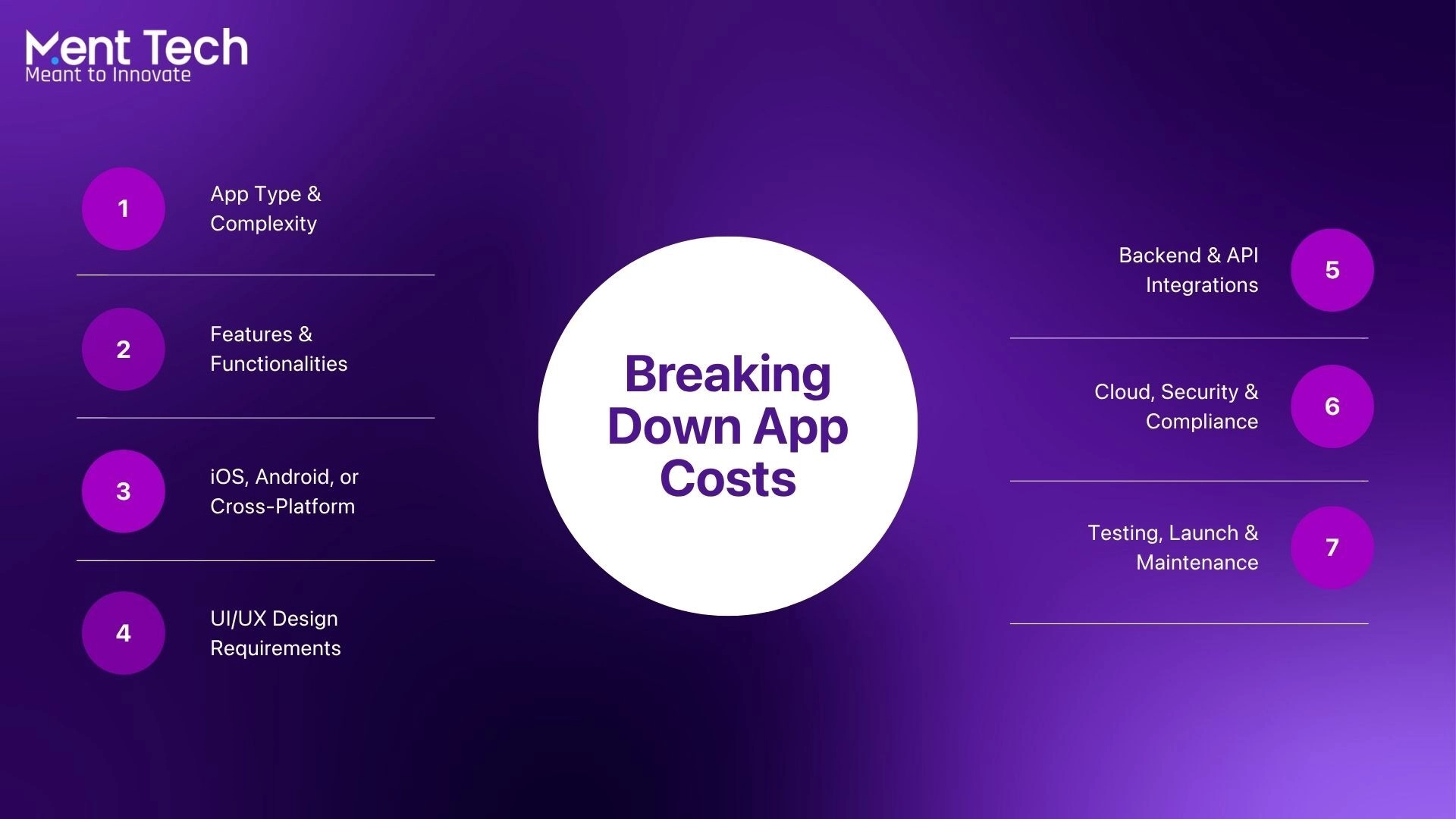
Mobile App Development Cost Breakdown
When you pay for a mobile app, you are not paying for one thing. You are paying for 10 to 12 distinct workstreams, each with its own cost, timeline, and risk profile. Here is where your money goes.
Discovery and Product Strategy: $3,000 to $10,000
This is where the product gets defined. Features get prioritized. Technical decisions get made. Teams that skip this phase almost always pay for it later through scope creep, missed requirements, and expensive rework. It is one of the most important investments in the entire project.
UI/UX Design: $5,000 to $30,000
A basic screen layout costs less. Custom design systems, branded animations, multi-role dashboards, and accessibility compliance for US markets cost more. For enterprise clients, accessible design is not optional. It is a legal and procurement requirement.
Frontend Development: $10,000 to $60,000
This is everything the user touches. Screens, navigation, transitions, state management. The more logic lives in the frontend, the higher this number climbs.
Backend Development: $15,000 to $80,000
Your backend handles everything users do not see. Authentication, business logic, admin controls, real-time data sync, notifications. A complex backend serving thousands of concurrent users looks nothing like a simple API connecting two tables in a database.
API Development: $5,000 to $25,000
Very few apps work in isolation. Payment gateways, CRMs, ERP systems, logistics platforms, messaging tools, and analytics dashboards all need to plug in somewhere. This is where API development services directly affect both quality and cost. Poorly designed API layers are one of the most common sources of post-launch failures and emergency patches.
Database Setup: $3,000 to $15,000
Choosing the right database structure early matters. A poorly designed schema causes performance problems, expensive migrations, and data integrity issues at scale. Get this right once.
Cloud Deployment: $5,000 to $20,000 setup, plus ongoing hosting costs
Hosting, CDN, auto-scaling, monitoring, load balancing, and storage all sit here. Cloud deployment services are not a one-time cost. They are a recurring expense that grows as your user base grows. Planned correctly from the start, cloud infrastructure supports growth without panic fixes.
Security and DevSecOps: $5,000 to $30,000+
US healthcare apps need HIPAA compliance. Fintech apps need PCI-DSS controls. Enterprise software needs SOC 2 documentation. Encryption, role-based access, audit logging, penetration testing, and vulnerability scanning are all part of this. DevSecOps as a service weaves these controls into the development process. That is a very different approach from bolting them on after the app is already built.
Testing and QA: $5,000 to $25,000
The development stage alone takes 40 to 55 percent of a typical mobile app development budget, with testing and deployment making up a significant portion of the remaining spend. QA covers functional testing, device compatibility, performance under load, and security. Skipping it leads to negative reviews, refund requests, and emergency patching in production.
App Store and Play Store Launch: $1,000 to $3,000
Submission setup, compliance checks, store listing copy and assets, and initial review management.
Maintenance and Support: 15 to 20 percent of build cost per year
A $100,000 app typically needs $15,000 to $20,000 per year to stay current. OS updates break things. Security patches need applying. Features need adjusting based on user feedback. Build this into your budget from day one.
Key Factors That Affect Mobile App Development Cost
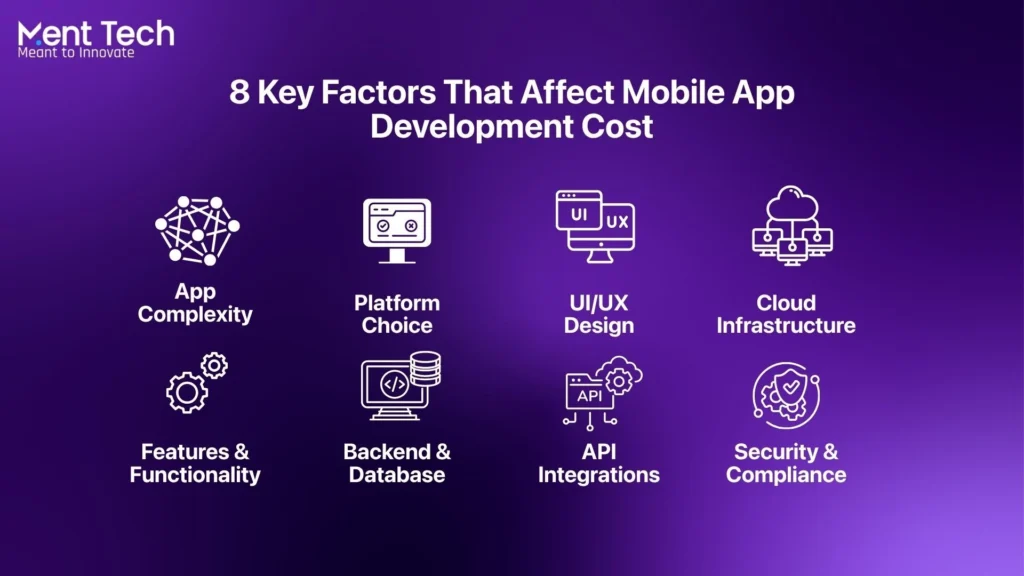
App Complexity
This is the single biggest cost driver. A simple app has a handful of screens, standard logic, and no heavy backend requirements. A mid-level app adds payments, user management, push notifications, and maybe a basic admin panel. An enterprise app might involve multi-role access, offline sync, compliance workflows, deep third-party integrations, and AI-driven features.
Every step up adds development hours, testing time, and long-term maintenance.
Platform Choice
Your platform decision shapes cost significantly.
- iOS targets the Apple ecosystem. In the US, iPhone users spend more per app and have higher average revenue per user than Android users on the same platform.
- Android gives you broader reach globally and across income brackets.
- Cross-platform development using Flutter or React Native allows a shared codebase for both iOS and Android. It can cut total development spend by 30 to 40 percent compared to building two separate native apps. For most startups and mid-sized businesses, this is the practical default in 2026.
- Hybrid apps are cheaper but carry performance trade-offs. Fine for internal tools or budget MVPs. Not ideal for consumer-facing products where user experience is a differentiator.
- Native apps cost the most but deliver the best performance. Worth it for complex, high-traffic products where milliseconds matter.
UI/UX Design Requirements
Template-based design keeps costs low. But if your app needs a custom design system, branded motion graphics, complex data visualizations, or WCAG accessibility compliance, design costs climb accordingly. For US enterprise clients, accessibility is often a buying requirement, not a feature request.
Features and Functionalities
Here is a quick cost reference by feature:
| Feature | Estimated Cost |
| Login / Signup | $1,000 - $3,000 |
| User Profiles | $2,000 - $5,000 |
| In-App Payments | $5,000 - $15,000 |
| Push Notifications | $1,500 - $4,000 |
| In-App Chat | $5,000 - $20,000 |
| Maps and Geolocation | $5,000 - $15,000 |
| Video / Audio Streaming | $10,000 - $30,000 |
| Booking System | $8,000 - $20,000 |
| Admin Panel | $5,000 - $20,000 |
| Analytics Dashboard | $5,000 - $15,000 |
| AI Features | $15,000 - $50,000+ |
AI features deserve a separate mention. In 2026, recommendation engines, AI chatbots, predictive analytics, and personalization layers have moved from premium additions to expected functionality in many product categories. They cost more to build, test, and maintain. Plan for that.
Backend and Database Requirements
More users mean more demand on your backend. Real-time sync, concurrent sessions, complex admin workflows, and large data sets all push backend costs up. The worst time to discover a poorly designed backend is when your user base starts growing and performance drops.
API Integrations
Most real-world apps talk to other systems. Payment processors, CRMs, ERPs, logistics APIs, messaging platforms, analytics tools. The number and complexity of those connections directly affects the cost for mobile app development on any project. Secure, well-documented API development services reduce integration failures and make future feature additions easier to plan.
Cloud Deployment and Infrastructure
Cloud infrastructure is an upfront cost and a recurring one. Hosting, storage, CDN performance, auto-scaling, uptime monitoring, and disaster recovery planning all sit here. Cloud deployment services that are architected properly from the start handle traffic spikes without emergency fixes and scale predictably as your product grows.
Security and Compliance
This section matters most for US-based businesses in regulated industries. Healthcare apps need HIPAA-compliant data handling. Fintech apps need PCI-DSS certification. Enterprise software sold to government or large corporations often requires SOC 2 Type II. DevSecOps as a service builds security controls into every sprint rather than treating compliance as a final checklist item before launch. That approach is less expensive, more reliable, and easier to document.
Mobile App Development Cost by App Type
| App Type | Complexity | Estimated Cost |
| Ecommerce App | Medium to High | $40,000 - $150,000 |
| Healthcare App | High | $80,000 - $250,000+ |
| Fintech App | High | $100,000 - $300,000+ |
| Real Estate App | Medium to High | $50,000 - $150,000 |
| SaaS Mobile App | Medium to High | $60,000 - $200,000 |
| On-Demand Delivery App | High | $80,000 - $200,000+ |
| Social Networking App | High | $100,000 0- $300,000+ |
| Marketplace App | High | $80,000 - $250,000+ |
| Booking App | Medium | $40,000 - $120,000 |
| Enterprise Workflow App | Very High | $150,000 - $500,000+ |
Healthcare and fintech consistently sit at the top of this list. Both involve sensitive user data, strict regulatory environments, and security requirements that add meaningful cost to every development phase. Enterprise workflow apps are expensive because they often need to connect with existing internal systems, handle high concurrent loads, and meet corporate IT security policies that most consumer apps do not face.
Mobile App Development Cost by Platform
| Platform | Cost Level | Best For |
| iOS App | Medium to High | Premium US user base and Apple ecosystem |
| Android App | Medium to High | Wider market reach globally |
| Cross-Platform App | Medium | Faster, more affordable launch on both platforms |
| Hybrid App | Low to Medium | Budget-friendly MVPs and internal tools |
| Native App | High | Performance-critical consumer or enterprise products |
Cross-platform has genuinely matured. Teams were skeptical of Flutter and React Native a few years ago. In 2026, they cover the majority of use cases well, and the performance gap with native is narrow enough that it rarely matters in practice.
Mobile App Development Cost Calculator: What Should You Include?
A mobile app development cost calculator is only useful if it accounts for everything. Most online calculators miss half the variables. Here is what a proper budget estimate needs to include before you talk to any agency.
App type and core purpose: What problem does this solve, and for whom?
Platform targets: iOS, Android, or both?
User roles: Each distinct user type needs its own flows and permission logic.
Feature list: Get granular. Login, profiles, payments, chat, notifications, search, maps, video, bookings, admin panel. List all of it.
Design complexity: Standard UI components or a fully custom design system?
Admin panel needs: Web-based admin access? What does it need to do?
Backend requirements: Basic data storage and retrieval, or real-time sync with complex business logic?
API integrations: List every third-party system the app needs to talk to.
Cloud hosting requirements: Which cloud provider? What are your uptime, latency, and storage expectations?
Security and compliance: What regulations apply to your industry? HIPAA? PCI-DSS? SOC 2?
Testing scope: Device coverage, user load testing, security testing, compliance validation.
Ongoing maintenance: Budget 15 to 20 percent of your build cost per year from launch onward.
Working through this list before you contact a development team means you get more accurate quotes, fewer surprises, and better conversations about what is realistic for your budget.
How to Reduce Mobile App Development Cost Without Losing Quality
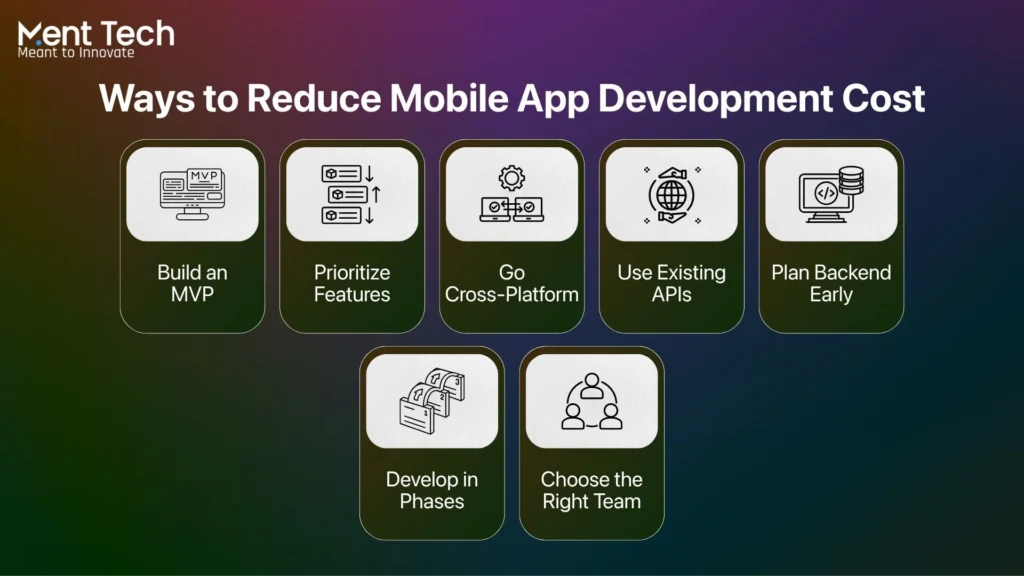
Spending less does not have to mean building less. The difference is in how you make decisions.
Start With An MVP
Build the core functionality. Launch it. See what users actually do with it. Then invest in Phase 2 features based on real behavior, not assumptions.
Focus On Essentials
Every feature in your backlog has a price tag. Half of them can wait. The ones that cannot are your MVP scope.
Use Cross-Platform Development
One codebase for iOS and Android is not a compromise in 2026. For most product types, it is the smart choice.
Leverage Existing APIs
Payment processing, mapping, messaging, and analytics all have mature, affordable third-party solutions. Do not spend $30,000 building what Stripe and Twilio already built for you.
Plan The Backend Early
Fixing a poorly designed backend at scale costs ten times more than getting it right at the start.
Deliver In Phases
Break the project into milestones with defined deliverables and payments tied to each. It keeps scope in check and gives you natural review points before committing further budget.
Choose The Right Partner
A team that asks the right discovery questions before writing a line of code will cost you less over the full project than one that starts fast and invoices for rework later.
How to Choose the Right Mobile App Development Company
There are thousands of mobile app development companies offering competitive rates. Price alone is a poor filter. Here is what actually matters.
Portfolio depth - Have they shipped apps that are live, active, and used by real people? Can they show you the work?
Industry experience - Building a healthcare app is different from building a logistics platform. Domain knowledge matters.
Technical breadth - Look for teams with genuine depth across frontend, backend, cloud infrastructure, and security. Gaps in one area tend to create problems in all the others.
API and systems integration capability - Can they connect your app to the external systems your business already runs on?
Cloud deployment experience - Do they architect and manage cloud infrastructure, or just hand off a build and walk away?
Security practices - How do they handle compliance requirements, vulnerability management, and penetration testing?
Pricing transparency - Do they provide itemized quotes with clear milestones, or vague estimates and hourly billing with no ceiling?
Communication - Are they responsive, structured, and proactive about flagging risks before they become problems?
Post-launch support - Will they be reachable six months after launch when you need a bug fixed or a new feature scoped?
How Ment Tech Labs Can Help Build Cost-Effective Mobile Apps
Ment Tech Labs is a software engineering and mobile application development partner built for businesses that need scalable, secure, and production-ready products, not just a prototype.
From your first MVP to a multi-market enterprise platform, Ment Tech Labs supports the full development lifecycle. That includes planning, UI/UX, backend engineering, API development services, cloud deployment services, DevSecOps as a service, generative AI development services, artificial intelligence integration services, QA, and post-launch maintenance.
Other services the Ment Tech Labs team delivers:
Mobile App Development Company: Native, cross-platform, and hybrid apps tailored to your users and your business goals.
Custom Mobile App Development: Purpose-built applications designed from the ground up, not adapted from templates.
SaaS Development Company: Multi-tenant SaaS products built for subscription-based business models and long-term product growth.
Enterprise Software Development: Enterprise-grade platforms with ERP and CRM connectivity, role-based access control, and compliance documentation.
Custom Software Development Services: End-to-end engineering for businesses that need something built precisely to spec.
Every engagement starts with a realistic cost estimate based on your actual requirements, not a template quote.

Wrapping It Up
Mobile app development cost in 2026 is not one number. It is the combined result of every technical and business decision you make before and during the build.
Complexity, platform, feature scope, design quality, backend architecture, API depth, cloud infrastructure, compliance requirements, and post-launch support all push that number in different directions. Some of those decisions save money early and cost more later. Others are worth the upfront investment.
The businesses that consistently get the best ROI from their mobile products are not necessarily the ones with the biggest budgets. They are the ones that planned properly, scoped honestly, and chose a development partner who treated their money as carefully as their own.
Avoid choosing purely on price. Focus on long-term quality, technical reliability, and a team that will still be there to help when the product needs to grow.
Partner with Ment Tech Labs to estimate your mobile app development cost and build a scalable, secure mobile application for your business in the USA.
Contact Ment Tech to get a realistic, itemized cost estimate based on your app idea, platform needs, feature list, and growth roadmap.