SaaS isn’t some niche tech trend anymore. Walk into almost any startup or growing business in the USA today, and chances are, they’re either running on a SaaS model or building one.
Which brings up the question every founder ends up asking sooner or later: how much does saas platform development cost? Truth is, there’s no flat number. It moves based on how complex your product is, how many user roles you’re dealing with,
the cloud setup behind it, billing, integrations, security, and what it takes to keep things running once you’re live.
We’re going to walk through real numbers in this guide, not vague ranges that leave you guessing.
And if you’re still figuring out where to start, Ment Tech Labs can help you plan it out, build it right, and keep supporting it long after launch.
How Much Does SaaS Platform Development Cost in 2026?
Alright, here’s the number everyone’s actually scrolling down for. Saas platform development cost in 2026 usually sits somewhere between $25,000 and $700,000, sometimes more. Big gap, I know. But once you see what’s behind it, it makes sense. A scrappy MVP and a full enterprise platform aren’t even in the same conversation.
Roughly, it breaks down like this:
| SaaS Type | Estimated Cost |
| Basic SaaS MVP | $25,000 - $60,000 |
| Mid-level SaaS platform | $60,000 - $150,000 |
| Advanced SaaS platform | $150,000 - $300,000+ |
| Enterprise SaaS platform | $300,000 - $700,000+ |
And if you’re building specifically for the USA market, plan to sit toward the higher end. Compliance stuff, beefier infrastructure, tighter security, and the integrations enterprise clients tend to ask for all add to the saas development cost. Not because anyone’s padding the bill; that’s genuinely just what it takes to build something solid enough to hold up at that level.
Also Read: How to Develop an MVP in 2026 Without Wasting Budget
Learn how to plan a lean MVP, avoid overbuilding, and keep your early SaaS budget focused.
Complete SaaS Platform Development Cost Breakdown for Businesses
Most people think the saas development cost just means what you pay the developers. It’s a lot more layered than that, and that’s usually where budget surprises come from.
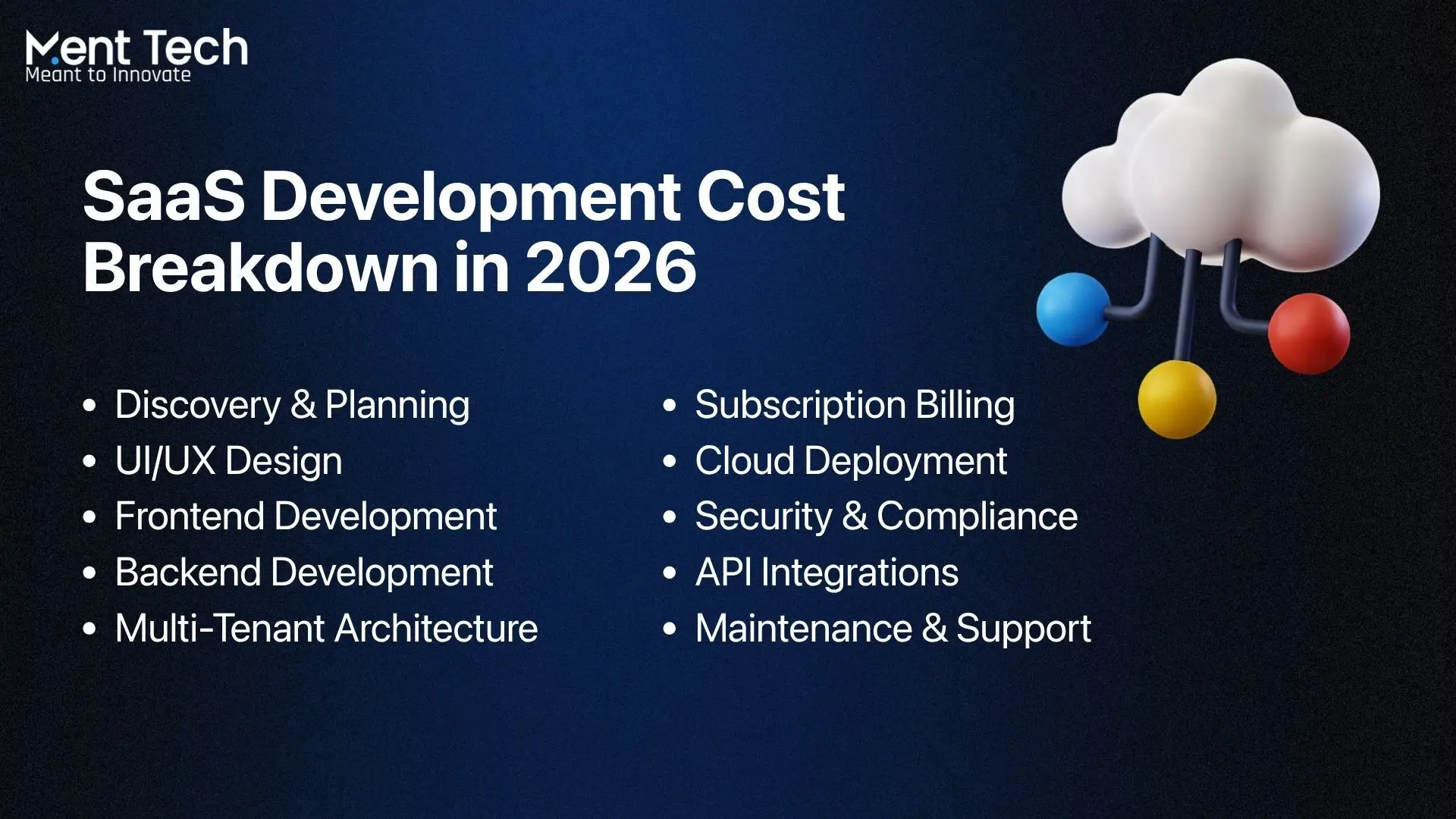
- Discovery and Planning
This is where your idea gets stress tested before any money goes into building it. Skip it, and you’ll pay far more fixing wrong assumptions later.
- UI/UX Design
Not just about looks. A confusing dashboard is the fastest way to lose a paying customer in their first week.
- Frontend and Backend Development
The biggest chunk of your saas platform development cost is often over half the budget. This is where the actual product gets built.
- Multi-Tenant Architecture
This is what makes SaaS actually SaaS. Without it, you’re basically building separate app copies for every single customer.
- Subscription Billing
Stripe and PayPal handle the payments, but someone still has to build the plans, trials, and invoicing logic around them.
- Cloud Deployment and Security
Where your app lives and how well it’s protected. Solid cloud deployment services keep things stable as you scale, and security isn’t the place to cut corners.
SaaS Platform Development Cost by Feature
A lot of founders skip the single big number and ask a better question instead: what does each feature actually cost? Mapping out saas platform development costs for 2025 and 2026 per feature, this way gives a much clearer picture because some features that sound small end up costing way more than people expect.
| Feature | Cost Impact | Why |
| User login and authentication | Low to Medium | Basic login is cheap. Add SSO, 2FA, or enterprise-grade access controls, and the price climbs fast. |
| Admin dashboard | Medium | Needs real role-based permissions, not just a generic settings panel. |
| Subscription billing | Medium to High | Stripe or PayPal handles the transaction, but plans, upgrades, downgrades, and invoicing logic still need to be built around them. |
| Analytics dashboard | Medium to High | A few simple charts are cheap; real-time data across thousands of users is a different project entirely. |
| API integrations | Medium to High | Every CRM, ERP, or payment gateway connection adds its own testing and upkeep down the line. |
| AI features | High | Cost swings wildly depending on the model, the data feeding it, and how deeply it’s wired into the actual workflow. |
| Cloud deployment | Medium to High | Scales directly with how much traffic and data your platform needs to handle day-to-day. |
| Security and compliance | High | Not really optional for USA enterprises, and the price tag reflects that. |
Key Factors That Affect SaaS Development Cost
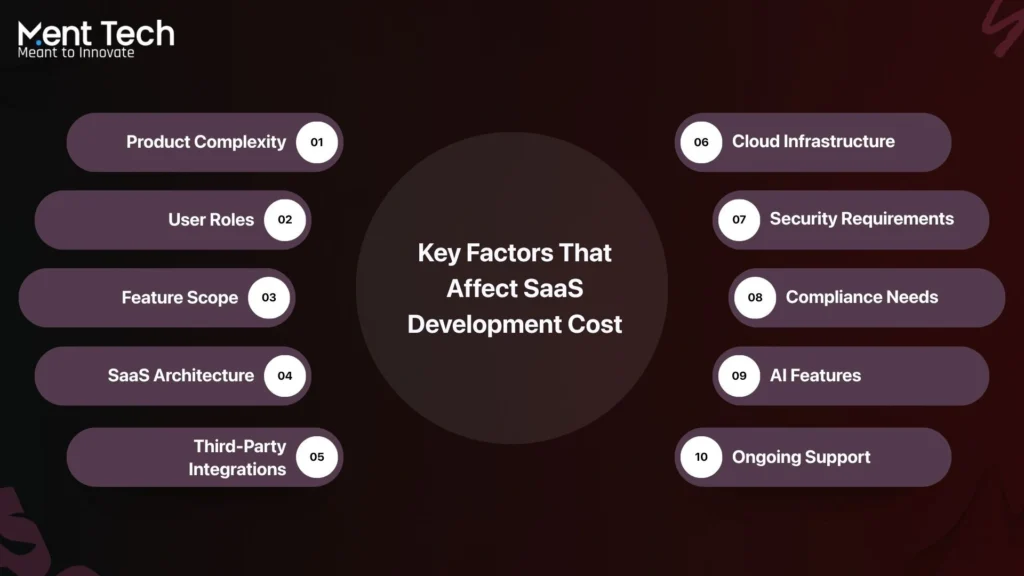
These are the levers that actually move your number up or down, more than anything else in the build.
1. Product Complexity
A simple SaaS tool with one core feature isn’t anywhere near the same investment as a full enterprise platform with dozens of moving parts. The complexity shows up directly in the final bill.
2. Number of User Roles
Admin, customer, vendor, manager, team member, and super admin. Each role needs its own permissions and screens. More roles, more logic to build and test.
3. Multi-Tenant Architecture
Every customer needs their data kept separate and secure while sharing the same infrastructure underneath. Getting this right takes real engineering, not a shortcut.
4. UI/UX Design
Custom dashboards, smooth onboarding, responsive layouts, and accessibility. All of it adds design hours before a single feature even gets built.
5. API Integrations
CRMs, ERPs, payment gateways, analytics tools, communication platforms, every connection you add comes with its own setup cost and ongoing upkeep.
6. Cloud Infrastructure
Hosting, scaling, monitoring, storage, backups, and performance. This is where solid cloud deployment services actually earn their price tag, especially once your user base starts growing.
7. Security and Compliance
SOC 2, HIPAA, GDPR, encryption, audit logs, role-based access, and secure DevOps. None of this is optional once you’re selling to serious USA businesses.
8. AI and Automation Features
Chatbots, recommendation engines, copilots, workflow automation, predictive analytics. This is where generative AI development services and artificial intelligence integration services come into play and where scope can quietly balloon if it’s not tightly defined upfront.
Also Read: AI Agent Development Cost in 2026: Complete Pricing Guide for Businesses. See what affects AI agent pricing before adding automation, copilots, or AI workflows to your SaaS platform.
SaaS Development Cost by Product Type
The category of SaaS you’re building moves the saas development cost more than most people expect. Healthcare and fintech, for example, carry compliance work that a basic project tool just doesn’t need.
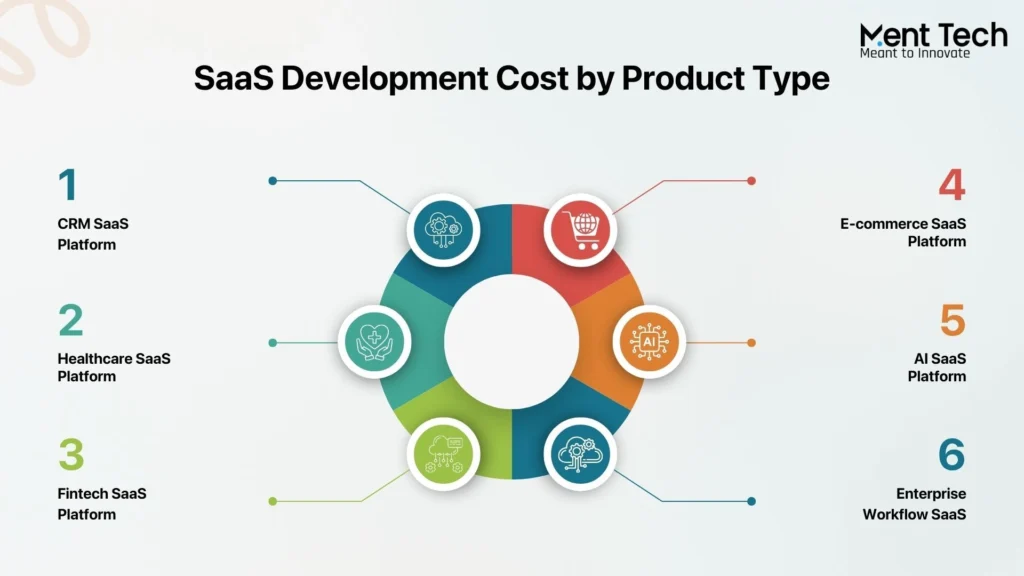
CRM SaaS Platform Mid complexity, roughly $60,000 to $150,000. Pipeline tracking, contact management, and integrations with sales tools make up most of the build.
Healthcare SaaS Platform: High complexity, roughly $150,000 to $400,000+. HIPAA compliance alone adds a real chunk on top of the actual product.
Fintech SaaS Platform: High complexity, roughly $200,000 to $500,000+. Security, fraud prevention, and regulatory requirements push this into one of the pricier categories.
E-commerce SaaS Platform: Mid- to high complexity, roughly $80,000 to $250,000. Inventory handling, payments, and multi-vendor support add up quickly depending on scale.
AI SaaS Platform: High complexity, roughly $150,000 to $450,000+. Cost depends heavily on the model and data work, and this is usually where artificial intelligence integration services factor into the budget.
Enterprise Workflow SaaS: High complexity, roughly $250,000 to $700,000+. These tend to fall under a custom enterprise software development company’s territory, built tightly around a specific business’s internal processes.

How Much Does SaaS Development Cost in the USA?
Building specifically for the US market usually means your saas development costs run higher than what offshore teams quote. That’s not padding. It’s what real US-grade work actually involves.
A few things drive that difference:
- Higher development rates compared to outsourced markets
- Stronger compliance baked into the build, not bolted on later
- Enterprise-level security from day one
- Cloud-native architecture instead of patched-together hosting
- Tighter communication and project management throughout
- A real product strategy, not just a feature checklist
- Support that sticks around well after launch
Honest take: if a saas development company quotes you a number that feels too low for the US market, it probably is. The same goes for any saas application development company promising enterprise results at bargain pricing. Plan a realistic budget upfront; it’s cheaper than fixing a rushed build later.
Hidden Costs of SaaS Platform Development
Here’s the part nobody puts in the original quote. The costs that show up after launch, not before it. If your saas platform development cost stops at “build,” you’re in for a surprise later.
1. Cloud Hosting
Hosting starts cheap when you’ve got a handful of users testing the product. The bill changes shape entirely once real traffic hits, and most founders only notice when the invoice does.
2. Third-Party APIs
Plenty of APIs look free or near-free on the pricing page. Once you’re making thousands of calls a month instead of a few hundred, that “free tier” disappears fast.
3. Payment Gateway Fees
Stripe and PayPal don’t charge you once; they take a small cut on every transaction, every month, forever. At scale, that percentage turns into real money.
4. Maintenance
A SaaS product isn’t a one-time build; it’s something you keep feeding. Servers need monitoring, dependencies need updating, and bugs need fixing; none of that stops just because the launch went well.
5. Security Updates
New vulnerabilities get discovered constantly in frameworks, libraries, and dependencies you didn’t even write. Patching them on a schedule isn’t optional if you want to stay trustworthy.
6. Compliance Audits
Passing a SOC 2 or HIPAA audit once doesn’t mean you’re done. These come back around on a schedule, and each cycle costs time, documentation, and usually a consultant’s fee.
7. Customer Support Tools
Somebody has to handle tickets, live chat, and onboarding questions once real customers show up. That software isn’t part of the build budget, but you’ll need it from day one of having paying users.
8. Database Scaling
A database that handles 500 users smoothly can choke at 50,000 if it wasn’t built to scale. Re-architecting under pressure costs far more than planning for growth early would have.
Feature Upgrades
The market doesn’t stand still, and neither do customer expectations. Staying competitive means the product keeps evolving well after launch day, and that’s ongoing budget, not a one-time spend.
AI Model and API Usage
If AI is part of your platform, costs don’t stop at integration. Ongoing model usage, inference calls, and artificial intelligence integration services all scale right along with your traffic, so the bill grows as your product succeeds.
How to Reduce SaaS Development Cost Without Cutting Quality
Quick reassurance before we get into this: cutting costs here doesn’t mean cutting quality. It mostly comes down to doing things in the right order.
Start with an MVP: Build the smallest thing that actually solves the problem and stop there. You’ll learn what people really want way before you’ve blown money on features nobody asked for. An MVP development company like Aalpha would choose this approach to keep the initial product focused and practical.
Prioritize Core Features: Everything’s going to want a piece of the budget; that’s just how it goes. Be honest with yourself about what actually matters right now and let the rest wait.
Avoid Overbuilding: We get it; it’s tempting to build for the huge scale you’re hoping to hit one day. But build for where you actually are, not where you wish you already were.
Use Scalable Architecture From Day One: Not the same thing as overbuilding; this one’s just smart. A few good calls early on save you from a painful, expensive rebuild later, and honestly barely touch the upfront cost.
Use Existing APIs Where Possible: Why on earth build logins or payments from scratch when something solid already exists out there? Plug it in, move on, and put that energy into the part that actually makes your product yours.
Build AI Features in Phases: You don’t need the whole AI roadmap on day one; nobody does. Ship one thing that genuinely works, watch how people use it, then build the next piece. So much less risky than throwing the entire budget at it upfront.
Plan Cloud Costs Early: Whatever you decide about hosting in week one is going to quietly follow you around for years. Spend a little time on it now; save yourself a messy cleanup later.
Choose the Right SaaS Development Company
Here’s the part nobody likes hearing: the cheapest quote is rarely actually the cheapest option in the end. A saas development company that actually understands SaaS architecture saves you money through fewer do-overs, not a lower hourly rate.
Final Thoughts
At the end of the day, saas platform development cost in 2026 isn’t one fixed number. It moves based on how complex your product is, the features it needs, the architecture behind it, cloud infrastructure, integrations, security, AI requirements, and the maintenance that keeps it running long after launch.
So if you’re comparing quotes, skip the urge to chase the lowest one. The real saas development cost usually shows up later anyway, in rebuilds, security gaps, and platforms that can’t actually scale. Look for a partner who understands SaaS architecture, thinks long-term, and actually delivers, not just one with a nice proposal deck.
Partner with Ment Tech to get a clear, honest estimate on your saas platform development cost and build something that’s actually ready to grow with your business in the USA.