Walk into almost any hospital or clinic today, and you will find AI quietly running in the background, helping staff write notes, answer patient questions, or sort through mountains of paperwork. Generative AI has moved past the hype stage and is now just part of how healthcare gets done.
And honestly, it had to happen. Staff is stretched thin, costs keep climbing, documentation never stops piling up, and patients still expect quick, personal care, no matter how busy a clinic is. That gap between what providers can handle and what patients expect is exactly why generative AI use cases in healthcare have picked up so much momentum lately.
Ment Tech Labs helps healthcare organizations build secure, scalable healthcare AI solutions that improve efficiency, automate workflows, and enhance patient experiences.
Why Healthcare Organizations Are Investing in Generative AI
If you ask people working inside hospitals right now, they will tell you the same thing in different words. Everyone is tired, money is tight, and patients are not exactly known for their patience anymore. That is basically the whole story behind why nearly 70 percent of healthcare payers and providers have already started using generative AI somewhere in how they run things; about 70% of healthcare payers and providers are actively implementing generative AI solutions to improve care delivery, efficiency, and operations, and that number is only going in one direction.
Operational efficiency: Honestly, a decent healthcare AI platform can take on a surprising amount of grunt work, and nobody has to go hire five more people just to keep up.
Workforce productivity: Once AI starts handling notes, data entry, and the usual back-and-forth messages, clinicians and staff stop feeling like they are constantly behind.
Administrative automation: Intake forms, scheduling, and billing. The boring stuff basically runs itself in the background now, so people are not chained to paperwork all day.
Patient engagement: People want answers fast, and they want it to feel personal, not like talking to a wall. That is just the bar now.
Better access to information: Nobody wants to spend ten minutes hunting through old files for one detail. Pull it up; there it is, done.
Faster clinical workflows: Referrals, discharge summaries, and all the stuff that used to take forever now move a lot quicker, which is exactly why more providers are turning to generative AI development services to wire this straight into how they already work.
For growing healthcare startups, generative AI for healthcare startups can make a real difference by reducing manual admin work, improving patient communication, and helping teams scale care operations without adding unnecessary cost or complexity.
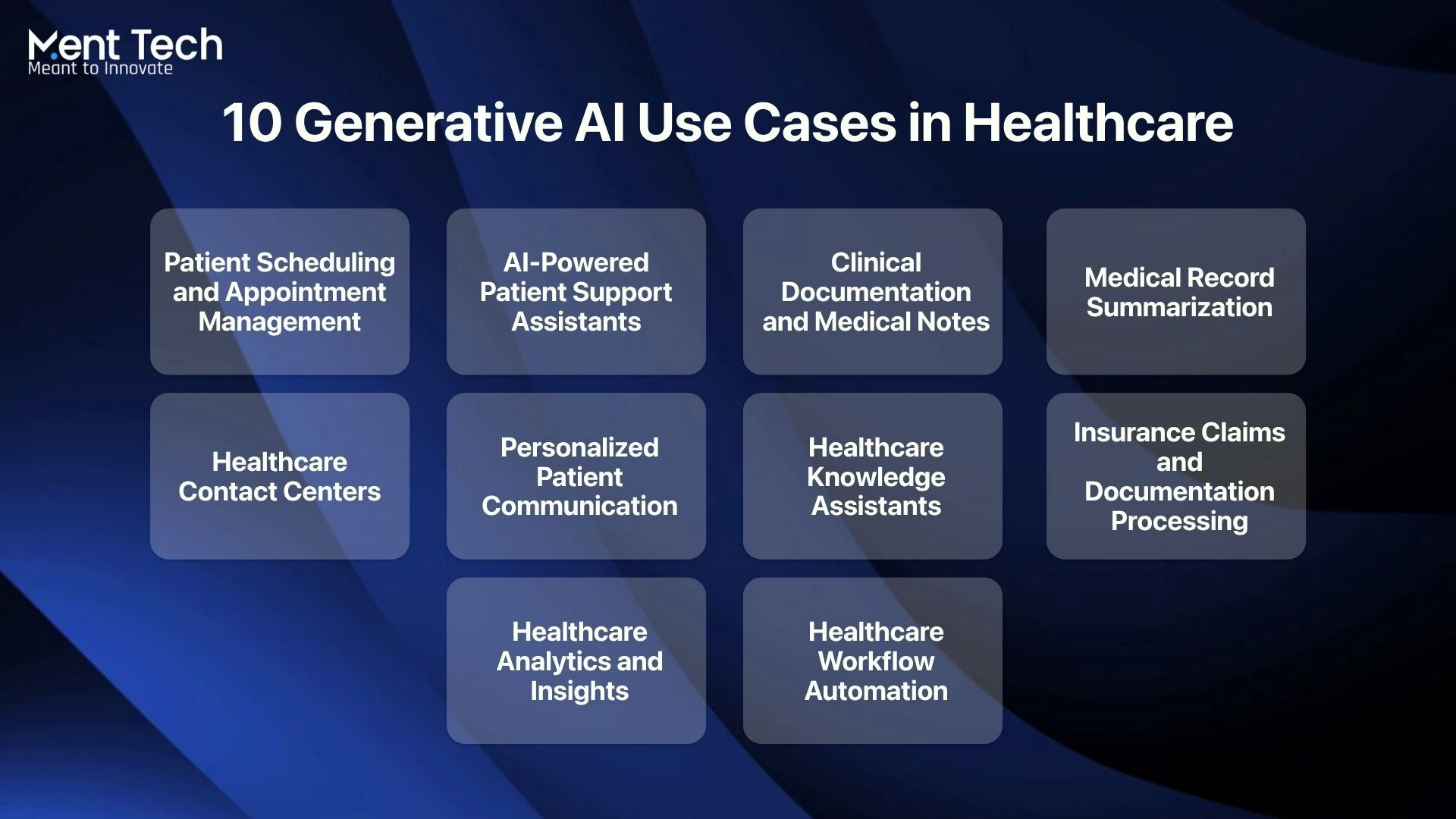
Top 10 Generative AI Use Cases in Healthcare
There are a lot of generative AI use cases in healthcare floating around right now, but not all of them are worth the hype. The ten below are the ones actually showing up in real hospitals and clinics today, not just in pitch decks.
Patient Scheduling and Appointment Management
Most modern healthcare AI platforms have quietly taken over scheduling, and patients barely notice the AI is even involved until a reminder text shows up at exactly the right time.
- Automated scheduling and rescheduling that skips the back-and-forth phone calls.
- Smart reminders that actually get read instead of ignored.
- Fewer no-shows, which means fewer empty slots and lost revenue.
AI-Powered Patient Support Assistants
These assistants do not clock out at 5 pm. They are still around at 2 am when someone is worried about a side effect and does not want to wait until morning.
- Round-the-clock support so patients are not stuck waiting on hold.
- Quick answers to the same FAQs that staff would otherwise repeat all day.
- Basic care guidance and symptom navigation that points people in the right direction before it turns into an unnecessary ER visit.
AI chatbots in healthcare are also becoming a strong starting point for providers that want faster patient support without overloading front-desk teams. They help answer common questions, guide patients through basic care steps, and keep support available even after normal clinic hours.
Clinical Documentation and Medical Notes
Ask any physician what eats up their evenings, and documentation usually comes up first. This is one of those generative AI in healthcare use cases that doctors notice almost immediately.
- Documentation that writes itself while the conversation happens.
- Clinical notes are generated in real time instead of being typed up after hours.
- Less burnout and real-time savings, since nobody is finishing charts at midnight anymore.
Medical Record Summarization
Nobody wants to scroll through ten years of scattered notes just to understand one patient’s history, and now they do not have to.
- Long, messy patient histories turned into something readable in seconds.
- Faster access to the details that actually matter during a visit.
- Better decision support because doctors are not digging through old records.
Healthcare Contact Centers
A lot of contact center traffic is the same handful of questions over and over, which is exactly the kind of work AI handles without breaking a sweat.
- Call automation for the routine stuff that does not need a human.
- Patient inquiries are answered quickly instead of sitting in a queue.
- Routing and triage support that gets urgent calls to the right person fast.
Personalized Patient Communication
Generic reminders get ignored. Personalized ones get read, and that difference matters more than people think.
- Follow up and medication reminders that patients actually notice.
- Treatment instructions are explained in plain language, not medical jargon.
- Engagement campaigns that keep patients connected between visits instead of going quiet.
Healthcare Knowledge Assistants
Staff waste a surprising amount of time hunting for information that already exists somewhere in the system; it is just buried.
- Internal knowledge search, so people are not emailing around for answers.
- Quick policy lookup instead of digging through old PDFs.
- Step-by-step guidance on procedures when someone needs a refresher.
Insurance Claims and Documentation Processing
This is where generative AI insurance use cases really stand out, since claims and paperwork are exactly the kind of repetitive, document-heavy work AI is built for.
- Faster claims review with fewer manual errors slipping through.
- Document summarization that turns long files into something reviewable in minutes.
- Customer support and workflow automation that keep claims moving instead of being stuck in a backlog.
Healthcare Analytics and Insights
Data only helps if someone can actually make sense of it in time to act on it.
- Spotting trends in patient or operational data before they become real problems.
- Reporting support that saves teams from building spreadsheets by hand.
- Operational insights that help leadership make decisions backed by real numbers, not guesswork.
Healthcare Workflow Automation
A lot of healthcare still runs on workflows that were never designed to move fast, and generative AI is what finally speeds them up.
- Intake automation that gets patients into the system faster.
- Referral management that does not get lost between departments.
- Administrative workflows and care coordination are running smoothly in the background.
Generative AI Use Cases in Healthcare: Benefits for Providers and Patients
At this point, it is worth stepping back and asking the obvious question: Who actually benefits from all this? Turns out it works both ways. The same generative AI use cases in healthcare that make life easier for staff also end up improving things for the people sitting in the waiting room.
Benefits for Healthcare Providers
Ask any provider who has rolled out AI, and they will probably tell you the biggest win is just getting their time back.
- Reduced administrative burden, since AI quietly takes on the paperwork nobody wanted to do anyway
- Improved productivity across teams, because less time chasing admin tasks means more time actually doing the job
- Faster access to information, so staff are not digging through systems just to find one detail
- Better resource utilization, with fewer people stuck doing repetitive work that AI can handle instead
Benefits for Patients
Patients notice the difference too, even if they do not always realize AI is behind it.
- Faster response times, whether it is a quick question or something more urgent
- Better communication overall, with clearer updates instead of vague follow-ups
- Improved access to care, since scheduling and support are not stuck behind office hours anymore
- More personalized experiences, the kind that come from a healthcare AI platform that actually remembers context instead of starting from scratch every time
A lot of providers exploring generative AI development services are doing it for exactly this reason. The benefits show up on both sides of the relationship, not just internally.
Generative AI Use Cases in Healthcare vs Traditional Healthcare Software
It helps to see this side by side because the difference between old healthcare software and what generative AI use cases in healthcare actually do is bigger than most people expect. Traditional systems were built to follow fixed rules. Generative AI, on the other hand, actually understands context and adjusts as it goes, which is exactly why so many providers are moving away from rigid, rule-based tools.
| Feature | Traditional Software | Generative AI |
| Documentation | Manual | Automated support |
| Patient Support | Limited | Conversational assistance |
| Information Retrieval | Search-based | Context-aware answers |
| Workflow Automation | Rule-based | Adaptive automation |
| Scalability | Moderate | High |
The gap really comes down to flexibility. Traditional software does what it is told and nothing more, while generative AI adapts to the situation in front of it, which is a big part of why generative AI healthcare use cases keep replacing older systems one department at a time.
Challenges of Implementing Generative AI in Healthcare
None of this comes risk-free, and it would be dishonest to pretend otherwise. Healthcare deals with sensitive information every single day, so rolling this stuff out takes a lot more care than it would almost anywhere else.
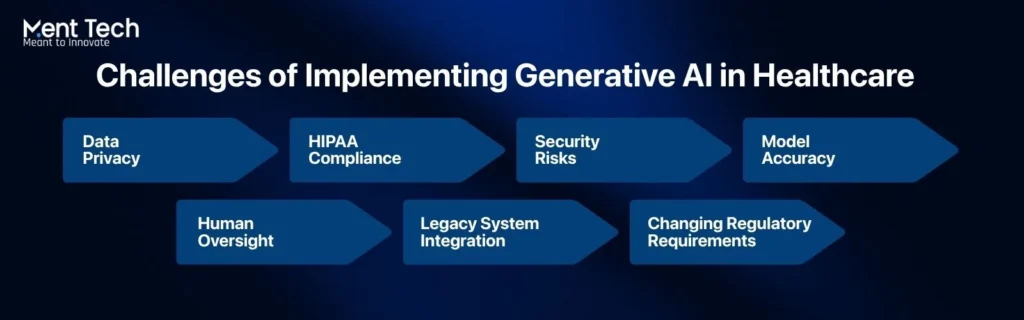
- Data privacy
Patient records are about as sensitive as data gets, and once something goes wrong here, there is no real way to undo it. Any AI system touching that data needs privacy built in from the start, not bolted on later.
- HIPAA compliance
This is not a thing you check off once and move on from. It shapes how data gets stored, who can see it, and how the whole system is built, basically from day one.
- Security concerns
Healthcare has always been a favorite target for attackers, and bringing AI into the picture just means there are more doors to lock, not fewer. Every layer needs attention, the model itself included.
- Model accuracy
A bad recommendation from a shopping app is annoying. A bad one in a clinical setting is a different story entirely. These models need to be tested constantly, not just checked once before launch and left alone.
- Human oversight
AI is supposed to make a clinician’s job easier, not make the call for them. The second it starts replacing judgment instead of supporting it, things get risky fast, so keeping a person in the loop really matters here.
- Integration complexity
Almost nobody is starting fresh. Most healthcare organizations are working around legacy systems and software that were never built with AI in mind, and getting them all to play nicely together takes real work.
- Regulatory requirements
The rules keep changing as the technology does, so this is not really a one-and-done situation. It is more of an ongoing thing that organizations have to keep up with.
How Ment Tech Labs Helps Build Healthcare AI Solutions
At some point, every healthcare organization realizes the same thing: knowing you need AI is the easy part; actually building it well is where things get complicated. That is usually where Ment Tech Labs comes in, working alongside healthcare teams to figure out what actually needs solving before writing a single line of code.
- Generative AI development services: Less buzzword, more real engineering. Ment Tech Labs builds AI systems around how a clinic or hospital actually operates, not a generic template stretched to fit.
- Healthcare AI platforms: Built to handle the day-to-day reality of healthcare operations, from patient data to staff workflows, instead of trying to force a one-size-fits-all tool into place.
- AI-powered patient support: Designed so patients get quick, helpful answers without feeling like they are talking to a wall, which matters more than most software tries to account for.
- Workflow automation and healthcare integrations: New AI tools get connected with the systems an organization already runs on, so nobody has to tear everything down just to move forward.
- Compliance-focused architecture: Security and HIPAA considerations get built in from the start, not patched on after the fact once something goes wrong.
- Scalable cloud deployment: Patient volume rarely stays flat, so everything is built to grow with an organization instead of buckling under more demand.
Final Thoughts
Generative AI is not some far-off concept anymore. It has become a genuinely practical way for healthcare organizations to improve both patient care and day-to-day operations. The generative AI use cases in healthcare covered here show up in real hospitals and clinics already, not just in future roadmaps.
That said, none of this works just by buying a tool and hoping for the best. Getting real value out of AI takes the right strategy, the right technology, a solid compliance framework, and, honestly, the right implementation partner who actually understands healthcare and not just AI.
Partner with Ment Tech to explore generative AI use cases in healthcare and build secure, scalable healthcare AI solutions for your organization..