Manufacturing has always been a game of margins. Produce faster, waste less, deliver on time, and do it all without letting quality slip. But in 2026, the pressure has shifted up a gear. Supply chains are harder to predict. Skilled labor is harder to retain. And the cost of downtime hits harder than ever.
That’s where generative AI use cases in manufacturing are changing the equation. AI can now read machine data and flag risks before breakdowns happen, help workers pull up SOPs in seconds, auto-generate shift reports, and give operations leaders the insights they need without digging through spreadsheets. It’s not a future concept anymore. Manufacturers across the USA are already putting it to work on the shop floor.
Ment Tech helps manufacturing businesses build generative AI solutions that improve production workflows, automate day-to-day operations, and support smarter industrial decision-making at every level.
What Is Generative AI in Manufacturing?
Generative AI in manufacturing refers to the application of AI, machine learning, and natural language processing to derive value and useful insights from production data. The focus is not just on democratizing access to data but on generating insights, summaries, recommendations, and instructions that enable teams to make smarter decisions more quickly. This includes production insights & analysis, process & quality optimization, documentation generation & automation, forecasting, and many more.
The key difference between generative AI in manufacturing and those older automation tools is context. It isn’t just rule-based. It interprets unstructured data, learns the patterns of the operation, and outputs something that truly aligns with what the team was looking for, be it a shift report, a troubleshooting procedure, or an inventory planning recommendation.
Read more - How to Integrate Generative AI APIs
Why Manufacturers Are Adopting Generative AI in 2026
Manufacturing pressure is real. Tighter margins, unpredictable supply chains, and data piling up faster than anyone can act on it. Manufacturing AI spending grew 48% year over year because manufacturers got tired of managing chaos manually. Generative AI in the manufacturing industry finally fits how factories actually work.
- Rising production costs: Every department is feeling the squeeze. Raw materials cost more. Energy bills are climbing. And adding headcount to solve operational problems is no longer something most manufacturers can afford. AI helps teams find where money is quietly leaking out and fix it before it becomes a bigger problem.
- Supply chain uncertainty: It’s not about one bad shipment anymore. It’s about a market where disruptions happen constantly, and recovery time keeps shrinking. Manufacturers using AI can see problems coming earlier, adjust plans before schedules fall apart, and stop reacting to every crisis like it’s a surprise.
- Equipment downtime: A machine going down mid-shift is one of the most expensive things that can happen in a factory. AI-driven predictive maintenance reduces equipment downtime by 45% and cuts maintenance costs by 25%. That alone is enough reason for most plant managers to pay attention.
- Data overload: Factories have never had a shortage of data. What they’ve always had a shortage of is time to do anything with it. Shift logs, quality checks, sensor readings, and maintenance histories. It all exists. Generative AI finally makes it usable by turning raw data into clear summaries and actionable recommendations.
- Need for faster decisions: In manufacturing, the cost of a slow decision is real and measurable. AI puts the right information in front of the right people at the right time so leaders can move fast without second-guessing whether they’re looking at the full picture.
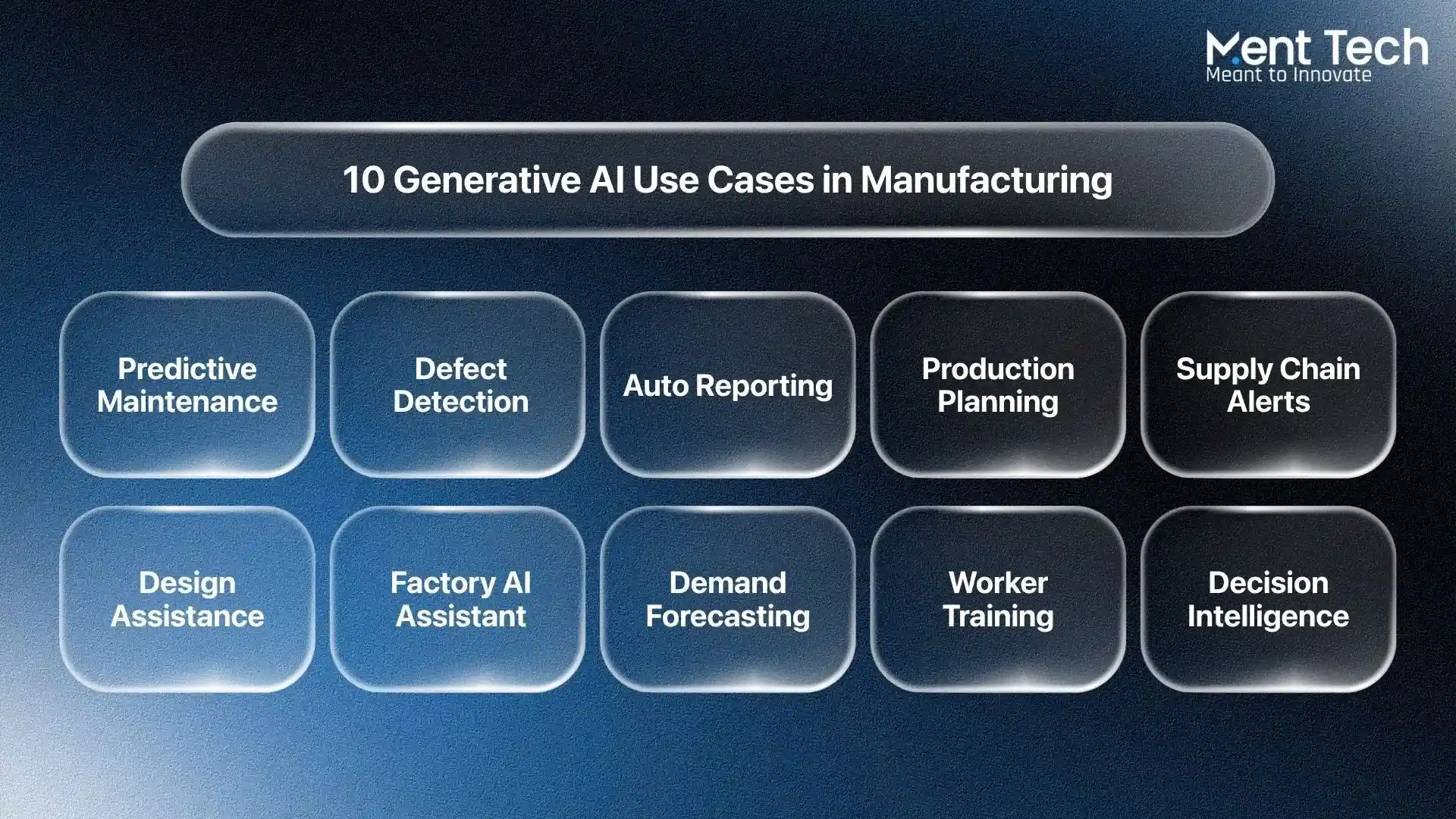
10 Generative AI Use Cases in Manufacturing
1. Predictive Maintenance Support
Ask any maintenance manager what their worst day looks like, and the answer is always the same. A critical machine goes down without warning, right in the middle of a production run, they can’t afford to pause. The parts aren’t on site. The technician is tied up somewhere else. And the cost of that one breakdown ripples through the entire schedule. Generative AI exists to stop that moment from happening by watching equipment behavior constantly and raising the alarm before things get to that point.
- Early risk detection. AI reads equipment data around the clock and catches the early signs of trouble while there’s still time to do something about it.
- Plain-language summaries. Maintenance teams get clear, readable reports on machine health and what to prioritize instead of wading through raw sensor data.
- Smarter scheduling. AI recommends maintenance windows that fit around production so repairs happen on the team’s terms, not the machine’s.
2. Quality Control and Defect Analysis
The most expensive defect is the one nobody catches until it’s too late. By the time a quality issue reaches the end of the line, it’s already in dozens of units; the batch may need to be scrapped, and the root cause is buried somewhere in a shift log nobody has time to read. Generative AI helps quality teams get in front of that by constantly analyzing inspection data and surfacing patterns before they turn into bigger problems.
- Pattern recognition. AI looks across shifts, machines, and production lines to find where defects keep appearing and what’s consistently behind them.
- Corrective action suggestions. Teams don’t just get told there’s a problem. They get specific recommendations on what to change to fix it.
- Real-time escalation. Issues get flagged the moment they appear instead of turning up days later in a report that arrives too late to help.
3. Production Planning and Scheduling
Every planner knows the feeling. You build a schedule that makes sense, you communicate it to the floor, and by Tuesday, something has already changed. A material didn’t arrive. A machine needs attention. A customer pushed up their order date. Planning in manufacturing means constantly adjusting to things that weren’t in the forecast, and generative AI makes that process a lot less painful by keeping up with the changes in real time.
- Demand-driven planning. AI tracks demand signals as they shift and helps planners adjust schedules before the gaps turn into actual production problems.
- Capacity visibility. Teams can see at any point where the line is running tight, where there’s room to move, and where a conflict is about to happen.
- Timeline recommendations. AI builds out realistic schedule options based on what’s actually available, so planners spend less time running numbers and more time making decisions.
4. Supply Chain Optimization
Supply chain management has never been simple, but the last few years have made it genuinely hard. Lead times that used to be predictable aren’t anymore. Suppliers that were reliable have become risk factors. And the volume of information a supply chain team needs to track has grown faster than any team can manage manually. Generative AI helps by doing the monitoring and surfacing the signals that matter before they turn into disruptions.
- Supplier performance tracking. AI keeps tabs on delivery records, quality scores, and lead times across every supplier and flags the ones becoming a liability before they cause a problem.
- Logistics delay alerts. Teams hear about shipment issues early enough to adjust production plans rather than finding out when the materials don’t show up.
- Procurement planning support. AI helps teams make smarter calls on what to order and when based on what demand is actually doing right now, rather than what last quarter looked like.
5. Product Design and Engineering Assistance
Engineers are at their best when they’re solving problems that actually need them. The trouble is that a surprising amount of their time goes toward things that don’t. Writing up documentation. Reformatting specs. Searching through previous design versions for something that should be easy to find. Generative AI handles that side of the job so engineers can focus on the work that requires their expertise.
- Concept exploration. AI generates initial concepts, material options, and design variations based on project requirements, so teams start with more to work with and explore more directions faster.
- Documentation drafting. Specs, revision notes, and technical write-ups get drafted automatically, cutting real hours out of every project cycle without sacrificing accuracy.
- Design iteration support. AI reviews previous versions and suggests improvements grounded in performance data, material properties, and production constraints.
6. AI-Powered Factory Assistants
Workers on the shop floor lose more time than most managers realize just looking for information. The SOP for a machine they don’t use every day. The correct torque spec for a part. The right safety procedure for a situation that doesn’t come up often. Tracking that information down takes time and interrupts the people who usually get asked. AI chatbot development services make it possible to give every worker a factory assistant that answers those questions instantly, so the work doesn’t have to stop.
- Instant SOP access. Workers ask a question and get the right procedure immediately without leaving the floor to search through binders or waiting for someone to respond.
- Troubleshooting guidance. When something behaves unexpectedly, the assistant walks workers through diagnostic steps specific to that machine and situation rather than pointing them to a generic manual.
- Safety and compliance support. Relevant safety protocols surface right at the point of need, so workers aren’t guessing or skipping steps when things get busy.
7. Automated Reporting and Documentation
At the end of a twelve-hour shift, the last thing anyone wants to do is sit down and write a detailed production report. But those reports matter. When they’re rushed, they’re inaccurate. When they’re skipped entirely, the gaps show up later in ways that are hard to trace and harder to explain during an audit. Generative AI takes the writing off the team’s plate entirely, so reports happen consistently without anyone having to find extra time to produce them.
- Shift and production reports. AI generates accurate shift summaries the moment the shift ends based on real operational data, not someone’s memory of what happened.
- Maintenance logs. Technicians stop writing up jobs manually after the fact. AI captures what happened as it happens and puts it into a clean, usable record.
- Compliance documentation. Audit-ready records get produced automatically, so nobody is scrambling to pull everything together when an inspection shows up.
8. Demand Forecasting and Inventory Planning
Too much inventory eats into cash flow. Too little and the production line stops. Most manufacturers know this problem well, and many are still trying to solve it with a combination of spreadsheets, experience, and hope. Generative AI brings something more reliable to that process by finding patterns in data that are too complex for any manual review and turning them into forecasts that teams can actually plan around.
- Demand pattern analysis. AI reviews sales history, seasonal trends, and current market signals to build forecasts that give production planning something real to work from.
- Inventory recommendations. Teams get clear guidance on what to stock, what to pull back on, and when to reorder based on what demand is actually signaling right now.
- Shortage and overstock alerts. AI catches inventory risks early enough for procurement teams to respond before a shortage disrupts the line or excess stock starts compressing margins.
9. Worker Training and Knowledge Support
Bringing a new hire up to speed in a manufacturing environment is genuinely time-consuming. There’s a lot to learn, the stakes for getting it wrong are real, and experienced workers can only answer so many questions before it starts affecting their own output. Generative AI supports the training process without adding to anyone’s existing workload by creating the right materials, answering questions on demand, and helping new employees build knowledge at a pace that actually works.
- Role-specific training content. AI creates onboarding guides, process walkthroughs, and job-specific training materials that match the actual environment the worker is stepping into.
- On-demand answers. New employees get accurate, process-specific answers immediately without having to interrupt a supervisor every time a question comes up.
- Knowledge gap tracking. AI helps training coordinators see where understanding is thin across the team so they can focus attention where it’s actually needed.
10. Manufacturing Decision Intelligence
The data exists in almost every manufacturing operation. The problem is that it’s spread across systems, departments, and formats that were never designed to connect. Leaders end up making calls based on partial information or waiting on reports that take days to compile when the decision needed to happen yesterday. Generative AI pulls it all together and gives leadership a current, clear picture of what’s actually happening, so decisions get made faster and with a lot more confidence.
- Unified performance summaries. AI connects data from across the operation and presents it in plain language so leaders know what’s happening without needing a data team to translate it for them.
- Scenario comparison. Leaders can ask AI to compare production options, cost changes, or operational decisions and get a clear breakdown of what each one actually means before committing.
- Faster strategic decisions. With AI handling the data work, leadership spends less time gathering information and more time making the calls that actually move the business forward.
Generative AI in Manufacturing: Real-World Examples
It’s one thing to talk about what AI can do. It’s another thing to see it working in real operations. These generative AI in manufacturing examples show what happens when the technology moves from a pilot project into an actual production environment.
Toyota and Predictive Maintenance
Toyota’s maintenance team stopped waiting for machines to break down. After deploying an AI-powered maintenance system, downtime at Toyota Indiana was cut by up to 50%. The team shifted from reactive repairs to planned interventions based on what the AI flagged days in advance. The disruption didn’t disappear. It just stopped being a surprise.
Bosch and Product Design
Bosch engineers used generative AI to build an automated toolchain that optimized the structure of MEMS sensors used in vehicles and healthcare devices. By generating synthetic image data, Bosch cut inspection system development from years to six months and boosted annual productivity by six figures. That’s not a marginal improvement. That’s a fundamental change in how fast a product moves from concept to production.
ACG Capsules and Shop Floor Assistance
Maintenance technicians at ACG Capsules stopped hunting through manuals every time something went wrong on the floor. After deploying an AI assistant trained on internal knowledge, workers got instant diagnostic guidance specific to their equipment and situation. The result was a repair time reduction of 30 to 40%, with less downtime and less dependency on senior technicians being available to answer every question.
How Generative AI Improves Manufacturing Operations
Most manufacturers don’t need more data. They need to do something with what they already have. That’s where generative AI in the manufacturing industry actually proves its worth. The manufacturers getting the most out of generative AI development services aren’t chasing technology for the sake of it. They’re solving problems that have been costing them for years.
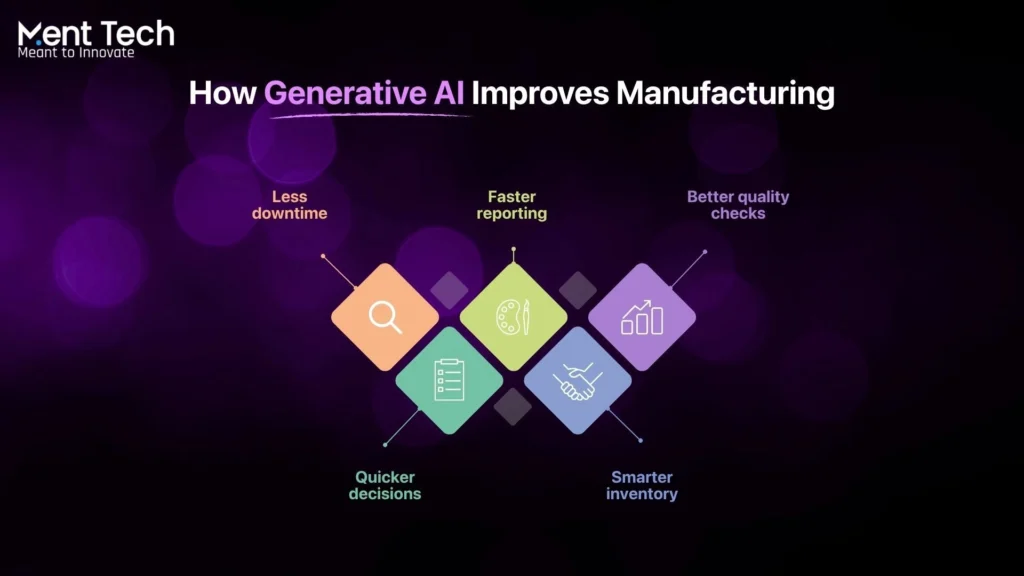
1. Reduced downtime and faster reporting
AI catches equipment warning signs early and gives maintenance teams something to act on before the breakdown happens. When the shift ends, the report writes itself. No one stays late. No one forgets what happened three hours ago.
2. Better quality control and smarter inventory decisions
Defects that used to spread through an entire batch before anyone noticed now get caught at the source. Inventory driven by real demand data instead of gut feel protects margin in ways that add up fast across a full production year.
3. Improved production planning and operational visibility
A schedule that falls apart by Tuesday was never really a plan. AI gives planners a live view of capacity, demand, and material availability, so what gets built on Monday actually holds through the week.
4. Lower manual workload and better worker support
Hours that disappear into writing reports and hunting down SOPs get handed back to the team. Workers get answers faster. Supervisors get fewer interruptions. Everyone focuses on problems that actually need them.
5. Faster decisions and stronger delivery performance
Slow decisions happen most often when leadership is waiting on information that should already be in front of them. AI closes that gap so the right data reaches the right person at the right time, and customer commitments stop being the first thing that slips.
Read more -Machine Learning Development Company