Not long ago, telemedicine was a backup plan. Today, it is how millions of Americans prefer to see their doctors. The shift happened fast, and the healthcare industry adapted. But the next wave is already here, and it is bigger than video calls.
AI is quietly becoming the backbone of modern virtual care. It is helping patients get answers faster, helping providers focus on what actually matters, and helping healthcare businesses run leaner operations. More importantly, it is creating business opportunities that the industry has never seen before.
Ment Tech helps healthcare organizations build AI-powered telemedicine platforms, patient engagement systems, and virtual care solutions designed for scalable healthcare delivery.
What Is AI in Telemedicine?
Let’s be honest. A lot of what slows down virtual healthcare has nothing to do with medicine. It is the back-and-forth of booking appointments, the repetitive intake forms, and the follow-up calls that never happen on time. AI in telemedicine steps in exactly there. It handles the noise so doctors can focus on the actual work.
But it goes deeper than admin tasks. A powerfully designed healthcare AI platform diagnoses based on symptoms, tracks hazards, assists with clinical decision-making, and remains an active participant in a patient’s health and well-being long after the appointment is over. It is a take-no-nonsense fuzzy cheat sheet and extra set of smarts that toils away silently beneath everything else. One that never tires, one that doesn’t lose its mind, and tech-savvy finger-pointers.
Why AI Is Becoming Essential for Telemedicine in 2026
Too many patients, not enough people, not enough time, and a system that was not built to handle any of this at this scale. Telemedicine helped bridge some of that gap. But it brought its own set of problems. And that is exactly where telemedicine AI is quietly becoming the thing nobody can do without.
- Physician Shortages
This one is straightforward. There are not enough doctors. There will not be enough doctors anytime soon. The providers who are out there are already at capacity, and patients keep coming. AI does not replace them. It just stops them from drowning.
- Rising Costs
Healthcare is expensive, and a lot of that expense has nothing to do with actual treatment. It is the phone calls, the paperwork, and the manual processes that pile up every single day. AI cuts through that, so the money goes where it should.
- Patient Demand
Patients have changed. They are not willing to sit on hold or wait two weeks for an appointment when everything else in their life works instantly. AI meets them where they are, on their schedule, without putting more on the provider’s plate.
- Workforce Burnout
This is the one that keeps healthcare executives up at night. Good clinicians are walking away because the job stopped feeling like medicine and started feeling like data entry. AI gives them their time back, and honestly, that matters more than any other benefit on this list.
- Exploding Data Volumes
Healthcare generates enormous amounts of data every day, and most of it sits unused because no team has the bandwidth to make sense of it. AI does not just process that data. It turns it into something clinicians can actually act on.
This is why strong healthcare data management matters before any telemedicine AI system can deliver reliable insights, safer decisions, or personalized care at scale.
10 Business Ideas Transforming Virtual Healthcare
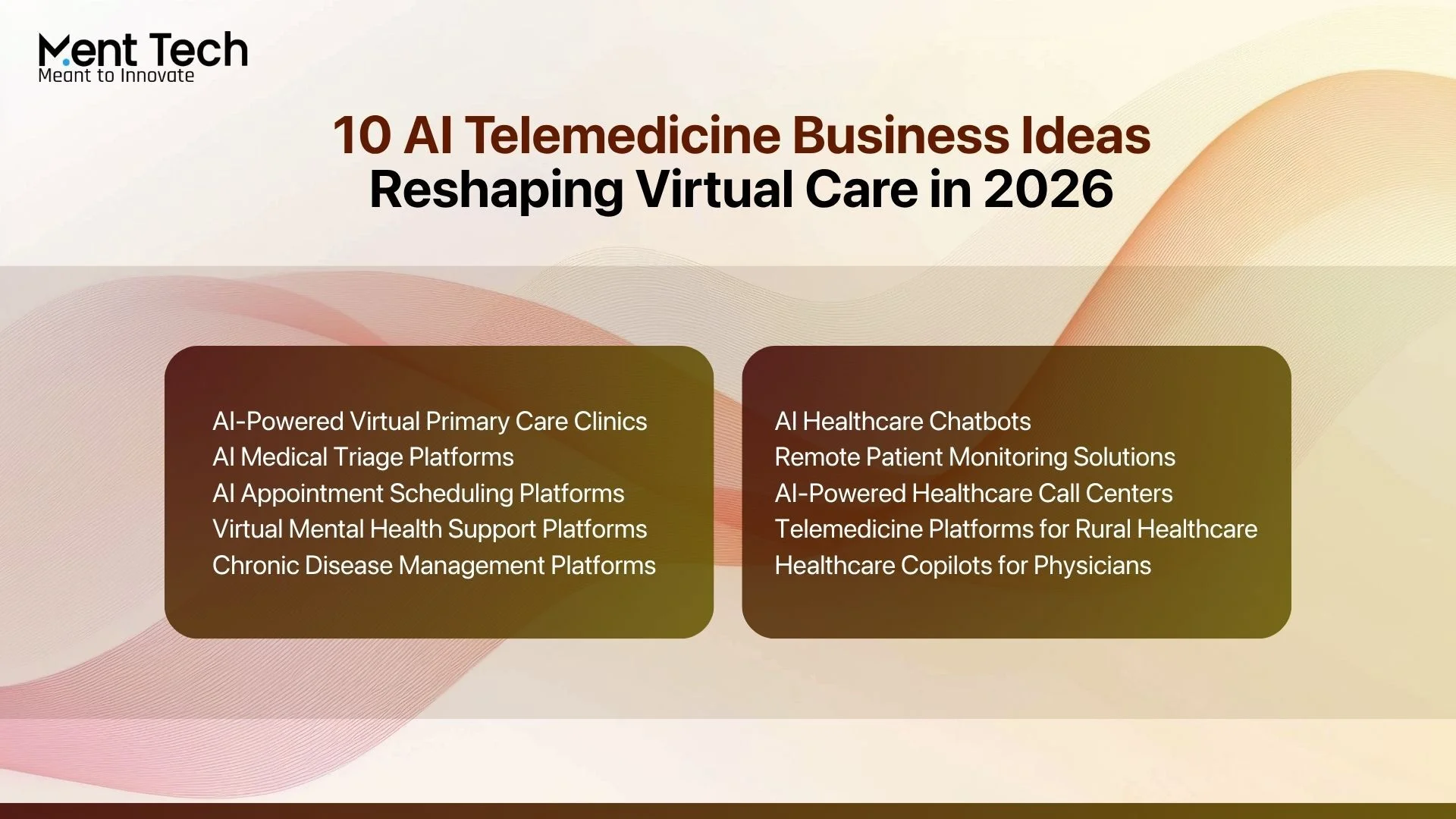
Some of the best healthcare businesses being built right now are not hospitals or insurance companies. They are small, focused teams solving one specific problem in virtual care really well. Here are the ten ideas worth paying attention to in 2026.
1. AI-Powered Virtual Primary Care Clinics
Nobody enjoys sitting in a waiting room. Nobody enjoys repeating their medical history to three different people before seeing a doctor. AI-powered virtual primary care clinics fix both of those things at once, and patients notice immediately.
- By the time a doctor joins the call, AI has already collected symptoms, reviewed health history, and flagged anything worth paying attention to.
- Clinical decision support runs quietly in the background, giving providers better information without slowing the consultation down.
- After the visit, follow-up instructions, prescription reminders, and check-in messages go out automatically without anyone on staff having to remember.
2. AI Medical Triage Platforms
Most people genuinely do not know whether their chest tightness needs an ER visit or just some rest and hydration. That uncertainty is expensive for the system and stressful for the patient. AI triage platforms take that guesswork out of the equation entirely.
- Patients describe their symptoms and get a clear recommended care pathway in seconds, not hours.
- Emergency departments stop getting flooded with cases that primary care could have handled.
- Providers walk into every appointment knowing the patient has already been properly assessed and routed.
3. AI Appointment Scheduling Platforms
Healthcare scheduling is a mess, and everyone in the industry knows it. Patients no-show, slots go empty, and staff spend hours on the phone doing work that should not require a human at all. AI scheduling platforms are built to end that cycle.
- Appointments get booked, rescheduled, and cancelled without a single staff member touching the calendar.
- The system spots a likely no-show before it happens and fills the gap automatically.
- Everything syncs with existing EHR systems, so patient records never fall out of date.
For healthcare businesses exploring AI chatbot platforms for healthcare scheduling, this model creates a smoother booking experience while reducing front-desk workload.
4. Virtual Mental Health Support Platforms
The mental health system was overwhelmed before telehealth existed. Now demand is even higher, and the shortage of providers has not caught up. AI mental wellness platforms are not trying to replace therapists. They are trying to make sure people do not fall through the cracks while they wait for one.
- Mood tracking and behavioral pattern analysis catch warning signs before they become a crisis.
- Between sessions, patients get personalized support, coping tools, and check-ins that keep them engaged in their care.
- When something crosses a clinical threshold, a human provider gets looped in immediately.
5. Chronic Disease Management Platforms
A fifteen-minute appointment every three months is not enough to manage diabetes or hypertension. Patients know it. Providers know it. The healthcare system has just never had a better option until now.
- Connected wearables send real-time health data back to the platform continuously; no manual logging required.
- AI spots a dangerous trend in someone’s blood pressure readings and sends an alert before it becomes a hospitalization.
- Care teams stay informed and involved without the patient having to initiate every single interaction.
6. AI Healthcare Chatbots
Patients do not stop having questions after 5 pm. They do not wait until Monday to wonder if their medication is causing a side effect. A good AI healthcare chatbot is just always there, and for most routine interactions, that is genuinely all patients need.
- Handles symptom questions, appointment bookings, onboarding, and follow-up reminders without any staff involvement.
- Gives the admin team their time back by taking on the conversations that do not need a human in the loop.
- Keeps patients connected to their care between visits in a way that actually improves outcomes.
7. Remote Patient Monitoring Solutions
The data coming from a patient’s smartwatch or continuous glucose monitor is genuinely valuable clinical information. The tragedy is that most of it never gets acted on in time. AI remote patient monitoring was built specifically to fix that.
- Vitals, glucose, heart rate, and oxygen levels are all monitored continuously from wherever the patient actually lives.
- The moment something looks wrong, the care team gets an alert while there is still time to intervene.
- Hospital readmissions drop because problems get caught at home instead of in an ambulance.
8. AI-Powered Healthcare Call Centers
If you have ever tried to reschedule a doctor’s appointment by phone, you already understand why this business idea exists. The experience is frustrating, slow, and wildly inefficient. Voice AI does not just improve it; it rebuilds it from scratch.
- Prescription refills, appointment reminders, and post-visit check-ins are all handled without a human agent picking up the phone.
- Call volume spikes get absorbed without patients sitting on hold or staff getting overwhelmed.
- Anything genuinely complex or clinical gets escalated to a real person immediately; no one gets lost in the system.
9. Telemedicine Platforms for Rural Healthcare
There are people in rural America who drive three hours to see a specialist. Not because they want to. Because there is no other option. A telemedicine platform built specifically for rural and underserved communities does not just create a business opportunity; they correct something that should have been fixed a long time ago.
- Patients access specialists, mental health providers, and chronic care support without ever leaving their town.
- The platform is designed for low-bandwidth connections because rural internet is what it is.
- AI fills the gaps where provider availability is thin, so patients still get consistent, quality care.
10. Healthcare Copilots for Physicians
Ask a doctor what the worst part of their job is, and very few of them will say the medicine. Most will say the paperwork. The notes, the summaries, and the documentation follow every single patient interaction. AI copilots are finally doing something about it.
- Clinical notes get captured in real time during the consultation, so the doctor never has to type up a summary afterward.
- Follow-up actions and care gaps get flagged automatically before the session even ends.
- Physicians finish their day with more energy and less resentment, and that matters more than any efficiency metric on a spreadsheet.
How AI-Powered Telemedicine Platforms Work
Most telehealth apps do one thing. They connect you to a doctor over video and then leave you to figure out the rest yourself. An AI-powered telemedicine platform is built differently. It stays with the patient from the very first interaction to the very last follow-up. Here is how.
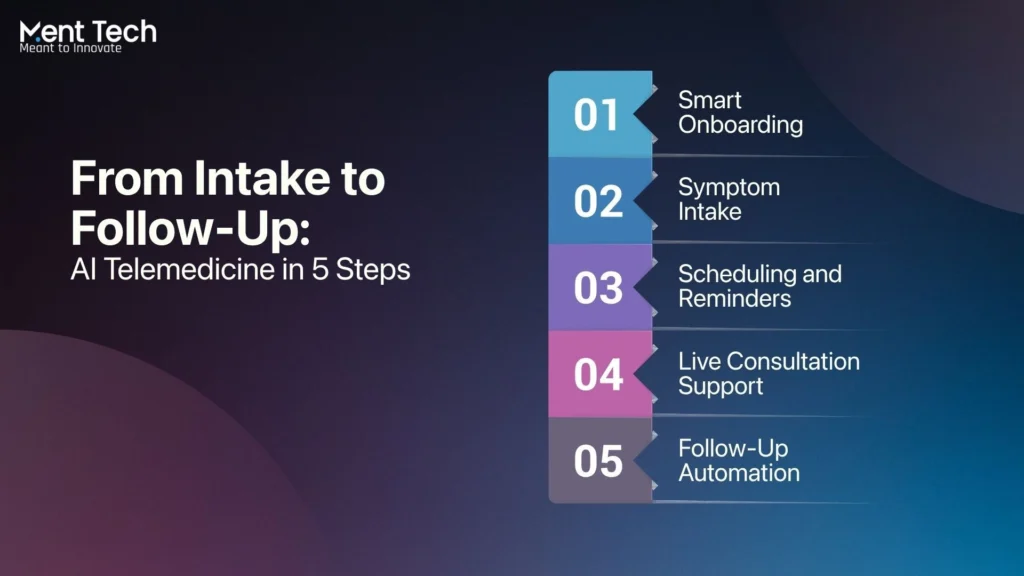
Step 1: Smart Onboarding
Forget the clipboard and the endless forms. AI has a conversation with the patient, collects what it needs, and stores it properly. Simple, fast, and nobody has to repeat themselves three visits later.
Step 2: Symptom Intake
The doctor joins, already knowing what is going on. AI has been asking questions, following up on answers, and building a clinical picture long before the provider logs in. The consultation starts informed, not cold.
Step 3: Scheduling and Reminders
Right provider, right time, no phone tag. AI books the appointment, sends the reminder, and quietly fills any gaps that open up. The calendar manages itself.
Step 4: Live Consultation Support
Notes get taken, records get surfaced, clinical flags get raised. All of it happens in the background while the provider stays completely focused on the patient in front of them.
Step 5: Follow-Up Automation
The visit ends, but the care does not. Reminders go out, check-ins happen, and the patient stays connected to their care without the platform dropping the ball the moment the call disconnects.
Recent Telemedicine AI News and Industry Trends
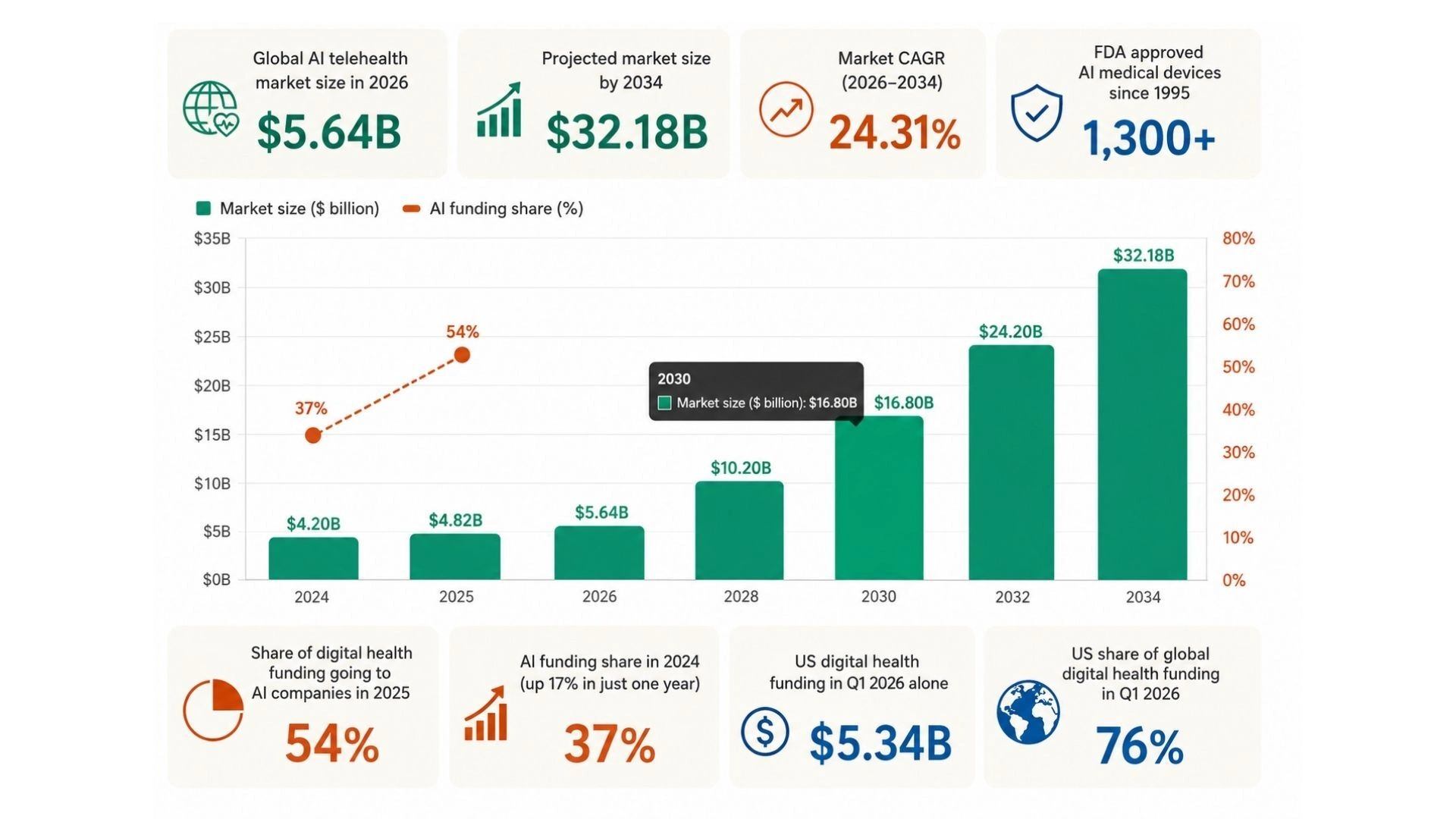
The telemedicine AI news coming out of 2026 is hard to ignore, and honestly, it is only getting louder. The global AI in telehealth market is projected to grow from $5.64 billion in 2026 to $32.18 billion by 2034. That kind of number does not come from hype. It comes from health systems, investors, and technology companies all arriving at the same conclusion at the same time. Virtual care powered by AI is not an experiment anymore. In 2025, 54% of all digital health investment went to AI-enabled companies, jumping from just 37% the year before. The people writing the checks have made their decision.
The regulatory picture is a different story. Not because the intent is not there, but because the technology keeps moving faster than any framework can comfortably contain. The FDA has approved more than 1,300 AI medical devices since 1995 and is still actively figuring out what responsible oversight looks like in real time. Healthcare organizations are left navigating a patchwork of federal rules, state-level legislation, and emerging standards that rarely move in the same direction at the same pace. For anyone building healthcare AI right now, that is just the reality of the space. The businesses that build compliance into their foundations rather than bolting it on at the end are the ones patients and providers will actually trust.
Why Healthcare Organizations Need the Right Development Partner
The technology was not the problem. The problem was the team that did not understand what they were actually building for. Healthcare does not forgive that gap. It exposes it. Choosing the right ML software development company is not a procurement decision. It is the difference between a platform that works and one that gets quietly shelved six months after launch.
- Healthcare Expertise
You cannot fake this one. A development team that has never worked inside clinical environments will spend the first three months of your project learning things they should have already known. That learning happens on your budget and your timeline. Find people who already know the landscape before they walk through your door.
- Compliance Knowledge
Everyone talks about HIPAA like it’s the whole picture. It is not even close. State-level privacy laws, FDA guidance on AI-assisted tools, and a regulatory environment that is genuinely still evolving mean compliance is something your partner has to live with every day, not something they sort out at kickoff and never think about again.
- AI Integration
This is where most healthcare AI projects quietly fall apart. Nobody warns you how hard it is to connect a new AI layer to a legacy EHR system that was never designed to talk to anything modern. The teams that have done it before know where the traps are. The ones that have not will find out the expensive way.
- Custom Workflows
Every hospital runs differently. Every clinic has its own quirks. Every telehealth provider has built processes that work specifically for them. A partner who shows up with a ready-made template and asks you to adapt your organization around it is not actually solving your problem. They are solving a problem they already had an answer for.
- Long-Term Scalability
The version of your platform that goes live on day one is not the version your organization will need in year three. The right partner knows that going in and builds with that future in mind from the very beginning, not as something to figure out when the cracks start showing, and users start complaining.
Final Thoughts
AI in telemedicine is not a future opportunity anymore. It is a present one. The organizations that are moving now are not just improving their operations. They are building entirely new ways to deliver care that did not exist five years ago. Better patient access, leaner workflows, faster support, and healthcare services that can actually grow without falling apart under the weight of their own demand.
The window to get ahead of this is still open, but it is not going to stay open forever. Healthcare businesses that invest early in AI-powered virtual care are the ones that will set the standard for how modern healthcare gets delivered. The ones that wait will spend years playing catch up with competitors who figured this out sooner.
Partner with Ment Tech Labs to build AI-powered telemedicine solutions designed for modern healthcare delivery and long-term growth.