Support teams can’t catch a break these days. Customers want answers in seconds, no matter if they’re on chat, email, phone, or DMing on social. Meanwhile, leadership keeps asking the same question: how do we do more without hiring more?
Deloitte’s 2026 State of AI in the Enterprise report found that two-thirds of organizations are already seeing real productivity and efficiency gains from AI adoption, and customer service happens to be one of the functions leading that charge. That’s not a coincidence. It’s the reason enterprise AI for customer service stopped being a “let’s test it out” project and became something companies are actually budgeting for, seriously.
Nobody’s trying to win points for installing a basic chatbot anymore. Enterprises want AI that can handle the repetitive stuff on its own, back up agents in real time, make every response a little sharper, and let support teams grow without things falling apart behind the scenes.
Ment Tech Labs helps enterprises build AI-powered customer service solutions, AI chatbot development services, support agents, and workflow automation systems built for scalable customer experience.
So let’s get into it. This guide walks through the best enterprise AI customer service platforms in 2026, what actually separates the strong ones from the overhyped ones, and how to figure out which fit is right for your business.
What Is Enterprise AI for Customer Service?
Enterprise AI for customer service is really just AI doing the heavy lifting behind your support operation, taking on the repetitive stuff that slows agents down, so your team can focus on what actually needs a human brain. It’s not just a chatbot sitting on your website. It’s chatbots handling the easy questions, AI agents that can pull up an order or update a record on their own, and a knowledge base that keeps itself updated instead of someone editing articles every week.
A lot is happening behind the scenes too, most of which customers never notice. Tickets get routed to the right team the moment they land. Intent detection figures out what someone actually needs, even when they type it badly or skip the details. Agent assist copilots quietly nudge human agents toward the right response while they’re still typing. Throw in voice and chat automation; CRM and helpdesk integrations that keep everything connected; and analytics that actually show what’s working, and that’s what a solid enterprise AI solutions setup looks like in practice.
10 Best Enterprise AI Customer Service Platforms
1. Ment Tech
Most platforms on this list hand you a fixed product and expect your business to bend around it. Ment Tech Labs does it the other way. It builds custom enterprise AI solutions around how your team actually works, not some generic template. That means real AI chatbot development, AI agent development company services for agents that can actually do things instead of just answering questions, and generative AI development services in the USA built for conversations that sound like a person, not a script.
Key features: Custom AI chatbots and agents, AI workflow automation, SaaS-based customer support platforms.
Enterprise strengths: Deep CRM and helpdesk integrations built around your existing stack, plus secure deployment baked in from day one.
Limitations: Custom builds naturally take a little longer to launch than a plug-and-play SaaS tool.
Best for: Enterprises that want a custom AI support system instead of squeezing into someone else’s platform.
2. Intercom Fin
Fin gets a lot of attention for actually being upfront about its numbers, which is rare in this space. It runs on per-resolution pricing, and Intercom even guarantees new enterprise customers a 65% resolution rate or gives them their money back.
Key features: Works inside Intercom’s own helpdesk or layers onto Zendesk and Salesforce.
Enterprise strengths: Independent benchmarks put its average resolution rate around 67%.
Limitations: Costs creep up once you add seats and extras, and it loses depth fast when workflows stretch across multiple systems.
3. Salesforce Agentforce
If your enterprise already lives inside Salesforce, this is the obvious next move since service data never has to leave the CRM.
Key features: Atlas Reasoning Engine for multi-step processes, native case management, and CRM-driven personalization.
Enterprise strengths: It’s scaled to roughly $800 million in ARR across more than 29,000 deals, which says a lot about how it holds up under real enterprise load.
Limitations: Step outside Salesforce, and things get messier. Connecting other tools usually means custom work, and rollouts often drag into months.
4. Zendesk AI
Zendesk layered its AI on top of an already massive support infrastructure, a natural pick for teams that don’t want to abandon their existing ticketing setup.
Key features: Intent detection, automated routing, workflow automation.
Enterprise strengths: The reporting and app marketplace are tough to beat, and the 2026 Forethought acquisition brought autonomous resolution capabilities straight into the platform.
Limitations: Because the AI was bolted onto an older system rather than built fresh, it can feel a bit stiff once workflows get complicated.
5. Decagon
Decagon’s standout feature is memory that actually sticks. It remembers context from past conversations instead of treating every chat like the first one.
Key features: Agent Operating Procedures (AOPs) for plain-language workflow logic, low-latency voice support, and cross-channel memory.
Enterprise strengths: Customers include Notion, Duolingo, and Rippling, with support for 15-plus languages.
Limitations: It isn’t HIPAA compliant, which rules it out for a lot of healthcare teams, and deployment usually takes around six weeks.
6. Sierra
Sierra leans hard into brand voice and outcome-based billing, so you pay when the AI actually gets results, not just for showing up.
Key features: Multi-model tone alignment, task-based workflow execution.
Enterprise strengths: It’s reached around $100 million in ARR with a $10 billion valuation and counts SiriusXM, SoFi, Rocket Mortgage, and Brex as customers.
Limitations: It’s a standalone platform, so adopting it usually means rethinking your current support setup rather than just bolting it on.
7. Ada
Ada’s been around long enough to earn a real enterprise track record, growing from chat into voice and email along the way.
Key features: No-code Playbooks for multi-step automation and integrations across 13-plus helpdesk and contact center systems.
Enterprise strengths: Ada claims an autonomous resolution rate of up to 83% on supported workflows, and it holds SOC 2, HIPAA, GDPR, and AIUC-1 certifications.
Limitations: Since it grew out of a chatbot architecture, it tends to struggle once workflows get deep and multi-step.
8. Kore.ai
Kore.ai is built for large, voice-heavy contact centers, a different breed than most chat-first platforms on this list.
Key features: Dialog task builder for complex workflows and deep telephony and CRM/ERP integrations.
Enterprise strengths: SOC 2 and ISO 27001 compliance with on-premises or private cloud deployment options, a strong fit for strict data residency requirements.
Limitations: Implementation takes serious resources, and pricing typically runs into six figures a year.
9. Freshdesk (Freddy AI)
Freddy AI is the practical, lower-cost choice for enterprises that want real AI capability without a six-figure contract attached.
Key features: Ticket classification, agent suggestions, and autonomous resolution built right into the existing Freshdesk ticketing system.
Enterprise strengths: Pricing starts noticeably lower than most enterprise-grade platforms.
Limitations: It charges per session even when the issue stays unresolved, and analytics and customization fall short of fully enterprise-grade tools.
10. Gorgias
Gorgias is the specialist of the bunch, built almost entirely around Shopify-driven e-commerce support.
Key features: Tight Shopify and e-commerce integrations with retail-specific automation built in.
Enterprise strengths: Order tracking, returns, and shipping queries work right out of the box with barely any setup.
Limitations: Its capabilities narrow significantly outside the e-commerce vertical, so it’s not the right fit for broader, non-retail support needs.
Comparison Table: Enterprise AI Customer Service Solutions
Once you lay everything out side by side, picking the right enterprise AI solutions setup gets a lot less overwhelming. Here’s how the 10 platforms stack up on what actually matters when you’re evaluating an AI platform for enterprise.
| Solution | Best For | AI Capabilities | Integrations | Enterprise Ready | Customization |
| Ment Tech | Custom AI builds | Chatbots, AI agents, generative AI | CRM, helpdesk, internal systems | Yes | Full |
| Intercom Fin | Intercom users | Multi-turn resolution | Zendesk, Salesforce | Yes | Moderate |
| Salesforce Agent Force | Salesforce-native teams | Multi-step reasoning | Native CRM only | Yes | Moderate |
| Zendesk AI | Existing Zendesk teams | Routing, intent detection | Zendesk ecosystem | Yes | Moderate |
| Decagon | Persistent memory needs | Voice, cross-channel memory | Zendesk, Salesforce, Intercom | Yes | High |
| Sierra | Brand-voice focus | Outcome-based resolution | Custom enterprise stacks | Yes | High |
| Ada | High-volume automation | No-code Playbooks | 13+ helpdesk systems | Yes | High |
| Kore.ai | Voice-heavy contact centers | Telephony automation | CRM, ERP, ITSM | Yes | High |
| Freshdesk (Freddy AI) | Mid-market teams | Ticket classification | Freshdesk ecosystem | Limited | Low |
| Gorgias | Ecommerce/Shopify | Retail-specific automation | Shopify, e-commerce tools | Limited | Low |
Key Features Every Enterprise AI Customer Service Platform Should Have
Most feature lists you’ll come across online look impressive but don’t actually tell you much. What really decides whether an AI platform for enterprise works for your team comes down to a handful of things, not fifty checkboxes on a vendor’s website.
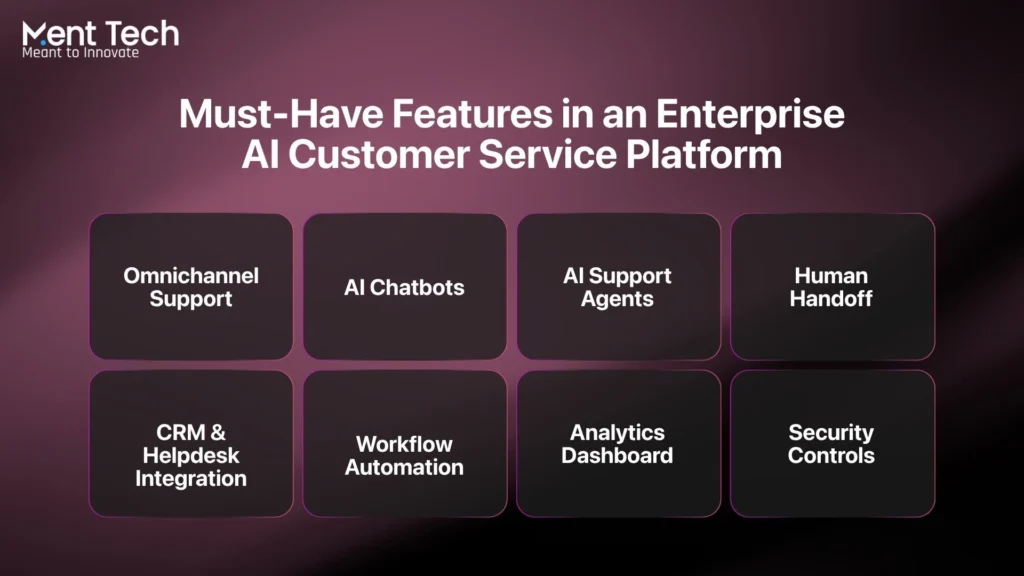
Omnichannel support: Customers don’t stick to one channel anymore. They start a chat, follow up by email, then call when it gets urgent. If a platform can’t carry that context across all three, you’re just creating more friction for everyone involved.
AI chatbot and AI support agent: People use these terms like they’re the same thing, but they’re not. A chatbot answers questions. An AI support agent actually does something: pulls up an order, updates a record, and takes action. Enterprise AI for customer service really only earns its name once it moves from responding to actually doing.
Human handoff: No AI gets everything right, and customers know that better than anyone. What separates a good platform from an annoying one is how smoothly it hands a conversation to a human, with full context intact, without making the customer repeat themselves from scratch.
CRM and helpdesk integration: AI sitting off in its own little bubble, disconnected from the systems you already use, doesn’t help much at enterprise scale. It needs to actually read and write to your CRM and helpdesk, or it’s just one more disconnected tool collecting dust.
Analytics dashboard: If you can’t see what’s getting resolved, what’s escalating, and where customers keep getting stuck, you’re basically flying blind. A good dashboard is what turns AI from a mystery box into something you can actually manage and improve over time.
Security controls: For enterprise buyers, there’s no compromising here. Encryption, access controls, audit trails. All of it becomes that much more important once you’re handling sensitive customer data at scale.
Custom Enterprise AI vs Off-the-Shelf Customer Service Tools
Choosing between the two usually comes down to how standard your support needs actually are. Off-the-shelf tools get you there fast and work fine for common scenarios. But once things get messier, with legacy systems, odd compliance rules, and workflows nobody else has, that’s usually when businesses turn to an enterprise ai chatbot development company instead.
1. Custom workflows
Custom Enterprise AI: Built around your actual ticket types and approval chains, the way your team really works, not how a vendor assumed you’d work.
Off-the-Shelf Customer Service: Fine for common scenarios, but the cracks show up fast once your process isn’t exactly textbook.
2. Enterprise data integrations
Custom Enterprise AI: Hooks directly into your CRM, internal databases, and even those old legacy systems most vendors quietly avoid.
Off-the-Shelf Customer Service: Plays nice with popular tools, but anything older or custom usually means a workaround or no connection at all.
3. Industry-specific support logic
Custom Enterprise AI: Understands the actual rules your industry runs on, because what works for fintech won’t work for healthcare or manufacturing.
Off-the-Shelf Customer Service: Designed to be broadly useful, which means it rarely picks up on the nuance your sector actually needs.
4. Security requirements
Custom Enterprise AI: Built around your specific compliance and data residency rules from day one, not retrofitted later.
Off-the-Shelf Customer Service: Comes with standard certifications that cover most businesses but won’t bend for unusual regulatory asks.
5. Brand-specific CX
Custom Enterprise AI: Sounds like your brand actually talking, not a generic AI voice wearing your logo.
Off-the-Shelf Customer Service: Offers some tone settings, sure, but conversations still feel a bit templated underneath.
6. Complex escalation rules
Custom Enterprise AI: Mirrors how your support team really escalates issues, layered logic and all.
Off-the-Shelf Customer Service: Handles the basic escalation paths fine, but multi-step or conditional rules tend to need a patch job.
How to Choose the Right Enterprise AI Customer Service Solution
In an environment where just about any platform you choose could do the trick, finding the right one is nothing more than a few simplicity filters rather than a hundred-point litmus test.
Define your support goals first: Are you trying to cut response times, reduce ticket volume, or free up agents for complex issues? The answer shapes everything else you evaluate.
Check integration needs: Look at the CRM, helpdesk, and internal tools you’re already running. If a platform can’t connect cleanly to your existing stack, it’ll cost you more in workarounds than it saves in automation.
Evaluate security and compliance: This matters more the bigger your business gets. Check certifications, data residency, and how the platform handles sensitive customer information before anything else.
Test AI accuracy on real conversations: Demos always look polished. Run your actual support scenarios through it and see how it actually performs, not how the sales deck says it performs.
Review how the human handoff works: When the AI hits its limit, does it pass the conversation smoothly with full context, or does the customer have to start over with a human agent?
Check scalability and vendor support: Make sure the platform can handle your growth and that the vendor actually shows up when something breaks, not just during the sales cycle.
Final Thoughts
Enterprise AI for customer service is not just a nice upgrade anymore. For expanding companies, it’s a viable solution to enabling speedier responses, lowering support costs, increasing the quality of customer experience, and supporting teams to handle greater ticket volumes without extra strain.
The right AI customer service solution should fit the way your business actually works. Some teams may only need faster ticket handling, while larger companies may need stronger integrations, security, and automation across multiple channels. A trusted SaaS development company in the USA can help you build a solution that feels practical, scalable, and built around your support goals.
Partner with Ment Tech Labs to build enterprise AI customer service solutions that improve response times, automate workflows, and deliver better customer experiences.