Healthcare teams are stretched thin. High call volumes, missed appointments, staff shortages, it adds up fast.
More clinics and hospitals are turning to AI voice platforms for healthcare scheduling, patient engagement, and clinical workflows. In 2026, the tools are better than ever.
This guide breaks down the best options, so you can find the right healthcare AI platform for your organization.
Looking to build your own? Ment Tech Labs can help. Let’s dive in.
What Is a Healthcare AI Platform?
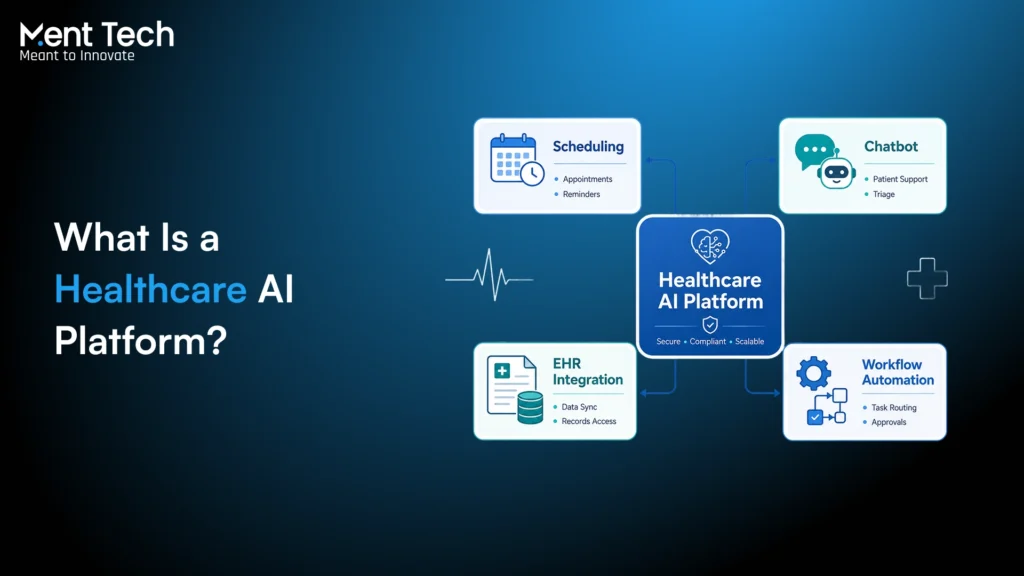
A healthcare AI platform is a digital system that uses AI to support healthcare operations, patient communication, appointment scheduling, care workflows, documentation, and internal automation.
It is not one tool. It is a set of connected capabilities that work together.
A solid AI platform for healthcare typically covers:
- Appointment scheduling and booking automation
- Voice call automation for inbound and outbound patient calls
- Patient engagement across web, mobile, and messaging
- AI chatbot support for FAQs, intake, and care guidance
- Clinical workflow automation for documentation and task routing
- Care reminders and follow-up automation
- Mental health chatbot support for check-ins and wellness
- Healthcare hiring workflow automation for staffing teams
A modern AI platform for healthcare should work for both patients and care teams at the same time, not just automate one isolated task.
Why Healthcare Teams Are Adopting AI Platforms in 2026
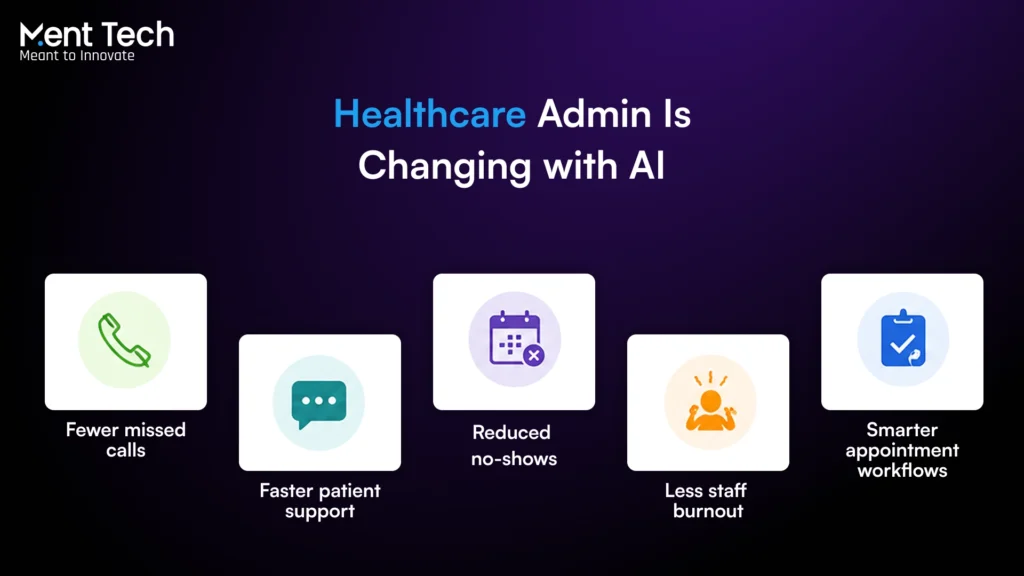
The pressure on healthcare admin has reached a point where manual processes are no longer sustainable for most organizations. The pain points are consistent:
- High inbound call volume is overwhelming front-desk staff
- Long patient hold times leading to abandoned calls and lost bookings
- Frequent rescheduling requests that pull staff away from other work
- Missed calls after office hours with no way to capture patient intent
- Rising no-show rates affecting revenue and scheduling efficiency
- Staff burnout from repetitive admin tasks
- Manual follow-ups that fall through the gaps
- Disconnected scheduling tools are causing booking errors
- Shortage of healthcare admin staff relative to patient volume
AI voice platforms for healthcare scheduling are especially useful when front-desk teams spend a big chunk of their day on routine appointment calls. These systems answer immediately, handle booking and rescheduling, and pass complex cases to human staff when needed.
How We Selected the Best AI Platforms for Healthcare
Each platform was evaluated on criteria that actually matter to healthcare operations:
- Healthcare-specific use cases rather than generic automation features
- Scheduling automation capability and appointment workflow depth
- Patient engagement features across multiple channels
- AI chatbot or voice agent support with natural conversation handling
- EHR and calendar integration readiness
- Human handoff options for complex or sensitive patient interactions
- Compliance and privacy readiness for healthcare data environments
- Scalability from single clinics to large care networks
- Reporting and analytics for scheduling and engagement performance
Always verify current features, pricing, and compliance certifications directly with each vendor before making a final decision.
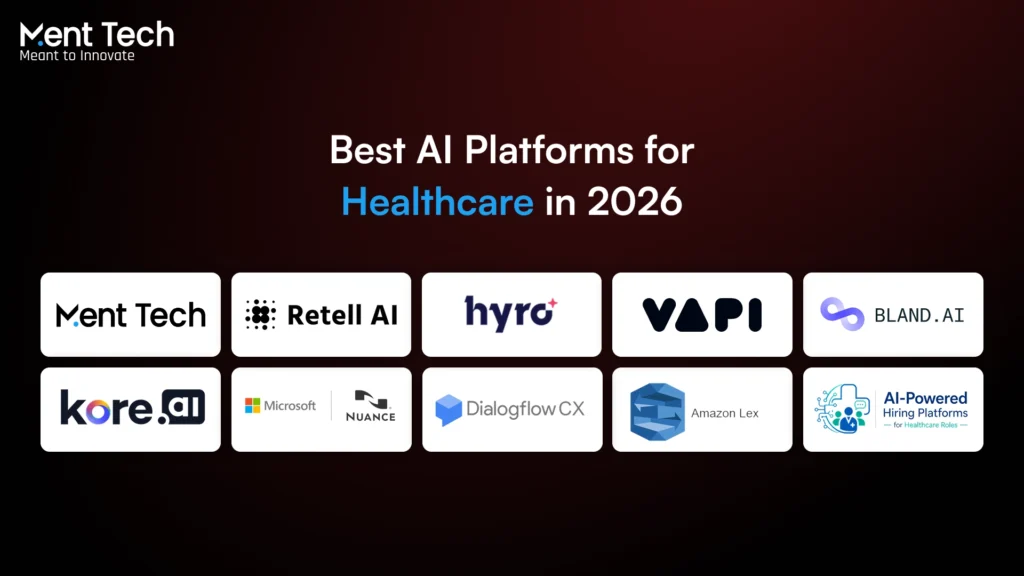
Best AI Platforms for Healthcare in 2026
1. Ment Tech
Ment Tech Labs is not a plug-and-play tool. It is built for healthcare companies that need something more.
Ment Tech Labs is an AI agent development company and an AI chatbot development company. The team builds custom healthcare AI platforms from the ground up.
You get a platform designed around your workflows. Not the other way around.
Here is what Ment Tech Labs covers:
- Healthcare AI platform development from architecture through deployment
- AI voice scheduling agents for phone-based booking and rescheduling
- AI chatbot development for web, mobile, and messaging
- Patient engagement automation including reminders and follow-ups
- Mental health chatbot development with escalation pathways
- AI agents workflow automation for scheduling, intake, and admin tasks
- EHR, CRM, and scheduling system integrations
- Secure cloud architecture and custom analytics dashboards
Not the right fit for every team. Best suited for organizations ready to invest in a custom build, not a monthly subscription.
2. Retell AI
Retell AI is built for healthcare teams that need reliable voice AI for patient phone workflows. It handles common clinic scenarios including booking new visits, rescheduling appointments, and routing patients to staff when human support is needed.
- Inbound call handling and appointment booking
- Rescheduling and cancellation management
- Natural phone conversations with scheduling system integrations
- Human escalation routing for complex cases
One of the more production-tested AI voice platforms for healthcare scheduling. Primarily phone-focused, so teams needing multi-channel engagement will need additional tools alongside it.
3. Hyro
Hyro is a healthcare-focused conversational AI platform built for patient engagement workflows. It handles appointment inquiries, clinic navigation, and patient information requests. It is designed specifically for healthcare rather than adapted from a general-purpose chatbot.
- Patient intent understanding and appointment inquiry handling
- Clinic and department navigation
- Healthcare system integrations and patient routing
Healthcare-native design means less configuration work to handle the specific language and workflows healthcare patients use. Better suited to larger organizations than small independent clinics.
4. Vapi
Vapi provides developer-first voice AI infrastructure. Technical teams get the flexibility to design custom scheduling flows, integrate with calendars and EHR systems, and build patient conversation experiences from the ground up.
- API-based voice infrastructure with custom workflow design
- Calendar and EHR integrations
- Custom patient conversation design
Strong flexibility for teams that want to build exactly what their clinic or platform requires. Requires engineering resources to configure healthcare-specific workflows. Not a no-code solution.
5. Bland AI
Bland AI is built for scale. It supports high-volume inbound and outbound call automation, appointment confirmations, and basic scheduling requests. For clinics managing large daily call volumes, the throughput capability is a real advantage.
- Inbound and outbound call automation at scale
- Appointment confirmations and rescheduling support
- Scalable phone throughput for busy clinic environments
Healthcare-specific workflow logic may need custom configuration. Works best when integrated with existing clinic scheduling systems.
6. Kore.ai
Kore.ai offers enterprise-grade voice and chat automation with workflow orchestration, advanced analytics, and integrations suited to complex healthcare environments.
- Voice and chat automation across multiple channels
- Workflow orchestration and enterprise integrations
- Analytics and reporting for patient service operations
Strong analytics and integration capabilities for health networks managing multi-department operations. Implementation scope makes it most suitable for larger organizations with dedicated IT teams.
7. Nuance / Microsoft Healthcare AI
Nuance is now part of Microsoft. Together, they offer an enterprise-grade platform for clinical documentation, voice AI, patient engagement, and healthcare integrations.
It goes well beyond scheduling. This one is built for complex clinical environments.
- Clinical documentation automation for care teams
- Voice AI for clinicians and patient-facing workflows
- Microsoft ecosystem connectivity and EHR integrations
One of the most mature clinical AI platforms available. Best for hospitals and care networks with heavy documentation and compliance needs. Enterprise pricing applies.
8. Google Dialogflow CX
Dialogflow CX is a flexible platform for building patient conversations, appointment automation, and voice or chatbot workflows. Teams on Google Cloud can design custom flows for specific scheduling scenarios.
- Multi-turn conversation design for complex scheduling interactions
- Voice and chatbot support with strong NLU capability
- Calendar and EHR integrations via connectors
Not a healthcare-specific solution out of the box. Requires development expertise to set up properly.
9. Amazon Lex
Amazon Lex lets healthcare teams on AWS build voice and text bots for patient support and appointment automation. Deep AWS integration makes it practical for teams already on that infrastructure.
- Patient support chatbots and scheduling assistant development
- Voice and text automation with AWS Lambda integration
- Scalable cloud infrastructure for healthcare environments
Needs healthcare-specific configuration to work for clinic workflows. Best for teams with cloud development capability.
10. AI-Powered Hiring Platforms for Healthcare Roles
Healthcare hiring is its own beast. Compliance, credentialing, scheduling demands. It is not like hiring for any other industry.
AI-powered hiring platforms help recruitment teams move faster through screening, interview scheduling, credential verification, and onboarding, without adding headcount.
- Candidate screening and healthcare role matching automation
- Interview scheduling and staffing workflow automation
- Credential verification and recruiter assistance
- AI agents for internal hiring workflows across multiple locations
Fills a gap that general-purpose ATS platforms are not built for. Verify data handling standards before deploying.
Best AI Chatbot Platforms for Automating Appointment Scheduling in Healthcare
The best AI chatbot platforms for automating appointment scheduling in healthcare are different from general-purpose chatbots. Healthcare scheduling involves multiple steps, conditional logic, provider availability checks, and compliance requirements that most generic tools are not built for.
When evaluating options, look for:
- Natural patient conversations that handle medical context and scheduling terminology
- Appointment type selection based on patient need and provider availability
- Real-time availability checks connected to scheduling systems
- Rescheduling and cancellation workflows without human involvement for routine requests
- Automated reminder delivery across email, SMS, and messaging channels
- Human handoff for complex requests, clinical questions, or emotional situations
- Secure data handling in line with applicable healthcare data regulations
- Integration with scheduling platforms, EHR systems, and clinic calendars
- Multi-channel support across web, mobile, WhatsApp, and voice
Chatbot scheduling works well for web and mobile environments. AI voice platforms for healthcare scheduling work best for phone-heavy clinics. Many healthcare organizations run both in parallel.
Healthcare AI Platform Use Cases Beyond Scheduling
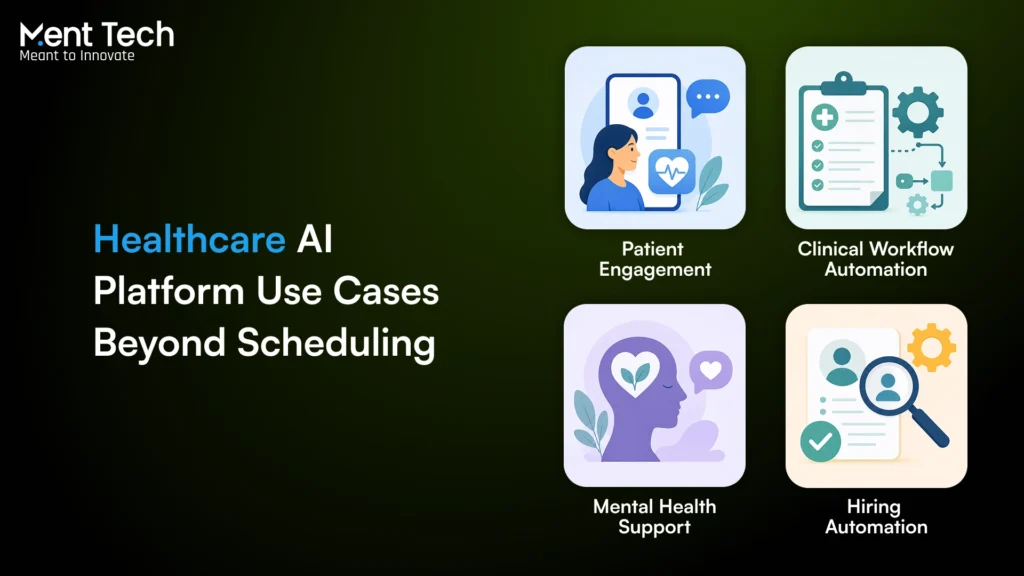
Patient Engagement
Automated reminders reduce no-shows. Follow-up messages support care plan adherence. Educational content helps patients manage chronic conditions. Medication prompts improve compliance. Satisfaction surveys give care teams actionable feedback without adding admin work. A well-designed healthcare AI platform connects all of this into a unified patient communication experience rather than a collection of disconnected messages.
Clinical Workflow Automation
Clinical workflow automation covers documentation support, task routing, intake summary generation, visit preparation, and internal workflow management. AI agents handle the handoffs between administrative and clinical tasks, making sure the right information reaches the right team member at the right time. This reduces the time clinicians spend on documentation and coordination rather than on patient care.
Mental Health Chatbot Support
A mental health chatbot can support mood check-ins, guided journaling, wellness resource delivery, and routine follow-up communication between clinical appointments. It creates a consistent touchpoint for patients managing anxiety, depression, or behavioral health conditions. A mental health chatbot is a support tool, not a replacement for licensed therapy or crisis intervention. Escalation pathways to human clinicians or crisis services must always be part of the deployment.
Also read: mental health chatbots as support tools
AI Agents Workflow Automation
AI agents’ workflow automation covers the full range of operational tasks that repeat daily in healthcare settings. Appointment routing, insurance document collection, follow-up reminders, intake workflow management, escalation alerts, and admin task automation are all areas where AI agents reduce manual workload. The goal is to keep staff focused on tasks that require human judgment while AI handles the rest consistently and at scale.
Healthcare Hiring Automation
AI-powered screening tools match candidates to healthcare roles based on credentials, availability, and experience. Onboarding workflows can be automated to collect documentation, run compliance checks, and coordinate training schedules. For healthcare networks managing high-volume recruitment across multiple locations, AI agents reduce the time from application to hire without sacrificing credential verification standards.
AI Voice Platforms vs Healthcare Chatbots: Which One Do You Need?
They solve different problems. Here is a simple way to think about it.
AI voice platforms for healthcare scheduling are best for
- Phone call answering and management for busy clinic front desks
- Appointment booking, rescheduling, and cancellation over the phone
- After-hours inquiry handling when staff are unavailable
- Front-desk call automation for high-volume scheduling environments
Healthcare chatbots are best for:
- Website and app-based patient support and FAQ handling
- Digital appointment requests from web and mobile interfaces
- Patient engagement across messaging channels
- Intake form collection and pre-visit preparation
- Follow-up reminders and post-visit communication
Most healthcare businesses benefit from running both. Voice AI handles the phone channel while chatbots manage digital patient engagement. The two work together to give patients consistent access however they reach out.
Benefits of AI Platforms for Healthcare
- Reduced front-desk workload as AI handles routine calls and scheduling requests
- Faster patient response times through immediate call and chat answering
- Better appointment access for patients regardless of time of day
- Lower call abandonment rates as wait times decrease
- Improved scheduling accuracy through automated booking and confirmation
- Fewer missed follow-ups through automated reminder and outreach systems
- More efficient staff workflows as AI takes over repetitive admin tasks
- Better data visibility through integrated analytics and reporting
- Scalable operations that grow without proportional headcount increases
- Improved patient experience through faster, more consistent communication
How AI Platforms Help vs Traditional Operations
| Pain point | Traditional approach | With AI platforms |
| High call volume | Front desk manually handles every call | AI voice agents handle inbound calls instantly at scale |
| After-hours calls | Patients reach voicemail with no support | AI works around the clock to book and confirm |
| No-shows | Manual reminder calls take staff time | Automated reminders reduce no-show rates significantly |
| Rescheduling requests | Staff interrupts other tasks to manage changes | AI handles routine rescheduling without human involvement |
| Staff burnout | Admin teams spend hours on repetitive tasks | AI offloads repetitive work so staff focus on patient care |
| Disconnected tools | Multiple systems require manual updates | AI integrates with EHR and calendars for unified scheduling |
Common Mistakes to Avoid When Choosing Healthcare AI Platforms
- Choosing a generic chatbot for complex scheduling workflows that need healthcare-specific logic
- Ignoring EHR and calendar integration as a core requirement from the start
- Building AI workflows with no human escalation path for sensitive patient interactions
- Treating privacy and compliance planning as something to address after launch
- Skipping conversation testing before deploying patient-facing AI systems
- Not accounting for multilingual support where patient populations need it
- Launching without an analytics dashboard to measure scheduling and engagement performance
- Starting implementation without mapping current workflows to understand where AI fits
- Over-automating sensitive patient interactions that require human judgment and empathy
- Treating AI as a replacement for clinical judgment rather than a support layer for operational work
How Ment Tech Labs Can Help Build Healthcare AI Platforms
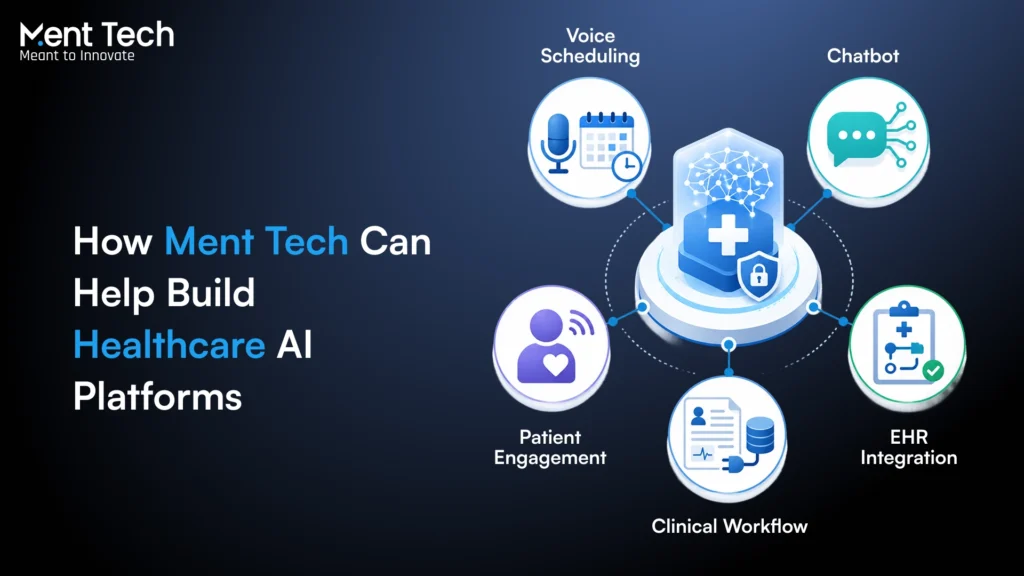
Ment Tech Labs helps healthcare companies build AI-powered platforms for scheduling, patient engagement, clinical workflows, and internal automation. Whether you need an AI voice scheduling agent, healthcare chatbot, mental health chatbot, AI workflow agent, or a complete healthcare AI platform, Ment Tech Labs can design and develop a secure, scalable solution around your operational needs.
As both an AI agent development company and an AI chatbot development company with healthcare-specific experience, Ment Tech Labs builds platforms designed for the compliance, integration, and workflow requirements of healthcare operations rather than adapted from general-purpose AI tools.
- Healthcare AI platform development from architecture through deployment
- AI voice platforms for healthcare scheduling with full phone workflow automation
- AI chatbot development for patient-facing web, mobile, and messaging workflows
- Patient engagement automation, including reminders, follow-ups, and care communication
- Mental health chatbot development with escalation pathways and care team integration
- AI agents’ workflow automation for scheduling, intake, insurance documents, and admin
- Clinical workflow automation for documentation support and task routing
- Healthcare hiring workflow automation for candidate screening and onboarding
- EHR, CRM, and scheduling system integrations
- Secure cloud architecture and custom analytics dashboards
Final Thoughts: Healthcare AI Platforms Should Improve Access, Not Replace Care
The best healthcare AI platforms help clinics and care teams reduce repetitive admin work, answer patients faster, improve scheduling access, and support better communication across every channel patients use.
AI in healthcare should support the work of healthcare staff and patients. It is not a replacement for the judgment of medical professionals. The platforms in this guide are scheduling, engagement, and workflow tools. They free up clinical teams to focus on patients, not paperwork.
Also read: AI in healthcare data management
The organizations that benefit most from AI platforms are the ones that start with a clear picture of the workflow problem they are solving, choose platforms or build solutions that fit that specific context, and maintain human oversight wherever patient care decisions are involved.
Partner with Ment Tech Labs to build a healthcare AI platform that improves scheduling, patient engagement, and clinical workflow automation with secure, scalable AI.