Individuals aren’t signing into fitness sites looking for the same template workout that everyone else receives. They want something personalized, can pick up from where the individual was in their workout, and are supportive without being impersonal. Fitness sites have several companies that have rethought the online coaching model.
Gyms, personal trainers, wellness brands, and healthtech founders are now building online fitness coaching platforms that do a lot more than stream workout videos. We are talking about platforms that combine personalized training, progress tracking, live sessions, nutrition guidance, and real-time support in one experience that actually keeps users coming back.
If you are planning to build an online fitness coach platform with AI coaching, CRM integration, and personalized experiences, Ment Tech Labs can help you design and develop something that truly works for your business and your users.
What Are Online Fitness Coaching Platforms?
At their core, online fitness coaching platforms are digital products that bring together everything a user needs to train and actually make progress. Personalized workout plans, video coaching, progress tracking, nutrition guidance, trainer communication, and payments all live inside one place rather than scattered across five different tools.
What separates a good platform from a forgettable one is personalized fitness coaching. Users should not feel like they are browsing a fitness YouTube channel. They should feel like the platform actually knows their goals and is helping them move forward.
Why Fitness Businesses Are Investing in Online Coaching Platforms
A trainer with 10 in-person clients hits a ceiling fast. A platform has no such limit. Hybrid coaching is now the preferred model for over 60% of clients, which means businesses without a digital presence are already leaving money on the table.
Scale Faster: One trainer can coach hundreds of users through structured programs, automated check-ins, and pre-built workout plans.
Hybrid Memberships Work: Physical location stays relevant but stops being the only revenue source. Members get online access as part of their package.
Reduce Manual Work: An AI fitness coach can manage reminders, progress updates, and basic guidance automatically, freeing trainers to focus where it actually matters.
Ditch Generic Plans: Cookie-cutter plans do not retain users. Personalized fitness coaching keeps people engaged because the experience feels built for them.
Corporate Wellness Opportunity Companies are increasingly investing in online corporate wellness programs, creating a strong B2B revenue opportunity for platform owners.
Recurring Revenue Model: Subscriptions and memberships mean predictable monthly income rather than chasing one-off sessions.
Always On Support: Unlike human trainers, an AI fitness trainer has no off hours. Users get support and recommendations whenever they need them.
Key Features of an Online Fitness Coaching Platform
Building a platform without thinking through the features is how you end up with something users open once and never return to. Here is what actually needs to be inside it.
- User Profile Setup
Users give information about their age, fitness level, health goals, equipment on hand, injuries, schedule, lifestyle, etc. These are the main details.
- Personalised Workout Plans
The service recommends the best-suited training programs to a user according to their details. This is where personalized fitness training stops being just a trend and becomes more of a definite service.
- Video Library
Exercise demonstrations, form instructions, difficulty levels, and workout categories all in one place. Users should never have to guess how something is done.
- Live Coaching Sessions
Core one-on-one session features, group training, booking of trainers, scheduling, etc., will be present in the app itself. Users wouldn’t need to toggle between different Zoom calls.
- Progress Tracking Dashboard
Weight, body measurements, workout completion, strength progress, calories, and milestones tracked in one view. Users stay motivated when they can actually see how far they have come.
- Nutrition and Meal Planning
Macro tracking, meal recommendations, calorie goals, and diet preferences are all supported. Fitness results do not happen without nutrition, and your platform should reflect that.
- AI Chatbot Support
A well-built chatbot developed by an AI chatbot development company can answer fitness questions, help users find the right workouts, send session reminders, and guide them through the platform without requiring human intervention each time.
- Trainer Dashboard
Client management, workout assignment, progress review, chat, scheduling, and performance reports all in one place. Trainers should spend their time coaching, not doing admin.
- Payment and Subscription Management
Monthly plans, trainer packages, one-time programs, corporate wellness plans, and in-app purchases are all handled smoothly. If payments feel clunky, users will not stick around.
- Admin Panel
User management, trainer management, content uploads, payments, reports, notifications, and full platform controls. The backend needs to be just as solid as the front-end experience.
If you want to understand how AI chatbots are already improving user support, reminders, and guided conversations in health-focused digital products, read our guide on AI Chatbots in Healthcare: Trends, Use Cases & Benefits.
AI Fitness Coach vs Traditional Fitness App
A traditional fitness app gives you a workout list and hopes for the best. An AI fitness coach actually pays attention; it learns from your goals, tracks your history, reads your feedback, and adjusts as you progress. A white label fitness app can incorporate these AI-powered features while allowing businesses to launch a customized fitness platform under their own brand. The difference is not just technical; it changes how users experience the platform entirely.
| Feature | Traditional Fitness App | AI Fitness Coach |
| Workout Plans | Static lists that never change | Adaptive plans that evolve with progress |
| Tracking | Manual input from the user | AI-generated insights based on real data |
| Reminders | Generic push notifications | Behaviour-based nudges that feel personal |
| Programs | Fixed regardless of performance | Adjusted based on how the user is actually doing |
| User Experience | One way of content consumption | Conversational guidance like a real AI personal trainer |
| Personalisation | Same plan for everyone | Built around individual goals and energy levels |
| Equipment Awareness | Rarely considered | Plans adjust based on what the user has available |
Think of it this way. A traditional app is a brochure. An AI fitness trainer is a coach that shows up every day, remembers everything, and actually helps users move forward.
For a deeper look at how AI systems can keep learning from user behavior and improve personalization over time, explore our guide on Adaptive AI Development Services in 2026.
Business Models for Online Fitness Coaching Platforms
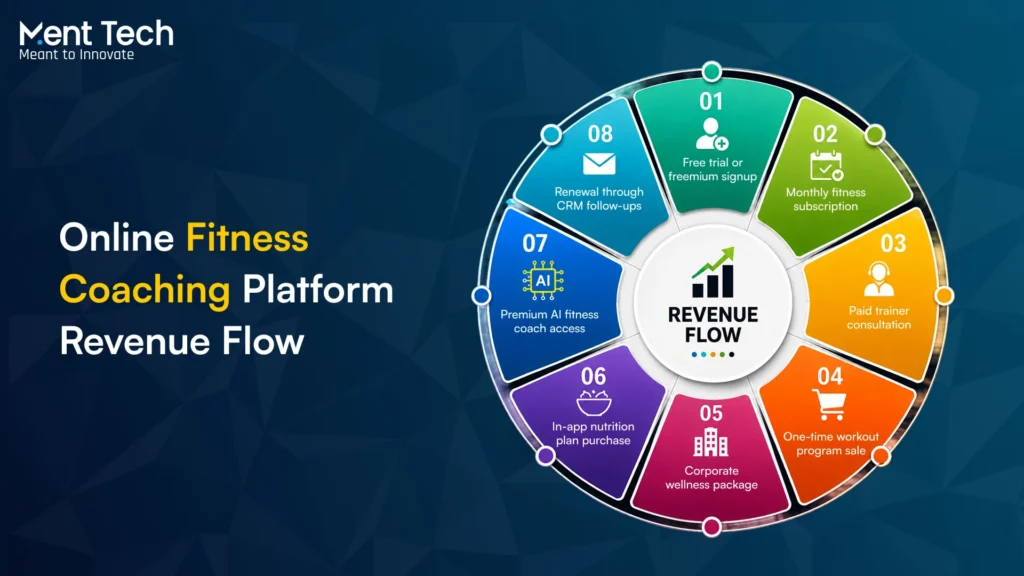
Picking the right business model is just as important as building the right features. Here are the models that actually work:
1. Subscription Model
Users pay monthly or yearly for full platform access. Simple, predictable, and the most common model for fitness platforms that want steady recurring revenue.
2. Trainer Marketplace Model
Trainers list their services, users browse and book, and the platform earns a commission on every transaction. Works well when combined with AI tools for gym crm integration to automate bookings, follow-ups, and trainer assignments without manual effort.
3. Freemium Model
Basic features stay free while premium plans are paid. Many users start by looking for a free AI personal trainer free option before committing to a paid plan. A freemium model lets them experience the platform first and converts them naturally over time.
4. Corporate Wellness Model
Companies pay for their employees to access fitness and wellness programs. This is a strong B2B revenue stream that brings in bulk subscriptions and longer contracts compared to individual users.
5. One-Time Program Sales
Sell standalone workout programs, diet plans, transformation challenges, or seasonal packages. No ongoing commitment is required from the user, making it an easy entry point.
6. Hybrid Gym Membership Model
Gyms bundle online coaching access with their existing offline membership. Members get the best of both worlds, and gyms create an additional revenue layer without building a separate product from scratch.
How to Build an Online Fitness Coaching Platform
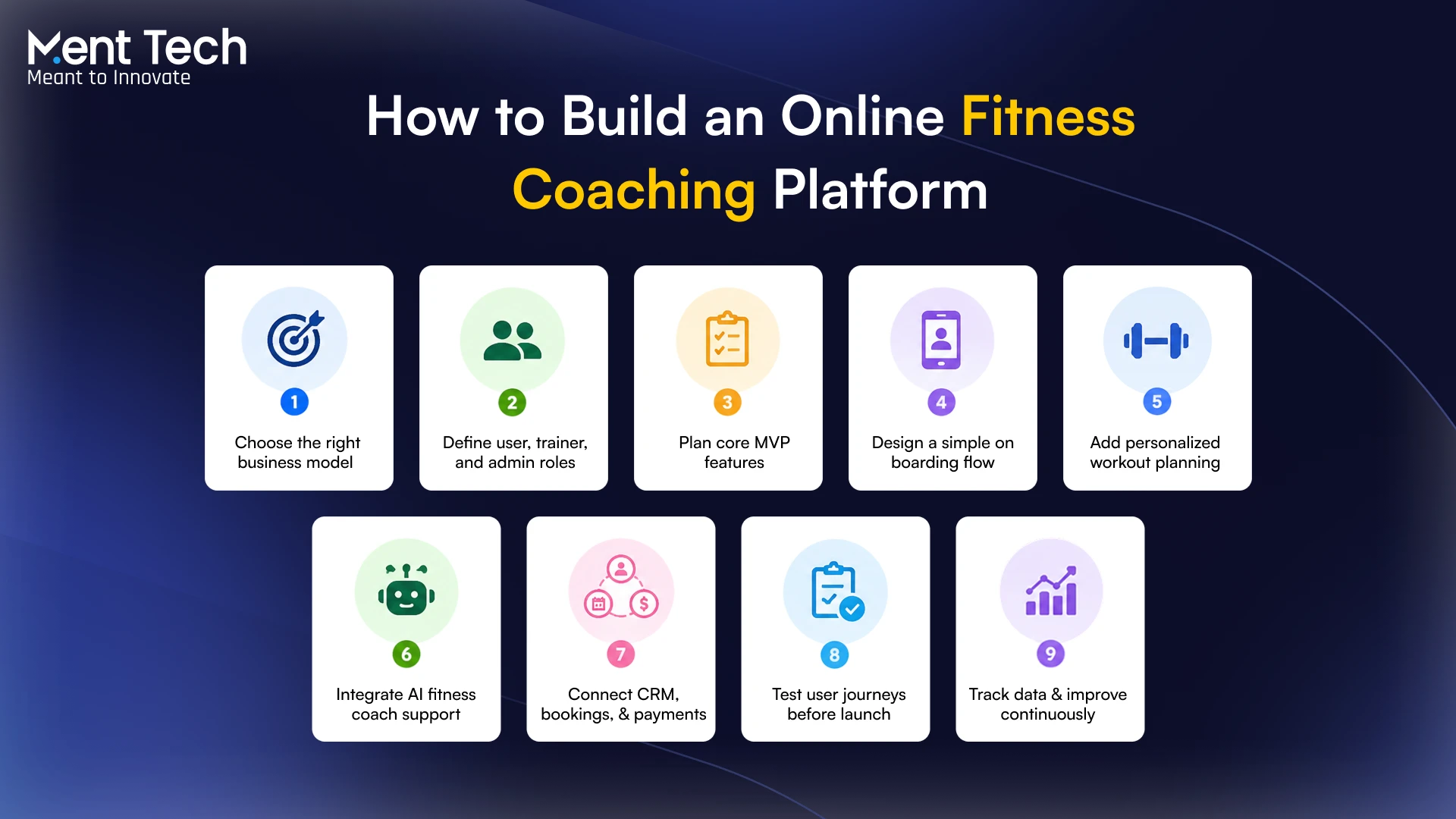
Nobody gets an online fitness coaching platform right by jumping straight into development. The businesses that build well start by thinking clearly, planning honestly, and building in the right order. Here is what that actually looks like:
Step 1: Pick Your Model
Before anything else, decide what you are building. A trainer marketplace, a gym platform, an AI coaching app, or a subscription product all need completely different foundations, so get this clear from day one.
Step 2: Know Your Users
Think about everyone who will touch the platform. Users, trainers, admins, gym managers, and nutritionists all need different experiences and different access to the same product.
Step 3: Start With MVP
Resist the urge to build everything at once. Start with the features that solve the core problem and let real user feedback tell you what comes next, rather than guessing.
Step 4: Make It Feel Easy
Workout discovery, progress tracking, and plan access should feel natural, not complicated. If users have to hunt for things, they will quietly stop using it.
Step 5: Add AI and Automation
This is where the product starts feeling genuinely smart. Working with an AI agent development company helps you bring in recommendations, adaptive coaching, and chatbot guidance that actually respond to how each user behaves.
Step 6: Connect Payments and CRM
Tie together payment gateways, booking tools, CRM systems, and notifications using proper AI integration services so the whole thing runs without anyone doing it by hand.
Step 7: Test Everything Properly
Do not rush the launch. Test every flow, including workouts, payments, trainer dashboards, and mobile performance. A single broken experience is enough to lose a user for good.
Step 8: Let Data Guide You
Once you are live, use analytics to understand what is working and what is not. Whether users come in looking for an AI personal trainer free option or jump straight to premium, the data will always show you the next move.
Common Mistakes to Avoid When Building a Fitness Coaching Platform
Most fitness platforms do not fail because of bad technology. They fail because of decisions made before development even starts. Here are the mistakes worth avoiding:
Too Many Features: Trying to launch with everything imaginable is how you end up over budget and behind schedule. Validate your MVP first and build from there.
Ignoring Trainers: If trainers find the platform clunky, they will not use it properly, and the whole user experience falls apart. Trainer tools deserve just as much attention as the user side.
No Personalization: A platform that treats every user the same will not hold anyone’s attention for long. Personalized fitness coaching is what makes users feel the product was built for them specifically.
Weak Onboarding: If someone signs up and cannot figure out where to start within the first few minutes, you have already lost them. First impressions on fitness platforms are everything.
Skipping CRM Integration: Missing AI tools for gym crm integration means losing out on automated follow-ups, member engagement, and retention triggers that keep users active without manual effort.
Generic AI Responses: A chatbot that gives vague, unhelpful answers damages trust fast. If you are going to build AI into the platform, make sure it actually adds value to the conversation.
No Retention Plan: Getting users to sign up is the easy part. Keeping them coming back requires progress tracking, milestone celebrations, and behavior-based nudges from a well-built AI fitness coach that notices when someone is going quiet.
How Ment Tech Labs Can Help Build Online Fitness Coaching Platforms
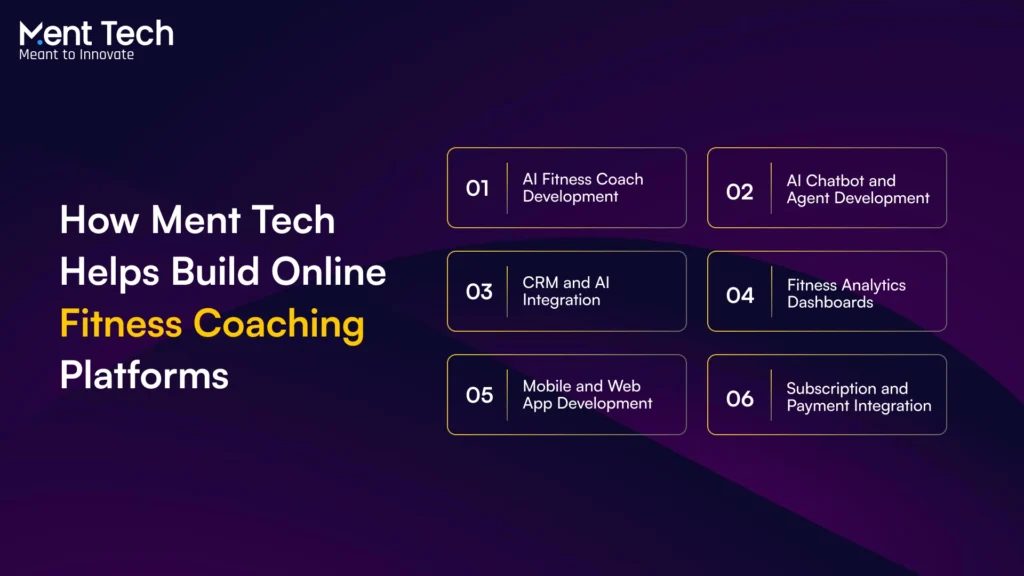
Ment Tech Labs helps fitness startups, gym chains, wellness brands, and healthtech businesses build online fitness coaching platforms that actually deliver results. Whether you are starting from scratch or scaling an existing product, here is what we bring to the table:
1. AI Fitness Coach Development
We build AI fitness coaches and AI personal trainer features that adapt to each user, recommend workouts, track progress, and keep people engaged without needing a human to manage every interaction.
2. AI Chatbot and Agent Development
As an experienced AI agent development company and AI chatbot development company, we develop smart conversational features that guide users, answer questions, and automate support around the clock.
3. CRM and AI Integration
We connect your platform with CRM systems, booking tools, and third-party services through reliable AI integration services, so everything works together without manual effort holding things together.
4. Fitness Analytics Dashboards
We build analytics dashboards that give trainers, admins, and business owners a clear view of user progress, engagement, retention, and platform performance in real time.
5. Mobile and Web App Development
From mobile-first fitness apps to full web platforms, we design and develop experiences that feel smooth, load fast, and keep users coming back session after session.
6. Subscription and Payment Integration
We handle subscription models, payment gateways, corporate wellness plans, and in-app purchases so your monetization works as well as your product does.
Final Thoughts: The Future of Fitness Coaching Is Personalized, Digital, and AI-Powered
The bar for what users expect from online fitness coaching platforms keeps rising. Generic workout plans and static content are not enough anymore. People want platforms that know their goals, adapt to their progress, and feel like they were built specifically for them. That is not a trend; that is the new standard.
AI is what makes that standard achievable at scale. It helps fitness businesses improve engagement, reduce manual workload, deliver smarter coaching, and create experiences that actually keep users coming back. The businesses investing in this now are the ones that will be hardest to compete with later.If you are ready to build something worth using, partner with Ment Tech to create an online fitness coaching platform that brings together personalized coaching, AI support, CRM integration, and a business model built to grow.