Something big is happening in finance right now. Asset managers, real estate firms, and fintech founders are building platforms and issuing tokens backed by properties, funds, commodities, and bonds.
The real-world asset tokenization market grew over 420% since early 2025 and crossed $30.2 billion by April 2026
Building an RWA tokenization platform is not simple. It touches legal structure, compliance, technology, and investor operations all at once. One weak layer creates problems everywhere else.
A solid platform needs asset onboarding, token issuance, KYC verification, smart contract execution, investor dashboards, and secondary trading working together from day one.
Planning to build a real estate tokenization, commodity tokenization, or fund tokenization platform? Use this as your starting point and build it right from the ground up with Ment Tech.
What Is Real-World Asset Tokenization?
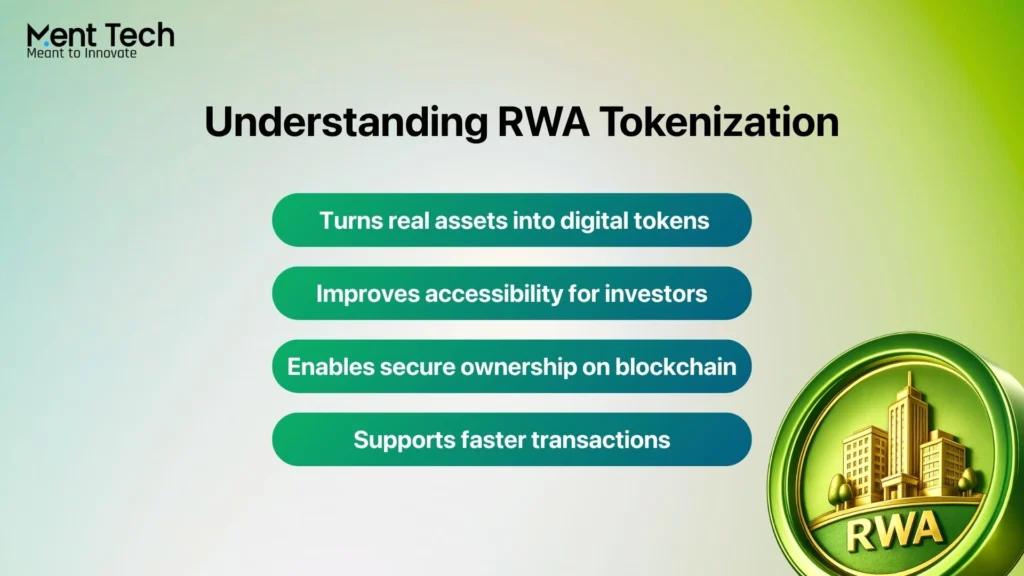
At its core, real-world asset tokenization converts a physical or financial asset into a digital token on a blockchain. That token can represent ownership, a revenue share, or a contractual claim depending on the legal structure.
The assets being tokenized go beyond real estate. Government bonds, private equity, commodities, infrastructure projects, and intellectual property are all live on platforms today.
Here is what actually changes when you tokenize an asset:
- Fractional ownership opens the door to more investors
- Blockchain records reduce ownership tracking burden
- Smart contracts handle distributions automatically
- An asset tokenization platform brings investors, documents, compliance, and reporting into one place
The structure varies by asset. The technology stays consistent.
Why Real World Asset Tokenization Is Growing in 2026
Traditional private asset markets have always been hard to operate in. The friction was real but the infrastructure to fix it did not exist. Now it does.
| Problem | Traditional Market | With Tokenization |
| High Entry Barriers | Large minimums lock out most investors | Fractional tokens lower the threshold |
| Slow Settlement | Days or weeks due to manual processes | Faster, blockchain-based record keeping |
| Poor Liquidity | Capital locked until asset is sold | Secondary marketplace exit pathways |
| Operational Overhead | Lawyers, notaries, paperwork heavy | Smart contracts reduce admin burden |
| Limited Investor Access | Geography and accreditation restrict reach | Cross-border investment becomes practical |
Regulators are moving in the same direction. The US, EU, UAE, and Singapore have all made progress on frameworks for tokenized securities. Institutional players including asset managers, banks, and family offices are building internal capabilities around tokenized assets.
The momentum is real and it is building in one direction.
How Real World Asset Tokenization Works
There is no shortcut version of this process. Every step matters, and the problems that sink tokenization projects almost always trace back to a step that was skipped or done poorly.
1. Asset Selection
Start with the asset. Your choice of asset determines everything that comes after it. Real estate, private equity, commodities, bonds, funds, invoices, IP rights, each one carries its own legal structure, compliance requirements, smart contract logic, and investor type.
Getting this wrong early is expensive. Getting it right upfront makes everything else easier to build.
2. Legal Structuring
This is where most first-time projects underestimate the work involved. Tokens do not automatically carry legal rights. The legal ownership model has to be defined before any token is issued.
That usually means establishing an SPV or similar structure, documenting what the token legally represents, defining investor rights, and mapping out how revenue or returns flow through to token holders. Without this, the tokens are technically interesting and legally meaningless.
3. Asset Verification and Valuation
The platform needs to know what it is tokenizing, and investors need confidence that the asset is what it claims to be. That requires collecting ownership documents, title records, valuation reports, and relevant compliance documentation.
The verification process varies by asset class but the principle is the same: no unverified asset should be presented to investors.
4. Smart Contract Development
Smart contracts carry the logic of the tokenized asset. They handle issuance, define who can hold tokens and under what conditions, manage distributions, enforce transfer restrictions, and automate compliance rules.
They run on the blockchain and execute without manual intervention once the conditions written into them are met. Getting them right matters enormously because fixing a bug in a deployed smart contract is difficult, and the consequences of getting it wrong can be severe.
5. Investor Onboarding
Investors cannot participate until the platform has verified who they are. KYC, AML screening, accreditation checks where required, jurisdiction eligibility, wallet setup, and investor profile creation all happen at this stage.
The onboarding process has to be thorough enough to satisfy compliance requirements while being clear enough that investors actually complete it without dropping off.
6. Token Issuance
With the legal structure confirmed, the asset verified, and the smart contracts deployed, tokens are minted and allocated. The issuance is recorded on-chain and managed through the platform’s admin system.
Each token represents whatever was defined in the legal and technical setup: ownership, a participation interest, a revenue right, or something else.
7. Secondary Trading and Transfers
After initial issuance, the platform can enable secondary trading for eligible investors, subject to the transfer restrictions and compliance rules encoded in the smart contracts.
Lockup periods, jurisdiction limits, and accreditation requirements are enforced automatically. This secondary trading layer is what creates a meaningful liquidity pathway for tokenized assets and one of the strongest selling points for investors considering participation.
Benefits of Real-World Asset Tokenization
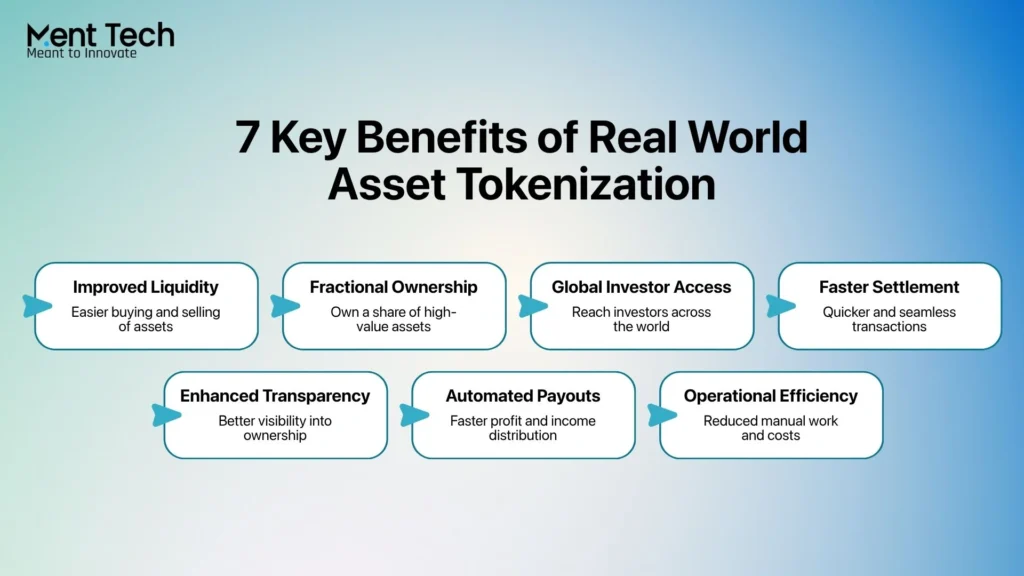
1. Improved Liquidity
Illiquid assets are not going to become as liquid as public equities overnight. But tokenization creates the infrastructure for secondary markets that simply did not exist before.
Investors have an exit pathway. Asset owners have a stronger fundraising story. That matters.
2. Fractional Ownership
Breaking a high-value asset into thousands of smaller tokens opens the investment to a much wider pool of participants.
A property worth five million dollars does not require a five-million-dollar check. That changes who can invest and how much capital an asset owner can realistically raise.
3. Global Investor Access
Compliance-controlled platforms can reach investors across jurisdictions without the manual complexity of traditional cross-border investment processes.
Jurisdiction checks, investor verification, and transfer restrictions are handled by the platform rather than by a team of lawyers working through each investor manually.
4. Faster Settlement
Blockchain-based records and smart contract execution reduce the time and intermediaries involved in ownership transfers.
What used to require multiple parties working through a multi-day process can happen in a fraction of the time, with a permanent on-chain record that does not need manual reconciliation.
5. Transparency
Investors can see token ownership, transaction history, and distribution records directly. For asset owners, that transparency builds trust and reduces the volume of investor queries.
For investors, it provides the visibility that private market instruments traditionally do not offer.
6. Automated Payouts
Rental income, fund distributions, interest payments, revenue shares. Smart contracts handle all of it automatically when the conditions are met.
No manual processing, no reconciliation delays, no risk of payments being missed because someone forgot to run a spreadsheet.
7. Operational Efficiency
Managing a tokenized asset offering through a proper platform eliminates a significant amount of manual work. Cap table management, investor communications, document distribution, compliance tracking.
These processes run digitally and automatically rather than through a combination of spreadsheets and email threads.
What Is an RWA Tokenization Platform?
An RWA tokenization platform is the full system that a business uses to issue, manage, distribute, and trade tokenized real-world assets. It is not a single application. It is a collection of interconnected modules that have to work together reliably across asset onboarding, investor management, compliance, smart contracts, custody, and trading.
When development teams talk about RWA tokenization platform development, they are talking about building and integrating all of these components in a way that holds up under real operating conditions: real investors, real compliance requirements, real asset values, and real regulatory scrutiny.
A production-ready platform includes:
- Asset onboarding and document management
- Token issuance and smart contract deployment
- Investor onboarding with KYC and AML verification
- Compliance engine with jurisdiction-based rules
- Investor dashboard with portfolio and distribution tracking
- Admin dashboard for operators and issuers
- Custody integration for secure asset and key management
- Payment integration for fiat and crypto
- Real-time cap table management
- Document vault for investor and regulatory records
- Secondary marketplace for compliant token trading
- Reporting and analytics
Not sure which platform fits your asset class? Check out the top tokenization platforms in 2026 to compare your options.
Key Features of an Asset Tokenization Platform
1. Asset Onboarding Module
This is where issuers list assets, upload documents, provide ownership proof and valuation details, define the legal structure, and go through verification.
The onboarding workflow is the first line of defense against unverified or poorly documented assets reaching investors. It needs to be thorough without being so cumbersome that issuers abandon it halfway through.
2. Token Issuance Engine
The issuance engine manages token supply, investor allocations, smart contract deployment, transfer rule configuration, and token metadata. It is what connects the legal structure of the asset to its on-chain representation.
Every token issued needs to be traceable back to a verified asset and a defined ownership or participation right.
3. KYC and AML Integration
No platform can operate without investor verification. Ment Tech’s asset tokenization platform connects with providers including Synaps, Jumio, Onfido, and Persona.
Different platforms have different requirements depending on asset class and jurisdiction. Having flexible integration options means the platform can be configured to meet those requirements without rebuilding the verification layer from scratch.
4. Smart Contract Engine
Token issuance, transfer restrictions, distributions, governance, redemptions, compliance automation. The smart contract engine handles all of it.
Contracts are audited before deployment and managed through a controlled upgrade process. This is the part of the platform that carries the most technical risk if done poorly and the most value if done well.
5. Investor Portal
Investors need somewhere to see their portfolio, access documents, track distributions, receive issuer updates, and manage their account without calling support every time they have a question.
A well-built investor portal reduces operational overhead and signals to investors that the platform is serious.
6. Admin Dashboard
The admin dashboard is the control center for the tokenized assets platform. Asset management, investor approval workflows, compliance configuration, transaction monitoring, reporting.
Platform operators and issuers run their day-to-day operations through this interface.
7. Compliance Automation
Jurisdiction-based eligibility rules, accreditation checks, transfer limits, holding period restrictions, and regulatory workflow management.
Compliance automation means these rules are enforced consistently and automatically rather than relying on manual review. The rules are configured once and applied across every transaction the platform processes.
8. Custody and Wallet Integration
Digital wallet provisioning, institutional custody connections, private key management, multi-signature authorization, and transaction approval workflows.
For platforms operating with meaningful asset values, institutional-grade custody is not optional. It is what makes the platform credible to serious investors and regulators.
9. Secondary Marketplace
Secondary trading gives investors something private markets traditionally cannot: a pathway out. Peer-to-peer trading, fractional ownership transfers, price discovery, and compliant exits.
Transfer approvals and compliance checks run through the same smart contract and compliance infrastructure as the primary issuance. The secondary marketplace does not operate outside the compliance framework; it operates inside it.
Development Process for an RWA Tokenization Platform
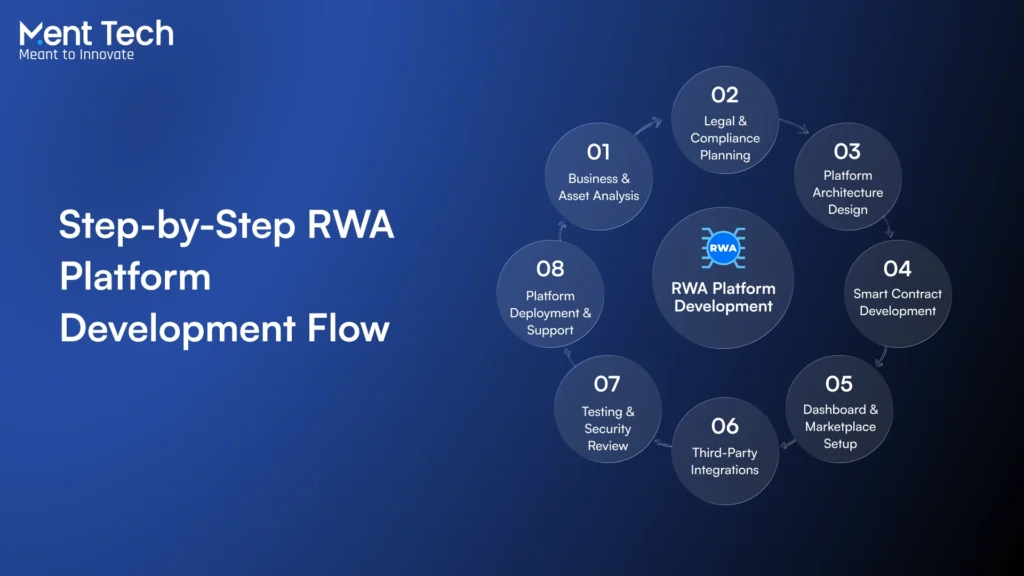
Good asset tokenization platform development follows a sequence that most teams underestimate in complexity. The steps below are not formalities. Each one shapes what the next one can do.
Step 1: Business Model and Asset Analysis
What is being tokenized? Who are the investors? Which jurisdictions are involved? What does the revenue model look like? What ownership structure is required? What compliance regime applies?
The answers to these questions determine the architecture of everything that follows. Skipping this step and going straight to building is one of the most common and expensive mistakes in the space.
Step 2: Legal and Compliance Planning
Map the compliance requirements before writing a line of code. KYC and AML obligations, investor eligibility rules, securities regulations in target jurisdictions, transfer restrictions, lockup requirements, and ongoing reporting obligations.
Legal structure decisions made at this stage shape the smart contract logic, the investor onboarding flow, and the platform’s ability to operate in its target markets.
Step 3: Platform Architecture
With the business model and compliance framework defined, the technical architecture can be designed properly.
User roles, dashboard structures, smart contract logic, marketplace flow, compliance engine design, custody integration, and third-party service connections all get mapped out here. Architecture decisions made now are expensive to undo later.
Step 4: Smart Contract Development
Contracts are built to the architecture specifications, reviewed internally, and then audited by an independent security firm before deployment. Token issuance, transfer rules, distribution logic, governance mechanisms, and compliance restrictions all sit in the contract layer. An audit is not a checkbox. It is the difference between a platform that can be trusted with real asset values and one that cannot.
Step 5: Dashboard and Marketplace Development
Investor portal, admin panel, issuer dashboard, document vault, reporting tools, and secondary marketplace.
The interface layer has to be functional and clear. A technically sound platform with a confusing investor portal creates support problems and undermines confidence in the product.
Step 6: Integrations
KYC and AML providers, custody solutions, payment rails, wallets, blockchain oracles, and the blockchain network itself.
Each integration is tested individually and as part of the full platform flow. Integration failures in production are visible to investors and hard to recover from.
Step 7: Testing and Security Review
Smart contracts, APIs, investor flows, compliance rules, wallet integrations, and admin permissions all go through structured testing before launch.
The security review covers the smart contract layer and the application layer, including access controls, data handling, and third-party dependencies.
Step 8: Deployment and Post-Launch Support
The platform goes live, performance is monitored, and the team stays available to respond to issues in the early operating period.
Post-launch support also means keeping the platform current as regulations evolve, features are added, and the asset offering grows.
RWA Tokenization Platform Development Cost
There is no single number here, and any firm quoting one without understanding your asset class, compliance requirements, integrations, and marketplace needs is guessing. What cost actually depends on is the scope of what you are building.
Basic RWA MVP
A basic MVP gets you asset listing, investor onboarding, token issuance, and a functional admin dashboard. It is the right starting point for teams that need to test the concept with real investors before committing to full-scale development.
Full Asset Tokenization Platform
A full asset tokenization platform adds KYC and AML integration, a complete smart contract engine, investor dashboard, document vault, custody integration, payment rails, and reporting. This is the minimum viable scope for a serious public offering.
Enterprise Tokenized Assets Platform
An enterprise-grade tokenized assets platform covers multi-asset support, a secondary marketplace, multi-chain deployment, institutional custody, advanced compliance automation, and analytics. This is what platforms targeting institutional investors or multiple jurisdictions actually need.
Working with a real world asset tokenization platform development company that has built across all three scopes means you are not paying to solve problems someone has already solved. Ment Tech Labs works with businesses at each of these levels and can help you scope a build that fits your timeline, market, and budget.
Common Mistakes to Avoid When Building an RWA Tokenization Platform
Building without legal structuring. A token without a legal foundation does not represent anything enforceable. Investors have no real claim, and the platform has no defensible position when it matters.
Ignoring KYC and AML. Investor verification is not a feature you add later. Platforms that skip it or treat it as secondary create regulatory exposure that is difficult and expensive to fix after launch.
Weak asset verification. If the platform cannot demonstrate that the underlying asset is what it claims to be, investor trust evaporates. Verification has to happen before tokens are offered, not after questions are raised.
No custody plan. Platforms handling meaningful asset values need a clear answer to how digital assets and private keys are secured. Institutional investors will ask this question directly.
No transfer restrictions. Smart contracts need to enforce who can hold tokens and under what conditions. Without those controls, tokens can reach ineligible investors in restricted jurisdictions, creating compliance problems that are very hard to unwind.
Poor smart contract testing. Deployed contracts are difficult to change and can be exploited if they contain bugs. An independent audit before deployment is not optional on a platform handling real asset values.
No investor dashboard. Investors who cannot track their holdings, access their documents, or see their distributions will lose confidence in the platform quickly and will tell other potential investors.
No secondary marketplace plan. Investors who feel permanently locked in are harder to convert in the first place. Having a clear secondary trading pathway, even if it comes in a later phase, is an important part of the investor proposition.
Weak compliance documentation. Technical controls are necessary but not sufficient. Regulators and institutional investors want to see documented compliance processes. If you cannot show the framework on paper, you are not ready for that audience.
Choosing the wrong blockchain. Network selection based on current hype rather than transaction costs, ecosystem maturity, regulatory acceptance, and long-term stability creates infrastructure problems that compound over time.
Choosing the right chain matters more than most teams think. If Solana is on your radar, here is what to look for.
Treating this like simple token creation. This is not an ICO. Every decision carries real consequences for real investors holding claims on real assets. The platform has to reflect that.
Why Choose Ment Tech Labs as Your RWA Tokenization Platform Development Company
Ment Tech Labs is a real-world asset tokenization platform development company that builds for production, not proof of concept.
There is a real difference here. A demo platform and a platform that handles real investors, real compliance, and daily regulatory scrutiny are not the same thing.
RWA tokenization platform development at Ment Tech Labs covers the full lifecycle. Asset onboarding, smart contracts, KYC and AML, investor portal, cap table management, custody integration, and secondary marketplace support all work together from day one.
Here is what Ment Tech Labs builds:
- Real estate tokenization platform for residential, commercial, and mixed-use properties
- Commodity tokens for gold, oil, agricultural products, and other physical assets
- IP tokenization for royalties, patents, music rights, and film rights
- Private equity and fund tokenization for asset managers
- Bond and debt instrument platforms for issuers
- White-label asset tokenization platform development for businesses launching under their own brand
Secure, scalable, and built for real market use. That is the standard every Ment Tech Labs platform is built to.
Building the platform is only half the work. Getting investors on it is the other half. Start with crypto marketing strategies that actually work.
Final Thoughts: RWA Tokenization Is Moving from Concept to Real Market Infrastructure
The conversation around real-world asset tokenization has shifted. It is not about whether this technology works. It works. The question now is whether the platform you build is serious enough to operate in real markets, with real investors, under real compliance requirements.
Businesses that succeed here are the ones that treat tokenization as what it actually is: a complex infrastructure problem that requires legal structure, compliance controls, asset verification, audited smart contracts, investor onboarding, custody, and a platform that holds all of it together. None of those pieces is optional. All of them have to work.
The opportunity is significant and the window to build a credible position in this market is open. But it will not stay open indefinitely. The businesses investing in proper real world asset tokenization platform development now are the ones that will be hardest to displace when the market matures.
Partner with Ment Tech to build a real-world asset tokenization platform that helps you tokenize assets, onboard investors, automate compliance, and scale with confidence.