AI Agents in Crypto
Crypto used to run on dashboards and gut instinct. Traders stared at charts, DAO members skimmed thirty-page proposals at midnight, and DeFi users tracked five different apps just to know if their yield was still worth the gas fee. That manual grind is exactly what AI agents in crypto are starting to replace.
These agents do not just display data; they act on it. A trading agent can flag unusual volume before a human notices the chart move. A DeFi agent can compare yields across protocols and warn about a draining liquidity pool.
A DAO assistant can summarize a governance proposal in seconds instead of making someone read the whole thing. This shift from static tools to active, reasoning systems is what makes 2026 feel different for Web3 products.
Ment Tech Labs helps Web3 businesses build AI-powered crypto products with AI agents, blockchain integrations, RAG systems, secure APIs, and scalable product architecture.
What Are AI Agents in Crypto?
They go on to describe AI agents in crypto as autonomous entities and glue of sorts with crypto’s blockchain infrastructure and independent execution capacity to process tasks, interact with smart contracts, and make decisions. Just to keep it simple, it’s not some bull script that has to be clicked to get activated. They read some blockchain data, interpret it, and respond accordingly without human intervention.
What differentiates AI agents in crypto from a simple bot is the stack underneath. The decision-making is based on reasoning that takes on-chain and off-chain data, calls tools or oracles in case the decision requires extra data, and interacts with wallets and smart contracts to translate a decision into an on-chain result. As real cash is added into the picture, often a human approval layer sits on top of the agent, so a proposal from the agent is validated and approved by a person (or a policy) before money is moved.
How Do AI Agents Work in Crypto Projects?
The flow behind AI agents in crypto is more straightforward than it sounds. Here is how it usually plays out.
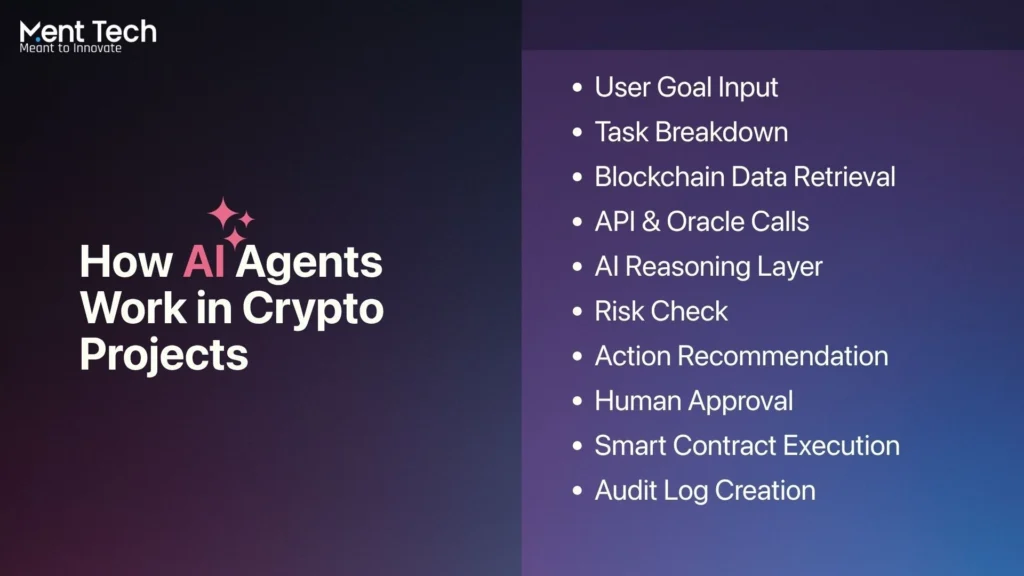
Goal Input: Someone tells the agent what they want, like flag risky wallets or find the best yield right now. This is the only manual step in the entire process.
Task Breakdown: The agent breaks the goal into smaller steps and figures out what data or tools it will actually need to get there.
Data Retrieval: It pulls live blockchain activity, price feeds, or on-chain wallet history relevant to the task, so the decision is based on current conditions and not stale information.
Tool Calling: APIs, oracles, or blockchain nodes get queried for the specific function it needs, whether that is a token price, a contract state, or a governance record.
Action Proposal: Based on what it found, the agent recommends a move or, in some setups, triggers it directly if the workflow allows for that level of autonomy.
Approval Check: For anything involving funds or high-risk actions, a human or a preset policy signs off first. This is the safeguard that keeps automation from turning reckless.
Workflow Completion: The transaction goes through, and the workflow closes out, usually with a log kept for auditing or reference later. This is also the exact flow most teams start with when a US MVP development company helps them ship a first working version before scaling to more autonomous actions.
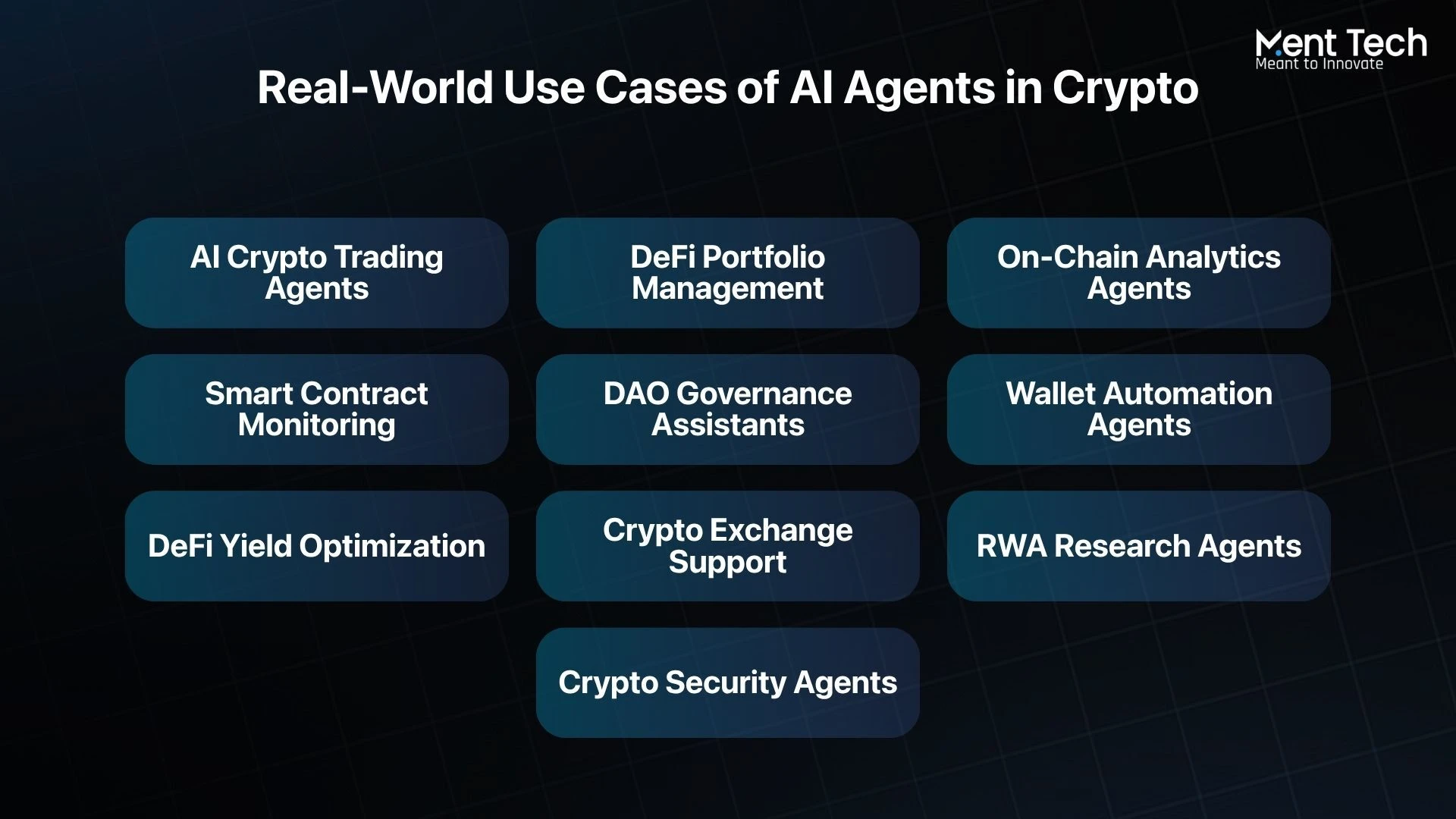
10 Real-World Use Cases of AI Agents in Crypto
From trading to security, AI agents in crypto are already handling real tasks across the Web3 stack. Here is where they fit in.
1. AI Crypto Trading Agents
Trading agents watch price action, volume, and market sentiment around the clock, something no human trader can realistically do. They track signals across multiple exchanges, summarize risk in plain language, and suggest entry or exit points based on current conditions. Instead of replacing a trader’s judgment, they cut down the hours spent staring at charts.
2. DeFi Portfolio Management Agents
These agents keep an eye on a user’s entire DeFi position across protocols. They rebalance allocations when exposure drifts too far in one direction, send alerts when risk crosses a threshold, and compare yield opportunities so idle capital does not sit unused. Exposure tracking happens continuously, not just when someone remembers to check.
3. On-Chain Analytics Agents
On-chain analytics agents monitor wallet activity, smart contract calls, and token movement in real time. They can spot a large holder moving funds before a price swing, flag unusual protocol activity, or summarize what a specific contract has been doing over the past week. This is one of the more mature use cases of AI agents in crypto today, since the data itself is already public and structured.
4. Smart Contract Monitoring Agents
These agents sit on top of deployed contracts and watch for anything that looks off. They flag suspicious transaction patterns, unexpected permission changes, or early signs of an exploit attempt. Governance changes get surfaced too, so teams are not caught off guard by an upgrade they missed.
For a deeper look at this shift, also read How AI in Web3 Is Driving Intelligent Contracts and Scalable Automation.
5. DAO Governance Assistants
Reading through a thirty-page governance proposal at midnight is not anyone’s idea of fun. Governance assistants summarize proposals into a few clear points, estimate the likely impact of a vote, and pull relevant treasury data so members can decide faster. They also handle repetitive community questions, freeing up core contributors for actual discussion.
6. Wallet Automation Agents
Wallet agents work quietly in the background of everyday crypto use. They categorize transactions automatically, send spending alerts when activity looks unusual, and time transactions around lower gas fees. For newer users especially, this kind of assistance removes a lot of the friction that makes wallets intimidating.
For teams exploring smarter wallet products, also read Top Agentic AI Crypto Wallet Development Companies.
7. DeFi Yield Optimization Agents
Yield opportunities shift constantly across lending pools and liquidity protocols, and manually tracking APY changes is tedious. These agents compare rates across platforms, monitor pool health, and recommend moves when a better opportunity opens up. Liquidity tracking runs in the background so users are not left holding capital in a pool that has quietly gone stale.
8. Crypto Exchange Support Agents
Exchange support agents handle the repetitive side of customer service. They assist with KYC steps, pull up trade history on request, answer account questions, and automate ticket routing so complex issues reach a human faster. This is a practical, lower-risk entry point for teams exploring an AI agent development company for their first deployment.
9. RWA Tokenization Research Agents
As real-world assets move on-chain, investors need help making sense of the data behind each tokenized asset. These agents summarize asset details, answer investor questions directly, and support compliance workflows that would otherwise require manual document review. They make tokenized asset research faster without replacing the due diligence itself.
10. Crypto Security and Risk Agents
Security agents focus on catching problems before they cause damage. They flag phishing attempts, scan contracts for known risk patterns, and watch for abnormal wallet behavior that might signal fraud. Paired with solid rag development services, these agents can pull from continuously updated threat data instead of relying on a fixed, aging dataset.
AI Agents in Crypto: Practical Examples
Theory is one thing, but it helps to see where AI agents in crypto actually show up in day-to-day operations. A few examples make this a lot less abstract.
- DeFi Liquidity Monitoring
Nobody on a DeFi team has time to babysit liquidity pools all day, and honestly, why would they? An agent can do that instead, catching a sudden drop, a weird volume spike, or a token pair going out of balance, and flagging it before users start getting hit with bad swaps or ugly slippage.
- Crypto Exchange Support
Ask any exchange support team, and they will tell you it is the same questions on loop: deposits, withdrawals, KYC, and a wallet that will not update. Handing that first layer to an agent means users are not stuck waiting, especially on the days when ticket volume spikes out of nowhere.
- DAO Proposal Summaries
Be honest, does anyone actually read every governance proposal cover to cover before voting? An agent can strip it down to what matters: the idea, the budget, the risk, and what it actually changes, so members are not voting blind just because reading the whole thing felt like too much.
- Portfolio Risk Insights
Most traders are not thinking in exposure percentages while they are staring at charts. An agent can say it plainly instead, something like this wallet is too concentrated in one token, or leverage here is higher than it looks,” which lands a lot better than a spreadsheet full of numbers.
- RWA Investor Questions
Tokenized assets come wrapped in a lot of fine print, yield terms, compliance steps, and payout schedules. The kind of stuff people gloss over. An agent that actually answers those questions on the spot means investors go in understanding what they signed up for, instead of finding out later.
Tech Stack for Crypto AI Agent Development
Building a crypto AI agent is not really a one-tool job, and anyone who has tried cutting corners here already knows that. It takes several layers working together, each one handling its own piece, from understanding what the user actually wants to moving real funds on-chain. Here is what that stack tends to look like once teams get it right.
| Layer | Tools / Technologies |
| LLM Layer | OpenAI, Claude, Gemini, open-source LLMs |
| Agent Framework | LangChain, LlamaIndex, AutoGen, CrewAI, ElizaOS |
| Blockchain Layer | Ethereum, Solana, Polygon, Base, BNB Chain |
| Smart Contract Layer | Solidity, Rust, Hardhat, Foundry |
| Data Layer | The Graph, Etherscan APIs, blockchain nodes, Chainlink oracles |
| RAG Layer | Pinecone, Weaviate, Qdrant, Milvus |
| Integration Layer | MCP servers, REST APIs, GraphQL APIs, webhooks |
| Security Layer | Wallet permissions, authentication, audit logs, policy controls |
| Cloud Layer | AWS, Azure, GCP, Docker, Kubernetes |
None of these layers really pull their weight alone. The LLM can reason all it wants, but it is useless without the blockchain layer to actually act on that thinking, and the RAG layer only stays sharp when there is proper RAG development services work behind it instead of a half-built pipeline.
Security is not optional either, not when real wallets and real money are on the line. Getting this stack right has less to do with chasing the newest tool on the list and more to do with making sure each layer actually talks to the next one without things quietly breaking somewhere in between.
Architecture of an AI Agent for Crypto Applications
Strip away the buzzwords, and honestly, a crypto AI agent is just a handful of layers stacked in the right order, nothing more mysterious than that. Here is how that architecture tends to play out for AI agents in crypto once you actually look under the hood.
1. Interface and Reasoning
This is where a user’s request comes in, and the LLM has to figure out what someone is actually asking for. The interface stays simple on the surface, but underneath, the reasoning layer is doing the real work of turning a vague ask into something it can actually act on.
2. Tool and Data Orchestration
Once the agent knows what it is trying to do, this layer goes and gets what it needs, calling APIs, checking blockchain data, and pulling relevant context from a RAG knowledge base so the answer is grounded in something real instead of a confident guess. This is usually the part where good rag development services end up making the biggest difference.
3. Blockchain and Wallet Access
This is where things get real. The blockchain API layer reads what is actually happening on-chain, while the wallet permission layer draws a hard line around what the agent can and cannot do with the funds it has access to.
4. Smart Contract Execution
When it is finally time to act, the agent talks directly to smart contracts to make the transaction happen, whether that is a swap, a stake, or casting a governance vote.
5. Oversight and Approval
Nothing risky just slides through unchecked. The monitoring and audit layer keeps a record of everything the agent touches, and the human approval layer sits right before anything involving real money goes out, so the agent can propose all it wants, but it does not get a blank check.
Benefits of AI Agents in Crypto Projects
Teams that have actually deployed AI agents in crypto tend to point to a handful of real, practical wins, not just the usual hype around automation.
- Faster decision support: Instead of waiting on someone to pull data and crunch numbers, teams get insights in real time, right when a decision actually needs to be made.
- Better user experience: Users get faster answers, clearer explanations, and less friction across the board, which matters a lot in a space that still confuses a lot of newcomers.
- Automated monitoring: Nobody has to sit and stare at dashboards all day anymore; agents catch the anomalies and flag them before things go sideways.
- Reduced manual research: Hours that used to go into reading proposals, comparing yields, or digging through wallet history get handed off, freeing people up for actual strategy work.
- Better risk visibility: Risk stops being something teams discover after the fact; agents surface it early enough to actually do something about it.
- Scalable support: One agent can handle a volume of questions or tasks that would otherwise need a much bigger team, without quality dropping off during busy periods.
Put together, these gains are a big part of why so many teams are exploring the future of ai agents in crypto right now, not as a distant idea but as something already reshaping how Web3 products get built and run.
Final Thoughts
Crypto has always moved fast, but keeping up with it manually was never really sustainable. That is exactly the gap AI agents in crypto are stepping into, not as some flashy add-on but as a genuine working layer that combines intelligence, automation, blockchain access, and user support in one place.
What makes this shift stick is that these agents are not just answering questions anymore; they are reading on-chain data, catching risk early, and handling the kind of repetitive work that used to eat up entire teams. As more Web3 products lean into this, the gap between platforms that still run on manual dashboards and ones that actually think for themselves is only going to get wider.
Partner with Ment Tech to build AI agents in crypto that are secure, scalable, and designed for real Web3 use cases.