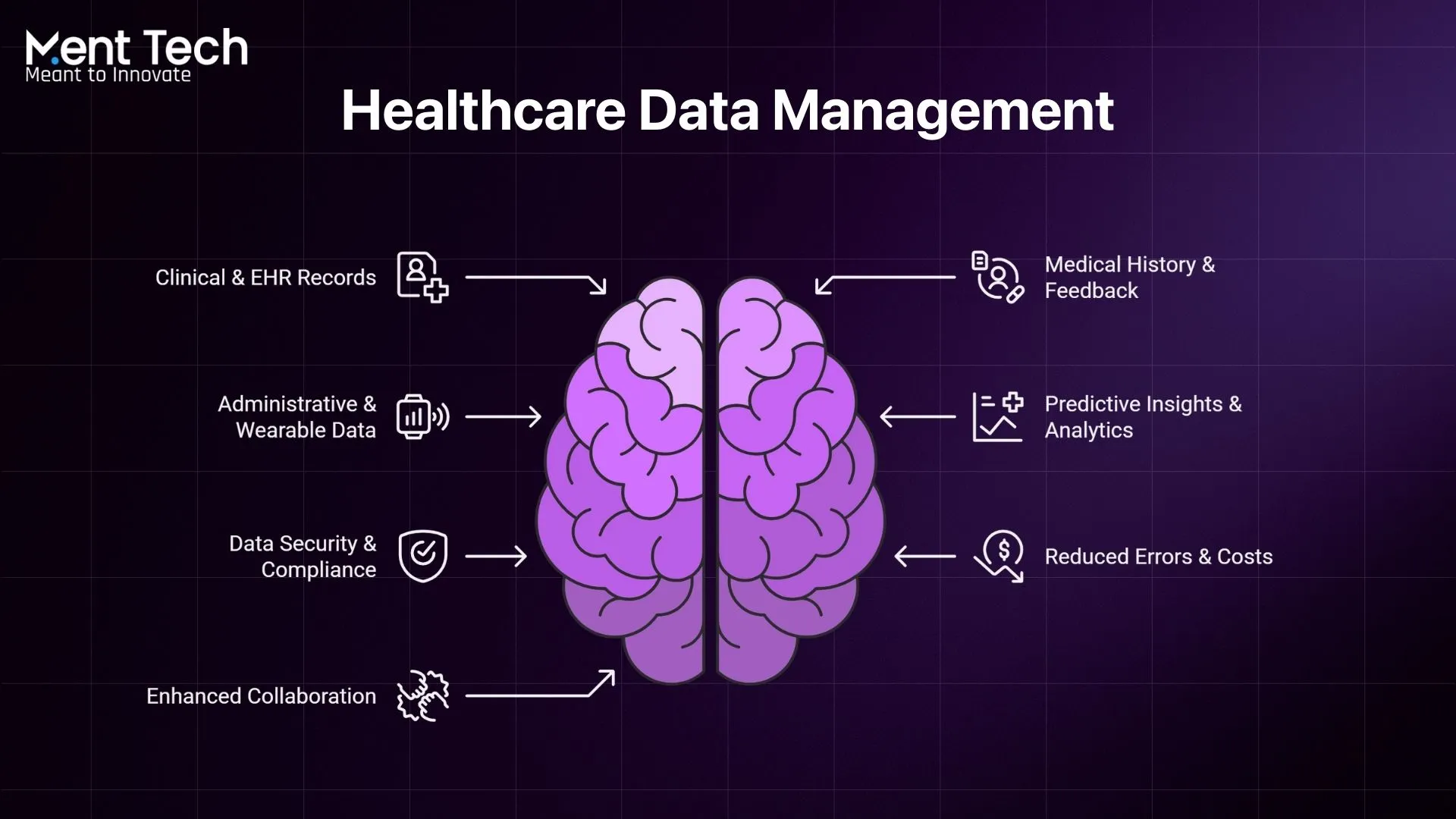
In the USA, the healthcare industry is facing growing challenges in managing data. Rising costs, slow documentation, and repeated billing delays are putting pressure on hospitals, clinics, and startups. To tackle these issues, many providers are turning to healthcare data management to streamline operations and improve efficiency.
Forward‑thinking healthcare organizations are adopting AI in healthcare data management to handle large volumes of clinical and administrative data. These platforms automate routine tasks, uncover insights, and help improve patient care while reducing administrative burdens.
With the global digital health market projected to reach US$456.9 billion by 2026, the importance of reliable systems is evident. As data continues to grow in volume and complexity, having the right systems in place is critical. Effective data management enables providers to stay compliant, operate more efficiently, and deliver improved patient experiences.
What is Healthcare Data Management?
Healthcare data management is the end-to-end process of collecting, storing, organizing, securing, and analyzing all types of healthcare data, including clinical (EHR/EMR), operational, financial, and equipment records. Unlike traditional HIM, which focuses mainly on patient documentation, it manages the full data lifecycle, including cleansing, access control, audit trails, integration, and HIPAA-compliant handling, forming a strong base for adaptive AI development in modern healthcare.
Healthcare data management transforms disconnected information into actionable intelligence that improves care and operations. Modern platforms unify data from multiple systems, automate routine tasks like inventory updates or billing checks, and deliver real-time insights for clinicians and administrators. With complete, consistent, and secure data, organizations reduce inefficiencies, accelerate decisions, and strengthen their foundation for analytics and AI-driven workflows.
Healthcare Master Data Management (MDM)
In healthcare, healthcare master data management goes beyond cleaning records. It’s the foundation of efficient, connected care systems. Many healthcare leaders focus on improving operational efficiency and interoperability, understanding that the challenge lies in linking systems rather than generating data. MDM ensures consistent rules for collecting, verifying, and sharing information while maintaining HIPAA and FHIR compliance.
A strong MDM framework unifies three critical areas:
- Patient Data: Consolidating test results, wearable data, and medical histories in one trusted system allows clinicians to make faster, safer decisions.
- Provider Data: Accurate credentials, schedules, and affiliations reduce errors and streamline team coordination.
- Payer Data: Connecting claims, payment histories, and plan details between providers and payers accelerates processing and minimizes mistakes, supporting smoother healthcare data management across the organization.
Components of Healthcare Master Data Management (MDM)
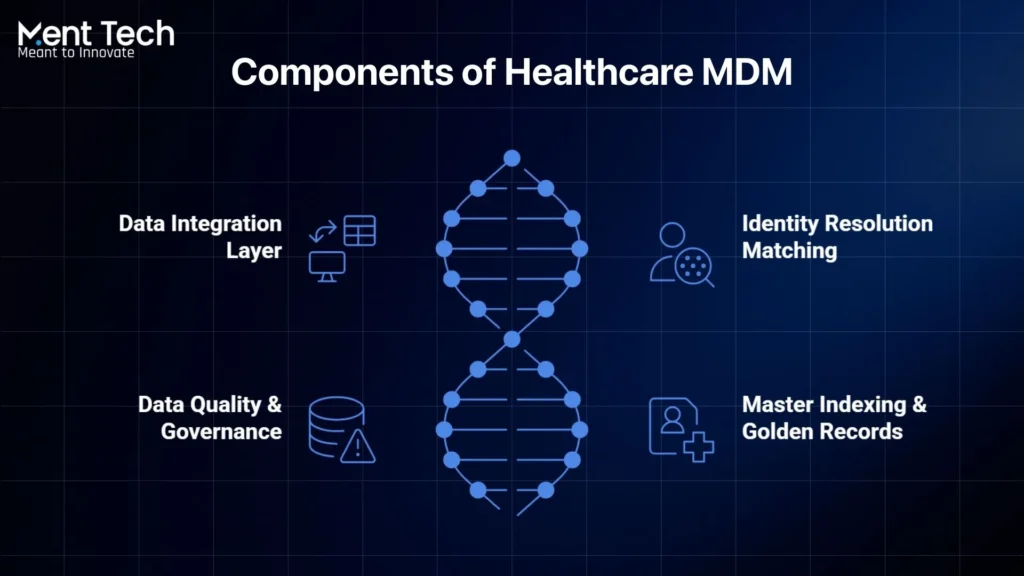
Healthcare master data management unifies, secures, and streamlines patient, provider, and payer information. By integrating systems, ensuring data quality, and creating golden records, organizations achieve accurate, reliable, and actionable data.
• Data Integration Layer
All systems, from EHR and billing software to CRMs and insurance portals, need to communicate in real time. MDM healthcare solutions use APIs, event-driven architectures, and standards like HL7 and FHIR to ensure secure, seamless data flow across platforms, enabling true interoperability.
• Identity Resolution and Matching
Duplicate or inconsistent records are a major challenge in healthcare data management. Intelligent algorithms match patient, provider, and payer information to create a single verified profile, ensuring master data management in healthcare transforms scattered data into accurate, actionable insights.
• Data Quality and Governance
High-quality data is essential for trust and compliance. MDM software validates entries, standardizes formats, and applies role-based access controls to meet HIPAA, GDPR, and PDPL standards, allowing healthcare organizations to rely on secure and consistent information.
• Master Indexing and Golden Records
Golden records provide one consistent version of truth for each patient, provider, and payer. This ensures updates propagate correctly across systems, reducing errors, improving billing and care coordination, and strengthening overall healthcare data management solutions.
Challenges of Traditional Healthcare Data Management
Traditional healthcare data management depends on manual, siloed systems, leading to delays, errors, and compliance issues, challenges that grow as organizations integrate modern tools like an AI agent healthcare app.
1. Fragmented & Unstructured Data
Healthcare data lives across EHR/EMR systems, imaging files, scanned documents, and third-party platforms, making it difficult to maintain one accurate source of truth while slowing down decisions and increasing duplication across the organization.
2. Constantly Changing Clinical Information
Patient histories, diagnoses, treatments, and provider details change constantly, and the rise of telehealth adds even more data types requiring continuous cleansing and validation to keep data management in healthcare accurate and dependable.
3. Regulatory & Compliance Requirements
Strict standards like HIPAA require well-governed, high-quality data, and any inconsistency increases audit complexity, compliance risks, and administrative workload for healthcare teams managing sensitive information.
4. Limited System Interoperability
Siloed applications and disconnected systems prevent smooth data sharing, delaying workflows and limiting real-time insights, even when organizations invest in the best tools for healthcare data management.
5. Growing Data Volumes & Storage Pressure
Massive increases in structured and unstructured data from devices, labs, and digital health platforms overwhelm legacy systems, demanding scalable healthcare data management solutions to avoid performance bottlenecks and financial inefficiencies.
6. Rising Cybersecurity Threats
Rising threats like ransomware and unauthorized access target sensitive medical data, making it essential for organizations to strengthen security controls and adopt trusted data management healthcare practices to reduce exposure.
Benefits of Effective Healthcare Data Management
Effective healthcare data management not only organizes and secures information but also enables better patient care, operational efficiency, and strategic decision-making. Key benefits include:
1. Enhanced Patient Care
Aggregating clinical, administrative, and wearable data enables personalized treatments and early interventions, helping clinicians make faster, evidence-based decisions for improved outcomes.
2. Improved Operational Efficiency
Centralized data reduces redundancies, streamlines workflows, and optimizes resource allocation, allowing teams to focus more on care delivery rather than administrative tasks.
3. Reduced Medical Errors
Complete and accurate patient information helps clinicians avoid errors in diagnoses, medications, and treatment plans, enhancing overall patient safety and trust.
4. Strengthened Data Security and Compliance
Role-based access, encryption, and audit trails ensure HIPAA compliance while protecting sensitive patient data from cyber threats and unauthorized access.
5. Data-Driven Decision Making
Integrated, high-quality data supports predictive insights, enabling administrators and clinical teams to make informed operational, staffing, and financial decisions.
6. Cost Savings and Resource Optimization
Minimizing errors and duplication optimizes staff, equipment, and supply usage, reducing operational costs while maintaining high-quality patient care.
7. Enhanced Collaboration and Communication
Standardized, accurate data allows seamless sharing across clinical, administrative, and financial teams, improving coordination and accelerating care delivery.
Essential Tools for Healthcare Data Management
Modern healthcare relies on advanced data tools to store, manage, and analyze clinical information securely. These platforms streamline operations, support accurate decision-making, and strengthen overall data management in healthcare environments through capabilities that complement enterprise AI development.
1. Electronic Health Records (EHR) Systems
EHR systems centralize patient data, medical history, labs, and medications into a single view. As one of the best tools for healthcare data management, they reduce errors, improve coordination, and ensure seamless information access.
2. Health Information Exchange (HIE) Networks
HIE networks enable secure data sharing across hospitals, clinics, and labs. By connecting multiple systems through a unified data management platform for healthcare, providers gain complete, real-time patient visibility.
3. Clinical Decision Support (CDS) Systems
CDS tools use analytics and evidence-based rules to guide clinical decisions. A key part of AI in healthcare data management, these systems deliver timely alerts and recommendations to enhance accuracy and patient safety.
4. Population Health Management (PHM) Systems
PHM platforms analyze large datasets to identify risks, track chronic conditions, and support preventive care. Leading healthcare data management companies use PHM to reduce readmissions and improve care outcomes.
5. Business Intelligence (BI) Tools
BI tools convert raw data into dashboards and insights for better planning. These solutions strengthen healthcare data analytics and management, helping teams optimize resources and improve operational efficiency.
IT Solutions and Emerging Technologies in Healthcare Data Management

The healthcare industry is rapidly adopting IT solutions to improve patient care and streamline data management. Modern systems integrate real-time data, analytics, and automation to make information more accurate and actionable, with generative AI in healthcare further enhancing insight generation.
1. Artificial Intelligence (AI)
AI enables predictive analytics, identifies patterns in patient data, and supports clinical decision-making, helping providers deliver proactive, personalized care. It also improves operational workflows and clinical efficiency, making it a vital part of healthcare data analytics and management.
2. Real-Time Data Integration
Advanced healthcare data management platforms integrate EHRs, EMRs, medical devices, and wearables, providing timely insights for better patient care. Seamless integration reduces delays, eliminates redundancies, and improves collaboration across clinical and administrative teams.
3. Blockchain for Data Security
Blockchain provides decentralized, tamper-proof storage for sensitive healthcare information, enhancing security, privacy, and compliance. Ensuring data integrity and preventing unauthorized access, it protects both patient and organizational information.
4. Predictive Analytics and Decision Support Systems
Predictive analytics and decision support systems analyze historical and real-time data to anticipate patient needs and optimize resources. They support informed clinical decisions, reduce inefficiencies, and help healthcare teams act proactively.
5. Cloud-Based Solutions
Cloud platforms offer scalable storage and processing for large healthcare datasets, while enabling secure access across locations and devices. These solutions improve data availability, simplify management, and support compliance with privacy regulations.
4 Steps of Data Management in Healthcare
Effective healthcare data management ensures information stays accurate, secure, and interoperable across systems. These four steps form the core of modern data management solutions, supporting the full health data lifecycle as digital services like telemedicine app development continue to expand.
1. Healthcare Data Governance
Governance sets clear rules for how data is collected, validated, and accessed. By creating a single source of truth, healthcare organizations improve accuracy, compliance, and decision-making across their healthcare data management systems.
2. Healthcare Data Integration
Integration connects EHRs, labs, claims, and device data into one unified flow. This ensures seamless interoperability, reduces duplication, and strengthens data management in healthcare through real-time access and consistent patient records.
3. Healthcare Data Enrichment
Enrichment converts raw clinical data into structured, meaningful insights using AI, ML, and NLP. This step enhances analytics, supports predictive modeling, and increases the value of enterprise-wide healthcare data management solutions.
4. Healthcare Data Storage
Storage provides a secure, scalable repository for structured and unstructured data. With cloud and hybrid systems, organizations maintain compliance, improve accessibility, and support long-term analysis in their healthcare data management platforms.
Real-World Examples of Healthcare Data Management
Healthcare organizations today use modern data management systems to improve accuracy, interoperability, and real-time decision-making. These real-world examples show how digital solutions are reshaping patient care and operational efficiency.
1. Mayo Clinic Platform (MCP)
The Mayo Clinic Platform unifies massive, multi-institutional datasets into a secure, standardized ecosystem. By enabling de-identified data access for researchers, MCP accelerates AI model training, cohort discovery, and real-world evidence analysis, supporting faster and more accurate clinical research across specialties.
2. Mobile Diagnostic Platform – Ment Tech Labs x Accuster
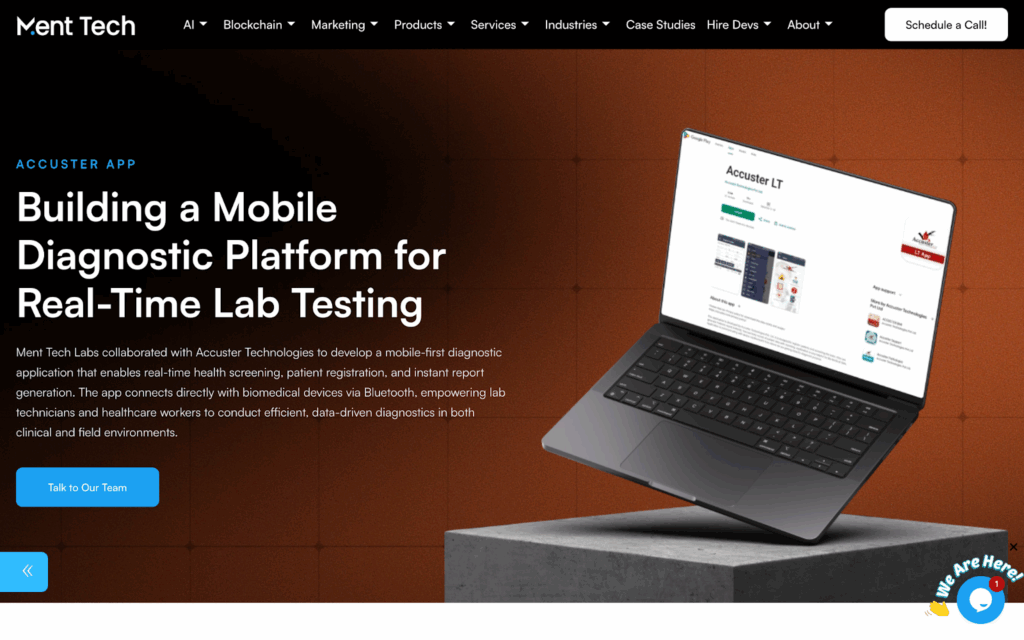
Ment Tech Labs partnered with Accuster Technologies to create a mobile-first diagnostic platform enabling real-time health screening, patient onboarding, and instant report generation. The app connects with biomedical devices via Bluetooth, empowering field workers and lab technicians to conduct fast, data-driven diagnostics in hospitals, remote areas, and mobile screening camps.
3. German Oncology Research Network
Six leading German university hospitals built a federated data pipeline that transforms oncology records into the HL7 FHIR standard. This enables privacy-preserving collaboration, high-quality data interoperability, and more efficient cancer research, setting a benchmark for modern, secure data management at scale.
Conclusion
Healthcare data management is becoming the backbone of modern care delivery—powering accurate decisions, seamless patient experiences, and stronger clinical outcomes. As data grows more complex, providers need systems that ensure reliability, security, and real-time accessibility across every workflow.
Ment Tech, a leading healthcare technology company, delivers secure, compliant, and scalable healthcare data management solutions. From interoperability frameworks to AI-driven analytics and master data management platforms, we help organizations modernize how they manage and use data. You can also hire AI developers from Ment Tech to integrate advanced intelligence into your healthcare systems.
Build your healthcare product with confidence and the right technology foundation. Partner with Ment Tech to streamline data, improve care efficiency, and strengthen your digital health infrastructure. Contact us today to discuss how we can support your healthcare data management goals.
FAQs:
Healthcare data is stored digitally across EHR/EMR systems, cloud platforms, and specialized databases. Secure healthcare data management solutions, including machine learning services, help organize, analyze, and protect this data while supporting operational and clinical needs.
Healthcare organizations face fragmented data, interoperability issues, rapid data growth, and strict compliance requirements. Effective data management in healthcare addresses these challenges while enhancing patient outcomes and operational efficiency.
Master Data Management consolidates patient, provider, and payer data into a trusted system. Leveraging end-to-end AI deployment improves accuracy, reduces duplication, and supports compliance while enabling actionable organizational insights.
Healthcare data management systems integrate and analyze patient and operational data to guide clinical decisions, reduce errors, and enhance efficiency. AI development helps generate predictive insights for better patient care.
Ment Tech guides organizations in implementing secure, scalable healthcare data management solutions. Through AI consulting, we integrate master data management to optimize care and operations.